

Home cinema shopping becomes easier once each component has a clearly defined role.
An AV receiver determines channel count, amplification, room correction and source connectivity, while a disc player serves viewers who want dependable access to physical film or music collections.
Larger systems may instead benefit from separate processors and power amplifiers that provide a more flexible upgrade path. This selection covers those different priorities rather than treating every entry as a direct alternative. It includes compact and full-size receivers, universal disc players, a scalable electronics range and two market updates relevant to physical-media buyers. The important distinctions are supported speaker layouts, expansion options, video compatibility, calibration and the formats already in your collection. Before choosing, count the speakers you intend to install, check how many HDMI sources must be connected and decide whether the system needs to grow. Room correction can be particularly useful in a multichannel setup, but optional licences, external amplification and additional speakers may affect the final configuration.

1. Pioneer UDP-LX500: Top-class universal Blu-ray player
Pioneer UDP-LX500 universal disc player, designed with a reinforced chassis, isolated internal sections and dual HDMI outputs.
The Pioneer UDP-LX500 is intended for systems built around physical media.
It plays CD, DVD, DVD-Audio, DVD-Video, SACD and Ultra HD Blu-ray, with HDR10 and Dolby Vision support for compatible video material.
Its two HDMI outputs can separate audio and video, while PQLS is available to reduce jitter when the player is paired with a compatible Pioneer AV receiver. Construction is a major part of the design: the drive sits in an anti-vibration enclosure, the power, digital-processing and analogue-audio sections are separated, and the double-layer chassis is reinforced to improve rigidity and limit mechanical noise.
Best for: Mixed movie and music disc collections
- Broad optical-disc format support
- HDR10 and Dolby Vision compatibility
- Separate HDMI outputs for audio and video
- Reinforced, anti-vibration construction
Verdict: A strongly constructed universal player for viewers and listeners who need one source for Ultra HD Blu-ray, SACD, DVD-Audio and conventional discs.

2. Onkyo TX-RZ30: Dolby Atmos AV receiver with 8K video support and Dirac Live
Onkyo TX-RZ30 9.2-channel AV receiver with network streaming, two-way Bluetooth and optional full-range Dirac Live room correction.
The Onkyo TX-RZ30 combines 9.2-channel architecture with Dolby Atmos playback, 8K video support and extensive network features.
Its specified output is 100 watts per channel with two channels driven.
Full-frequency Dirac Live room correction is available through a separately purchased licence, covering the stated range from 20 Hz to 20 kHz. Google Cast, AirPlay 2, Sonos integration, two-way Bluetooth and a wide selection of streaming services make it suitable for systems that also serve as everyday music hubs. Control options include the supplied infrared remote, Google Assistant, Siri and RS232.
Best for: Connected nine-channel cinema systems
- 9.2-channel AV architecture
- Dolby Atmos and 8K video support
- Optional full-frequency Dirac Live correction
- Broad streaming and wireless connectivity
Verdict: The TX-RZ30 is a versatile receiver for buyers who value modern video support, streaming and the option to add comprehensive Dirac Live calibration.

3. Arcam AVR10: High-performance AV receiver
Arcam AVR10 AV receiver with seven Class AB amplifier channels, 12-channel processing and Dirac Live calibration.
The Arcam AVR10 places particular emphasis on multichannel processing and room integration.
Its seven Class AB amplifier channels are rated at 60 watts each into 8 ohms, allowing a 5.1.2 Dolby Atmos system without additional amplification.
Its 12-channel surround processing can support a 7.1.4 arrangement when four external amplifier channels are added. Full 12-channel Dirac Live calibration takes measurements at nine positions before the results are processed on a computer and loaded into the receiver. AirPlay 2 and Google Chromecast provide native mobile streaming options.
Best for: Dirac-equipped systems with planned amplification upgrades
- Seven channels of Class AB amplification
- Twelve-channel surround processing
- Full 12-channel Dirac Live calibration
- AirPlay 2 and Google Chromecast
Verdict: The AVR10 suits buyers who want an internally amplified 5.1.2 system now and a route to 7.1.4 through external power amplifiers.

4. Denon AVC-X4800H: The ideal companion for a high-end home theater setup
Denon AVC-X4800H AV receiver with nine onboard amplifiers, 11.4-channel processing and extensive HDMI connectivity.
The Denon AVC-X4800H offers nine built-in amplifier channels and 11.4-channel processing, supporting a 5.2.4 installation from the receiver itself and larger configurations with external power amplification.
Dolby Atmos and DTS decoding are complemented by virtual-surround modes for rooms where dedicated height speakers are impractical.
Audyssey MultEQ XT32 handles automatic multichannel calibration. Connectivity is a central strength, with eight HDMI inputs, three outputs, eARC, HDR10+, Dolby Vision and supported 8K signal handling. VRR and QFT are also included for compatible gaming sources, while an MM phono input accommodates a turntable.
Best for: Expandable systems with numerous HDMI sources
- Nine built-in amplifier channels
- 11.4-channel processing for expansion
- Eight HDMI inputs and three outputs
- Audyssey MultEQ XT32 calibration
Verdict: The AVC-X4800H is a flexible centrepiece for a substantial home cinema that may grow beyond its nine internal amplifier channels.

5. Arcam Radia AV Series: a full-scale return to serious home cinema
The Arcam Radia AV Series spans three AV receivers, a 16-channel processor and two matching multichannel power amplifiers.
The Arcam Radia AV Series is a complete electronics family rather than a single component.
It comprises the AVA15, AVA25 and AVA35 receivers, the 16-channel AVP45 processor, and the PA4 and PA9 multichannel power amplifiers.
The range is designed to let an owner begin with a receiver and move towards a separate processor-and-amplifier system without abandoning the shared software platform or control logic. Common styling, including dark chassiswork, yellow accents and central colour displays, gives the components a consistent visual identity. Detailed model-by-model specifications are not provided in the supplied announcement, so buyers should treat this as a system-planning overview rather than a complete performance comparison.
Best for: Planning a scalable separates-based cinema
- Three receiver levels
- Dedicated 16-channel processor
- Matching multichannel power amplifiers
- Shared software and control platform
Verdict: The Radia AV Series is most relevant to buyers who want a coordinated route from a receiver-led installation to a modular processor-and-power-amplifier system.

6. Sony ends production of Blu-ray recorders as streaming takes over
Sony's production decision applies to Blu-ray recorders, while standard Blu-ray and DVD player production continues.
This is a market update rather than a product recommendation.
Sony has ended production of Blu-ray recorders after declining demand for standalone television recording and optical-disc archiving.
The distinction between recorders and players is important: Sony has said that production of standard Blu-ray and DVD players will continue. Owners of physical movie collections therefore should not interpret the decision as the immediate end of Sony disc playback hardware, but anyone specifically seeking recording functionality will face a narrower market.
Best for: Understanding changes in the optical-recorder market
- Clarifies the difference between recorders and players
- Confirms continued Blu-ray and DVD player production
Verdict: Sony's decision reduces recorder choice but does not amount to a withdrawal from standard Blu-ray and DVD playback.

7. Pioneer VSX-S520 AV Receiver: Compact Design with Wireless Connectivity and 4K Support
Pioneer VSX-S520 slimline AV receiver, measuring 70 mm in height and offering five-channel amplification with Wi-Fi and Bluetooth.
At 70 mm high and 4 kg, the Pioneer VSX-S520 addresses installations where a conventional full-height receiver would be difficult to accommodate.
It provides five amplifier channels, rated at 80 watts per channel into 4 ohms or 55 watts into 8 ohms, and a sixth channel that can power a passive subwoofer.
Wi-Fi, Bluetooth and 4K support add useful modern connectivity. Compactness brings compromises: there is no pre-output, the speaker connections use clips rather than screw terminals, only one subwoofer output is provided and the rear USB port found on the earlier model is absent.
Best for: Space-conscious five-channel installations
- Compact 70 mm chassis height
- Wi-Fi and Bluetooth connectivity
- Five amplified speaker channels
- 4K video support
Verdict: The VSX-S520 is a practical slimline receiver when compact dimensions matter more than pre-outs, premium terminals or extensive subwoofer connectivity.
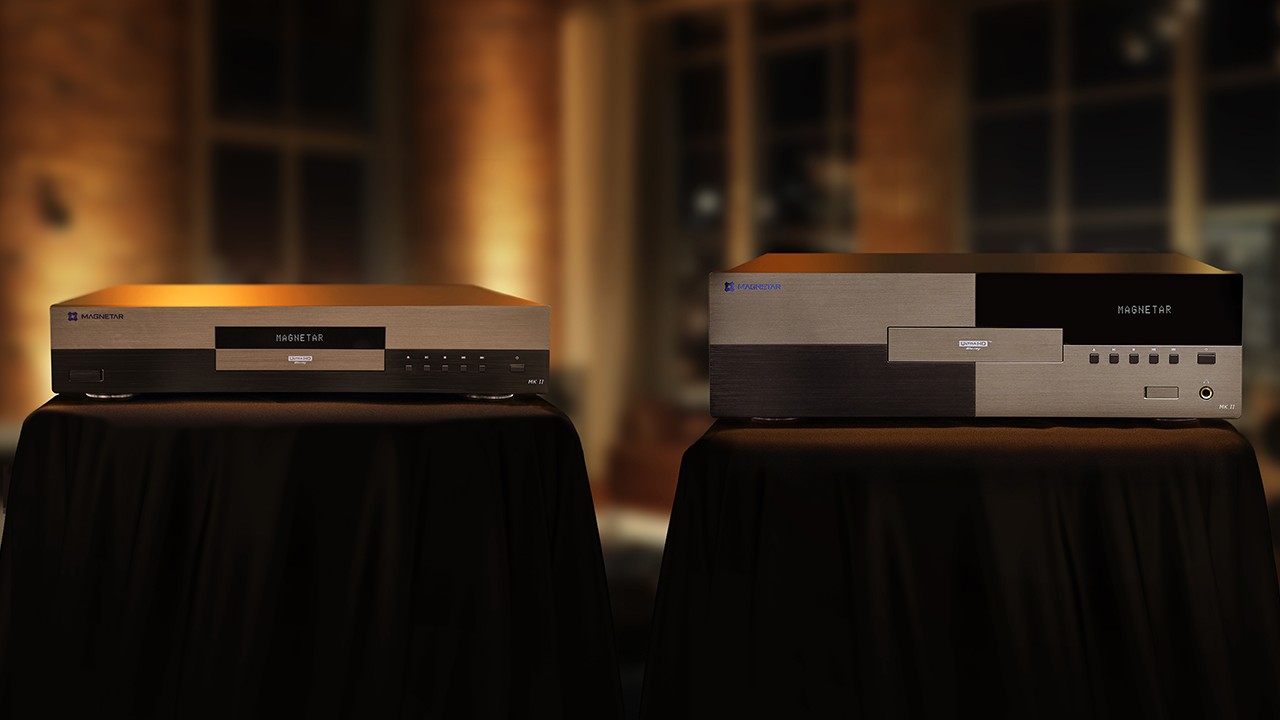
8. Magnetar UDP900MkII & UDP800MkII: The Future of 4K UHD Blu-ray Players
Magnetar UDP900MkII and UDP800MkII premium 4K UHD Blu-ray players, both designed to accommodate earlier optical-disc formats.
The Magnetar UDP900MkII and UDP800MkII are premium optical-disc players announced for viewers who want to retain access to physical movie libraries.
Both are described as capable of playing previous optical-disc formats as well as 4K UHD Blu-ray material, reflecting Magnetar's focus on high-end, format-independent playback.
The source does not provide enough detailed information to distinguish the two models by connections, audio design or construction, so they should be considered together until those differences are established.
Best for: Premium universal-disc playback
- 4K UHD Blu-ray playback
- Compatibility with earlier optical-disc formats
- Designed for physical-media collections
Verdict: These Magnetar players are promising options for committed disc collectors, although the supplied announcement does not yet establish which model best suits a particular system.

9. Marantz Cinema 60: Powerful 7.2-channel AV receiver
Marantz Cinema 60 7.2-channel receiver with three 8K-capable HDMI inputs, immersive-audio decoding and an MM phono stage.
The Marantz Cinema 60 is a 7.2-channel receiver that can power a 5.1.2 Dolby Atmos or DTS:X setup.
Dolby Atmos Height Virtualization and DTS Virtual:X offer alternatives when dedicated height speakers cannot be installed.
Three of its six HDMI inputs support 8K at 60 Hz, along with HDR10+ and Dynamic HDR; compatible gaming features include 4K at 120 Hz, VRR, ALLM and QFT. Amplification uses discrete HDAM modules, and the stated nominal output is 100 watts per channel into 8 ohms. A built-in MM phono stage also allows direct connection of a compatible turntable.
Best for: Seven-channel cinema and gaming systems
- 5.1.2 Dolby Atmos and DTS:X support
- Three 8K-capable HDMI inputs
- VRR, ALLM and QFT gaming features
- Built-in MM phono stage
Verdict: The Cinema 60 is well matched to a 5.1.2 installation that needs modern gaming support, multiple advanced HDMI inputs and turntable connectivity.

10. Pioneer VSA-LX805: Top-of-the-line AV receiver
Pioneer VSA-LX805 flagship AV receiver with 11 Class AB amplifier channels, dual ESS Sabre DACs and Dirac Live calibration.
The Pioneer VSA-LX805 is built for an extensive 7.2.4 speaker layout, using 11 internal Class AB amplifier channels.
Its stated output is 150 watts per channel into 8 ohms with two channels driven.
Two ESS Sabre ES9026PRO DACs serve all 11.2 channels, while cast-aluminium heatsinks manage the output stages. Dirac Live Room Calibration is included for adapting the system to the listening room, and optional Dirac Live Bass Control modules can extend calibration to one or two subwoofers. The source notes that these bass-control upgrades require an additional purchase.
Best for: Large 7.2.4 systems without extra power amplifiers
- Eleven internal amplifier channels
- Supports a 7.2.4 speaker configuration
- Dirac Live Room Calibration
- Optional single- or dual-subwoofer bass control
Verdict: The VSA-LX805 provides the channel count and room-correction platform needed to run a complete 7.2.4 cinema from one receiver.
Quick comparison
These entries address different parts of a home cinema rather than competing on identical terms.
Start by deciding whether the requirement is amplification, disc playback, a compact installation or a scalable separates system; then compare channel count, expansion, calibration and source compatibility.
| Product | Best for | Verdict |
|---|---|---|
| Pioneer UDP-LX500: Top-class universal Blu-ray player | Mixed movie and music disc collections | Universal playback, dual HDMI outputs and substantial construction distinguish it from the AV receivers in this selection. |
| Onkyo TX-RZ30: Dolby Atmos AV receiver with 8K video support and Dirac Live | Connected nine-channel cinema systems | A 9.2-channel receiver with extensive streaming and optional licensed full-frequency Dirac Live correction. |
| Arcam AVR10: High-performance AV receiver | Dirac-equipped systems with planned amplification upgrades | Seven internal amplifier channels are paired with 12-channel processing and a route from 5.1.2 to externally amplified 7.1.4. |
| Denon AVC-X4800H: The ideal companion for a high-end home theater setup | Expandable systems with numerous HDMI sources | Nine amplifiers, 11.4-channel processing and eight HDMI inputs make it particularly adaptable. |
| Arcam Radia AV Series: a full-scale return to serious home cinema | Planning a scalable separates-based cinema | A coordinated family of receivers, processor and power amplifiers provides the broadest system-level upgrade path here. |
| Sony ends production of Blu-ray recorders as streaming takes over | Understanding changes in the optical-recorder market | This is purchasing context rather than equipment: recorder production is ending, but standard player production continues. |
| Pioneer VSX-S520 AV Receiver: Compact Design with Wireless Connectivity and 4K Support | Space-conscious five-channel installations | Its 70 mm height is the defining advantage, balanced by limited expansion and simpler connections. |
| Magnetar UDP900MkII & UDP800MkII: The Future of 4K UHD Blu-ray Players | Premium universal-disc playback | Two announced 4K UHD players aimed at broad optical-disc compatibility, although detailed differences are not established here. |
| Marantz Cinema 60: Powerful 7.2-channel AV receiver | Seven-channel cinema and gaming systems | A focused 5.1.2 option with three advanced HDMI inputs, gaming features and an MM phono stage. |
| Pioneer VSA-LX805: Top-of-the-line AV receiver | Large 7.2.4 systems without extra power amplifiers | Eleven onboard amplifier channels allow a complete 7.2.4 configuration without separate power amplification. |
Frequently asked questions
How many receiver channels do I need for Dolby Atmos?
A 5.1.2 layout needs seven amplified speaker channels, while 5.2.4 requires nine and 7.2.4 requires eleven; the decimal figure for subwoofers does not add conventional speaker-amplifier channels.
Check both the receiver's processing capacity and its number of built-in amplifiers, because some models need external power amps for their largest layouts.
Is room correction worth prioritising?
Room correction can help integrate speakers and subwoofers with the listening space.
The Arcam AVR10 and Pioneer VSA-LX805 include Dirac Live, the Denon uses Audyssey MultEQ XT32, and the Onkyo offers full-frequency Dirac Live through an additional licence, so verify what is included before budgeting.
Should I buy a universal disc player or rely on streaming?
A universal player makes sense if you own formats such as Ultra HD Blu-ray, SACD or DVD-Audio and want one device to handle them.
Streaming remains more convenient for on-demand viewing, but it does not replace access to every physical format or collection.
What should I check before choosing an AV receiver?
Confirm the intended speaker layout, HDMI input count, video and gaming formats, room-correction package, streaming services and expansion options.
Also measure the equipment space and allow suitable room around the receiver rather than assuming a full-size model will fit.
Match the component to the room and upgrade plan
Begin with the speaker system you can realistically install rather than the largest configuration listed on a specification sheet.
A compact five-channel room may be better served by the slim Pioneer VSX-S520, while a straightforward 5.1.2 installation aligns naturally with the Marantz Cinema 60 or Arcam AVR10.
Nine-channel systems bring the Onkyo TX-RZ30 and Denon AVC-X4800H into consideration, with the Denon offering additional processing capacity for later expansion. A complete 7.2.4 layout can be powered internally by the Pioneer VSA-LX805. Physical-media buyers should make a separate decision based on disc formats and system connections. The Pioneer UDP-LX500 explicitly supports a wide mix of movie and audio discs and can split sound and picture across two HDMI outputs. The Magnetar UDP900MkII and UDP800MkII also target broad optical compatibility, but the supplied material does not contain enough model-level detail for a precise comparison between them. Sony's recorder withdrawal should not be confused with the end of standard Blu-ray and DVD players. Finally, account for the full installation rather than only the main component. External amplifiers may be needed to use all available processing channels, some room-correction functions require paid licences, and additional speakers can change both placement and wiring requirements. Selecting the right channel count, connectivity and upgrade path at the outset is more useful than paying for facilities the room cannot accommodate.


Join the discussion
Share your thoughts, listening impressions or product experience.