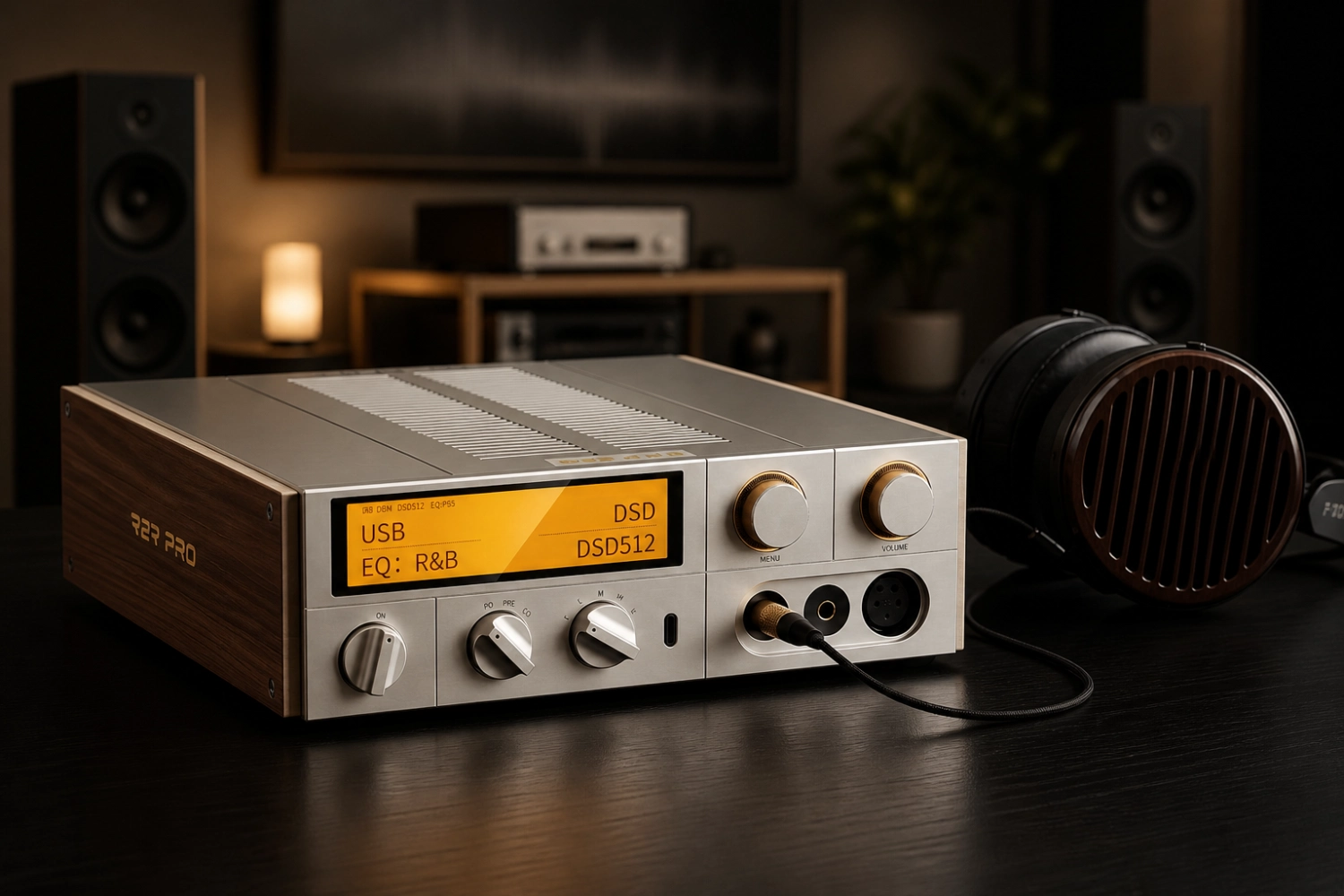

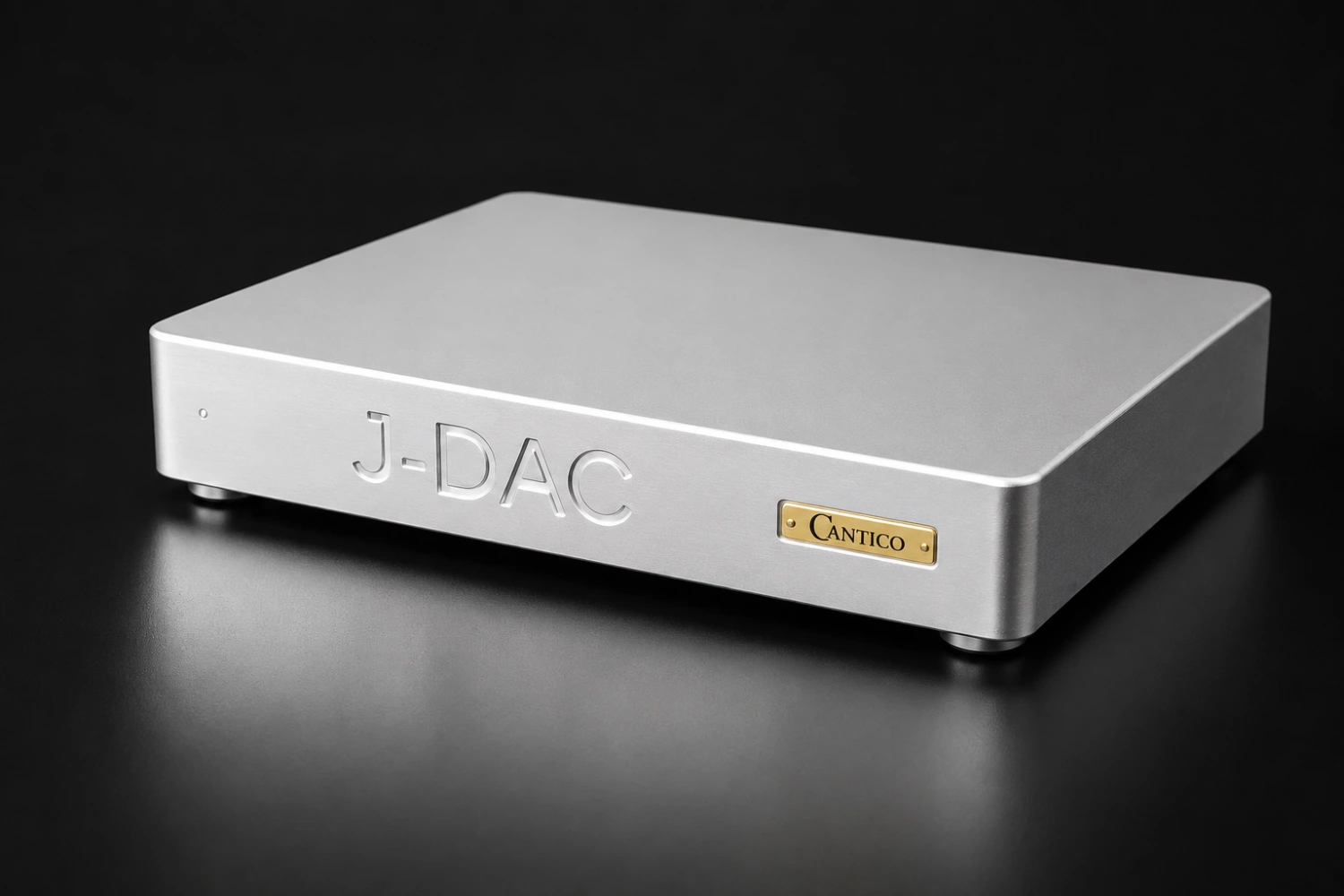
The Cantico J-DAC and Rotaxis Core64 are being compared because both are high-end DAC concepts built around isolation, simplified signal paths, and transformer-coupled analog output stages rather than a long list of convenience features. The overlap is real, but the products speak to different buyers: Cantico presents a finished Italian-made DAC with conventional digital inputs and a stated price, while Rotaxis presents a more radical R-2R ladder architecture with several proprietary timing and averaging ideas but fewer conventional purchase details in the source article.
| Category | Cantico J-DAC | Rotaxis Core64 |
|---|---|---|
| Original report | Cantico J-DAC article | Rotaxis Core64 article |
| DAC approach | Simplified signal path; separate power supplies; transformer-based output stage | True resistive ladder architecture with 24-bit resolution, according to Rotaxis Audio |
| Output stage | Single JFET transistor per channel between conversion resistors and custom-made output transformers | Fully discrete Class A output stage connected through Lundahl transformers |
| Analog outputs | Balanced XLR and single-ended RCA, but only one output type can be active at a time via rear switch | Output terminal details beyond transformer coupling are not specified in the source |
| Digital inputs | USB, AES/EBU, coaxial S/PDIF, optical Toslink | USB, S/PDIF, I²S |
| Format support | USB: DSD 2X and PCM up to 24-bit/384 kHz; other digital inputs: PCM up to 24-bit/192 kHz | Not stated in the source article |
| Power supply | Three separate toroidal transformers for digital processing, DAC section, and analog stages | Galvanically isolated power supply, external unit only |
| Build | Single-piece aluminum body; 5 mm aluminum base plate; weight up to 13 kg | Board-level resistor-ring architecture is described; chassis details are not stated |
| Interface philosophy | Physical output selection to avoid unnecessary switching circuits | No touch screens; small volume and sampling-rate indicator |
| Expansion | No upgrade path stated | Future external control and streaming unit planned via I²S over HDMI |
| Price | Suggested retail price: $12,000 | Not stated in the source article |
Design and build: Italian mechanical solidity versus ladder-DAC radicalism
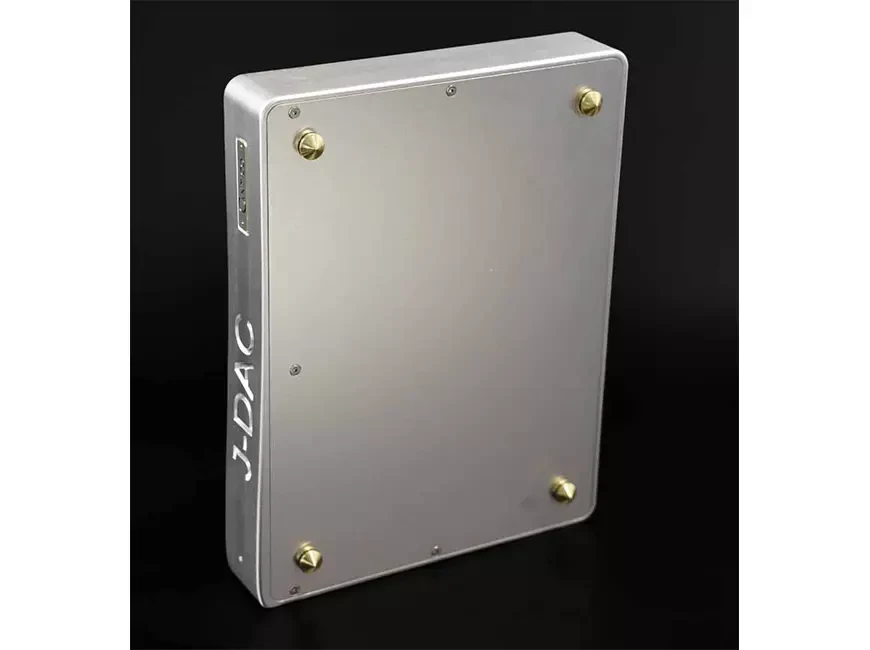
The Cantico J-DAC is the more fully described physical product. It is developed and manufactured in Ponderano, Italy, by a brand founded by Silvio Germano Ricci and focused on hand-assembled audio components and speaker systems. The enclosure is crafted from a single piece of aluminum, with a 5 mm aluminum base plate and a stated weight of up to 13 kg. Cantico’s stated intention is mechanical stability and reduced sensitivity to external vibration.
That does not prove a sonic advantage on its own, but it does tell a buyer something practical: this is a substantial component, likely intended for a fixed rack position rather than casual repositioning. The source also confirms that Cantico designs and manufactures all analog boards in-house, using a proprietary high-precision copper milling process instead of traditional photochemical PCB manufacturing. The company says this allows more precise quality control of the analog component.
The Rotaxis Core64 is described less as a chassis-led product and more as an architecture-led DAC. The article centers on its PulseAxis Staircase Design: a true resistive ladder with 24-bit resolution, where each bit is represented by precisely matched resistors arranged in ring form. Rotaxis says these rings are designed to reduce EMI, thermal drift, and crosstalk, and that the resistor rings are physically intertwined and counter-rotate to eliminate radio interference.
Editorially, this makes the Core64 the more technically unusual of the two, at least on paper. But the source does not provide comparable information on enclosure construction, weight, materials, or manufacturing location. Buyers who want detailed physical construction data get more from the Cantico source; buyers attracted to unconventional ladder-DAC theory will find more to study in the Rotaxis description.
Signal path and output stage: both use transformers, but not for the same story
The strongest common ground is transformer coupling. Cantico uses a transformer-based output stage in which each channel has a single JFET transistor placed between the conversion resistors and custom-made output transformers. According to Cantico, this provides galvanic isolation and the same level of quality on both balanced XLR and single-ended RCA outputs.
There is an important operational limitation: only one analog output type can be active at a time. A physical rear-panel switch selects XLR or RCA. Cantico frames this as a signal-path decision, avoiding unnecessary switching circuits and preserving the shortest possible path. For a buyer, the practical implication is simple: if you want to feed a balanced preamp and a separate RCA device simultaneously, the J-DAC’s design does not support that use case as described.
Rotaxis also uses transformer isolation, but in a different circuit context. Its output stage is described as fully discrete, Class A, with no op amps, connected to the output terminals through Lundahl transformers. The source says this is intended to preserve phase, eliminate ground loops, and provide instant dynamic response. Those are manufacturer claims rather than independently verified listening or measurement results in the article.
The Rotaxis design also explicitly rejects several common digital-DAC techniques. Rotaxis says the Core64 is built with no feedback, no noise reduction, and no digital trickery, and that it avoids delta-sigma modulation, noise shaping, and digital filters. That will appeal to buyers who value minimal digital manipulation as a design philosophy. It may be less reassuring to buyers who prefer published measurements, since the source does not include measured distortion, noise, jitter, linearity, or output-level data.
Features and connectivity: Cantico is clearer, Rotaxis is more minimalist
The Cantico J-DAC has the more conventional and fully specified input set: USB, balanced AES/EBU, coaxial S/PDIF, and optical Toslink. USB supports DSD 2X and PCM up to 24-bit/384 kHz, while the other digital inputs support PCM up to 24-bit/192 kHz. That makes it easier to match with common transports, streamers, CD players, and computers, based on the source facts.
The Rotaxis Core64 in base form offers USB, S/PDIF, and I²S digital inputs. The I²S connection matters because the source also says a future external control and streaming unit will connect via I²S over HDMI, allowing owners to expand the system without replacing the main DAC. That is a meaningful ownership concept, but it is explicitly future-facing in the article. The available source does not state supported PCM or DSD rates for the Core64, nor does it describe AES/EBU or Toslink support.
Interface design also differs. Cantico gives the buyer a rear-panel physical output selector for RCA or XLR. Rotaxis, by contrast, is described as having no touch screens, no noise, and only a small volume and sampling-rate indicator. The source does not explain the volume function in detail, so it should not be assumed to replace a preamplifier unless confirmed elsewhere.
Performance claims and realistic use cases
Neither source article includes listening impressions, lab measurements, comparisons against rivals, or awards. That matters. Any performance judgment here must be limited to architecture and stated design intent, not confirmed sonic superiority.
The Cantico J-DAC’s performance case rests on galvanic isolation, separate power supplies, mechanical mass, shielding, and a very short analog signal path. Its three toroidal transformers separately serve digital processing, the DAC section, and analog stages. It also uses 3D-printed conductive carbon shielding with proprietary geometry, intended to improve electromagnetic isolation. Editorial inference: the J-DAC is best understood as a high-end system DAC for buyers who want physical solidity, conventional source compatibility, and a carefully isolated analog output stage.
The Rotaxis Core64’s performance case is more conceptual and more ambitious in its language. Rotaxis describes its PulseAxis ladder as clock-accelerated at a base frequency of 11.2 MHz with a sub-frequency of around 100 MHz, using quarter-clock intervals grouped by current weight. It also describes Thermaphase Averaging, where rings of 64 levels move remaining artifacts into ultrasound to be filtered by a four-pole RC filter. GlitchLock Timing is said to divide activity into quarter-note pulses within the DAC and octal pulses between two polar ladders to prevent current jumps or overlaps at bit boundaries.
Those are highly specific claims, but they remain claims in the supplied source. Editorial inference: the Core64 is most compelling for the buyer who is interested in R-2R conversion, passive resistive ladder thinking, and a deliberate rejection of common digital filtering and noise-shaping approaches. It is less suited to someone who needs complete format, pricing, and chassis information before shortlisting.

Ownership considerations: certainty, integration, and future expansion
The Cantico J-DAC has a stated suggested retail price of $12,000 and is described as now available. That makes it easier to evaluate as an actual purchase. Its limitations are also easy to understand: it is expensive, heavy, and its analog outputs are mutually exclusive. The format support is clearly stated, and the input range is broad enough for many traditional and computer-audio systems.
The Rotaxis Core64 source does not state price or availability. It does mention a base version and a future external control and streaming unit, but not a release date, price, or full specification for that add-on. The upgrade path is attractive in principle because it suggests the main DAC could remain in place while control and streaming functions evolve. However, that remains less concrete than Cantico’s finished-product presentation.
For system matching, the Cantico’s XLR/RCA switch is both a purist feature and a practical constraint. Rotaxis’s external-only galvanically isolated power supply may appeal to buyers who like separating power hardware from signal circuitry, but the source does not provide physical or electrical details. In short, Cantico offers more purchase certainty; Rotaxis offers more architectural intrigue.
Pros and cons: Cantico J-DAC
- Pros: Developed and manufactured in Italy; substantial single-piece aluminum construction; three separate toroidal transformers; transformer-coupled output stage; USB, AES/EBU, coaxial, and Toslink inputs; stated PCM and DSD support; stated $12,000 suggested retail price.
- Cons: Only XLR or RCA can be active at one time; heavy at up to 13 kg; no upgrade path mentioned; no measurements or listening results included in the source article.
Pros and cons: Rotaxis Core64
- Pros: True 24-bit resistive ladder architecture as described by Rotaxis; proprietary PulseAxis, Thermaphase, and GlitchLock concepts; discrete Class A output stage; Lundahl transformer isolation; USB, S/PDIF, and I²S inputs; planned future control and streaming expansion via I²S over HDMI.
- Cons: No price stated; no format-rate support stated; no chassis, weight, or material details stated; future expansion is not fully specified; many performance statements are manufacturer claims rather than independently verified data in the source.
Who should buy each DAC?
Choose the Cantico J-DAC if you want a high-end DAC with a finished, well-defined specification, a stated price, and broad conventional connectivity. It is the better fit for buyers using AES/EBU or Toslink, buyers who value substantial enclosure design, and buyers who want a transformer-coupled analog stage without stepping into an unusually experimental DAC architecture.
Choose the Rotaxis Core64 if the core attraction is R-2R ladder conversion and you are specifically interested in a DAC that avoids delta-sigma modulation, digital filters, noise shaping, op amps, and touch-screen-style interface complexity. It is better suited to an enthusiast who is comfortable evaluating a product by design philosophy first and waiting for missing purchase details to become clear.

Final verdict
The Cantico J-DAC is the safer recommendation for a real-world shortlist because the source provides more complete buying information: availability, price, construction, input support, output behavior, and power-supply architecture are all clearly described. Its design is purist, but not obscure, and its limitations are easy to plan around.
The Rotaxis Core64 is the more provocative design. Its ladder architecture, ring-based resistor layout, Thermaphase Averaging, GlitchLock Timing, and Lundahl transformer-coupled Class A output stage make it stand apart from typical DAC descriptions. But the lack of price, format support, and physical product details makes it harder to recommend decisively on the supplied information alone.
Overall winner: Cantico J-DAC, for the buyer ready to purchase and integrate a documented high-end DAC. Specialist pick: Rotaxis Core64, for the R-2R purist who is drawn to its architecture and willing to investigate the missing ownership details before committing.