
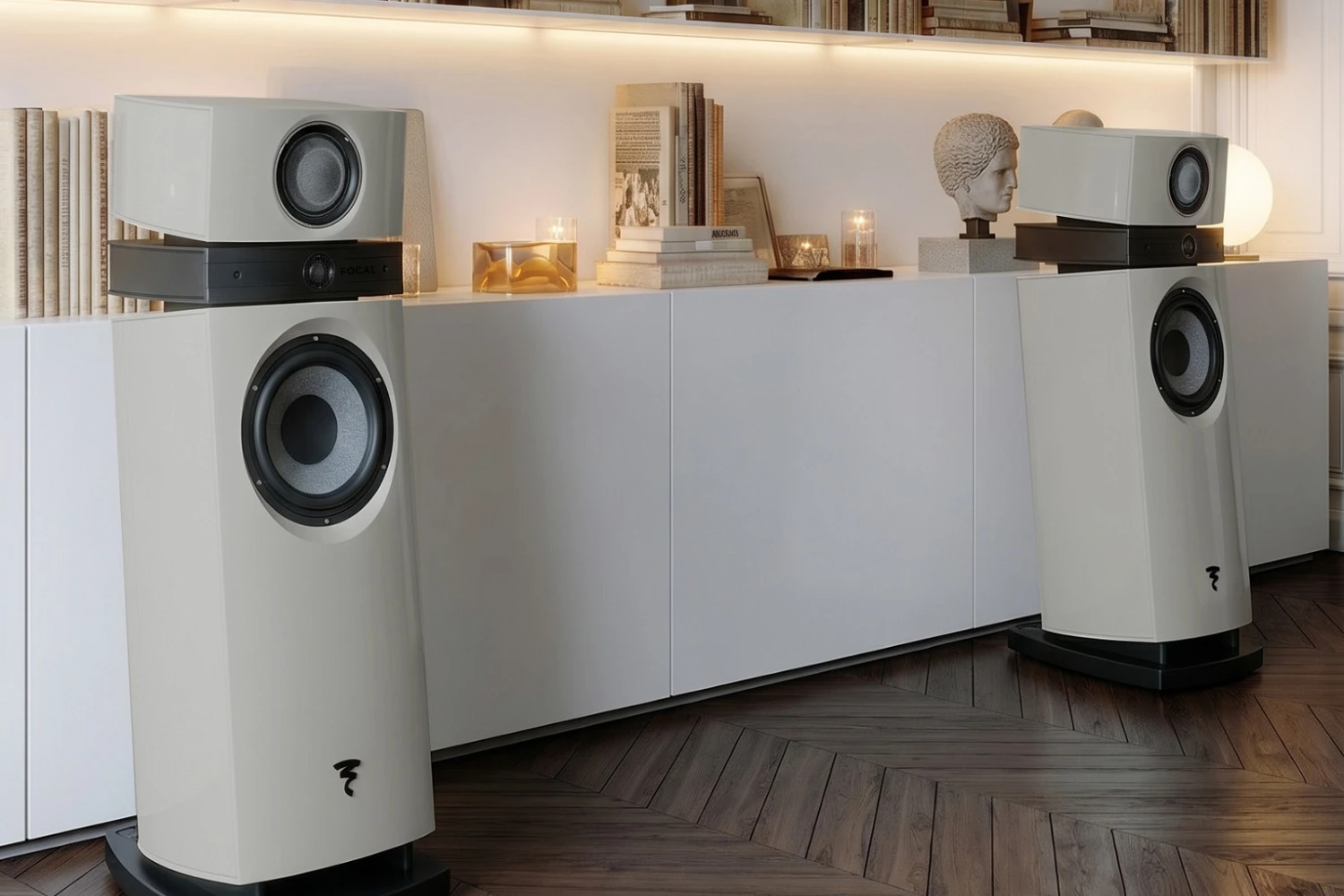
The Focal Scala Utopia Evo M and Bowers & Wilkins Formation Bass are worth comparing because both promise substantial low-frequency performance, yet they belong to very different categories. The Focal is a $40,000-per-pair high-end passive loudspeaker intended to serve as the main speaker in a serious stereo system. The Bowers & Wilkins is an active wireless subwoofer designed to add bass support inside the company’s Formation ecosystem. In other words, this is not a like-for-like shootout; it is a decision between building around a complete full-range loudspeaker and adding dedicated bass to an existing or planned wireless Formation setup.
Sources: Focal Scala Utopia Evo M original post and Bowers & Wilkins Formation Bass original post.
| Category | Focal Scala Utopia Evo M | Bowers & Wilkins Formation Bass |
|---|---|---|
| Product type | Three-way bass reflex passive loudspeaker | Active wireless subwoofer |
| Main role | Primary high-end stereo loudspeaker | Bass extension for Formation systems |
| Drivers | 5-inch reinforced W-cone M-profile midrange, 27 mm PRISM M-profile inverted dome tweeter, redesigned 11-inch W-cone woofer | 2 x 165 mm / 6.5-inch long-throw woofers with paper-Kevlar cones and outer aluminum layer |
| Amplification | Not specified; passive speaker requiring external amplification | 250 W IcePower Class D amplifier |
| Frequency information | ±3 dB down to 27 Hz; -6 dB at 24 Hz; tweeter range stated up to 40 kHz | 20 Hz to 150 Hz |
| Adjustment | Low, midrange and treble adjustment; bass and treble controls allow ±1 dB | DSP control, dynamic EQ, automatic sound equalization, memory for five custom settings |
| Connectivity | Four isolated WBT terminals supporting bi-wiring or bi-amping | Formation Wireless with AES encryption, RJ45 Ethernet or Wi-Fi, USB service only, app setup for iOS and Android |
| Construction | High-density MDF panels up to 60 mm thick, multi-compartment cabinet, Focus Time driver alignment | Barrel-shaped enclosure designed to reduce resonances and internal standing waves |
| Dimensions / weight | Not specified in the source article | 440 x 234 x 240 mm; 12.1 kg |
| Price / availability | From $40,000 per pair; available from August 2026 | Price not stated in the source article |
Design and build: sculpted high-end tower versus compact barrel subwoofer
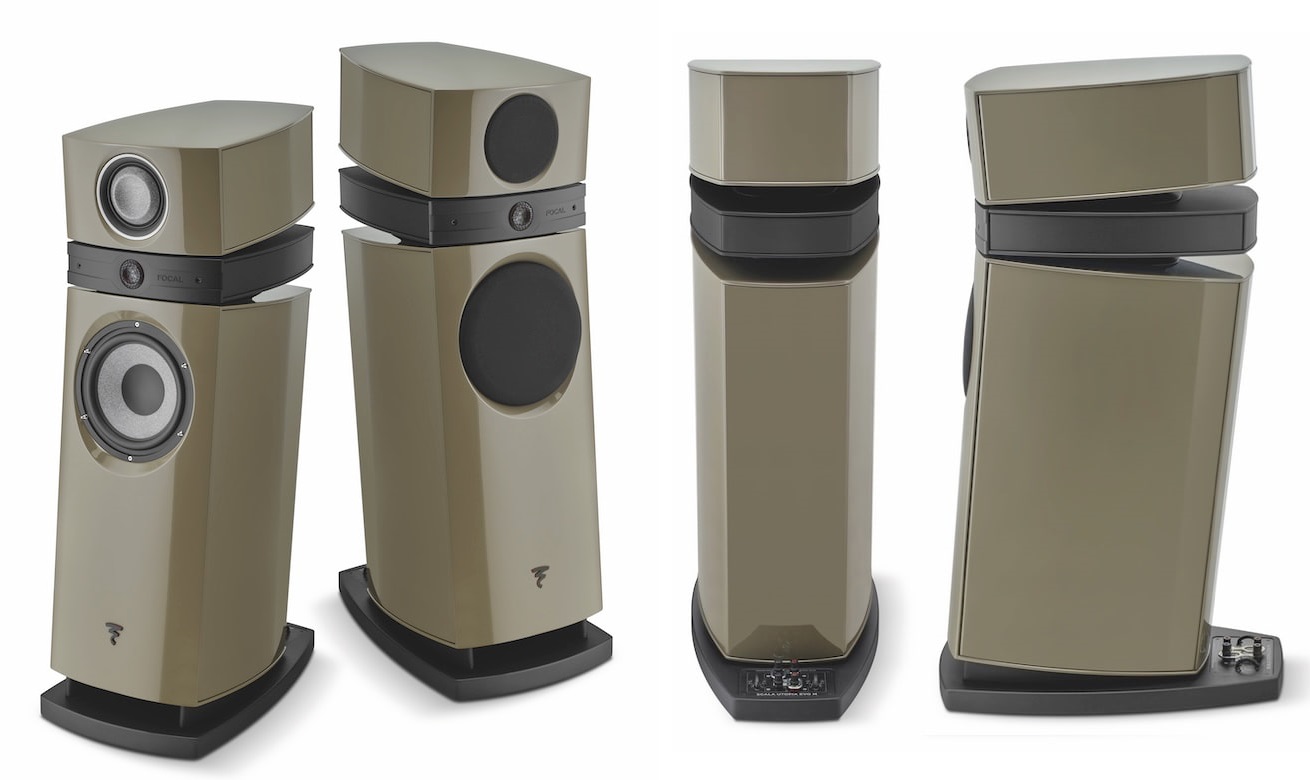
The Focal Scala Utopia Evo M continues the Scala formula: a three-way bass reflex loudspeaker with a multi-compartment enclosure and dimensions described in the source as compact for a Utopia model. Focal has not treated the Evo M as a cosmetic refresh. The article states that the drivers, crossover filter, enclosure tuning and mechanical structure have all been revised. The cabinet uses high-density MDF panels up to 60 mm thick, with a heavy vibration-damping frame developed using vibration analysis. The source also notes Focal’s Focus Time arrangement, which mechanically aligns the drivers with the listening position to improve time synchronization.
Manufacturing is part of the Focal story here. The cabinet is made by Focal’s cabinetmakers in Burgundy, while the drivers are produced in Saint-Étienne. That vertical control matters because the Scala Utopia Evo M relies on specific driver geometry, cabinet tolerances, crossover settings and finish quality. Finishes include high-gloss black, high-gloss off-white and high-gloss warm taupe, with light walnut/off-white and dark walnut/sepia brown options available for an additional charge.
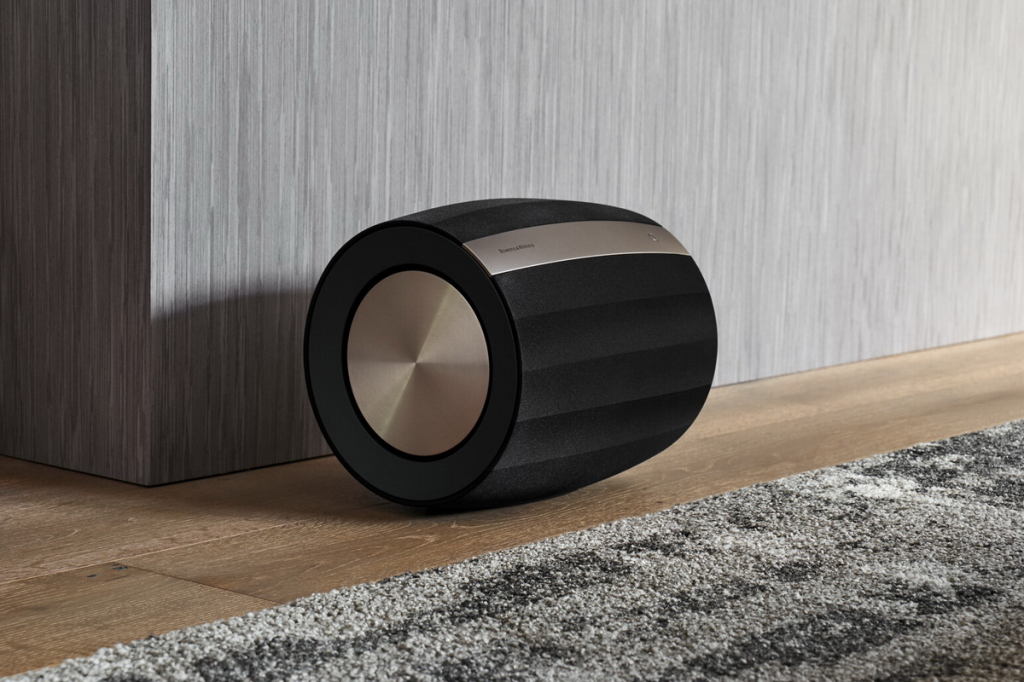
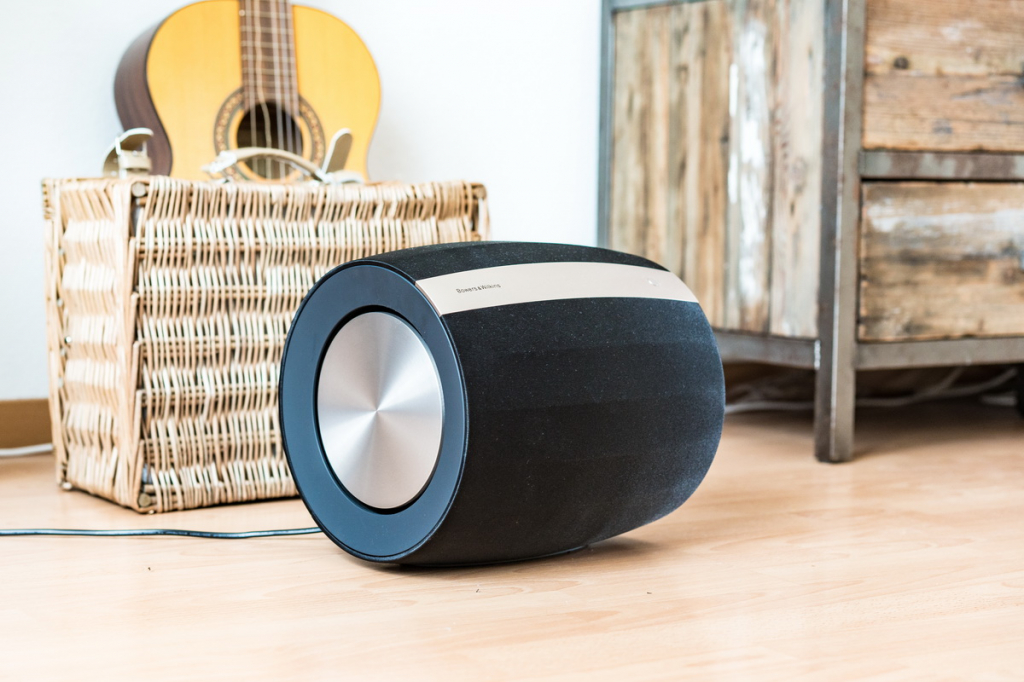
The Bowers & Wilkins Formation Bass takes the opposite physical approach. It is a compact active subwoofer in a barrel-shaped enclosure. According to the source, that shape is not only visual; it works as an acoustic load for the bass drivers, helps eliminate resonances and internal standing waves, and better resists wall vibration than traditional rectangular designs. Its two 6.5-inch woofers fire in opposite directions, and their synchronous operation is said to optimize load on the body and support more uniform bass distribution in the room.
Drivers and acoustic architecture
The Focal is the more complex loudspeaker because it must cover bass, midrange and treble on its own. The new 5-inch reinforced W-cone midrange uses an M-profile diaphragm derived from Focal’s Utopia Main professional monitor series. The source lists W-sandwich construction, one-piece M-profile geometry, TMD suspension, a neodymium motor and an 80 mm voice coil. Focal’s stated goal is cleaner, more linear midrange reproduction with lower distortion and greater control at higher listening levels.
High frequencies come from Focal’s 27 mm PRISM M-profile inverted dome tweeter, first introduced in the Diva Alta Utopia. The source says PRISM uses a multi-material diaphragm and microstructured construction that Focal claims is stiffer than beryllium while retaining low mass and damping. It is paired with Focal’s IAL2 Infinite Acoustic Loading system, lowering the tweeter’s resonant frequency to 528 Hz and enabling a stated frequency range up to 40 kHz.
The Scala’s bass section uses a redesigned 11-inch W-cone woofer with a 16 cm dual ferrite motor and a more precisely laser-cut composite sandwich diaphragm. It works with a large laminar bass port intended to move air while avoiding rumble, compression and other unwanted behavior when the speaker is heavily loaded.
The Formation Bass is simpler by design: it is only responsible for the low end. Its two 6.5-inch long-throw woofers use paper-Kevlar cones with an outer aluminum layer. The source does not present it as a replacement for full-range speakers; it is specifically described as being optimally coordinated with Formation series products including Duo, Bar and Wedge.
Features and connectivity
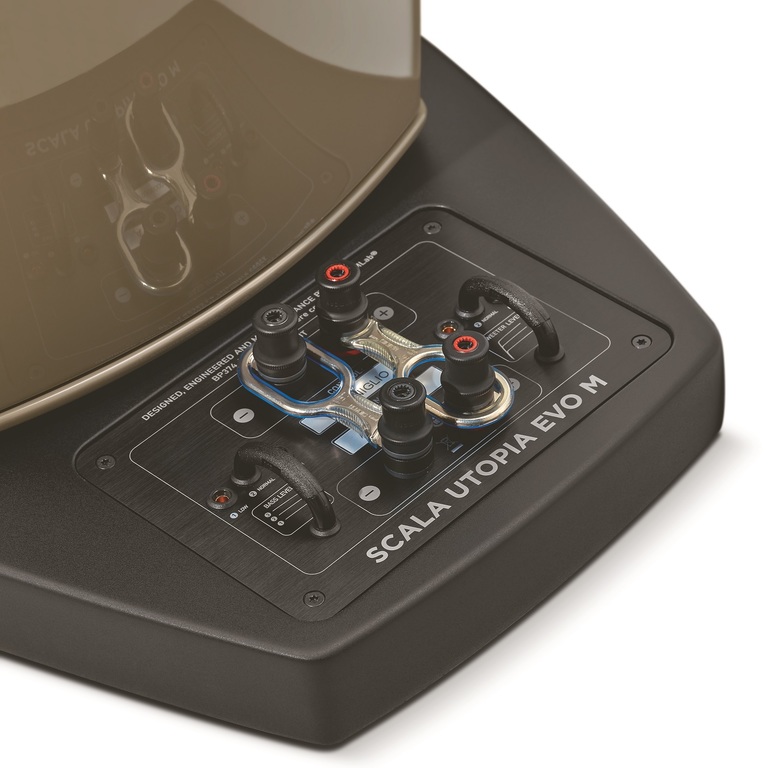
The Focal Scala Utopia Evo M is a passive loudspeaker, so the source does not mention built-in amplification, wireless streaming or app control. Its connectivity is traditional high-end hi-fi: four isolated WBT terminals supporting bi-wiring or bi-amping. The revised OPC+ crossover uses high-quality components and thick internal cabling. More unusually, the user can adjust the amount of low, midrange and treble, with bass and treble controls allowing ±1 dB. This is explicitly not room correction, but it gives owners a small amount of tonal fine-tuning without changing electronics or modifying the room.
The Bowers & Wilkins Formation Bass is far more integrated electronically. It has a 250 W IcePower Class D amplifier, DSP control, dynamic EQ and an automatic sound equalization system for Formation components. Setup is handled through the Bowers & Wilkins Formation control app for iOS and Android. Wireless communication uses the Formation Wireless secure peer-to-peer network with AES encryption, and the unit also includes RJ45 Ethernet or Wi-Fi network input. USB is listed for service only.
This difference is central to the buying decision. The Focal expects a conventional high-end system around it: suitable amplification, cabling and careful placement. The Bowers & Wilkins expects a Formation environment and is designed to be added and configured through software.
Performance and use case based on confirmed facts
No listening tests are supplied in the source articles, so any performance comparison must stay with the confirmed design claims and specifications. The Scala Utopia Evo M is specified at ±3 dB down to 27 Hz, with a -6 dB point at 24 Hz. For a passive loudspeaker that is described as easier to handle in a typical living room than the larger Utopia models, that indicates substantial bass capability without requiring a separate subwoofer on paper. The source also emphasizes that Focal has focused heavily on midrange linearity and high-frequency refinement, not just bass weight.
The Formation Bass has a stated response of 20 Hz to 150 Hz. As a subwoofer, its job is narrower but potentially very useful: reinforce the low frequencies of Formation speakers and soundbar systems. Its DSP, dynamic EQ and custom setting memory are intended to adapt the subwoofer’s behavior to room acoustics. The source also says it can be used to create both stereo and multi-channel audio systems, within the Formation context.
The editorial inference is straightforward: choose the Focal if the priority is a complete, full-range high-end loudspeaker capable of handling the whole musical spectrum. Choose the Formation Bass if the priority is low-frequency support for an existing Formation Duo, Bar or Wedge system, especially where wireless integration and app-based setup matter more than traditional separates.
Ownership considerations
The Focal carries the larger commitment. Its starting price is $40,000 per pair, availability is stated for August 2026, and the source positions it as a refined high-end loudspeaker with revised drivers, cabinet work and crossover design. Buyers should also consider the unstated but unavoidable system context: because it is passive, it will require external amplification. The source does not specify amplifier requirements, dimensions or weight, so those should be confirmed with a dealer before purchase.
The Bowers & Wilkins Formation Bass is more compact and self-contained. Its dimensions are 440 x 234 x 240 mm and weight is 12.1 kg. It consumes under 6 W in sleep mode, according to the listed specifications. However, it is not a universal wired subwoofer in the way many home-theater subs are. The supplied article focuses on Formation Wireless, app setup and optimal coordination with Formation series products. Buyers outside that ecosystem should verify compatibility carefully rather than assume it will integrate like a conventional line-level sub.
Who should buy each?
Buy the Focal Scala Utopia Evo M if you are building a serious passive stereo system and want the main loudspeakers to deliver bass, midrange and treble as a complete package. It suits a buyer who values advanced driver engineering, traditional high-end speaker terminals, cabinet craftsmanship, finish options and a small degree of tonal adjustment. It is also the more appropriate choice if the system goal is two-channel music reproduction built around full-range floorstanding speakers.
Buy the Bowers & Wilkins Formation Bass if you already own, or plan to own, Formation Duo, Formation Bar or Formation Wedge products and want dedicated bass support with wireless setup. It suits buyers who prefer a compact active subwoofer with built-in amplification, DSP, app control and automatic equalization inside a connected speaker system. It is not the product to buy as a standalone replacement for main speakers.
Pros and cons
Focal Scala Utopia Evo M pros:
- Complete three-way high-end loudspeaker rather than an add-on component.
- Revised midrange, tweeter, woofer, crossover, enclosure tuning and mechanical structure.
- Stated bass extension of ±3 dB to 27 Hz and -6 dB at 24 Hz.
- PRISM M-profile tweeter with IAL2 loading and stated range up to 40 kHz.
- Bi-wiring or bi-amping support via four isolated WBT terminals.
- Low, midrange and treble adjustment, including ±1 dB bass and treble controls.
Focal Scala Utopia Evo M cons:
- Starting price of $40,000 per pair puts it firmly in high-end territory.
- Requires external amplification; amplifier requirements are not specified in the source.
- Dimensions and weight are not provided in the article.
- Tonal controls are not room correction.
Bowers & Wilkins Formation Bass pros:
- Active design with built-in 250 W Class D amplification.
- Compact barrel-shaped enclosure intended to reduce resonances and standing waves.
- Dual opposed 6.5-inch woofers for optimized cabinet loading.
- DSP, dynamic EQ, automatic equalization and five custom setting memories.
- Wireless Formation integration with app setup for iOS and Android.
- Stated frequency response from 20 Hz to 150 Hz.
Bowers & Wilkins Formation Bass cons:
- Designed around the Formation ecosystem, not described as a universal hi-fi subwoofer.
- Does not cover midrange or treble; it must be paired with speakers.
- Price is not stated in the source article.
- USB is for service only, not audio input.
Final verdict
The Focal Scala Utopia Evo M is the clear choice if this comparison is about selecting a main high-end loudspeaker. It is a complete three-way passive speaker with extensive driver, cabinet and crossover revisions, meaningful bass specifications, traditional high-end connectivity and a small amount of user tonal adjustment. It is expensive, and the source leaves some practical questions open, but its purpose is broader and more ambitious.
The Bowers & Wilkins Formation Bass wins only under a different brief: adding low-frequency reinforcement to a Formation wireless system. In that context, its active amplification, DSP, wireless networking, app setup and compact resonant-resistant enclosure make sense. It should not be viewed as a cheaper alternative to the Focal, because it is not a full-range loudspeaker.
So the decisive answer is: choose the Focal Scala Utopia Evo M for a primary audiophile speaker system; choose the Bowers & Wilkins Formation Bass for Formation-system bass support. They overlap in bass ambition, but not in role, scale or system philosophy.