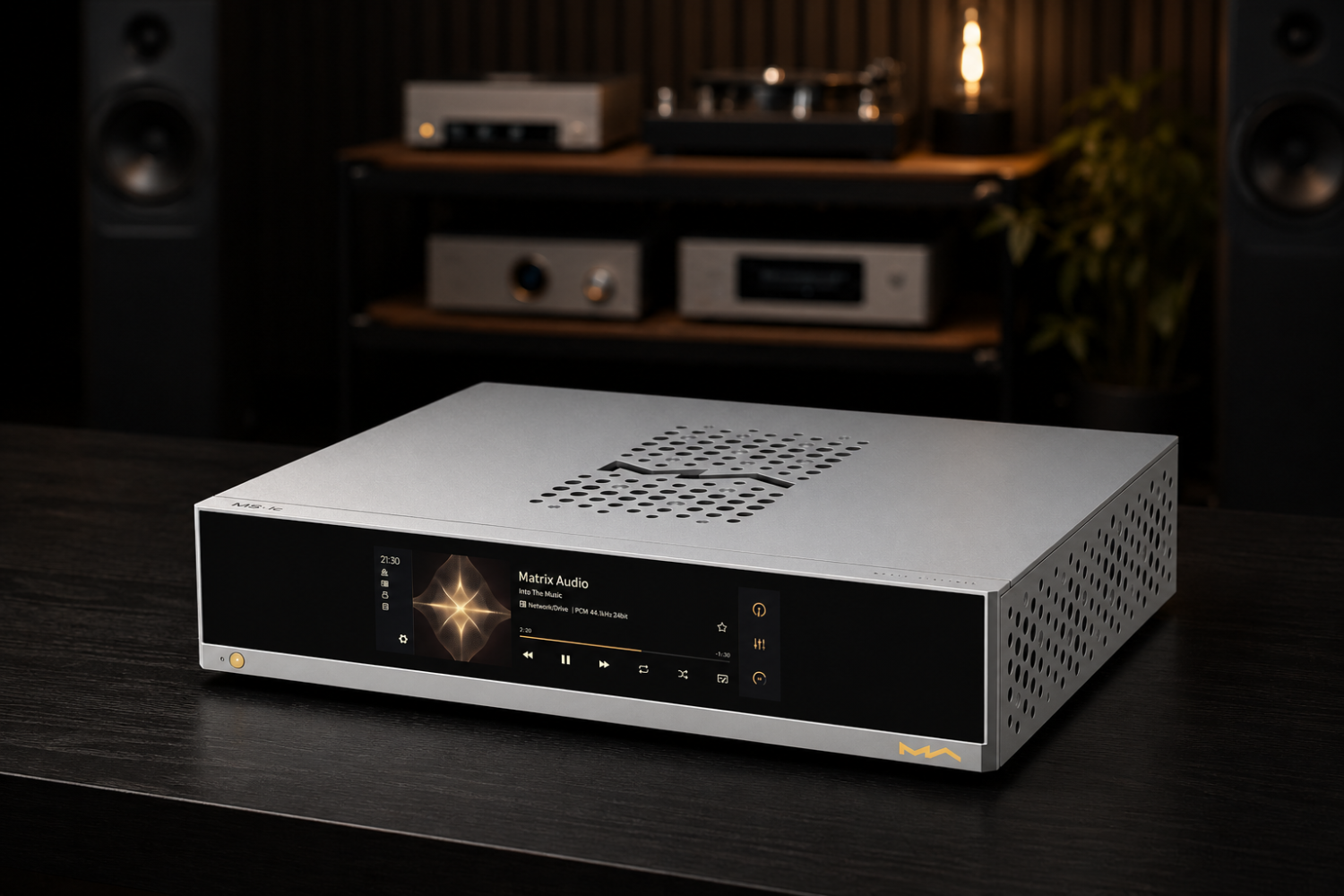

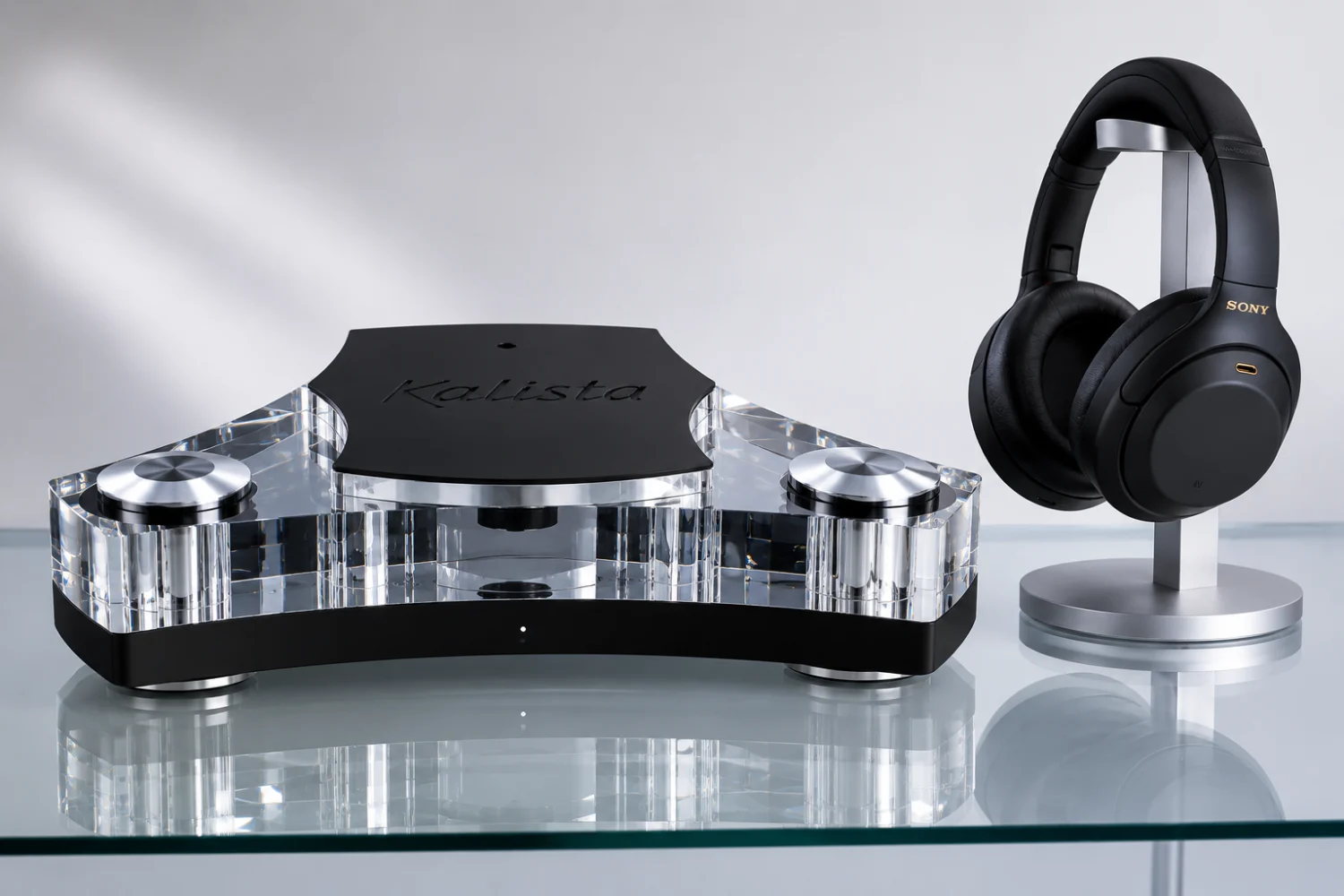
These products are being compared because they address the same high-end streaming chain from very different positions. The Kalista DreamPlay S and DreamPlay SC are reference-level network audio sources, while the Matrix Audio SI-1 is an optical network isolator designed to sit between a wired network and an existing streamer. One is the player; the other is an accessory intended to clean up the network path feeding a player.
Sources: Stereoindex’s original reports on the Kalista DreamPlay S and DreamPlay SC and the Matrix Audio SI-1 Network Audio Isolator.
| Category | Kalista DreamPlay S / DreamPlay SC | Matrix Audio SI-1 |
|---|---|---|
| Product type | High-end network audio players; DreamPlay S is a streamer without DAC, DreamPlay SC adds onboard DA conversion. | Active optical network isolator for use with an existing music streamer. |
| System role | Primary digital source for streaming playback. | Network-side support component intended to isolate the streamer from network noise and interference. |
| Digital audio support | DreamPlay S processes PCM from 32-bit/44.1 kHz to 384 kHz and DSD64 to DSD256; PCM up to 32-bit/384 kHz and DSD64 to DSD128 via DoP over S/PDIF and AES/EBU; native DSD up to DSD256 via I2S. | No audio-format processing stated; it handles network data via 1 Gbps RJ45 input and isolated 1 Gbps RJ45 output. |
| DAC provision | DreamPlay S has no DAC; DreamPlay SC uses an ES9039MPRO DAC chip and provides RCA and XLR analog outputs. | No DAC; not a streamer or converter. |
| Network connection | Ethernet 10/100/1000 Mbps and dual-band Wi-Fi 2.4/5 GHz. | One RJ45 1Gb input and one RJ45 output, with internal dual-channel optical isolation. |
| Streaming services/protocols | DLNA/UPnP, Audirvana, Spotify Connect, Roon Ready, Deezer, TIDAL Connect, Qobuz Connect, vTuner, and MQA renderer support up to 32-bit/384 kHz. | Not a streaming platform; service compatibility depends on the connected streamer. |
| Build and power | Handcrafted in France, advanced power supplies, Kalista materials and finishes; DreamPlay S uses a separate Elektra power supply module according to the specifications. | Solid aluminum enclosure, internal linear power supply with toroidal transformer, multiple independent DC regulation circuits, dual femtosecond clock circuits. |
| Price and availability | Pricing and delivery information not yet announced in the source article. | Available immediately from stock at a suggested retail price of €899. |
Design and build: sculptural source component versus compact isolation hardware
Kalista’s DreamPlay S and DreamPlay SC are presented as luxury digital sources, not utility boxes. Métronome Technologie positions the Kalista brand around the idea that technology, materials and design are linked, and the DreamPlay models continue that approach with a flat, sculptural form and visibly premium construction. Both are handcrafted in France and offered in Black Pearl and Diamond finishes. The source article also makes clear that their appearance is distinctive and deliberately aimed at the premium segment.
The Matrix Audio SI-1 is much smaller and more functional in purpose, but not casual in construction. Its enclosure is milled from solid aluminum and uses Matrix Audio’s perforation pattern. The stated dimensions are 12 cm wide, over 20 cm deep and about 4.5 cm high, with a weight of 1.5 kg. That weight matters practically: the article notes that it stands firmly even when used with a high-quality power cable. It is a network accessory, but one built like a serious hi-fi component.
The editorial inference is straightforward: Kalista is intended to be seen as a centerpiece in a reference system, while the Matrix is designed to disappear into the network chain while still meeting high-end expectations for power supply, enclosure and isolation.
Features and connectivity: the Kalista plays music; the Matrix conditions the path
The most important difference is functional. The Kalista DreamPlay S and DreamPlay SC are network players. The DreamPlay S is for users who already own a high-quality DAC. It provides digital outputs including I2S, S/PDIF and AES/EBU, plus USB 2.0 for external storage and network access via Ethernet or Wi-Fi. The DreamPlay SC adds onboard conversion using an ES9039MPRO DAC chip and supplies both balanced XLR and unbalanced RCA analog outputs, while retaining digital outputs.
The DreamPlay models also cover a broad range of streaming ecosystems: DLNA/UPnP, Audirvana, Spotify Connect, Roon Ready, Deezer, TIDAL Connect, Qobuz Connect and vTuner. Qobuz Connect, TIDAL Connect and Spotify Connect allow compatible services to stream directly to the device rather than relying on the phone as the audio source. Roon Ready support makes the Kalistas suitable for Roon-based libraries and multiroom environments.
The Matrix Audio SI-1 does not play, decode or convert music. It has one RJ45 1Gb input and one RJ45 output. Internally, it converts the incoming electrical network signal to optical and back again using dual-channel optical isolation, one path for upstream and one for downstream. Its purpose is galvanic isolation, data transmission optimization and surge protection. In short: the SI-1 belongs before a streamer, not instead of one.
Performance and use case: confirmed specifications and claimed benefits
The Kalista performance story in the source article is specification-led. The DreamPlay S natively processes linear PCM from 32-bit/44.1 kHz to 384 kHz and DSD64 to DSD256. Via S/PDIF and AES/EBU using DoP, it supports PCM up to 32-bit/384 kHz and DSD64 to DSD128; native DSD up to DSD256 is available via I2S. For the DreamPlay SC’s DAC section, the article states THD+N below -122 dB and dynamic range of 137 dB. Those are confirmed figures from the supplied source, not independent lab measurements by Stereoindex in this comparison.
The Matrix Audio SI-1’s performance case is based on network isolation rather than audio format support. The source article says the wired network can create a path for contamination and unwanted potential differences on ground, potentially limiting final signal processing quality. The SI-1 addresses this with complete galvanic isolation between the home network and the streamer, using optical conversion inside the unit. It also uses an internal linear power supply, a toroidal transformer, multiple DC regulation circuits and dual femtosecond clock circuits.
The article on the SI-1 describes the audible effect as greater clarity, contrast, natural flow and spatial realism. For a buyer, it is important to read that as a reported product effect from the source article, not as a head-to-head listening test against the Kalista streamers. There is no supplied evidence that the Matrix can make a lesser streamer equal to a Kalista, nor that a Kalista system would or would not benefit from such isolation.
Ownership considerations: price certainty, system complexity and matching
The Matrix Audio SI-1 is the easier product to evaluate financially because the source gives a suggested retail price of €899 and says it is available immediately from stock. It also has a clear deployment: place it in the wired network path feeding a streamer. Buyers should note that its relevance depends on already having, or planning to use, a network streamer via Ethernet. The article emphasizes wired streaming for maximum resolution and stability; the SI-1 is not described as a Wi-Fi product.
The Kalista DreamPlay S and SC are more consequential purchases. They replace or define the digital source in a system, and the choice between S and SC depends on DAC ownership. If you already have a serious external converter, the DreamPlay S is the more logical model because it omits onboard DAC conversion. If you want a one-brand streaming and conversion solution, the DreamPlay SC is the intended option. However, the source article states that prices and delivery information had not yet been announced, so any value judgment must remain provisional.
Complexity also differs. A DreamPlay SC can feed an amplifier or preamplifier through analog RCA or XLR outputs. A DreamPlay S requires an external DAC. The Matrix SI-1 requires a streamer and does nothing without one. That makes Kalista the core component and Matrix the supporting component.
Pros and cons: Kalista DreamPlay S / DreamPlay SC
- Pros: Complete high-end streaming source platform with broad protocol and service support.
- Pros: Choice between transport-only DreamPlay S and DAC-equipped DreamPlay SC.
- Pros: Ethernet, dual-band Wi-Fi and USB 2.0 storage support are all stated.
- Pros: DreamPlay SC adds RCA and XLR analog outputs and uses the ES9039MPRO DAC chip.
- Pros: Handcrafted French build and distinctive Kalista design for systems where appearance matters.
- Cons: Pricing and delivery timing were not announced in the source article.
- Cons: DreamPlay S requires a separate DAC, which adds cost and system matching considerations.
- Cons: Large ambition and premium positioning may be unnecessary if the existing streamer is already satisfactory.
Pros and cons: Matrix Audio SI-1
- Pros: Clear, focused role: galvanic isolation between network and streamer.
- Pros: Active optical-electrical isolation with separate upstream and downstream optical paths.
- Pros: Internal linear power supply with toroidal transformer and multiple regulation circuits.
- Pros: Also intended to provide surge protection against events such as lightning strikes, power surges and electrostatic discharge.
- Pros: Price and availability are stated: €899 suggested retail price, available immediately from stock.
- Cons: It is not a streamer, DAC or music server, so it cannot replace a source component.
- Cons: Benefits depend on the rest of the system and on using a wired network connection.
- Cons: Streaming-service support is entirely determined by the connected streamer, not by the SI-1.
Who should buy the Kalista DreamPlay S or DreamPlay SC?
Buy the Kalista DreamPlay S if you are building a reference digital front end around an external DAC and want a dedicated streaming transport with high-resolution PCM and DSD handling, I2S, S/PDIF and AES/EBU outputs, plus broad service support. It is the more appropriate Kalista model for owners already committed to a preferred converter.
Buy the Kalista DreamPlay SC if you want the streaming platform and DAC conversion in one Kalista component. Its analog RCA and XLR outputs make it the more self-contained option, and the published DAC specifications give buyers concrete figures to consider. The catch is that price and delivery were not yet available in the source, so purchase timing remains uncertain.
Who should buy the Matrix Audio SI-1?
Buy the Matrix Audio SI-1 if you already have a streamer you like and want to address the network connection as a potential source of interference. It is especially relevant to systems using Ethernet, where the network cable can also create an electrical path between the streamer and the wider home network. Its role is narrow but serious: isolate, protect and optimize the network feed before it reaches the streamer.
Do not buy it expecting a new streaming interface, app ecosystem, DAC upgrade or format expansion. The SI-1’s value is conditional on the quality and sensitivity of the system around it.
Final verdict: not rivals, but very different upgrade decisions
The Kalista DreamPlay S/SC and Matrix Audio SI-1 are not interchangeable products. The decisive choice is based on what problem you are solving. If you need a new primary streaming source, the Kalista models are the clear answer: DreamPlay S for external-DAC systems, DreamPlay SC for an integrated streaming-DAC solution. They define the digital front end.
If you already own a capable streamer and want to refine the network side without replacing it, the Matrix Audio SI-1 is the more targeted and financially transparent option. It cannot compete with the Kalista as a source because it is not a source. Equally, a Kalista does not make the same ownership argument as the SI-1 because it is a far larger system decision with no announced price in the supplied source.
Overall winner by role: Kalista wins for buyers choosing a reference streaming component; Matrix wins for buyers optimizing an existing Ethernet-based streaming chain. For most shoppers, that distinction matters more than declaring a single universal champion.