
A good home cinema system is not built from a single specification.
The right choice depends on whether you need a full AV processor for separate power amplifiers, a receiver with built-in amplification, a disc player for physical media, or simply clearer guidance on how many speakers your room and ambitions require.
This Stereoindex selection brings together capable home cinema components and one practical speaker-layout guide from our source coverage. The list ranges from flagship processors with extensive channel support to compact or entry-level receivers, plus a dedicated 4K UHD Blu-ray player for viewers who still value disc playback. The emphasis here is on supported distinctions: channel capability, room-correction tools, HDMI and video handling, streaming options, installation flexibility, and the role each product is designed to play in a system. Specifications are included only where they are stated in the source material.

1. Anthem AVM 90: Powerful fifteen-channel AV processor
Anthem AVM 90 AV processor, designed as the control hub for high-channel-count home theater systems.
The Anthem AVM 90 is a flagship AV processor aimed at ambitious home theater systems rather than simple receiver-based setups.
Its support for object-oriented audio codecs up to 15.4 channels, balanced XLR outputs, ARC Genesis room correction, and eARC make it a strong control center for a separates-based cinema.
The source also notes seven HDMI inputs, two HDMI outputs, Ultra HD bandwidth up to 18.2 Gbps, and support for Dolby Vision, HDR, and Hybrid Log Gamma.
Best for: Large separates-based home theaters
- Supports up to 15.4 channels
- ARC Genesis room correction with upgraded microphone
- Balanced XLR audio outputs
- Chromecast and AirPlay 2 streaming support
Verdict: Choose the Anthem AVM 90 if your system is built around external amplification and you want extensive channel support with serious room-correction tools.

2. Marantz NR1711: AV receiver equipped with advanced sound optimization
Marantz NR1711 AV receiver, a slim home cinema component with 5.1.2-channel immersive audio support.
The Marantz NR1711 is a low-profile AV receiver that suits rooms or furniture where a full-height component is not ideal.
It supports Dolby Atmos and DTS:X in a 5.1.2-channel configuration, offers Dolby Atmos Height Virtualization and DTS Virtual:X for systems without height speakers, and includes Audyssey MultEQ speaker calibration with Dynamic Volume and Dynamic EQ.
The source also highlights 8K video at 60 Hz, 4K at up to 120 Hz, 4K upscaling, voice assistant compatibility, app control, and seven discrete amplifiers rated at 90 W per channel into 6 ohms.
Best for: Compact living-room cinema systems
- Slim, low-profile chassis
- 5.1.2 Dolby Atmos and DTS:X support
- Audyssey MultEQ calibration
- Voice assistant and app control
Verdict: The Marantz NR1711 is a practical choice when you want immersive-format support and room correction in a space-saving receiver.

3. Denon AVR-X3600H: Fully equipped 7-channel AV receiver
Denon AVR-X3600H AV receiver with multiple HDMI connections for source-heavy home theater systems.
The Denon AVR-X3600H is a feature-rich AV receiver for users who want strong surround flexibility and broad HDMI connectivity.
The source describes support for Dolby Atmos and DTS:X, options for a 7.2.2 system with height channels or a 9.2 layout for traditional surround, and Audyssey MultEQ XT32 autocalibration using the included microphone.
It also includes eight HDMI inputs, three HDMI outputs, 4K video transmission with HDR, Dolby Vision and HLG, plus analog and digital video conversion to 4K.
Best for: Flexible surround systems with many sources
- Dolby Atmos and DTS:X support
- Audyssey MultEQ XT32 autocalibration
- Eight HDMI inputs and three outputs
- Front HDMI input for quick connection
Verdict: The Denon AVR-X3600H stands out for buyers who need generous HDMI connectivity and advanced Audyssey calibration in a receiver-based setup.

4. McIntosh MX200: Engineered to support extensive Dolby Atmos configurations
McIntosh MX200 home cinema processor with balanced outputs and support for extensive Dolby Atmos layouts.
The McIntosh MX200 is an 11.2-channel home cinema decoder processor for systems that use separate amplification.
It supports Dolby Atmos and DTS:X and is designed for layouts from 5.1 to 7.2.4 channels.
The source specifies four HDMI 2.1 inputs, one HDMI output, support for 4K/120Hz, Dolby Vision and HDR10+, 11 balanced XLR outputs, two independent subwoofer outputs, Dirac Live room correction, and integration compatibility with Control4 and Crestron Home.
Best for: Installed cinema rooms using separate amplifiers
- Supports layouts up to 7.2.4 channels
- Dirac Live room correction
- 11 balanced XLR outputs
- Control4 and Crestron Home compatibility
Verdict: The McIntosh MX200 is best understood as a premium processor for carefully planned systems where balanced outputs, Dirac Live, and control-system integration matter.

5. Arcam AVR11: High-performance 12-channel AV receiver
Arcam AVR11 AV receiver with Dirac Live calibration and expansion potential for larger home cinema layouts.
The Arcam AVR11 is a premium AV receiver built around Class AB amplification, full 12-channel Dirac Live calibration, and support for current surround formats from Dolby, DTS, and IMAX Enhanced.
The source notes Dolby Atmos compatibility in a 5.1.2 setup, with 7.1.4 requiring the addition of a four-channel power amplifier or two stereo amplifiers.
It also supports streaming from mobile devices via Apple AirPlay 2 or Google Chromecast, and its seven powered channels are rated at 60 W into 8 ohms.
Best for: Performance-focused systems that may expand with external amps
- Class AB amplification
- Full 12-channel Dirac Live calibration
- Dolby Atmos 5.1.2 support
- AirPlay 2 and Chromecast streaming
Verdict: The Arcam AVR11 suits buyers who want a receiver with serious calibration and a pathway toward larger immersive layouts using additional amplification.

6. Denon AVC-S660H: AV Receiver boasting superior surround sound and gaming experiences
Denon AVC-S660H AV receiver, an entry-level surround amplifier with network and high-resolution file playback support.
The Denon AVC-S660H is positioned in Denon’s entry-level S series and is primarily distinguished from the AVR-S660H by the absence of an FM tuner.
It offers five high-current discrete amplifiers, 8K/60 Hz video support, Dolby TrueHD and DTS-HD Master Audio compatibility, and Audyssey MultEQ calibration with Dynamic EQ and Dynamic Volume.
The source also describes strong network and file playback support, including playback from local network media, front USB storage, high-resolution WAV, ALAC and FLAC up to 24-bit/192 kHz, DSD up to 5.6 MHz, Bluetooth, dual-band Wi-Fi, AirPlay 2, and services including Tidal, TuneIn, Deezer and Spotify Connect.
Best for: Starter home cinema systems with streaming needs
- Entry-level Denon S-series positioning
- 8K/60 Hz video support
- Audyssey MultEQ with Dynamic EQ and Dynamic Volume
- Network, USB, Bluetooth, Wi-Fi and AirPlay 2 playback
Verdict: The Denon AVC-S660H is a sensible entry point for a straightforward surround system that also needs modern streaming and local-file playback.

7. Pioneer SC-LX704: Powerful AV receiver with Google Cast support
Pioneer SC-LX704 AV receiver, built for immersive home cinema formats and height-channel speaker systems.
The Pioneer SC-LX704 is a high-powered AV receiver designed for immersive cinema formats.
The source highlights Dolby Atmos, DTS:X and IMAX Enhanced Surround readiness, a sound processor intended to build precise spatial effects, and support for four ceiling channels.
Its sixth-generation Direct Energy HD amplifiers are rated at 9 x 135 W into 8-ohm speakers, and the front flap conceals useful ports including HDMI, USB and headphone connections. The article also notes Google Cast support in the product title.
Best for: Immersive setups with height speakers
- Dolby Atmos, DTS:X and IMAX Enhanced Surround support
- Four ceiling-channel support
- 9 x 135 W into 8 ohms stated output
- Front HDMI, USB and headphone ports
Verdict: The Pioneer SC-LX704 is aimed at users who want a powerful receiver prepared for a full three-dimensional speaker layout.

8. How many speakers should a home theater system have?
Home theater speaker-layout planning guide explaining channels, subwoofers and height speakers.
This guide is not a component recommendation but an essential planning resource.
It explains how home theater channel numbers work, including the meaning of the first number for full-range channels, the second for subwoofers, and the third for height or overhead speakers.
For anyone choosing between layouts such as 5.1, 7.2, or 7.1.4, it provides the basic vocabulary needed before buying receivers, processors, speakers, or subwoofers.
Best for: Planning speaker count and layout
- Explains channel-number notation
- Clarifies the role of subwoofers
- Introduces height-channel layouts
- Useful before choosing hardware
Verdict: Read this guide first if the numbers behind surround and immersive speaker layouts are still unclear.
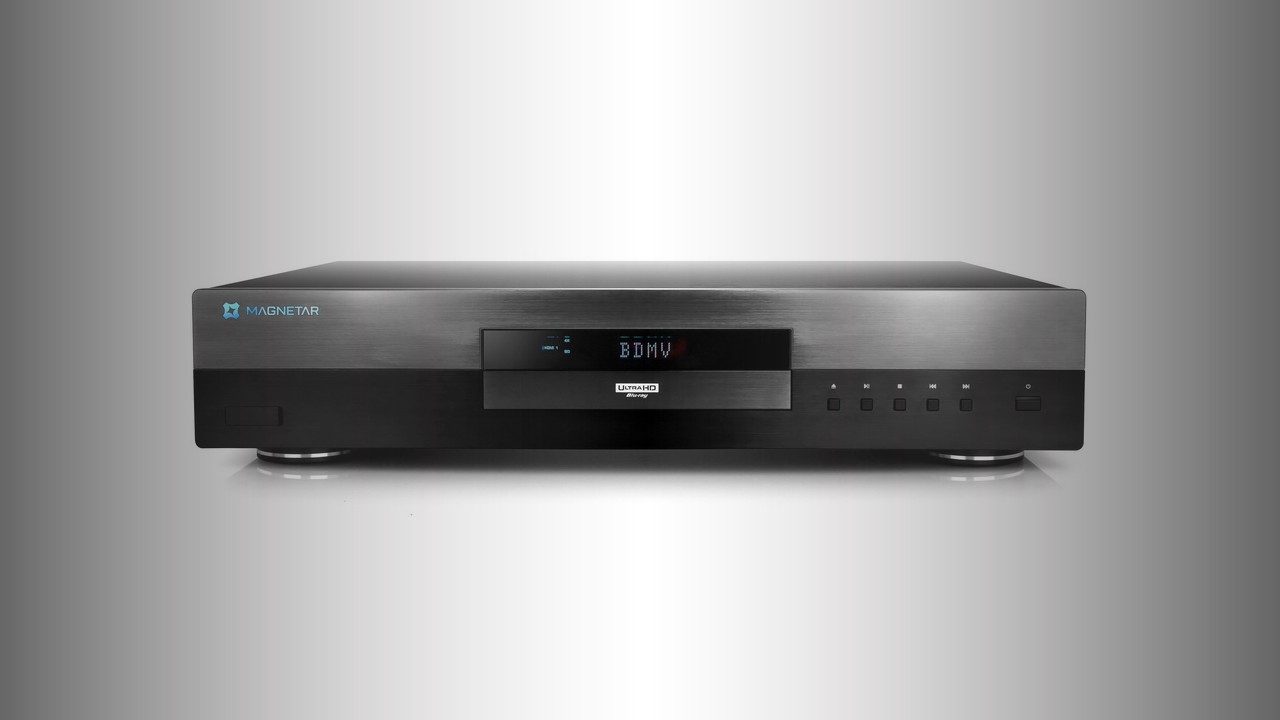
9. Magnetar UDP800: Classic 4K UHD Blu-ray Player
Magnetar UDP800 4K UHD Blu-ray player for disc playback, HDR video and high-resolution audio files.
The Magnetar UDP800 is a full-size 4K UHD Blu-ray player for disc-based and file-based movie playback.
The source describes a MediaTek MT8581 quad-core processor, support for 4K Ultra HD, HDR10, HDR10+, Dolby Vision, BT., BT.709 and BT.601 color profiles, plus HDR-to-SDR conversion.
It plays DVDs, Blu-rays, 4K UHD discs and media files, supports H.265 and H.264 formats, and can upscale video to 4K resolution at up to 50/60 fps. Audio support includes DSD64/128, multichannel DSD64 and 192 kHz/24-bit PCM files.
Best for: Physical-media movie collections
- 4K UHD disc playback
- Dolby Vision, HDR10 and HDR10+ support
- 4K upscaling up to 50/60 fps
- DSD and 192 kHz/24-bit PCM audio file support
Verdict: The Magnetar UDP800 is the dedicated source component to consider when discs and broad HDR format support remain central to your cinema setup.
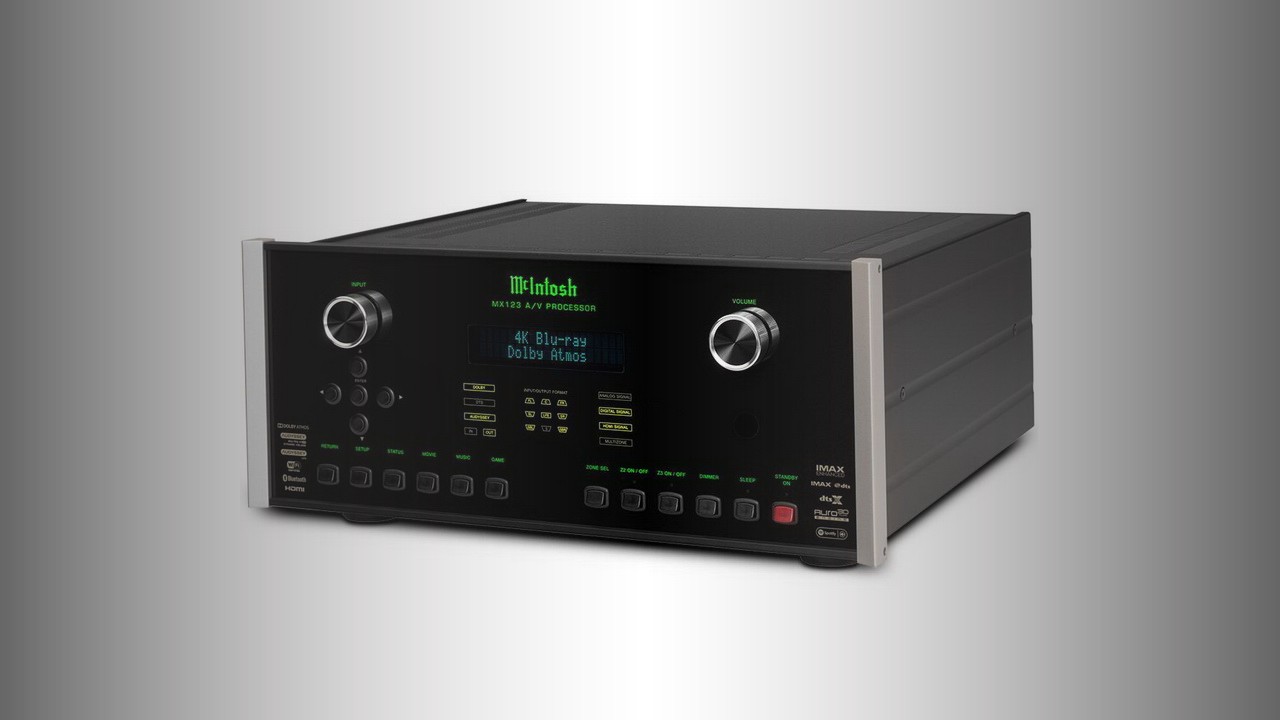
10. McIntosh MX123: AV processor perfect for home theater enthusiasts
McIntosh MX123 AV processor with extensive HDMI connectivity and 13.2-channel output capability.
The McIntosh MX123 is an AV processor for high-end home theaters using separate amplification.
It supports Dolby Atmos, DTS:X and Auro-3D, provides 13.2 discrete audio channels through balanced and unbalanced outputs, and includes additional unbalanced outputs for connection flexibility.
On the video side, the source lists seven HDMI inputs and three HDMI outputs, 18 Gbps bandwidth, HDCP 2.3, Dolby Vision, HDR10, HLG, 4K Ultra HD at 50/60 Hz, 4:4:4 color spacing, pass-through 3D video, eARC on one HDMI output, and 4K Ultra HD upscaling.
Best for: High-end processor-based home theaters
- 13.2 discrete audio channels
- Balanced and unbalanced outputs
- Dolby Atmos, DTS:X and Auro-3D support
- Seven HDMI inputs and three outputs
Verdict: The McIntosh MX123 is a wide-ranging processor for complex cinema systems that need extensive surround-format support and flexible analog output options.
Quick comparison
These products do not all solve the same problem.
Some are AV processors that require separate power amplifiers, some are receivers with built-in amplification, one is a source player, and one is a speaker-layout guide.
The clearest way to compare them is by role in the system rather than by ranking them as direct substitutes.
| Product | Best for | Verdict |
|---|---|---|
| Anthem AVM 90 | Large separates-based home theaters | A flagship AV processor with up to 15.4-channel support, ARC Genesis correction and balanced outputs. |
| Marantz NR1711 | Compact living-room cinema systems | A slim AV receiver with 5.1.2 immersive audio support and Audyssey MultEQ calibration. |
| Denon AVR-X3600H | Flexible surround systems with many sources | A receiver with broad HDMI connectivity, Dolby Atmos and DTS:X support, and Audyssey MultEQ XT32. |
| McIntosh MX200 | Installed cinema rooms using separate amplifiers | An 11.2-channel processor with Dirac Live, balanced outputs and control-system compatibility. |
| Arcam AVR11 | Performance-focused systems that may expand with external amps | A Class AB AV receiver with Dirac Live and expansion potential for larger immersive layouts. |
| Denon AVC-S660H | Starter home cinema systems with streaming needs | An entry-level Denon AV amplifier with five discrete channels, 8K/60 Hz support and strong network playback. |
| Pioneer SC-LX704 | Immersive setups with height speakers | A powerful receiver prepared for Dolby Atmos, DTS:X and IMAX Enhanced Surround with four ceiling-channel support. |
| How many speakers should a home theater system have? | Planning speaker count and layout | A practical explainer for understanding channel numbers, subwoofers and height speakers before buying hardware. |
| Magnetar UDP800 | Physical-media movie collections | A dedicated 4K UHD Blu-ray player with Dolby Vision, HDR10+, disc playback and high-resolution audio file support. |
| McIntosh MX123 | High-end processor-based home theaters | A 13.2-channel AV processor with extensive surround-format support, balanced and unbalanced outputs, and multiple HDMI connections. |
Frequently asked questions
Should I choose an AV receiver or an AV processor?
Choose an AV receiver if you want built-in amplification in one chassis, as with the Marantz, Denon, Arcam and Pioneer models here.
Choose an AV processor such as the Anthem AVM 90, McIntosh MX200 or McIntosh MX123 when you are building a separates system with external power amplifiers and want more flexible output and installation options.
How many speakers do I need for Dolby Atmos at home?
A basic immersive layout needs conventional surround speakers plus height information.
In the source material, examples include 5.1.2 on the Marantz NR1711 and Arcam AVR11, while larger processor-based or expanded systems can move toward layouts such as 7.2.4.
The speaker-layout guide explains that the first number is full-range speakers, the second is subwoofers, and the third is height or overhead channels.
How important is room correction in a home cinema system?
Room correction is useful because speaker placement and room acoustics strongly affect surround balance.
The products here use different systems, including ARC Genesis on the Anthem AVM 90, Audyssey variants on the Marantz and Denon receivers, and Dirac Live on the McIntosh MX200 and Arcam AVR11.
Do I still need a Blu-ray player if my receiver or processor has streaming features?
Streaming and disc playback serve different roles.
Several receivers and processors here include network, AirPlay, Chromecast or service support, but the Magnetar UDP800 is a dedicated 4K UHD Blu-ray player for DVDs, Blu-rays, 4K UHD discs, media files and HDR formats including Dolby Vision and HDR10+.
How to choose the right home cinema component
Start by deciding what role the next purchase must play.
If you need the central switching and decoding hub for a system with external amplification, focus on processors such as the Anthem AVM 90, McIntosh MX200 or McIntosh MX123.
The Anthem offers the highest stated channel ceiling in this selection at up to 15.4 channels, while the McIntosh MX200 emphasizes 7.2.4 layouts, Dirac Live, balanced outputs and installation-system compatibility. The McIntosh MX123 is also a high-channel processor, with 13.2 discrete channels and broad surround-format support including Auro-3D. If you want a more self-contained system, an AV receiver is the more direct path. The Marantz NR1711 is the space-saving option thanks to its low-profile case and 5.1.2 immersive support. The Denon AVR-X3600H is the stronger fit when you need many HDMI inputs and Audyssey MultEQ XT32. The Arcam AVR11 is attractive if Dirac Live and Class AB amplification are priorities, especially if you may later add power amplification for a larger layout. The Denon AVC-S660H is the simpler entry point, with five powered channels, 8K/60 Hz support and broad streaming and file playback. The Pioneer SC-LX704 is the option to study if your plan includes height speakers and the listed immersive formats. Do not buy channel count in isolation. Match the component to your actual speaker layout, the number of HDMI sources you own, the HDR formats your display supports, the room-correction system you prefer, and whether you need network streaming or physical disc playback. If speaker-number notation is still unclear, the included speaker-layout guide is the right first stop. If discs remain important, the Magnetar UDP800 fills a different but essential role as a 4K UHD Blu-ray source rather than a receiver or processor.



Sound Off
0Join the discussion if you have something to add.