Edifier M90 Wireless Speakers: One System for Desk, TV and Everyday Listening
The Edifier M90 is an active two-way wireless speaker system designed to move comfortably between desktop audio, TV sound, streaming, gaming and everyday listening, with Bluetooth 6.0, HDMI eARC, USB-C, optical and line-in connectivity.
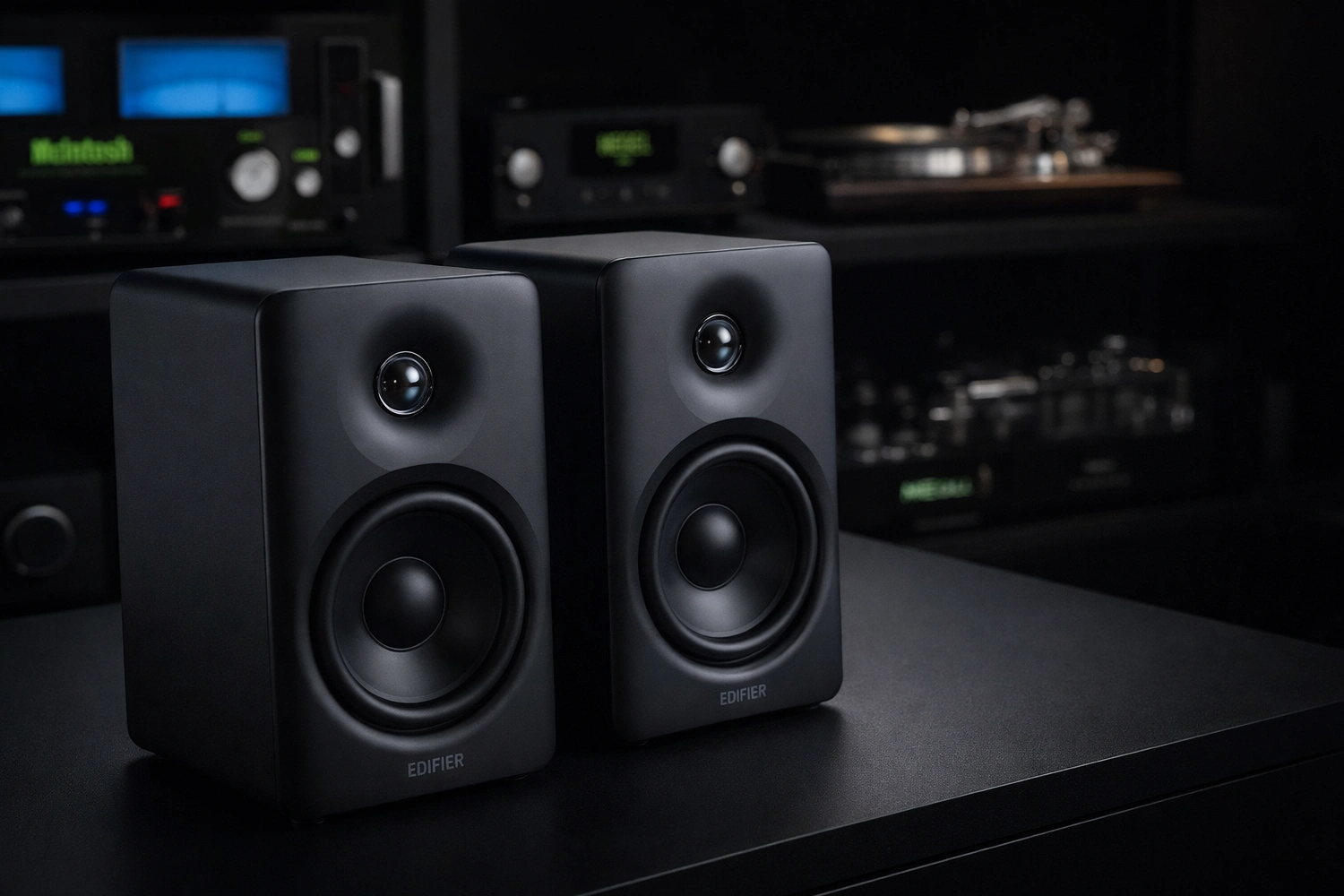
The Edifier M90 arrives with a practical premise: one compact active speaker system that can serve a desk, a TV, streaming devices and game consoles without requiring a separate amplifier or a stack of boxes. Available in black or white, the M90 is not positioned around a single use case. Instead, its appeal lies in how many modern audio habits it is designed to accommodate. It combines wireless playback, wired digital inputs, HDMI eARC, app control, DSP processing and a conventional two-way speaker layout in a master/slave active configuration. For listeners trying to simplify a room without reducing it to a basic Bluetooth speaker, that combination is the main story.
A speaker system built around real-world switching
Many contemporary listening spaces are no longer dedicated hi-fi rooms. A pair of speakers may need to sit beside a monitor during the day, handle music from a phone in the evening, and connect to a TV or console when required. The Edifier M90 is designed around that kind of mixed-use environment. Its input list includes line-in, optical, USB-C and HDMI eARC, alongside Bluetooth 6.0 wireless connectivity. That range matters because it reduces the pressure to choose between convenience and compatibility.
paragraphs_placeholder_fix

HDMI eARC makes the M90 more TV-friendly
The inclusion of HDMI eARC is one of the M90’s most important design choices. Active stereo speakers often offer optical input, which remains useful, but HDMI eARC can make a system much easier to integrate with a television. When used with compatible TVs, it is intended to support a cleaner one-cable link and more convenient control behavior than older audio outputs typically provide.
For anyone who wants better TV sound without moving to a full surround package or a conventional AV receiver, that can be a meaningful advantage. The M90’s form factor and active architecture make it a simpler proposition: connect the source, control the volume, and keep the system compact. The product is not presented as a home-cinema replacement for multi-speaker surround systems, but HDMI eARC gives it a credible role in smaller living rooms, bedrooms, gaming setups and media desks where stereo sound and ease of use are the priorities.

Bluetooth 6.0, LDAC and multipoint for wireless convenience
Wireless playback is handled by Bluetooth 6.0, with LDAC and multipoint support. LDAC support is notable because it gives compatible source devices a higher-quality Bluetooth option than basic codec support alone. As always with Bluetooth, the final result depends on the source device, codec availability and the material being played, but the presence of LDAC shows that wireless operation has not been treated as a mere afterthought.
Multipoint support adds a different kind of usefulness. In everyday terms, it can make the speakers easier to share between a phone, tablet, computer or other Bluetooth source, reducing the friction of switching devices. That is especially relevant for a system intended to live between work and leisure. A user might stream music from a phone, take audio from a laptop, and then move to another device without treating the speaker system as a single-purpose component.

Active two-way architecture with dedicated amplification
The M90 is a two-way active loudspeaker system using a master/slave arrangement. The master speaker houses the amplification and connection electronics, while the second speaker is linked to it by cable. This is a common and sensible layout for powered stereo speakers because it keeps the user’s system simple: no separate amplifier is required, and the electronics are matched to the drivers by design.
Each driver has its own amplifier. The driver complement includes a 25 mm silk-dome tweeter and a midrange/woofer of approximately ten centimeters. A dedicated amplifier channel for each driver allows the system’s electronics and DSP to manage the tweeter and midrange/woofer separately. Without making any listening claims, this approach can be attractive because it gives the manufacturer more control over crossover behavior, driver integration and system protection than a purely passive speaker connected to an arbitrary amplifier.

DSP as a central design tool
Digital signal processing plays a central role in the M90. Edifier describes the DSP as optimizing performance for different kinds of content, including music, video and games. In a multi-use speaker, this matters because the demands of those sources are not identical. Dialogue clarity, game effects, background music, streaming audio and nearfield desktop listening can all place different pressures on a compact system.
The M90 supports up to 24-bit/96 kHz resolution depending on the source. That figure should be understood in context: high-resolution support is most useful when the source material and connection also provide an appropriate signal. Still, it is a worthwhile inclusion for listeners using USB-C or other compatible digital sources, because it indicates that the speaker’s digital path is designed for more than basic compressed playback.

Controls that suit both desk and couch use
Usability is another area where the M90’s feature set is deliberately broad. Built-in controls allow quick local adjustments when the speakers are within arm’s reach, which is useful on a desk or sideboard. A multi-directional remote extends that control to a sofa or bed, making the M90 more practical when used with a TV or console.
The Edifier ConneX mobile app, available for iOS and Android, adds another control layer. App support can be especially valuable during setup or when switching between modes and sources. The main benefit is not novelty; it is reducing the number of times the owner has to reach behind the speaker, cycle blindly through inputs, or rely only on a small physical control. For a speaker intended to handle several source types, that kind of day-to-day convenience is a core part of the design.

A compact alternative to separate boxes
The M90’s appeal is partly about consolidation. Traditional hi-fi systems separate the source, amplifier and speakers. That approach can be rewarding, but it also requires space, matching decisions and cabling. The M90 integrates amplification, digital inputs, wireless reception and control functions into a stereo speaker pair. For many rooms, that is a more realistic solution.
This does not mean the M90 is aimed at replacing every dedicated component system. Rather, it sits in the increasingly important middle ground between simple lifestyle speakers and more elaborate hi-fi or home-theater setups. It gives a prospective owner stereo separation, multiple wired inputs, modern wireless support and TV connectivity without asking for a rack of components. That position is distinctive because it addresses how many people actually use audio today: across several devices, often in shared spaces, and with limited tolerance for complicated operation.
Conclusion
The Edifier M90 is best suited to listeners who want a flexible active stereo speaker system for mixed daily use rather than a narrowly focused hi-fi component. Its strongest documented qualities are its broad connectivity, including HDMI eARC, USB-C, optical, line-in and Bluetooth 6.0; its LDAC and multipoint wireless support; its active two-way master/slave architecture with dedicated amplification; and its combination of physical, remote and app-based control. It should be most attractive for desktop users, TV viewers, gamers and streaming listeners who want one tidy speaker pair to cover several roles without adding a separate amplifier or building multiple audio systems.