

Choosing a DAC is less about chasing the longest format list and more about matching the converter to the way you actually listen.
A compact desktop DAC/amp, a full-size preamplifier DAC, a purist R2R design, and a television-friendly digital hub can all sit under the same category, yet they solve very different problems.

1. Audiolab M-DAC+
Audiolab M-DAC+ digital-to-analog converter with selectable filters and high-resolution USB support.
The Audiolab M-DAC+ is presented as a substantial evolution of the original M-DAC, keeping the ES9018 Sabre 32-bit DAC chipset while adding supporting circuitry aimed at signal integrity.
Its discrete clock generator is intended to minimize jitter, and the Class A JFET output stage is designed to preserve signal quality after conversion.
It also gives listeners meaningful control through seven selectable digital filters, making it a good fit for systems where source material, speakers, and personal taste may call for adjustment.
Best for: Listeners who want a configurable full-size DAC for high-resolution digital sources
- ES9018 Sabre 32-bit DAC chipset
- USB input supports up to 32-bit/384 kHz
- DSD64, DSD128 and DSD256 compatibility
- Seven user-selectable digital filters
Verdict: The M-DAC+ stands out as a flexible hi-fi DAC with serious attention paid to clocking, filtering, and output-stage design.

2. McIntosh MDA200
McIntosh MDA200 DAC with black glass front panel, rotary controls, and multiple digital input options.
The McIntosh MDA200 is built around the company’s DA2 digital audio module, a platform associated in the source with higher-end McIntosh components.
Its appeal is breadth: seven digital inputs include coaxial, optical, USB, MCT for compatible McIntosh SACD/CD transports, and HDMI ARC for audio from a television.
Balanced and unbalanced outputs, Roon Tested certification, and support for native DSD up to DSD512 over USB make it a strong candidate for a system that needs to bring multiple digital sources together without abandoning traditional hi-fi connectivity.
Best for: McIntosh-based or multi-source systems that need a full-featured digital hub
- Seven digital audio inputs
- HDMI ARC for TV audio
- Balanced and unbalanced analog outputs
- Roon Tested certification
Verdict: The MDA200 is the most connectivity-focused choice here, especially for users who want McIntosh styling, TV audio integration, and broad digital input support.

3. Denafrips Ares 12TH-1
Denafrips Ares 12TH-1 balanced NOS R2R DAC in an anodized aluminum enclosure.
The Denafrips Ares 12TH-1 takes a deliberately different route from chip-based DACs by using a balanced NOS R2R architecture.
The conversion stage is described as using 480 selected precision resistors with an Altera FPGA, while the power section includes a 60-watt O-core transformer, LDO regulation, and high-performance capacitors.
Connectivity is practical as well, with USB-B, I2S over HDMI, coaxial, optical, RCA, and balanced XLR, making this a compact but serious option for listeners drawn to ladder-DAC design.
Best for: Listeners who specifically want an R2R DAC with balanced outputs in a compact chassis
- Balanced NOS R2R design
- USB-B, I2S over HDMI, coaxial and optical inputs
- RCA and balanced XLR outputs
- NOS and oversampling modes
Verdict: The Ares 12TH-1 is the purist ladder-DAC pick, combining R2R conversion with useful modern digital inputs.
4. FiiO K17 R2R
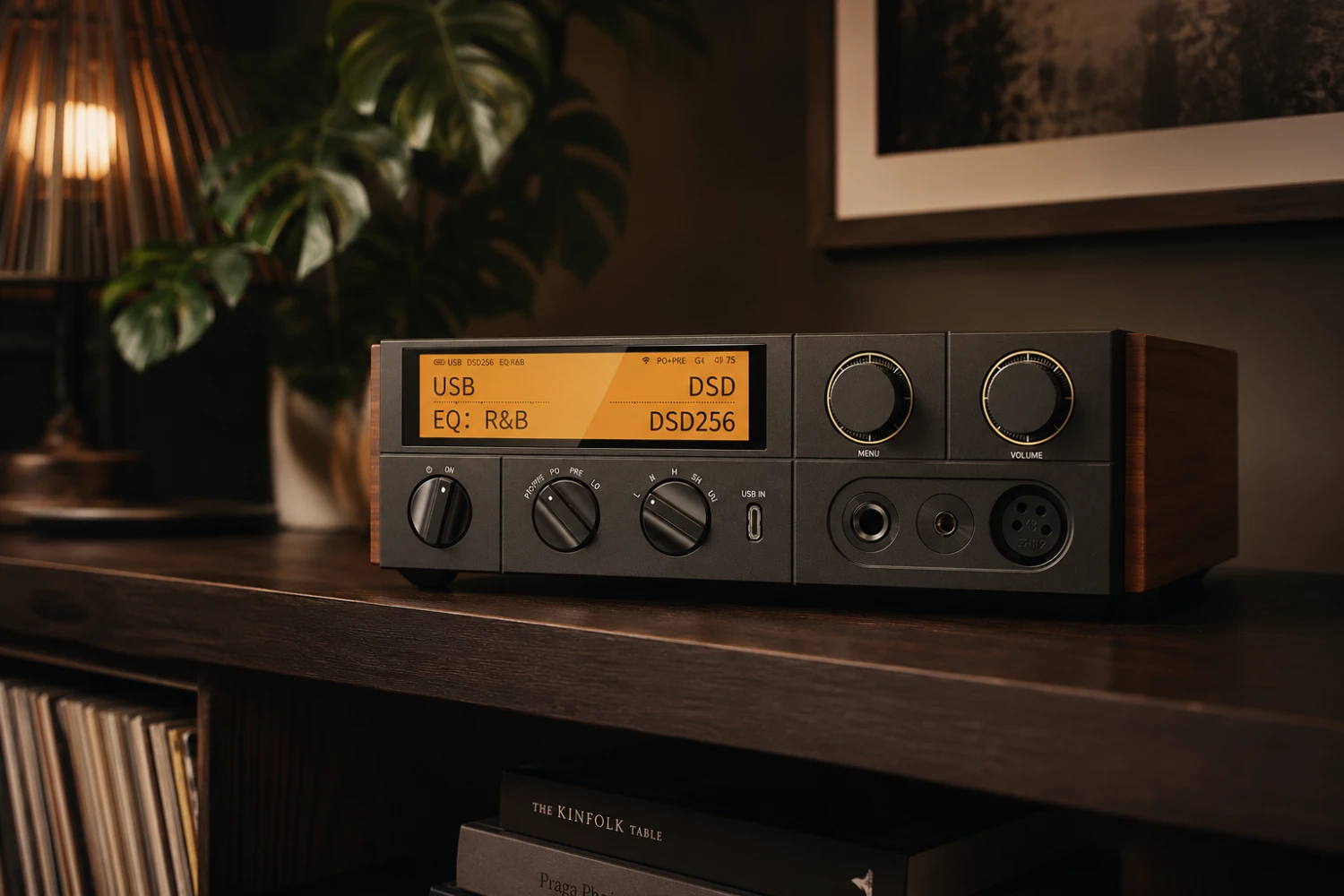
FiiO K17 R2R desktop DAC, streamer and headphone amplifier with wood-accented side panels.
The FiiO K17 R2R is less a simple DAC than a desktop audio center.
It combines a DAC, network streamer, and headphone amplifier, with FiiO’s segmented R2R PRO resistor matrix forming the heart of the digital-to-analog stage.
The source also highlights a fully discrete class AB headphone amplifier and a chassis that pairs aluminum with real wood side panels, giving it a more domestic appearance than many desktop components. For a desk or small system, its strength is integration.
Best for: Desktop listeners who want R2R-style conversion, streaming, and headphone drive in one component
- DAC, network streamer and headphone amplifier in one unit
- FiiO segmented R2R PRO conversion stage
- Fully discrete class AB headphone amplification
- Aluminum chassis with real wood side panels
Verdict: The K17 R2R is the integrated desktop hub here, aimed at users who do not want separate DAC, streamer, and headphone amp boxes.

5. Topping D900
Topping D900 DAC and preamplifier with display, multiple digital inputs and system-control features.
The Topping D900 is positioned as a flagship DAC and preamplifier built around Topping’s fully discrete PSRM architecture.
The supplied material emphasizes extremely low stated distortion, a 131 dB signal-to-noise ratio, and a separate preamplifier stage that can connect directly to active speakers.
Its feature set is unusually broad, including USB-B, USB-C, I2S-LVDS over HDMI, AES/EBU, coaxial, optical, Bluetooth 5.1 with LDAC support, trigger input and output, and a configurable 10-band PEQ with user profiles.
Best for: Systems with active speakers or users who want DAC, preamp, EQ, and broad input support in one box
- Fully discrete PSRM architecture
- Separate preamplifier stage for active speakers
- Wide digital input selection including USB-B, USB-C and AES/EBU
- 10-band PEQ with user profiles
Verdict: The D900 is the most system-control-oriented option, combining conversion, preamplifier functions, input flexibility, and onboard EQ.

6. Musical Fidelity MX-DAC
Musical Fidelity MX-DAC with understated front panel and LED indicators for input and playback status.
The Musical Fidelity MX-DAC is described as a relatively restrained design by feature count, but not a bare-bones one.
It offers five digital inputs, including two coaxial, two optical, and USB-B, and it was Musical Fidelity’s first USB DAC to support DSD, up to DSD128.
There is no volume control, so it belongs in a system with a separate preamp or integrated amplifier, but the inclusion of RCA and XLR outputs, filter switching, and clear LED status indication makes it easy to place and use.
Best for: Traditional hi-fi systems that already have volume control and need a straightforward DAC
- Five digital inputs
- USB DSD support up to DSD128
- RCA and XLR outputs
- Simple LED status display
Verdict: The MX-DAC is a clean, practical choice for listeners who value input choice and balanced output over built-in preamp functions.
7. Luxsin X8
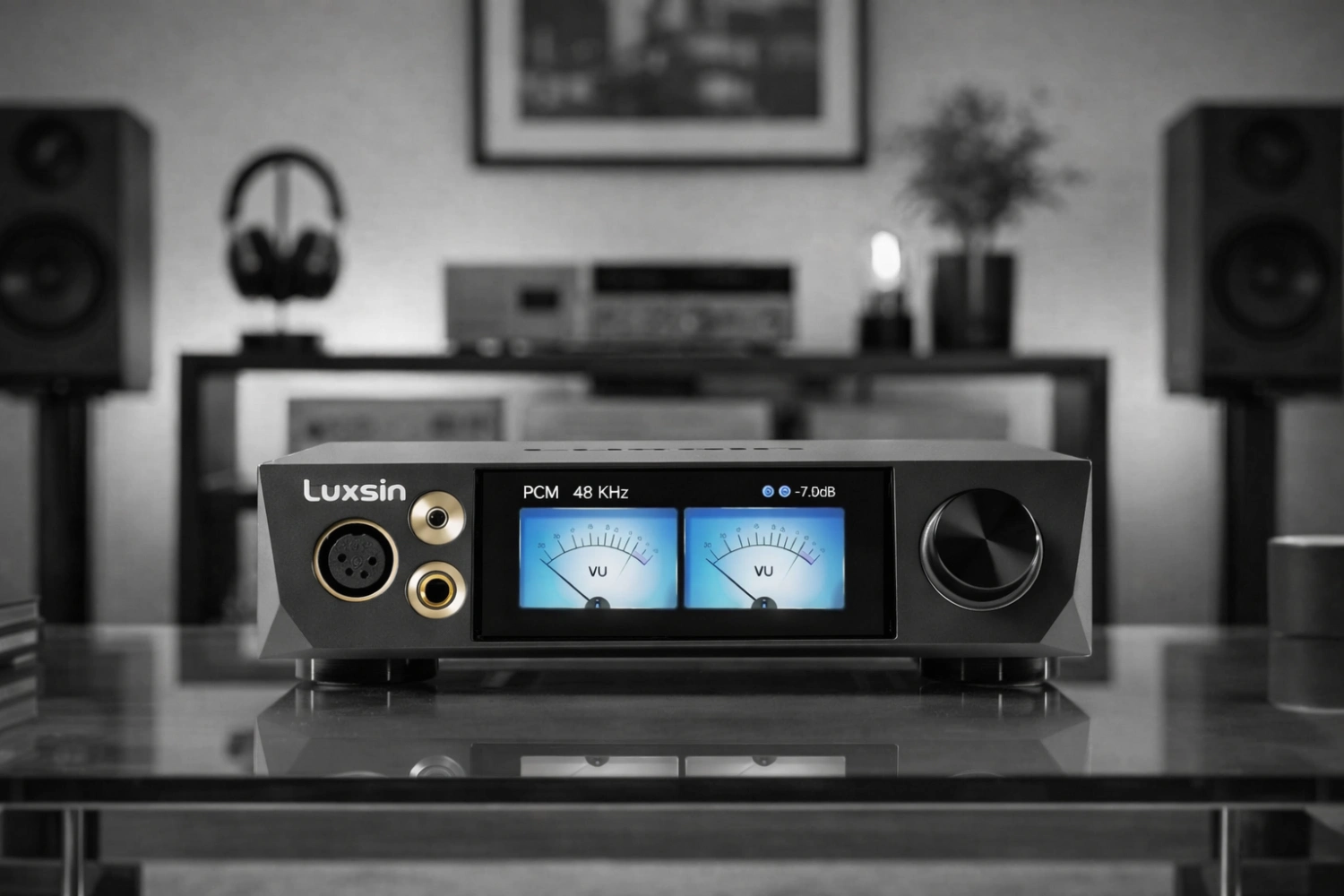
Luxsin X8 desktop DAC/amp with eight-DAC architecture and separated internal power design.
The Luxsin X8 is a desktop DAC/amp built around an eight-DAC layout using Cirrus Logic CS43198 chips in a dual-mono parallel architecture.
The source describes four DACs per channel working together, with separated left and right channels, independent power delivery, buffering, clock distribution, and shielding for each DAC.
It also notes nearly 5 watts per channel of output power and a fully separated linear power supply, making the X8 one of the more ambitious headphone-oriented entries in this selection.
Best for: Desktop headphone users who want a powerful DAC/amp with a multi-DAC architecture
- Eight Cirrus Logic CS43198 DAC chips
- Dual-mono parallel architecture
- Nearly 5 watts per channel of output power
- Fully separated linear power supply
Verdict: The X8 is the power-focused desktop DAC/amp, notable for its eight-DAC layout and strong headphone-output emphasis.

8. Shanling H2
Shanling H2 portable DAC and amplifier positioned as a more affordable model in Shanling’s portable range.
The Shanling H2 is presented as a more affordable portable DAC and amplifier below Shanling’s H5 and H7 models.
The source makes clear that it has reduced functionality, simplified internals, and less power than its higher-positioned siblings, so it should be considered by buyers who want a lower-cost entry into Shanling’s portable DAC/amp line rather than the maximum feature set.
It is the least fully documented product in the supplied material, but its role is clear: a compact, value-oriented portable option.
Best for: Portable listeners who want a lower-cost Shanling DAC/amp and can accept fewer features
- Portable DAC and amplifier format
- More affordable than Shanling’s higher models
- Part of Shanling’s expanding portable audio line
Verdict: The H2 is the budget-conscious portable pick, best approached as a simplified alternative to Shanling’s more capable H5 and H7 models.

9. Esoteric D-02X
Esoteric D-02X digital-to-analog converter with dual-mono internal design and extensive power-supply architecture.
The Esoteric D-02X is described as a complete redesign of the earlier D-02, with technology derived from Esoteric’s higher-end Grandioso D1 condensed into a single dual-mono chassis.
The source highlights independent power supplies with four toroidal transformers, 16 DAC chips per channel operating in differential mode, ES-LINK4 input, 36-bit D/A conversion, HCLD linear buffer amplification, and support for DSD up to 11.2 MHz.
This is the statement-level DAC in the group, focused on elaborate internal architecture rather than compactness or all-in-one convenience.
Best for: High-end systems where an elaborate dedicated DAC is preferred over an all-in-one device
- Single-chassis dual-mono design
- Independent power supplies with four toroidal transformers
- 16 DAC chips per channel in differential mode
- DSD support up to 11.2 MHz
Verdict: The D-02X is the luxury dedicated converter here, built around extensive power-supply separation and a heavily specified dual-mono architecture.

10. Questyle Sigma Pro
Questyle Sigma Pro transportable DAC and headphone amplifier with dual-mono conversion and Current Mode amplification.
The Questyle Sigma Pro is a transportable DAC and headphone amplifier aimed at listeners who want more than a tiny USB dongle can usually provide.
Its dual-mono DAC layout uses two ESS ES9069 chips, paired with Questyle’s analog circuitry and four fully discrete Current Mode amplification stages.
Multiple hardware gain levels, an XMOS XU316 digital controller, high-resolution PCM and DSD support, full MQA decoding including MQA-CD, and a dedicated Studio Monitoring mode give it a broader remit than casual mobile listening.
Best for: Portable or transportable headphone users who need more control and drive than a small dongle
- Dual-mono DAC layout with two ESS ES9069 chips
- Four fully discrete Current Mode amplification stages
- Multiple hardware gain levels
- Studio Monitoring mode
Verdict: The Sigma Pro is the transportable power option, suited to users who want a serious DAC/headphone amp for mobile, stationary, or monitoring use.
Quick comparison
The clearest way to separate these DACs is by role.
Some are traditional hi-fi converters, some add preamplifier duties, some are headphone-first devices, and a few are designed as broader hubs for streaming, television audio, or active-speaker systems.
| Product | Best for | Verdict |
|---|---|---|
| Audiolab M-DAC+ | Configurable hi-fi DAC use | A full-size DAC with high-resolution USB support, DSD compatibility, and seven selectable filters. |
| McIntosh MDA200 | Multi-source McIntosh-style systems | A digital hub with seven inputs, HDMI ARC, MCT support, balanced outputs, and Roon Tested status. |
| Denafrips Ares 12TH-1 | Balanced R2R conversion | A compact NOS R2R DAC with USB, I2S, coaxial, optical, RCA, and XLR connectivity. |
| FiiO K17 R2R | Desktop all-in-one listening | A DAC, streamer, and headphone amplifier centered on FiiO’s R2R PRO conversion stage. |
| Topping D900 | Active-speaker and EQ-based systems | A DAC and preamplifier with wide input support, Bluetooth, PEQ, triggers, and per-input level control. |
| Musical Fidelity MX-DAC | Straightforward hi-fi integration | A DAC with five digital inputs, DSD128 over USB, balanced outputs, and no onboard volume control. |
| Luxsin X8 | Powerful desktop headphone use | A DAC/amp with an eight-DAC dual-mono architecture, strong output-power emphasis, and separated power design. |
| Shanling H2 | Affordable portable DAC/amp use | A simplified and less powerful portable alternative to Shanling’s higher H5 and H7 models. |
| Esoteric D-02X | Statement dedicated DAC systems | A high-end dual-mono converter with extensive power-supply separation and support for DSD up to 11.2 MHz. |
| Questyle Sigma Pro | Transportable headphone and monitoring setups | A serious portable DAC/amp with dual-mono conversion, Current Mode amplification, hardware gain, and Studio Monitoring mode. |
Frequently asked questions
Should I choose a pure DAC or a DAC with preamp and headphone functions?
Choose a pure DAC if your amplifier or preamplifier already handles volume control and source switching.
Consider a DAC/preamp such as the Topping D900 if you want to connect directly to active speakers, or a DAC/amp such as the FiiO K17 R2R, Luxsin X8, Shanling H2, or Questyle Sigma Pro if headphone listening is central to the system.
Do balanced XLR outputs matter?
Balanced outputs are useful when the rest of your system supports them, especially for longer cable runs or balanced-input amplifiers.
In this group, models such as the McIntosh MDA200, Denafrips Ares 12TH-1, Musical Fidelity MX-DAC, and others offer balanced connectivity, but the final choice should match the inputs on your amplifier or active speakers.
How important are high-resolution formats like DSD?
Format support matters most if you own or stream music in those formats.
The Audiolab M-DAC+ supports DSD64, DSD128, and DSD256; the McIntosh MDA200 supports native DSD up to DSD512 over USB; the Denafrips Ares 12TH-1 lists very high USB PCM and DSD support; and the Esoteric D-02X supports DSD up to 11.2 MHz.
If your library is mostly standard PCM, connectivity and system matching may be more important.
What is the practical difference between chip-based and R2R DACs?
The supplied products show two broad approaches.
Chip-based designs, such as those using ESS, AKM, or Cirrus Logic devices, can offer compact implementation and extensive format support.
R2R designs, such as the Denafrips Ares 12TH-1 and FiiO K17 R2R, use resistor-ladder-style conversion and may appeal to listeners specifically seeking that architecture. The right choice should be based on system needs, inputs, outputs, and whether you want a traditional DAC, a desktop hub, or a headphone amplifier as well.
How to choose the right DAC from this list
Start with the job the DAC must perform.
If you simply need a capable converter between digital sources and an existing amplifier, the Audiolab M-DAC+ and Musical Fidelity MX-DAC are the most straightforward traditional choices, with the Audiolab offering more user-adjustable filtering and the Musical Fidelity keeping the role clean and system-friendly.
If your system has many sources, the McIntosh MDA200 is the stronger hub, particularly when HDMI ARC, Roon Tested status, MCT compatibility, and multiple conventional digital inputs matter.