
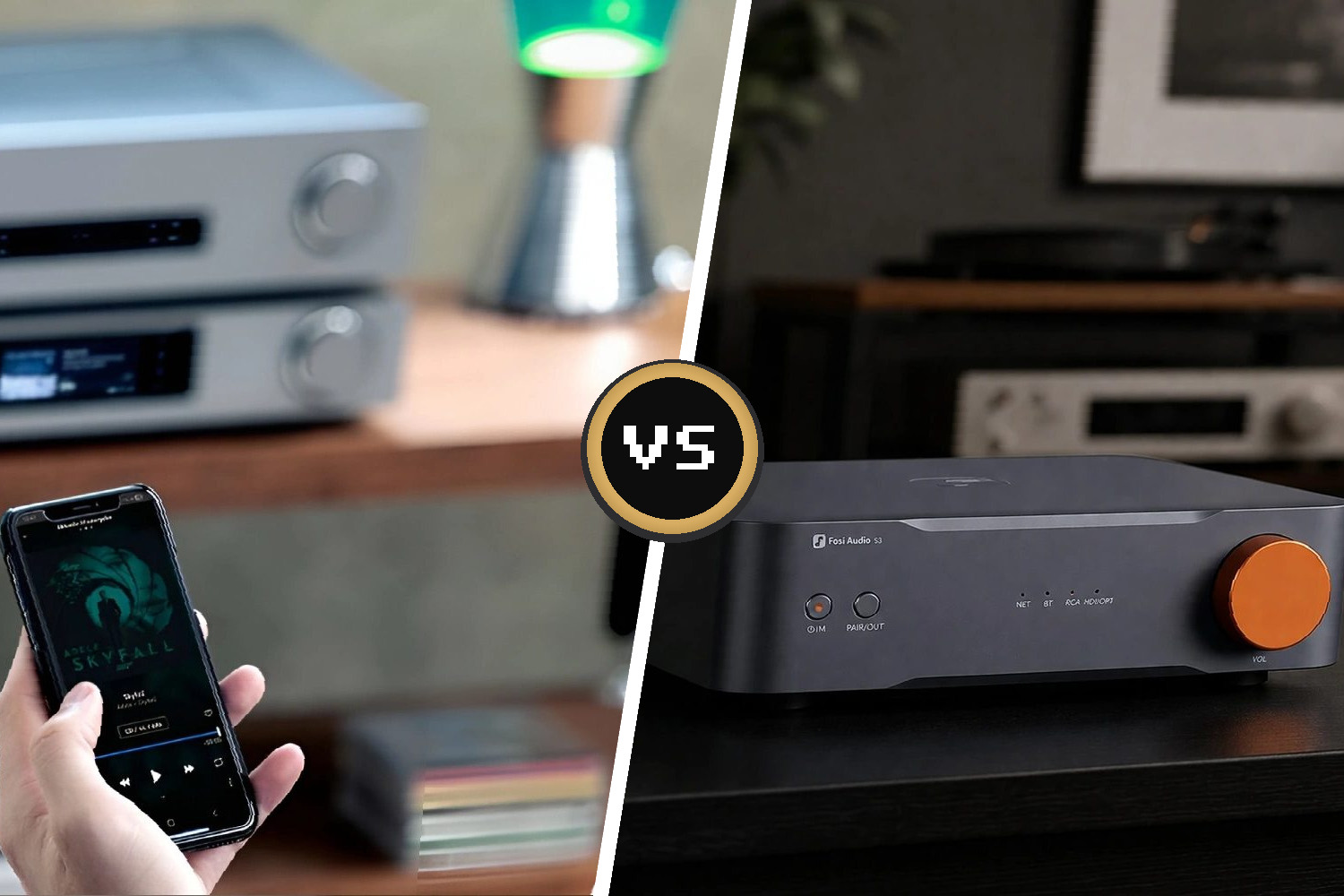
This is not a conventional contest between two equivalent pieces of hardware. Cambridge Audio’s proposition is a free firmware update for eligible StreamMagic network players, AV receivers and streaming preamplifiers, while the Fosi Audio S3 is a new compact component combining a streamer, DAC and preamplifier. The useful question is therefore not simply which is better, but whether an existing Cambridge system should be refreshed through software or replaced—or complemented—by a modern all-in-one hub.
Cambridge’s update focuses on longevity. It brings Qobuz Connect and other expanded streaming functionality to devices using second- and third-generation StreamMagic software, provided their hardware supports the relevant features. Newer fourth-generation StreamMagic products already include them. Eligible internet-connected components detect the update automatically, after which the owner confirms installation and download.
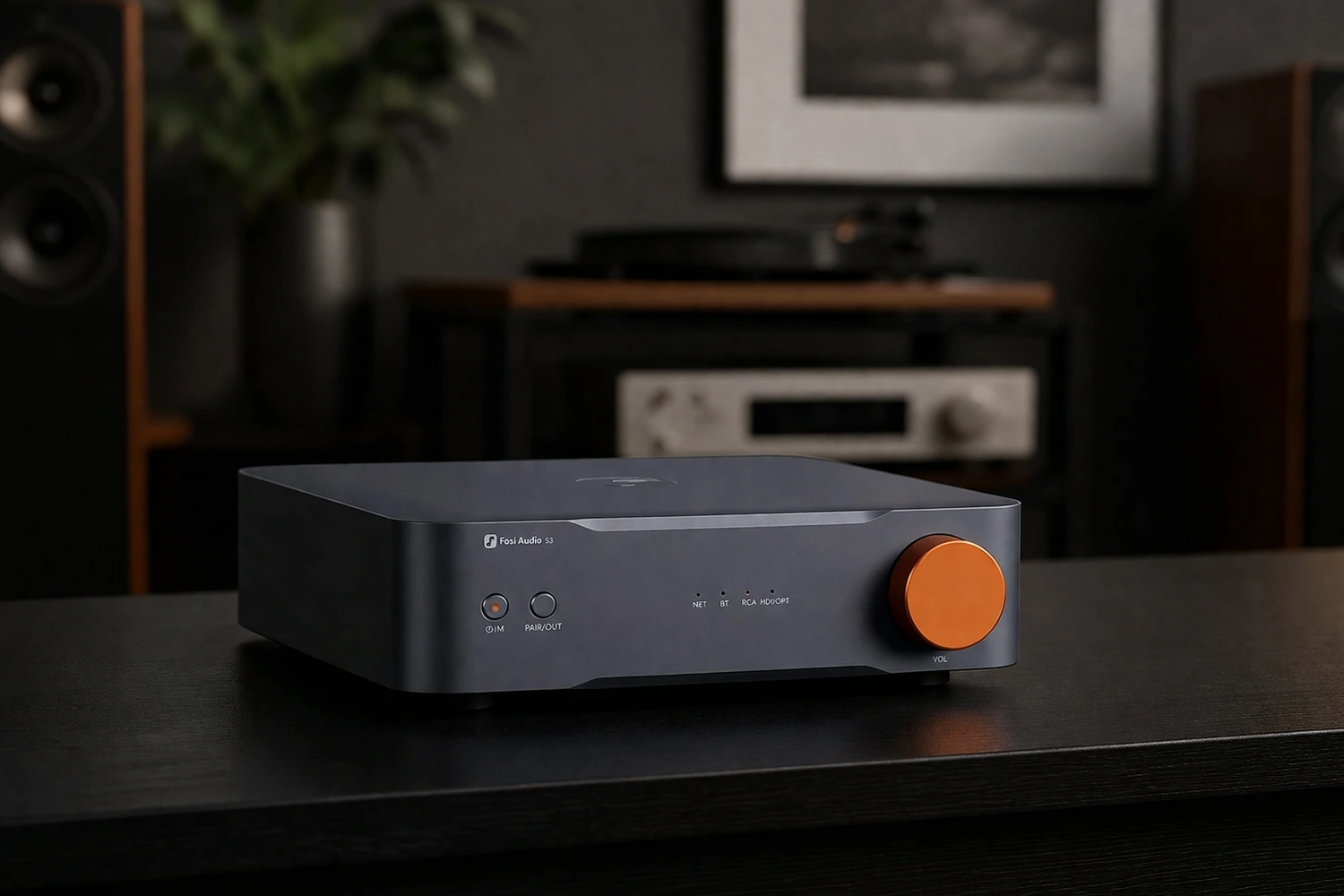
The Fosi S3 takes a hardware-led approach. Its compact chassis contains an AKM4493SEQ DAC, a fully balanced analog stage, network streaming, volume control, HDMI eARC and a subwoofer output. It can feed a power amplifier or active speakers directly, allowing it to become the control center of a small music, desktop or television system. Which route makes sense depends heavily on what equipment is already in place and which connections the system needs.
Cambridge Audio StreamMagic Firmware Update: Extending the Life of Existing Hardware
Cambridge Audio’s side of this comparison is a platform upgrade rather than a single network player. It applies across eligible network players, AV receivers and streaming preamplifiers equipped with second- or third-generation StreamMagic software. Consequently, there is no universal chassis, DAC, output stage or connection panel to assess: those details remain specific to the Cambridge component being updated.
The headline addition is Qobuz Connect. Once updated, compatible Cambridge hardware can be selected directly from within the Qobuz app on a phone or tablet. Playback is then handed to the network player without requiring the StreamMagic app to be installed for that particular task. For listeners already committed to Qobuz, this is a meaningful usability improvement because service selection, browsing and playback can remain inside the familiar Qobuz interface.
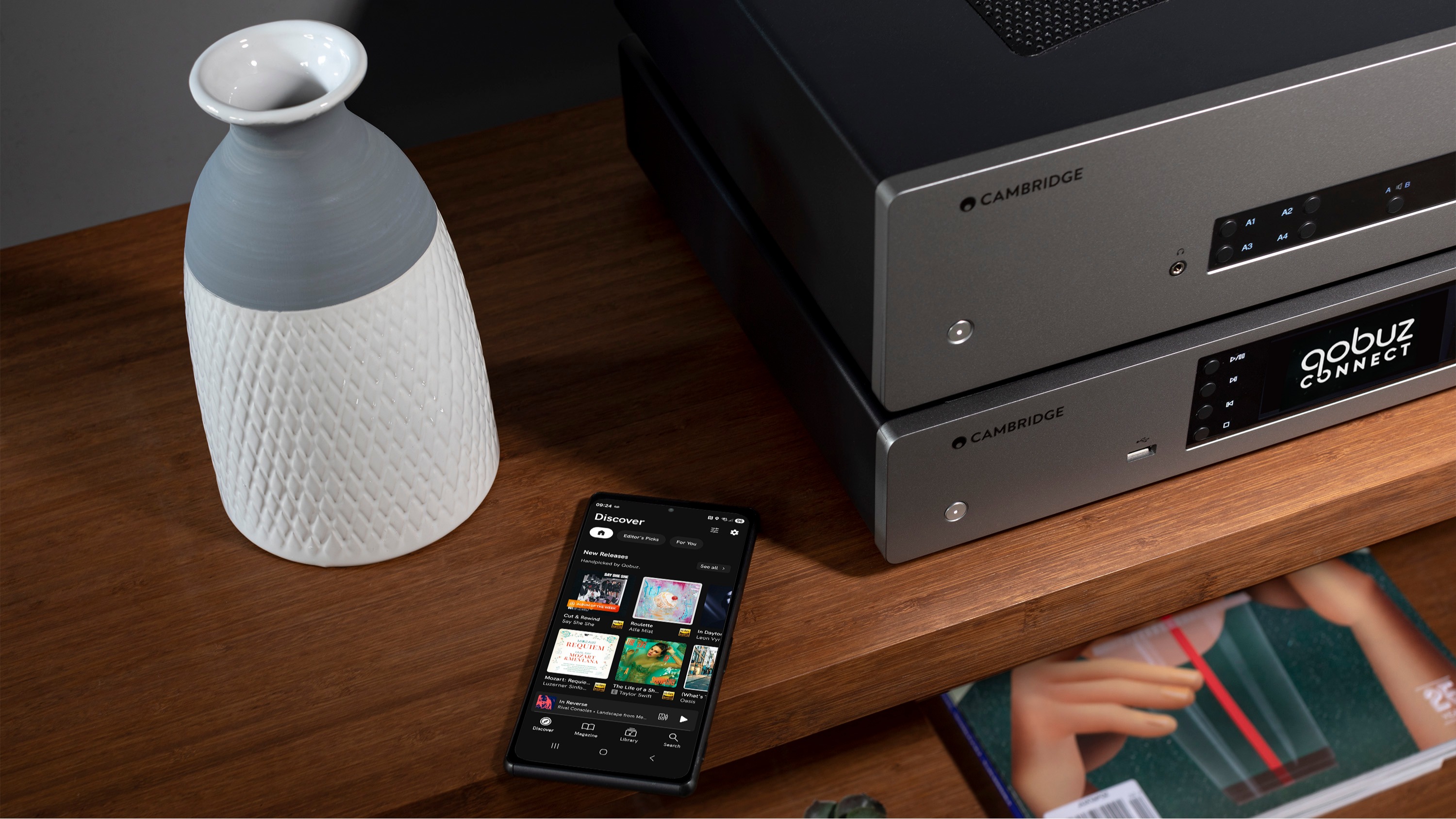
The update also extends features previously introduced on newer parts of the platform. Cambridge says older supported devices receive lossless Spotify streaming and Amazon Music integration within the StreamMagic app. Fourth-generation StreamMagic products already provide the expanded functionality, so the release is principally important to owners of earlier compatible models.
Setup is deliberately straightforward. An eligible component connected to the internet should detect the firmware automatically. The user then confirms the installation and download rather than sourcing files or manually transferring firmware. That low-friction process matters when the supported product pool includes components that have already served in systems for a long time.
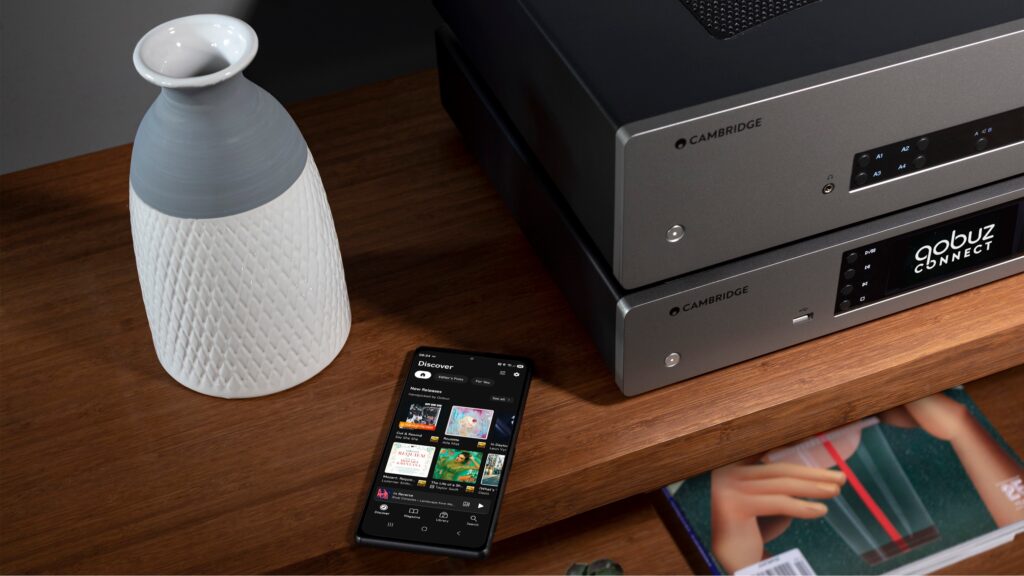
The strongest aspect of Cambridge’s proposition is continuity. Network audio products depend not only on physical construction but also on apps, authentication methods and evolving music services. Continuing to update older StreamMagic generations reduces the risk of otherwise functional hardware becoming inconvenient or partially obsolete. It also avoids disturbing a carefully matched system merely to gain a newer streaming interface.
There are unavoidable qualifications. The update cannot standardize hardware capabilities across several product ranges, and Cambridge explicitly frames feature availability around what the hardware permits. It does not add HDMI eARC, balanced XLR sockets, a subwoofer output or a newer DAC to a component that was not originally built with them. Owners must therefore distinguish between a software-service problem, which this release may solve, and a physical-connectivity or system-architecture problem, which it cannot.
Pros
- Free functionality expansion for eligible StreamMagic components
- Adds direct Qobuz Connect control to supported older hardware
- Extends current streaming features without requiring component replacement
- Automatic detection simplifies the update process
- Supports a sustainability-focused approach to network hi-fi ownership
- Preserves established system matching and existing hardware integration
Cons
- Not a uniform hardware product, so DACs, connections and capabilities vary by model
- New functions remain subject to the limits of each component’s hardware
- Cannot add physical features such as HDMI eARC or balanced outputs where none exist
- Eligibility is limited to supported StreamMagic generations and devices
- Amazon Music remains integrated through the StreamMagic app rather than described as a dedicated Connect implementation
Best for: Owners of eligible Cambridge Audio network players, AV receivers or streaming preamplifiers who are satisfied with their existing hardware and want current service integration without rebuilding the system.
Read the original Stereoindex article →
Fosi Audio S3: A Compact Streamer, DAC and Preamplifier
The Fosi Audio S3 is a defined piece of hardware with a very different purpose. It consolidates three core functions—network streamer, digital-to-analog converter and preamplifier—inside a chassis measuring 17.3 × 17.3 × 4.7 cm. Connect it to a power amplifier or active speakers and it can handle source selection, conversion and level control without a separate preamp or external DAC.
Digital conversion is built around the AKM4493SEQ. The S3 supports PCM up to 32-bit/384 kHz through Roon, while its HDMI eARC connection accepts PCM up to 24-bit/192 kHz. Fosi uses OPA1612 op-amps in a fully balanced analog circuit, along with ELNA capacitors and a low-noise LDO power supply. Digital and analog sections are separated to reduce interference, and balanced XLR outputs are provided for compatible downstream equipment.
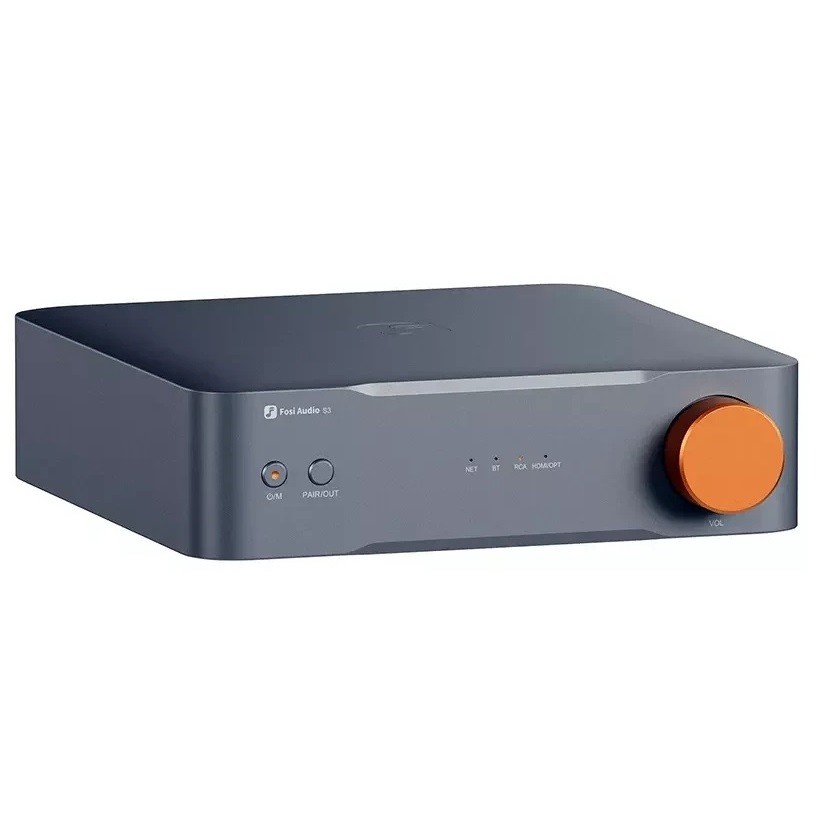
Its streaming support is broad. AirPlay 2, Spotify Connect, TIDAL Connect, Google Cast, DLNA and Roon Ready operation cover common phone, cloud and local-network workflows. Music can arrive over dual-band Wi-Fi or Ethernet, while Bluetooth 5.3 provides a direct wireless option. Fosi’s control app supplies playback management and a built-in five-band equalizer.
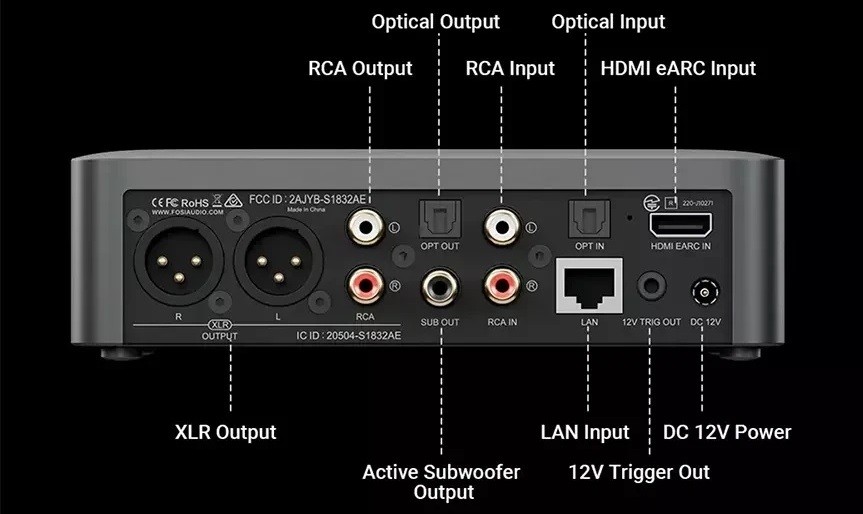
HDMI eARC is one of the S3’s most consequential differences from the Cambridge software update. It allows a compatible television to send PCM audio into the stereo system without requiring an AV receiver. The dedicated subwoofer output also supports a compact 2.1 arrangement, making the S3 suitable for a living room in which music, films and series share the same amplifier and speakers.
The physical design is equally relevant to system building. Its small footprint suits a desktop as readily as a rack, while 12V trigger support can coordinate power behavior with compatible equipment. Protection circuits are also included. Power comes from 12V DC.
The S3 is not an integrated amplifier. Although it incorporates preamplifier functionality, it still needs active loudspeakers or a separate power amplifier. Nor should its extensive service list be treated as universal: Qobuz Connect and Amazon Music integration are not specified among its supported platforms. There is also no supplied price information, so its monetary value cannot be compared directly with Cambridge’s free update. Its value case instead rests on the number of functions consolidated into one enclosure.
Pros
- Combines network streamer, DAC and preamplifier in one compact chassis
- AKM4493SEQ DAC supports PCM up to 32-bit/384 kHz through Roon
- Fully balanced analog circuit with balanced XLR outputs
- Wide streaming support including Roon Ready, Google Cast and major Connect platforms
- HDMI eARC integrates television audio into a stereo system
- Dedicated subwoofer output supports compact 2.1 systems
- Dual-band Wi-Fi, Ethernet and Bluetooth 5.3 provide flexible networking
- Five-band EQ, 12V trigger support and protection circuits aid practical integration
Cons
- Requires a power amplifier or active speakers because no speaker amplification is included
- Qobuz Connect and Amazon Music support are not specified
- HDMI eARC is limited to PCM, with support stated up to 24-bit/192 kHz
- The five-band equalizer is useful but relatively simple
- Buying new hardware is unnecessary if an existing eligible Cambridge component already meets the system’s physical requirements
Best for: Listeners building a compact system around active speakers or a power amplifier, especially when HDMI eARC, balanced outputs, Roon, Google Cast or a dedicated subwoofer connection are priorities.
Read the original Stereoindex article →
Cambridge StreamMagic Update vs Fosi S3: Direct Comparison
The central distinction is software continuity versus hardware consolidation. Cambridge improves an installed component while retaining its original DAC, analog circuitry, enclosure and sockets. Fosi supplies a complete new front end with a specified converter, balanced preamplifier stage and contemporary connection set. For a Cambridge owner whose only frustration is the lack of direct Qobuz control, the firmware route is considerably less disruptive. For someone missing HDMI eARC, XLR outputs or a subwoofer connection, software cannot bridge the gap.
Streaming ecosystems divide the products further. Cambridge’s update makes Qobuz Connect the centerpiece and adds Amazon Music inside StreamMagic, alongside lossless Spotify streaming as described by the manufacturer. The S3 explicitly supports Spotify Connect, TIDAL Connect, AirPlay 2, Google Cast, DLNA and Roon Ready operation. Fosi is therefore the more clearly documented choice for a mixed-platform household or Roon-based library, whereas Cambridge has the explicit advantage for direct Qobuz-app control.
The S3 also has the more transparent technical specification because it is one model rather than a platform spanning multiple components. Its AKM4493SEQ DAC, OPA1612-based balanced stage, XLR outputs and supported resolutions are known. No equivalent blanket statement can be made for updated Cambridge devices; their conversion quality, analog topology and maximum resolution depend on the original model. The firmware should not be interpreted as a sonic hardware upgrade, and no comparative listening conclusion is established here.
System matching follows logically. A Cambridge component that already works with the owner’s amplifier and sources remains the least risky option: no cables need to be reconsidered, and the established gain structure and physical layout stay intact. The S3 is more attractive when starting fresh, reducing box count, feeding active monitors, connecting to balanced amplification or sharing speakers with a television.
Both approaches address real-world convenience, but at different levels. Cambridge removes the need to enter its own app when using Qobuz Connect and distributes firmware automatically to online devices. Fosi offers a broader central-control role, bringing network playback, Bluetooth, television sound, DAC duties, volume control, EQ and subwoofer integration together. Its setup is inherently more involved because it becomes part of the signal path, yet it can eliminate several separate components.
Value cannot be reduced to a conventional price comparison. The Cambridge update is free and potentially postpones replacement, making it compelling for an eligible owner. The S3’s price is not provided, so no claim about bargain status is justified. Its value proposition is functional density: it may replace a streamer, DAC and preamp while also handling television audio. The better choice is the one that solves an actual system requirement rather than the one with the longer feature list.
| Category | Cambridge Audio Firmware Update Adds Qobuz Connect to StreamMagic Devices Since 2014 | Fosi Audio S3: Compact Streamer, DAC & Preamp with HDMI eARC and Roon Ready | Edge |
|---|---|---|---|
| Product type | Firmware update for eligible StreamMagic hardware | Compact streamer, DAC and preamplifier | Depends on whether hardware is already owned |
| Primary streaming distinction | Qobuz Connect plus expanded support for older StreamMagic generations | AirPlay 2, Spotify Connect, TIDAL Connect, Google Cast, DLNA and Roon Ready | Cambridge for Qobuz Connect; Fosi for documented platform breadth |
| DAC implementation | Varies with the original Cambridge component | AKM4493SEQ with PCM up to 32-bit/384 kHz through Roon | Fosi for a clearly specified implementation |
| Analog stage | Depends on the updated device | OPA1612 op-amps in a fully balanced circuit with ELNA capacitors | Fosi on documented design detail |
| Outputs | Determined by the original hardware | Balanced XLR and dedicated subwoofer output specified | Fosi where these connections are required |
| Television integration | No new physical connection is added by firmware | HDMI eARC with PCM up to 24-bit/192 kHz | Fosi |
| Network connections | Depend on the original StreamMagic model | Dual-band Wi-Fi and Ethernet | Fosi on confirmed specifications |
| Bluetooth | Varies by device and is not added universally | Bluetooth 5.3 | Fosi |
| Control and setup | Update is detected online and installed after confirmation | Fosi app with playback management and five-band EQ | Cambridge for minimal disruption; Fosi for integrated control |
| Amplification requirement | Depends on whether the Cambridge device is a player, receiver or preamplifier | Needs a power amplifier or active speakers | System dependent |
Verdict: Preserve a Proven System or Rebuild Around Modern Connectivity
Existing Cambridge owners should begin by checking whether their StreamMagic component is eligible and whether its physical connections still satisfy the system. If the answer is yes, the free update is the rational first move. Qobuz Connect materially modernizes daily operation, while the wider streaming additions help keep established hardware useful. Replacing a satisfactory component merely to obtain a supported service would undermine the very longevity this update is designed to provide.
The Fosi Audio S3 wins no automatic overall crown because it solves a different problem. It is the stronger candidate for a new compact system or for one that needs hardware Cambridge’s firmware cannot create: HDMI eARC, a dedicated subwoofer output, balanced XLR connectivity, Bluetooth 5.3 or an explicitly Roon Ready endpoint. Its streamer, DAC and preamp architecture can substantially simplify a desktop or living-room installation.
Service choice may decide the matter. Qobuz users gain a clearly stated direct route through updated Cambridge hardware. Listeners centered on TIDAL Connect, Google Cast, AirPlay 2, DLNA or Roon will find those protocols explicitly supported by the S3. Spotify is represented on both sides, though the implementations are described differently.
Ultimately, Cambridge offers exceptional value to someone who already owns the hardware because the improvement costs nothing and preserves the existing system. Fosi offers architectural value by concentrating several functions in a small enclosure. Choose the StreamMagic update when software compatibility is the problem; choose the S3 when the system needs a new physical and digital center.
Frequently asked questions
Does the Cambridge StreamMagic update turn an older player into the equivalent of the Fosi S3?
No. It expands streaming functionality on eligible Cambridge components but does not change their DAC, analog circuitry or physical connections. Features such as HDMI eARC, balanced XLR outputs and a dedicated subwoofer output cannot be added through firmware.
Which option supports Qobuz Connect?
Cambridge explicitly adds Qobuz Connect to compatible second- and third-generation StreamMagic devices. Qobuz Connect is not specified in the Fosi S3’s supported service list.
Can the Fosi Audio S3 drive passive speakers directly?
No. The S3 is a streamer, DAC and preamplifier rather than a power amplifier. It must be connected to active speakers or a separate power amplifier.
Which is better for television audio?
The Fosi S3 is the clearly documented choice because it includes HDMI eARC and accepts PCM through that input up to 24-bit/192 kHz. The Cambridge firmware update cannot add an HDMI socket to existing hardware.
Is the Fosi S3 suitable for a Roon system?
Yes. It is Roon Ready and supports PCM up to 32-bit/384 kHz through Roon. Roon compatibility for the Cambridge side cannot be generalized because the update covers multiple models and generations.
Which option offers better value?
For an owner of compatible Cambridge equipment, the free update is highly attractive because it adds services without requiring replacement. The S3’s price is not stated, so a direct cost comparison is not possible; its value rests on combining streaming, conversion, preamplification, television input and subwoofer integration in one compact unit.
Keep Your Cambridge Streamer or Switch to Fosi’s Compact S3?
Two products. One winner. You decide.

Cambridge Audio Firmware Update Adds Qobuz Connect to StreamMagic Devices Since 2014