

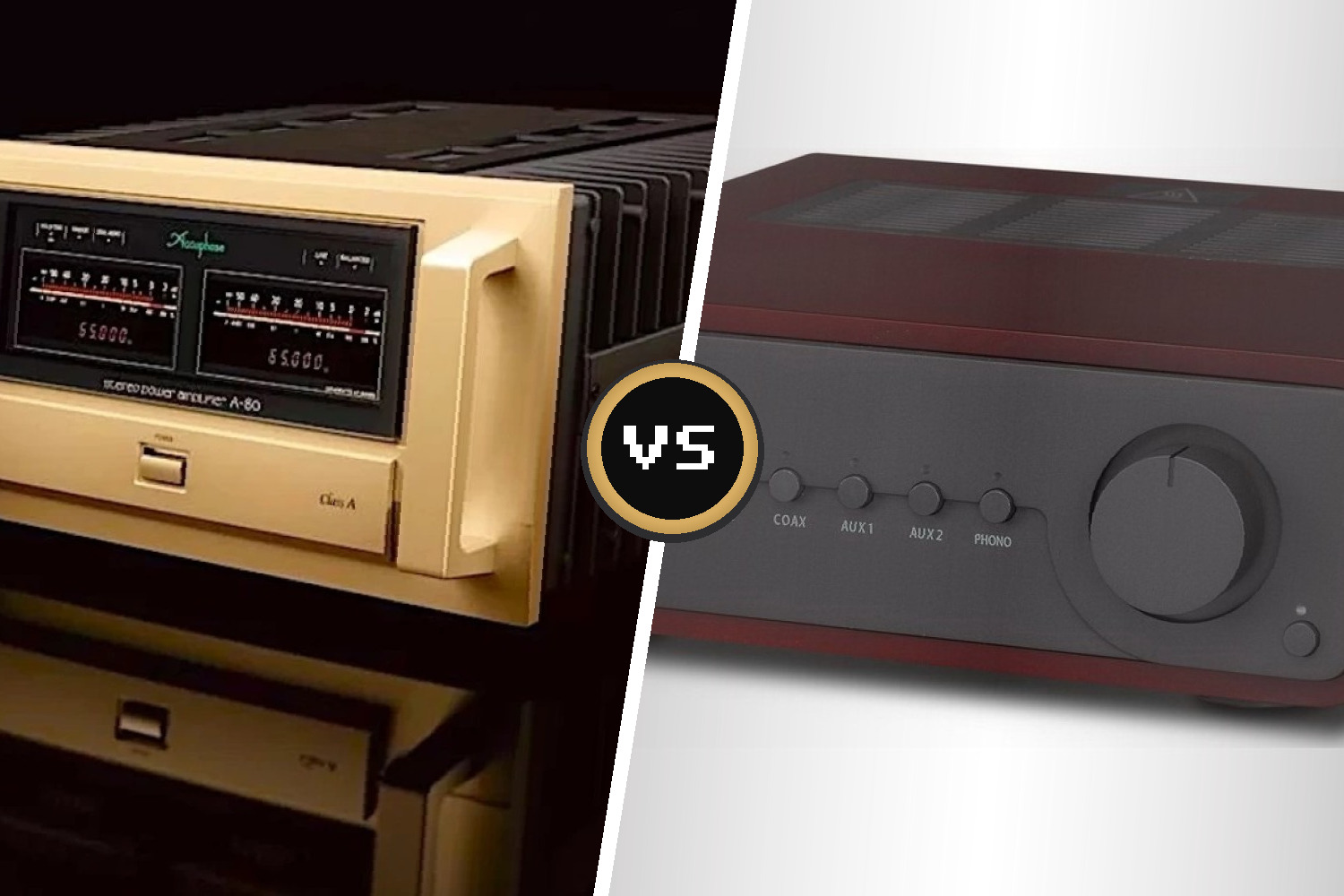

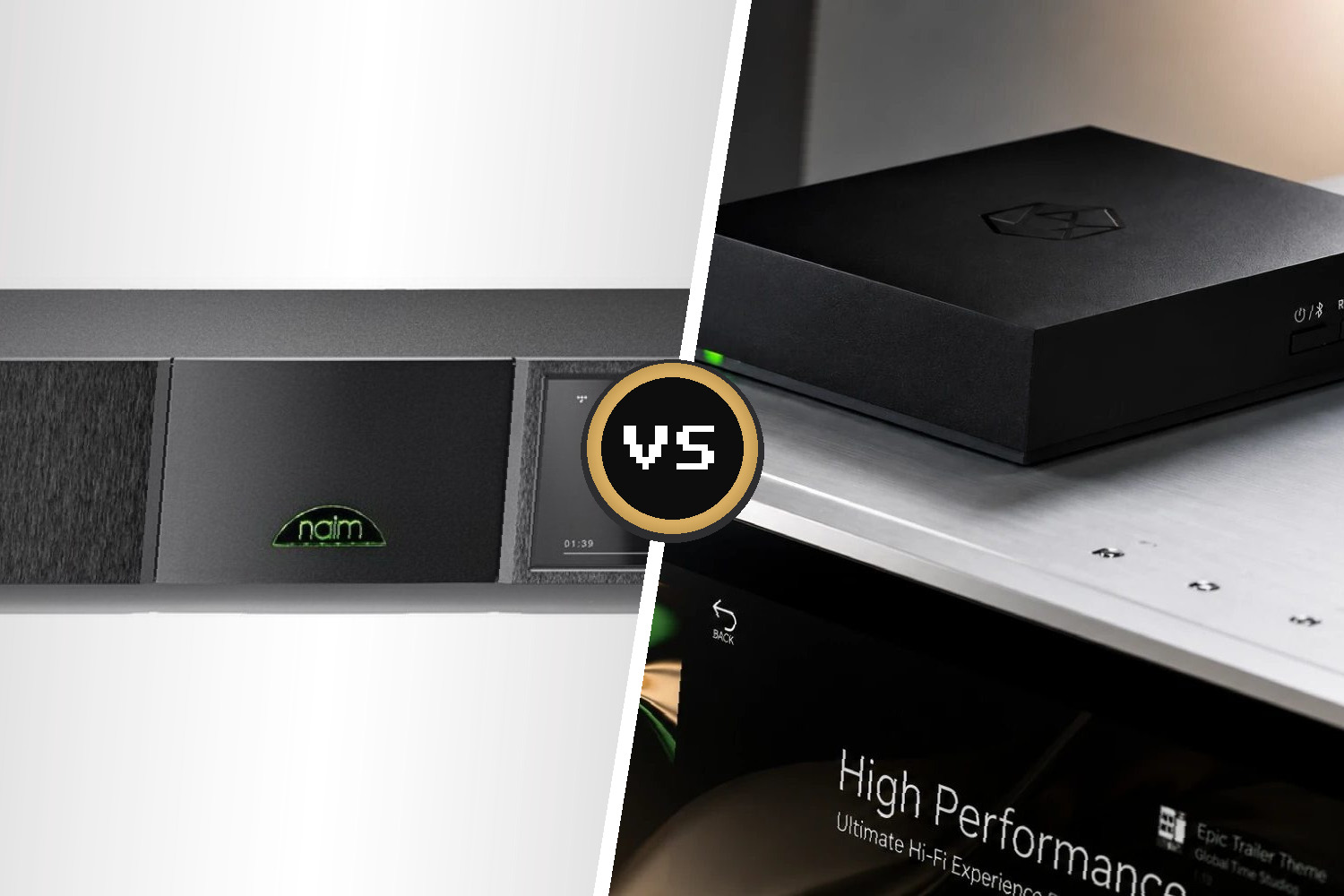
Accuphase A-80: class A powerful stereo amplifier
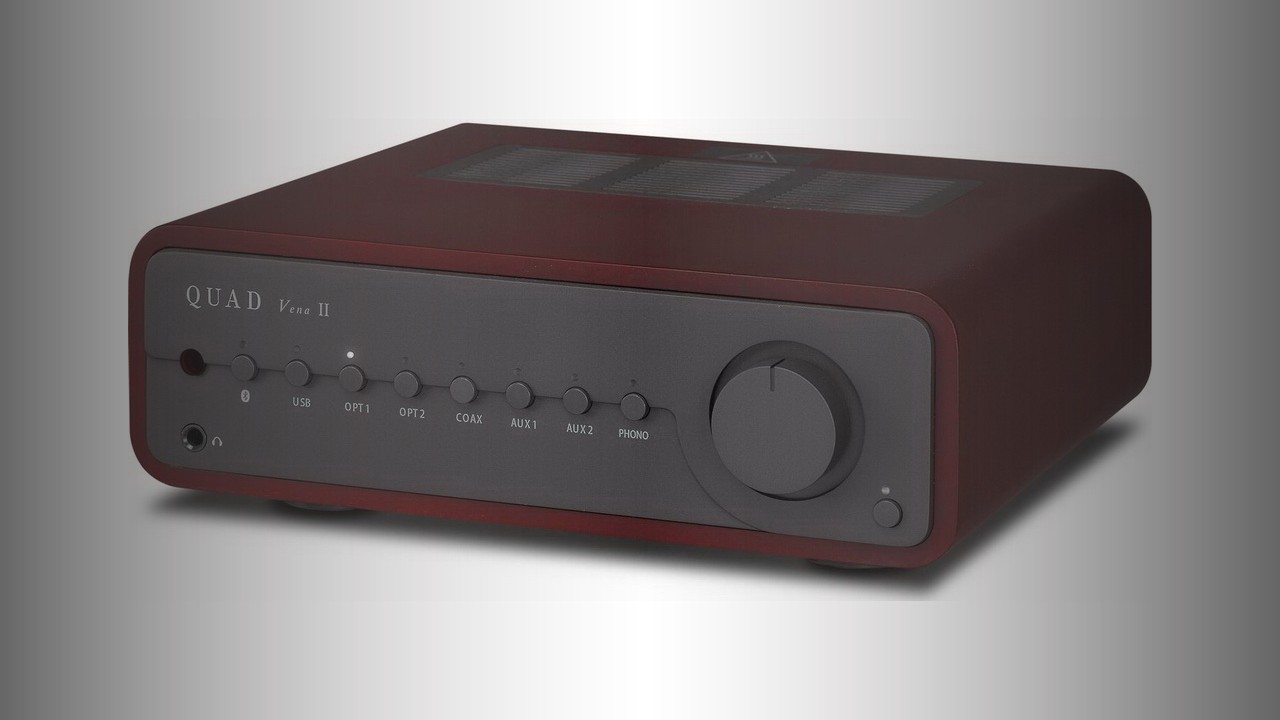
Quad Vena II: Upgraded compact Integrated amplifier
VS
At first glance, the Accuphase A-80 and Quad Vena II appear to be separated mainly by power, size and price. The more important distinction is architectural. The A-80 is a dedicated stereo power amplifier, so it needs an external preamplifier or another component with suitable volume-controlled output. The Vena II is an integrated amplifier designed to serve as the center of a complete stereo system. It includes source selection, volume control, analog and digital inputs, an MM phono stage, Bluetooth, a USB DAC and a dedicated headphone amplifier module.
That difference shapes every part of the comparison. Accuphase concentrates its resources on a pure Class A output stage, a substantial power supply and unusually strong stated performance as speaker impedance falls. Quad prioritizes compactness, source flexibility and straightforward daily operation. The A-80 delivers 65 watts per channel into 8 ohms, while the Vena II is rated at 45 watts per channel into the same load. Those figures alone do not communicate the scale of the difference: Accuphase states that the A-80 doubles output with each halving of impedance, reaching 520 watts per channel into 1 ohm, whereas no comparable low-impedance figure is supplied for the Quad.
These amplifiers therefore are not substitutes in the conventional sense. They suit different budgets, rooms, system plans and levels of complexity. The useful question is not simply which amplifier is better, but whether you need a specialist power amplifier around which to assemble an ambitious separates system or a compact hub capable of handling most modern and traditional sources by itself.
Accuphase A-80: A Pure Class A Foundation for a Serious Separates System
The A-80 is a stereo power amplifier operating in pure Class A. Its front panel carries large meters that display output level in watts and decibels, giving the design a clear visual identity while providing direct information about amplifier output. At 465 x 240 x 515 mm and 44.6 kg, this is a physically imposing component. Installation requires appropriately strong furniture, sufficient space and careful handling.

Its power supply is centered on a large shielded toroidal transformer and 120,000 microfarads of filter capacitance. The output stage uses 20 MOS-FET transistors. Accuphase declares a damping factor of 1000, attributed to very low output resistance. Collectively, these details show where the engineering emphasis lies: power delivery, control and dedicated analog amplification rather than source handling or space efficiency.
Rated output is 65 watts per channel into 8 ohms, rising to 130 watts into 4 ohms, 260 watts into 2 ohms and 520 watts into 1 ohm. The progression is especially relevant when assessing loudspeaker matching because it indicates output that doubles as load impedance is halved. The A-80 can also operate bridged as a monoblock, producing a stated 260 watts into 8 ohms. That creates an upgrade route in which a second unit can be used, although it substantially increases cost, space and system complexity.

The source gives a price of $18,990. No onboard DAC, phono stage, Bluetooth, headphone output, source switching or detailed input list is specified. Buyers should treat it as the power-amplification stage of a larger system and budget for the required control component, sources, cabling and speakers. Its value proposition rests on specialized construction and formidable stated load behavior, not on how many functions it replaces.

For system matching, the A-80 is the stronger candidate when loudspeakers present difficult impedance demands or when the owner wants a power amplifier capable of anchoring an elaborate separates system. Its 65-watt 8-ohm rating may look modest beside some non-Class A designs, but the supplied figures into 4, 2 and 1 ohm are central to understanding it. The A-80 is also the only amplifier here offering bridged monoblock operation.
Pros
- Pure Class A stereo power-amplifier design
- Output doubles from 65 watts per channel into 8 ohms to a stated 520 watts into 1 ohm
- Large shielded toroidal transformer and 120,000 microfarads of filter capacitance
- Twenty MOS-FET devices in the output stage
- Declared damping factor of 1000
- Can be bridged for 260 watts into 8 ohms in monoblock operation
- Large front meters display output in watts and decibels
Cons
- Requires a separate preamplifier or another suitable volume-controlled source
- Very large and heavy at 465 x 240 x 515 mm and 44.6 kg
- No digital conversion, phono stage, Bluetooth or headphone facility is stated
- The quoted $18,990 price places it in a highly specialized segment
- Monoblock expansion requires another amplifier and considerably more space and expenditure
Best for: Listeners building a high-end separates system around a dedicated pure Class A power amplifier, particularly where strong stated output into low impedances, bridged operation and substantial construction matter more than compactness or integrated source facilities.
Quad Vena II: A Compact Integrated Hub for Analog and Digital Sources
The Quad Vena II is a compact integrated amplifier measuring 94 x 313 x 302 mm and weighing 7.5 kg. It combines preamplification, a stereo power stage and extensive source connectivity in one enclosure. The metal case can also be specified with additional wooden side panels. Compared with the Accuphase, it is considerably easier to accommodate and requires far fewer additional components to establish a working stereo system.
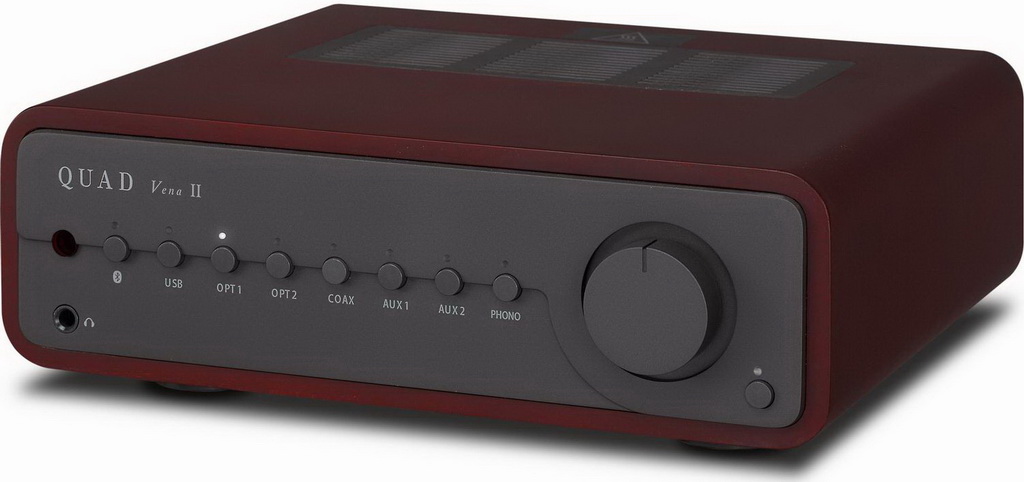
Output is rated at 45 watts per channel into 8 ohms and 65 watts per channel into 4 ohms. The source describes this as sufficient to drive large bookshelf speakers fully and positions the amplifier for high-quality systems in medium-sized rooms. It also characterizes the sound as dynamic and refers to Quad’s signature presentation, while the internal design uses separate stabilized supplies for the digital and analog sections to reduce crosstalk and pursue greater transparency.
Connectivity is the Vena II’s decisive advantage. Analog sources are supported through two pairs of line-level RCA inputs and an MM phono input. Digital connections include two TOSLink optical inputs, coaxial input, USB Type-B for a computer and USB Type-A for Apple-device playback and charging. Optical and coaxial digital outputs are also provided, along with an analog RCA pre-out. A pair of secure screw terminals connects the speakers.
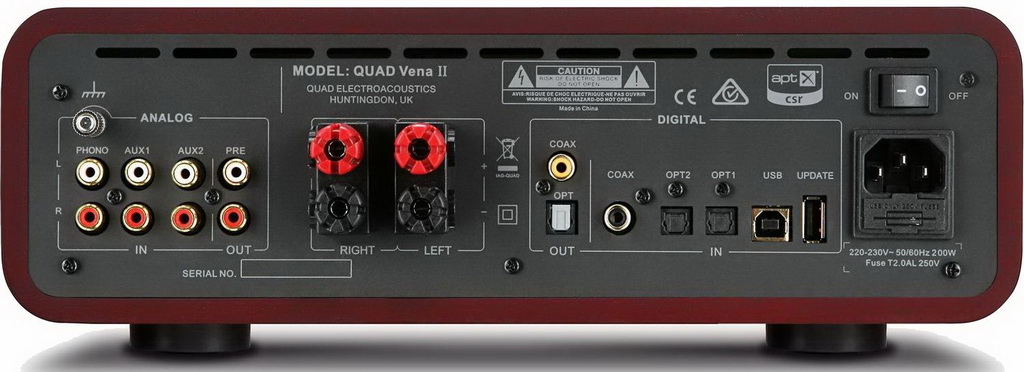
For computer audio, the detailed specification lists PCM support up to 32-bit/384 kHz and DSD256 through USB. S/PDIF inputs accept PCM up to 24-bit/96 kHz. Bluetooth supports A2DP, aptX and SBC, allowing convenient playback from compatible phones and tablets. The front-panel 3.5 mm headphone connection is backed by a separate headphone amplifier module, making private listening part of the core design rather than an external add-on.

Setup is correspondingly simple. Connect speakers, select an analog or digital source, and the Vena II can control the system without a separate preamplifier or DAC. A turntable with a moving-magnet cartridge can use the phono input, a computer can connect over USB Type-B, and a compatible mobile device can stream over Bluetooth. Maximum power consumption is listed as 750 watts. The specified signal-to-noise ratio is greater than 108 dB, distortion is less than 0.0005 percent at 30 watts into 8 ohms, and frequency response is 20 Hz to 20 kHz within plus or minus 0.5 dB.
Pros
- Integrated design combines amplification, volume control and source selection
- Two analog line inputs plus an MM phono input
- USB Type-B supports high-resolution PCM and DSD256
- Two optical inputs, coaxial input and digital outputs
- Bluetooth supports aptX and SBC
- Dedicated headphone amplifier module with front 3.5 mm connection
- Analog pre-out permits broader system integration
- Compact 7.5 kg enclosure is practical for smaller installations
Cons
- Lower output than the Accuphase into both 8-ohm and 4-ohm loads
- No output rating below 4 ohms is supplied
- No bridged monoblock mode is stated
- Bluetooth does not replace the full resolution available through USB
- The 3.5 mm headphone socket may require an adapter for headphones using a larger plug
- Its all-in-one priorities will not suit buyers specifically seeking a dedicated pure Class A power amplifier
Best for: Listeners who want a compact, easy-to-operate integrated amplifier for a medium-sized room, with support for line sources, an MM turntable, computer audio, optical and coaxial digital equipment, Bluetooth streaming and headphones.
Accuphase A-80 vs Quad Vena II: Direct Comparison
Design intent is the defining difference. The A-80 is focused entirely on the final stage of amplification, while the Vena II consolidates most of a stereo system’s control and source functions. Choosing Accuphase means accepting a separates-based installation and selecting a compatible preamplifier. Choosing Quad means that speakers and sources are enough to begin listening, with no separate DAC required for its supported digital connections.
On nominal 8-ohm output, the A-80 leads by 20 watts per channel: 65 watts against the Quad’s 45 watts. At 4 ohms, the gap expands to 130 watts against 65 watts. Accuphase additionally specifies 260 watts into 2 ohms and 520 watts into 1 ohm, figures for which Quad offers no direct equivalent in the supplied information. The A-80 is therefore the more compelling design for loudspeakers whose impedance behavior makes current delivery and low-load output important. This does not mean every speaker requires it; the Quad source specifically presents the Vena II as capable of driving large bookshelf designs in a medium-sized room.
Construction reinforces the contrast. Accuphase uses a massive chassis, shielded toroidal transformer, 120,000-microfarad capacitor bank and 20-MOS-FET output stage. Quad weighs roughly one-sixth as much and packages analog, digital, wireless, phono and headphone functions into a chassis less than ten centimeters high. The A-80 demands dedicated physical accommodation, while the Vena II can fit into spaces where the Accuphase would be unrealistic.
The formats contest is entirely one-sided because the A-80 is not presented as a digital source component. Quad handles PCM over S/PDIF up to 24-bit/96 kHz, and its USB implementation is specified for PCM up to 32-bit/384 kHz and DSD256. Bluetooth with aptX and SBC adds convenience, although USB is the connection associated with the highest listed format support. Accuphase owners must obtain all digital playback capability from external equipment.
Real-world usability likewise favors Quad if convenience is the goal. Its controls are described as thoughtfully arranged, and one box can accommodate a turntable, line-level devices, computer, optical and coaxial sources, Apple devices, Bluetooth playback and headphones. The A-80’s meters offer useful output indication, but everyday source selection and volume adjustment depend on the external preamplifier chosen by the owner.
Value cannot be judged by feature count alone. The A-80’s quoted $18,990 price buys a specialist Class A power amplifier with exceptional stated scaling into low impedances and an option for bridged monoblock use. No Quad price is supplied, so a direct price ratio would be unsupported. Functionally, however, the Vena II replaces several separate components, while the Accuphase requires additional system investment. Quad is the more rational proposition for a compact multi-source system; Accuphase is positioned for the buyer who values focused power-amplifier engineering above integration.
| Category | Accuphase A-80: class A powerful stereo amplifier | Quad Vena II: Upgraded compact Integrated amplifier | Edge |
|---|---|---|---|
| Amplifier type | Dedicated pure Class A stereo power amplifier | Integrated stereo amplifier with analog and digital source control | Depends on system architecture |
| Output into 8 ohms | 65 watts per channel | 45 watts per channel | Accuphase A-80 |
| Output into 4 ohms | 130 watts per channel | 65 watts per channel | Accuphase A-80 |
| Lower-impedance ratings | 260 watts into 2 ohms and 520 watts into 1 ohm | Not supplied below 4 ohms | Accuphase A-80 |
| Monoblock operation | Bridge mode, 260 watts into 8 ohms | Not stated | Accuphase A-80 |
| Digital playback | No onboard digital capability stated | USB, two optical inputs, coaxial input and Bluetooth | Quad Vena II |
| High-resolution formats | Not applicable without external digital equipment | Up to 32-bit/384 kHz PCM and DSD256 over USB; up to 24-bit/96 kHz PCM over S/PDIF | Quad Vena II |
| Analog source support | Requires external control equipment; input details are not supplied | Two line RCA inputs and MM phono | Quad Vena II |
| Headphone listening | No headphone output stated | 3.5 mm output with separate headphone amplifier module | Quad Vena II |
| Wireless playback | Not stated | Bluetooth A2DP with aptX and SBC | Quad Vena II |
Verdict: Choose the Architecture Before the Amplifier
The Accuphase A-80 wins decisively in specialized power-amplifier engineering. Its pure Class A topology, huge power supply, 20-MOS-FET output stage, declared damping factor of 1000 and doubling output figures down to 1 ohm make it the technically more ambitious amplifier. It is also the only option that can be bridged into a 260-watt 8-ohm monoblock. For an owner assembling a major separates system, particularly around speakers with demanding impedance characteristics, it is the clear choice of these two.
That superiority does not make the A-80 universally preferable. It is a 44.6 kg power amplifier costing a quoted $18,990, and it cannot independently select sources, control volume, decode digital audio, accept an MM cartridge, receive Bluetooth or drive headphones based on the supplied information. Its owner must want the cost, space and flexibility of a separates system rather than merely tolerate them.
The Quad Vena II is the recommended choice for the broader range of real-world installations. It is compact, substantially lighter and equipped to handle analog line sources, an MM turntable, computers, optical and coaxial digital components, compatible Apple devices, Bluetooth sources and headphones. Its 45 watts per channel into 8 ohms and 65 watts into 4 ohms are more modest, but the source supports its use with large bookshelf speakers in a medium-sized room.
Choose the A-80 when the power amplifier itself is the system’s centerpiece and low-impedance output, Class A operation, physical construction and future monoblock use justify a specialist purchase. Choose the Vena II when versatility, manageable size and one-box operation carry greater weight. This is not a close battle between equivalent products: Accuphase offers the more formidable power stage, while Quad offers the more complete amplifier.
Frequently asked questions
Can the Accuphase A-80 be used without a preamplifier?
The A-80 is described as a power amplifier rather than an integrated amplifier. The supplied information does not identify onboard source selection or volume control, so it should be partnered with a preamplifier or another suitable component providing controlled output.
Which amplifier is better for difficult loudspeaker loads?
The Accuphase has the stronger supplied evidence for difficult loads. It is rated at 65 watts per channel into 8 ohms, 130 watts into 4 ohms, 260 watts into 2 ohms and 520 watts into 1 ohm. Quad provides ratings only into 8 and 4 ohms, so performance below 4 ohms cannot be compared directly.
Does the Quad Vena II need an external DAC?
Not for its supported digital sources. It includes USB Type-B, two optical inputs and a coaxial input. The detailed specification lists up to 32-bit/384 kHz PCM and DSD256 through USB, while S/PDIF supports PCM up to 24-bit/96 kHz.
Can either amplifier connect directly to a turntable?
The Quad includes a phono input specified for moving-magnet cartridges. No phono stage is stated for the Accuphase, so a turntable system would need an external phono stage and appropriate preamplifier or control component.
Which model is more practical for headphone users?
The Quad is the practical choice because it has a front-mounted 3.5 mm headphone connection and a separate headphone amplifier module. No headphone output is specified for the Accuphase.
Can the Accuphase A-80 be upgraded to monoblock operation?
Yes. It can operate in bridge mode as a monoblock, with a stated output of 260 watts into 8 ohms. A stereo monoblock installation would require a second A-80 and would substantially increase the required space, weight and expenditure.


Join the discussion
Share your thoughts, listening impressions or product experience.