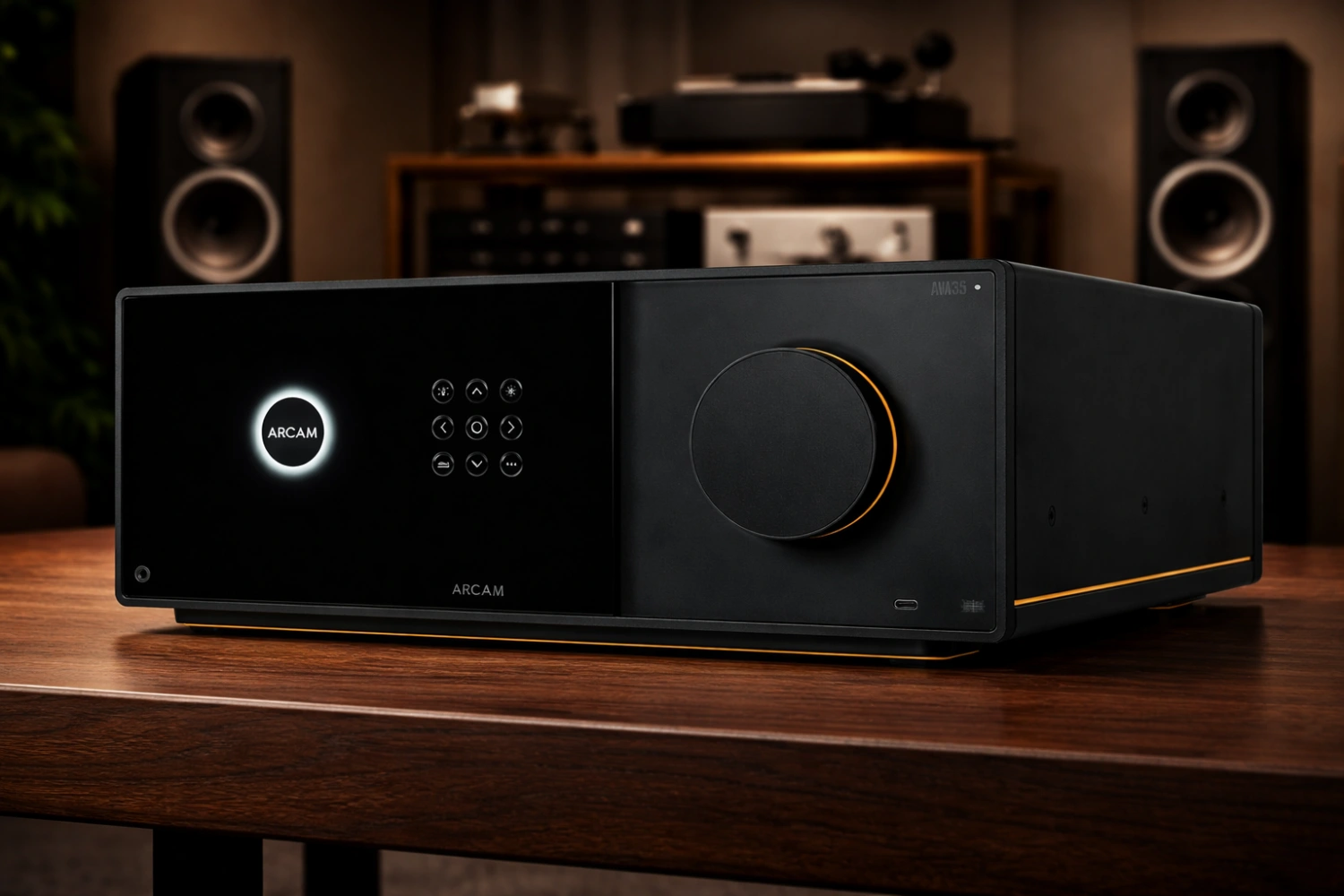

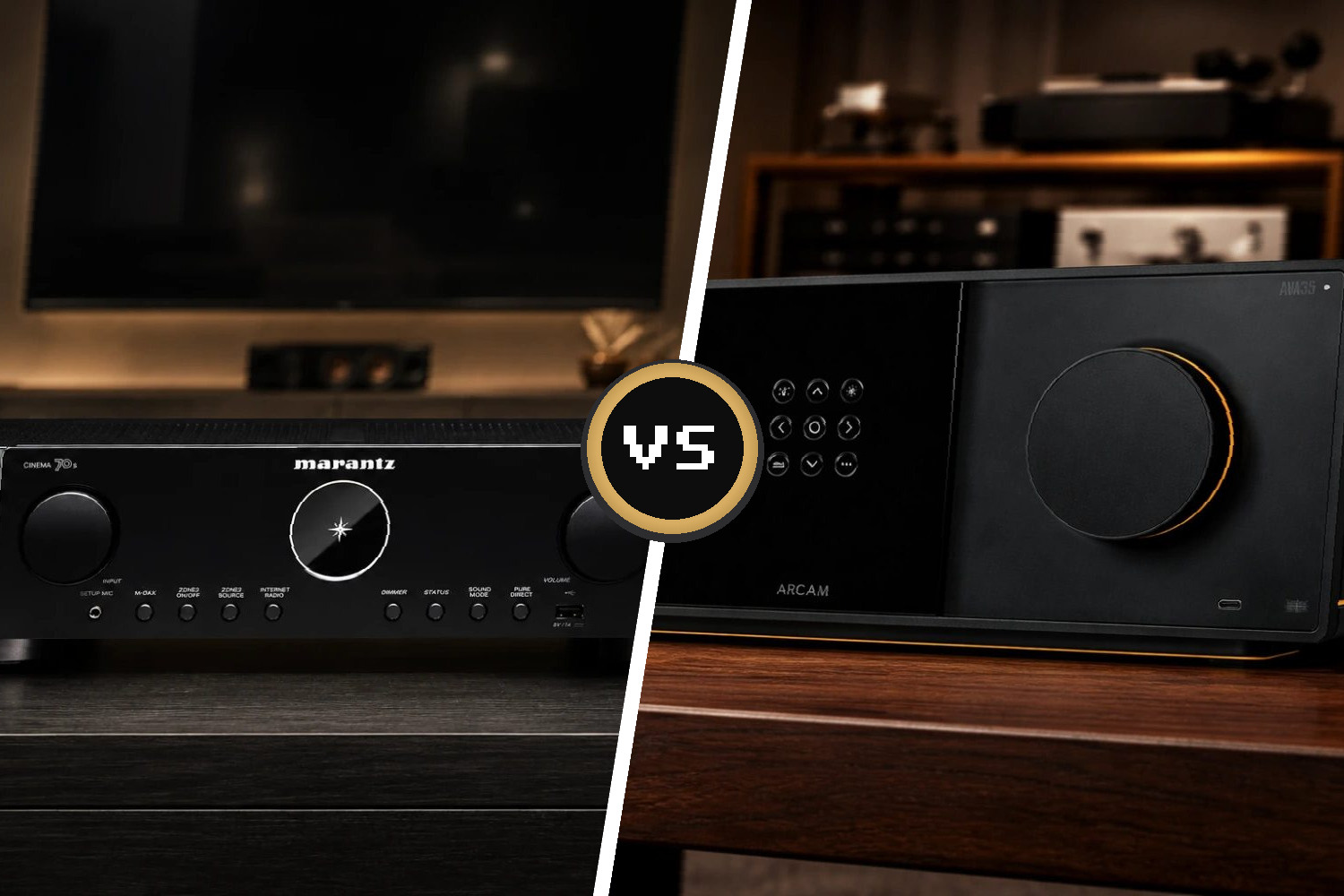
The Marantz Cinema Series 2 and Arcam AVA35 approach premium home cinema from different directions. Marantz offers a four-model family spanning the full-size Cinema 50 Series 2 and Cinema 60 variants through to the slimline Cinema 70s Series 2. Arcam instead positions the AVA35 as the flagship all-in-one receiver in its Radia AV range, with nine amplified channels, processing for as many as 16 channels and unusually flexible channel assignment.
Their common ground is substantial. Both platforms combine nine-channel amplification at the upper end, immersive-audio processing, external power-amplifier integration, modern HDMI connectivity, network streaming and access to advanced Dirac room correction. Yet the details matter. The Cinema 50 Series 2 processes 11.4 channels and supports Marantz-specific configuration features, while the AVA35 reaches 16-channel processing and provides 16 RCA preamplifier outputs. Lower Cinema Series 2 models prioritize accessibility or reduced chassis height rather than matching the Arcam’s maximum system scale.
There are also important differences in what comes with the receiver. Dirac Live Room Correction is standard on the AVA35, whereas Marantz describes Dirac support as an optional, purchasable upgrade. Marantz counters with a common new eight-channel, 32-bit DAC architecture across its entire Series 2 family, HEOS multiroom streaming, gaming additions and installation tools that extend beyond conventional playback specifications.
This comparison therefore is not simply a contest between two equivalent boxes. It examines whether the broader choice, distinctive setup tools and space-saving option of Marantz are more useful than the AVA35’s specified power, 16-channel ceiling and more explicitly documented format and connection support.
Marantz Cinema Series 2: One Updated Platform Across Four Receivers
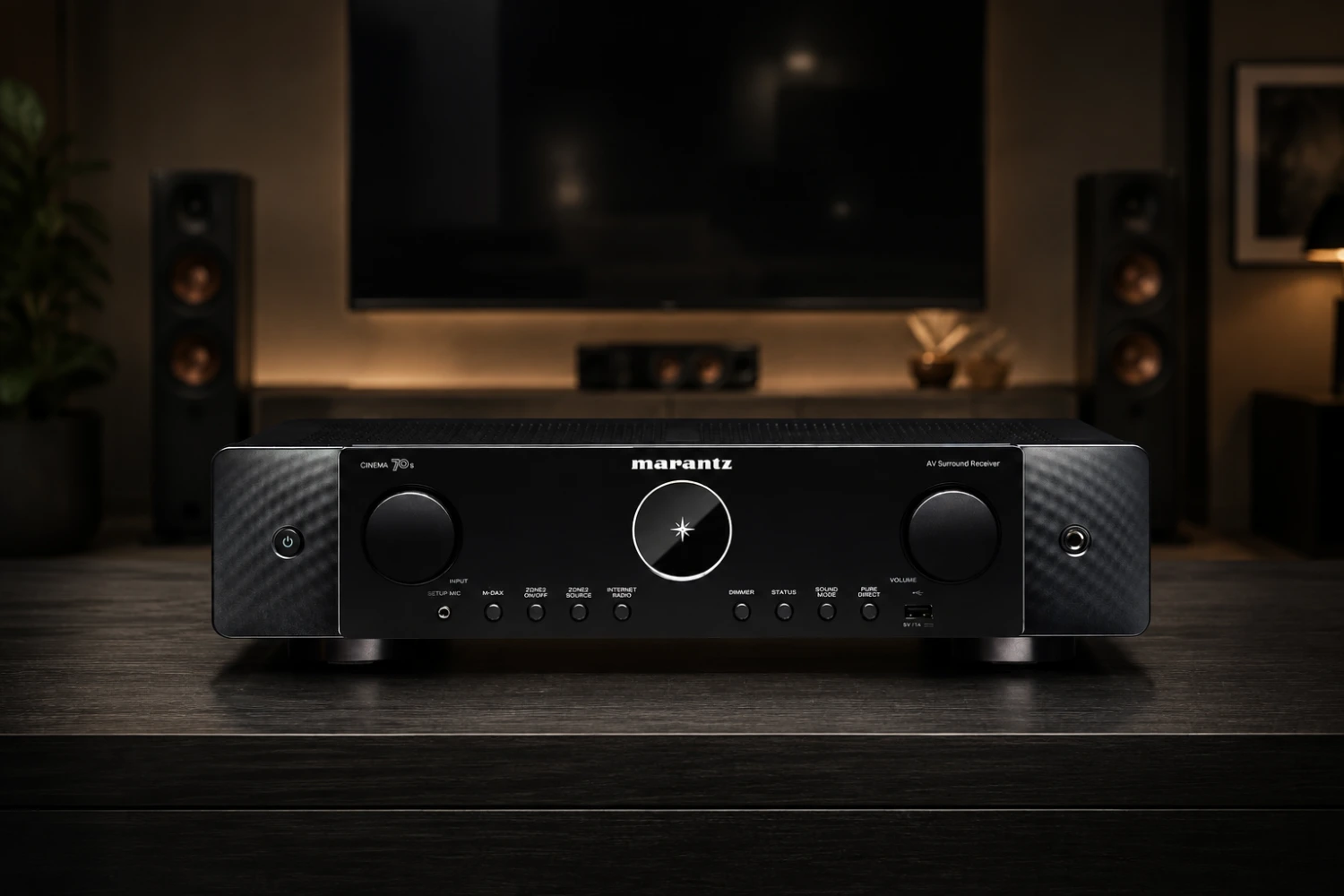
The Cinema Series 2 comprises the Cinema 50 Series 2, Cinema 60 Series 2, Cinema 60 DAB Series 2 and slimline Cinema 70s Series 2. All retain Marantz’s established Cinema styling while receiving updated conversion, room-correction compatibility, gaming support, streaming and system-management functions. The choice of chassis and capability is central to the range: Cinema 50 Series 2 targets larger theaters, the Cinema 60 versions carry much of the common technology into a less expansive package, and Cinema 70s Series 2 is designed for installations with restricted equipment space.
Every model uses a newly developed eight-channel, 32-bit DAC architecture. It is intended to perform high-resolution conversion simultaneously across its channels, simplify the signal path and reduce timing errors during multichannel processing. Marantz also specifies selected new internal components, copper parts and refined construction. Each receiver is tuned under the direction of the Marantz Sound Master to preserve the company’s intended sonic character, although no power-output figures or measurements are supplied for comparison.
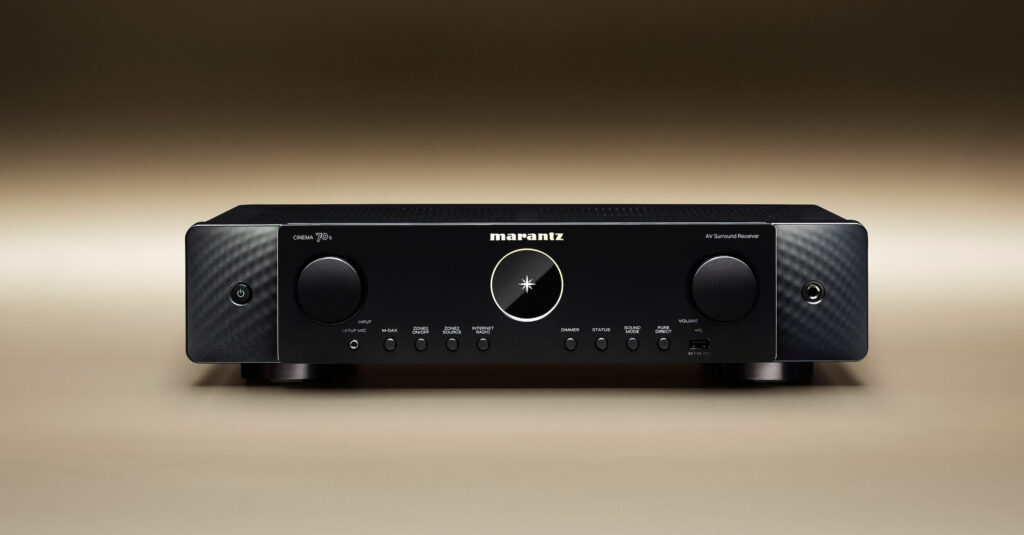
Cinema 50 Series 2 is the range leader, combining nine amplified channels with 11.4-channel processing. Every Cinema Series 2 model includes preamplifier outputs for all of its channels, so an owner can add external power amplification rather than replacing the receiver as system demands increase. The available processing and amplification counts for the Cinema 60 and Cinema 70s models are not detailed in the supplied material, so buyers should not assume that they duplicate the Cinema 50’s 11.4-channel architecture.
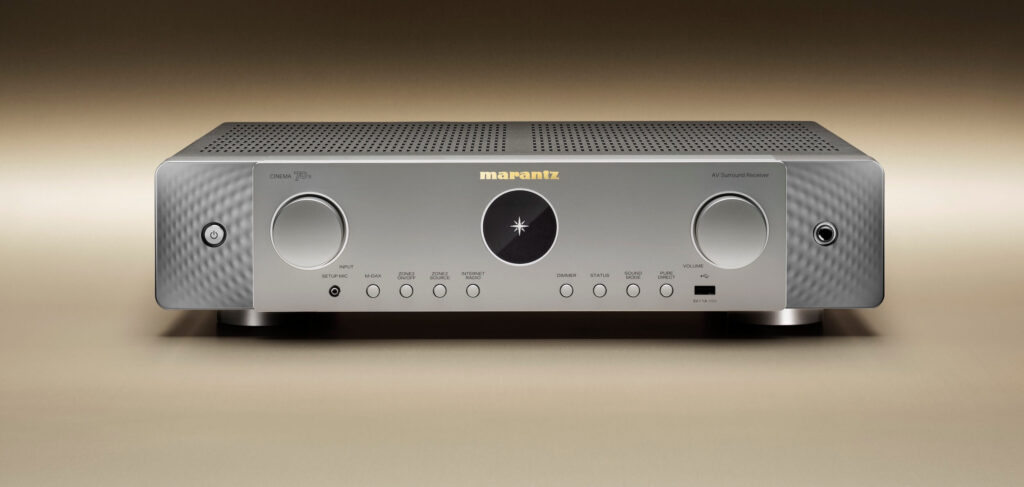
Room correction is a major part of the update. Cinema 60 Series 2, Cinema 60 DAB Series 2 and Cinema 70s Series 2 can be upgraded with optional Dirac Live Room Correction to address bass response, timing and tonal consistency. Cinema 50 Series 2 has the widest Dirac ecosystem in the range, supporting Dirac Live Room Correction, Dirac Live Bass Control and Dirac Live Active Room Treatment. Marantz also gives the Cinema 50 Dolby Atmos Channel Expander, which can engage all available speakers with channel-based Atmos material, and Center Bi-Amp Mode for compatible center speakers. Conventional front-left and front-right bi-amplification remains available for suitable speakers.
Gaming receives focused attention through 1440p video pass-through and AMD FreeSync compatibility, complementing the existing HDMI 2.1 feature set. Exact HDMI socket counts and maximum video resolutions are not specified. Low-latency Bluetooth LE Audio is planned through a firmware update rather than being presented as an active launch feature. Streaming and multiroom duties are handled by an updated HEOS platform, but individual services and file-format limits are not listed.
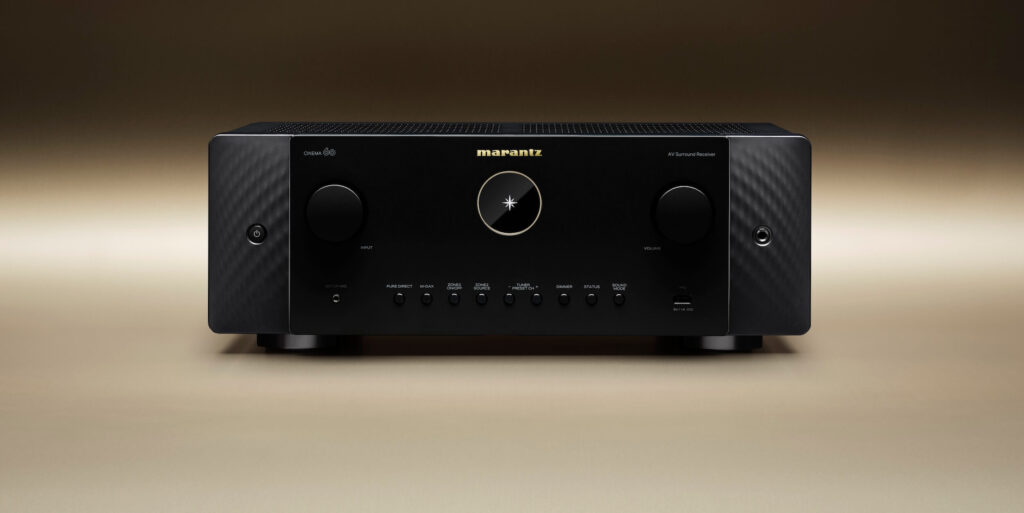
Web Control 2.0 allows setup and operation from a phone, tablet or computer, reducing dependence on a connected television. HDMI Diagnostics 2.0 in CI Mode provides automated HDMI verification and advanced troubleshooting for installers, while Channel Level Monitoring displays channel activity in real time. These are practical advantages in a complex room, where identifying a silent speaker or HDMI problem can otherwise involve considerable trial and error. Revised packaging uses less plastic, recyclable paper protection and a more efficient structure.
Pros
- Four-model range covers elaborate theaters, mainstream installations and space-limited systems
- Common eight-channel, 32-bit DAC architecture across every model
- Cinema 50 Series 2 offers nine-channel amplification and 11.4-channel processing
- Preamplifier outputs for every channel support external power-amplifier upgrades
- Optional Dirac availability extends down to the Cinema 60 and slimline Cinema 70s
- Cinema 50 supports Dirac Live Bass Control and Active Room Treatment
- Useful gaming and installation features include FreeSync, Web Control 2.0 and HDMI Diagnostics 2.0
Cons
- Dirac Live Room Correction is a purchasable option rather than an included feature
- Only Cinema 50 receives the broadest Dirac support and model-specific expansion modes
- Amplifier power, exact HDMI counts and supported streaming services are not specified
- Planned Bluetooth LE Audio depends on a later firmware update
- Lower models’ processing and amplifier-channel counts are not established here
Best for: Buyers who want to select a receiver around room size, system complexity and available rack space, particularly those attracted to HEOS, installer-oriented diagnostics or the Cinema 70s slimline chassis.
Read the original Stereoindex article →
Arcam AVA35: Flagship Processing and Flexible Channel Assignment
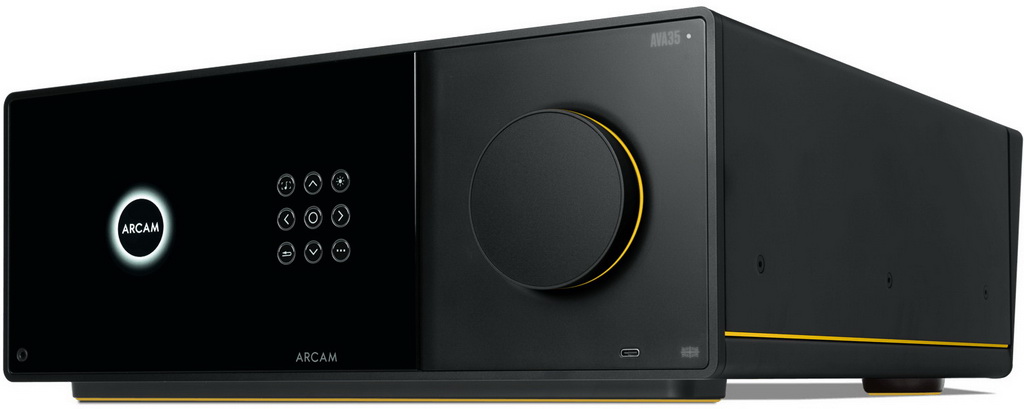
The AVA35 is the flagship receiver in Arcam’s Radia AV lineup. It houses nine amplified channels and processes as many as 16 channels, making it suitable for systems that begin as a receiver-based installation but may expand substantially through external amplification. Its 432 x 407.4 x 170mm enclosure weighs 10kg and carries a large, high-resolution color display for system status and metadata.
Arcam describes the amplifier as its proprietary Class G design, rated at 100 watts per channel into 8 ohms with all nine channels operating. Two-channel figures are 125 watts per channel into 8 ohms and 200 watts into 4 ohms; the nine-channel, 4-ohm rating is 120 watts per channel. The supplied specification list separately labels the amplifier class as Class AB, so the source information is not fully consistent on classification. The stated output figures, nine-channel count and maximum 900W power consumption remain the more concrete system-planning details.
Digital conversion uses an ESS Hyperstream IV DAC Pro architecture derived from Arcam’s flagship stereo products. The AVA35 supports Dolby Atmos, DTS:X, IMAX Enhanced and AURO 3D, alongside Dolby TrueHD, Dolby Surround, DTS-HD Master Audio, DTS Neural:X, virtualization modes and MPEG-H. Processing for up to 16 channels leaves considerable scope for height, rear and surround speakers beyond the nine onboard amplifier channels.
Matrix channel assignment is one of its defining features. Amplified channels can be assigned to different speaker positions, allowing an owner to use external amplification for the main speakers while redirecting internal channels to height or rear duties. This is more adaptable than a rigidly mapped amplifier section and should be especially valuable in a system that evolves in stages.
Dirac Live Room Correction is included as standard, measuring the room and optimizing frequency response and timing. Dirac Live Bass Control and Dirac Live Active Room Treatment are additional options for more sophisticated bass integration and consistency across listening positions. The source does not state that those advanced modules are included, so they should be treated separately from standard Dirac Live.
Seven HDMI inputs feed two Zone 1 outputs and one Zone 2 output. The HDMI 2.1a and HDCP 2.3 implementation supports video up to 8K/60Hz or 4K/120Hz, plus HDR, HDR10, HDR10+, HDR10+ Gaming, Dolby Vision and HLG. VRR, ALLM, CEC and eARC/ARC are also listed, giving the AVA35 a clearly documented connection set for current displays, game consoles and source components.
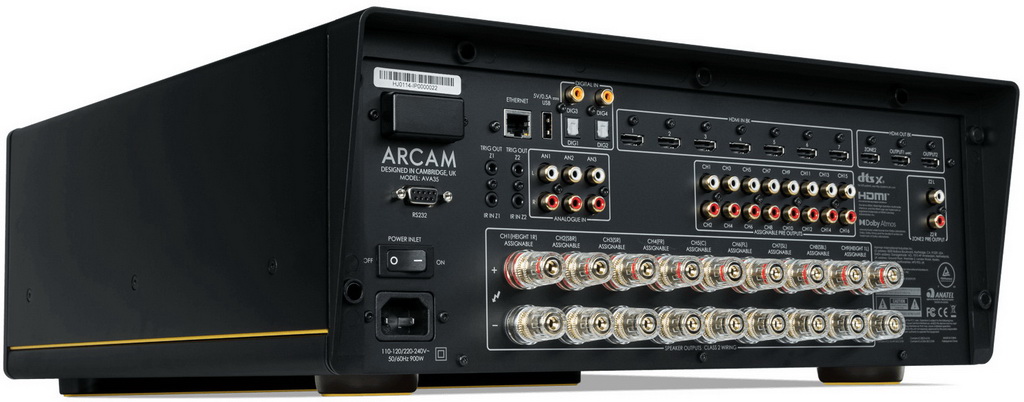
Music streaming includes Spotify Connect, Tidal Connect, Qobuz Connect and Roon Ready operation, with Apple AirPlay and Google Cast for wireless playback. Arcam also specifies Bluetooth with Snapdragon Sound and Auracast. Supported files include FLAC, WAV, MQA, AAC, ALAC, AIFF, MP3, OGG and WMA at up to 24-bit/192kHz. Physical audio inputs comprise two coaxial digital, two optical digital and three stereo RCA pairs, while 16 RCA preamplifier outputs enable external amplifier integration.
A Bluetooth remote and Arcam Radia app support everyday control. The app handles setup and configuration as well as internet radio, podcasts and UPnP playback across iOS, Android and Windows devices. That combination, together with the front-panel display, gives the AVA35 several control routes without making a television the only point of access.
Pros
- Processes up to 16 channels while amplifying nine internally
- Specified at 100 watts per channel into 8 ohms across nine channels
- Matrix assignment allows internal amplifier channels to be redirected
- Dirac Live Room Correction is included as standard
- Comprehensive immersive-format support includes Atmos, DTS:X, IMAX Enhanced and AURO 3D
- Seven HDMI inputs with 8K/60Hz, 4K/120Hz, VRR, ALLM and broad HDR compatibility
- Extensive streaming, wireless playback and 24-bit/192kHz file support
- Sixteen RCA preamplifier outputs provide a clear route to system expansion
Cons
- Systems using more than nine speakers require external amplification
- Dirac Live Bass Control and Active Room Treatment are additional options
- At 170mm high and 407.4mm deep, it does not offer a slimline alternative
- The supplied material inconsistently identifies the amplifier as both Class G and Class AB
- RCA rather than balanced preamplifier outputs are specified
Best for: Enthusiasts building a large, expandable immersive-audio system who want standard Dirac Live, explicit power ratings, flexible amplifier-channel assignment and comprehensive HDMI and streaming support in one chassis.
Read the original Stereoindex article →
Marantz Cinema Series 2 vs Arcam AVA35: Direct Comparison
The most important distinction is scope. Marantz is a platform with several physical and capability levels; Arcam is one flagship receiver. A Cinema 70s Series 2 buyer may prioritize reduced height and current connectivity, while an AVA35 buyer is more likely to be planning a high-channel-count installation. Cinema 50 Series 2 is the most direct Marantz counterpart because it also has nine amplified channels, but its 11.4-channel processing ceiling is lower than the Arcam’s 16 channels.
Arcam provides the clearer amplification specification. Its nine-channel output is rated at 100 watts per channel into 8 ohms, whereas no Series 2 Marantz power ratings are supplied. That prevents a responsible numerical power comparison. Marantz does, however, fit preamplifier outputs across the range, and the Cinema 50’s 11.4 processing enables external-amplifier expansion. Arcam goes further with 16 RCA outputs and matrix assignment, making the allocation of internal and external power particularly flexible.
Room correction requires close attention. Standard Dirac Live gives the AVA35 an immediate advantage for buyers who intend to calibrate with Dirac from the outset. Marantz owners must purchase the relevant upgrade. At the advanced end, both the AVA35 and Cinema 50 support Bass Control and Active Room Treatment, though the material does not establish equal licensing costs or identical implementation limits. The Cinema 60 and 70s models support the core Dirac Live Room Correction upgrade but are not stated to support those advanced modules.
The AVA35’s connectivity is documented in much greater detail, including HDMI quantities, 8K and 4K frame-rate limits, HDR variants, streaming services and supported music files. Marantz confirms HDMI 2.1, 1440p pass-through and FreeSync but does not provide enough information for a port-by-port or maximum-resolution comparison. Marantz differentiates itself through HEOS multiroom operation, scheduled Bluetooth LE Audio and professional tools such as HDMI Diagnostics and Channel Level Monitoring.
Value cannot be reduced to a price comparison because no prices are supplied. Instead, the relevant question is how much of each platform a buyer will use. The AVA35 concentrates advanced processing, standard room correction and extensive connectivity into one flagship component. Marantz lets the buyer avoid paying for an unnecessarily large chassis or maximum processing architecture by choosing among four models, although Dirac must be budgeted separately.
| Category | Marantz Cinema Series 2 Expands AV Receiver Lineup | Arcam AVA35: Flagship Class G AV Receiver with Dirac Live, 16-Channel Processing & 8K HDMI | Edge |
|---|---|---|---|
| Product structure | Four models, including full-size and slimline options | Single flagship Radia AV receiver | Marantz for choice |
| Internal amplification | Cinema 50 has nine channels; power not specified | Nine channels; 100W per channel into 8 ohms with nine driven | Arcam for documented output |
| Maximum processing | Cinema 50 processes 11.4 channels | Processes up to 16 channels | Arcam |
| DAC architecture | New eight-channel, 32-bit architecture | ESS Hyperstream IV DAC Pro | Different implementations |
| Core room correction | Dirac Live available as a paid option | Dirac Live included as standard | Arcam |
| Advanced Dirac | Bass Control and Active Room Treatment supported by Cinema 50 | Bass Control and Active Room Treatment available as options | Model and licensing dependent |
| Amplifier flexibility | All-channel pre-outs; center and front bi-amp options on Cinema 50 | Matrix assignment plus 16 RCA pre-outs | Arcam for complex expansion |
| Video and gaming | HDMI 2.1, 1440p pass-through and AMD FreeSync | 8K/60Hz, 4K/120Hz, VRR, ALLM and extensive HDR support | Arcam for specified breadth |
| Streaming | Updated HEOS streaming and multiroom platform | AirPlay, Google Cast, Spotify, Tidal, Qobuz and Roon Ready | Depends on ecosystem |
| Setup and diagnostics | Web Control 2.0, HDMI Diagnostics 2.0 and Channel Level Monitoring | Radia app, Bluetooth remote and large color display | Marantz for installation tools |
Verdict: Choose the Architecture That Matches the Room
The Arcam AVA35 is the stronger fit for a theater intended to grow beyond 11 channels. Its 16-channel processing, 16 preamplifier outputs and matrix channel assignment create a particularly convincing foundation for phased expansion. Standard Dirac Live, detailed HDMI support and an extensive list of streaming services also make its capabilities easier to assess before purchase. Nine-channel operation is backed by published power figures, although the conflicting Class G and Class AB descriptions should be clarified when buying.
Marantz’s advantage is not maximum processing but breadth of application. Cinema 50 Series 2 provides the most capable route, with nine-channel amplification, 11.4 processing, the full supported Dirac ecosystem, Dolby Atmos Channel Expander and Center Bi-Amp Mode. Cinema 60 Series 2 carries the common DAC and optional Dirac approach into a less expansive receiver, while Cinema 70s Series 2 addresses installations that cannot accommodate a conventional full-height chassis.
For custom installation and troubleshooting, Marantz makes a compelling practical case. Browser-based control, automated HDMI diagnostics and real-time channel monitoring are concrete tools rather than headline format badges. HEOS will also be a deciding factor for households already using that multiroom ecosystem. The trade-off is that buyers must investigate model-specific channel counts, power and HDMI provisions beyond the information supplied, and account for Dirac as an extra purchase.
There is no defensible universal winner. Choose the AVA35 for the larger processing envelope, standard Dirac Live, matrix assignment and thoroughly specified connectivity. Choose Cinema Series 2 when physical format, model choice, HEOS integration or Marantz’s installation features matter more than reaching 16 processed channels. Within the Marantz family, Cinema 50 is the natural option for an ambitious dedicated theater; Cinema 70s is the distinctive answer for a living room where equipment height is a limiting factor.
Frequently asked questions
Which receiver supports more processed channels?
The Arcam AVA35 processes up to 16 channels. The Marantz Cinema 50 Series 2, the most capable model identified in its family, offers 11.4-channel processing.
Is Dirac Live included with both products?
No. Dirac Live Room Correction is standard on the Arcam AVA35. It is an optional purchasable upgrade on compatible Marantz Cinema Series 2 receivers. Cinema 50 also supports Dirac Live Bass Control and Active Room Treatment; the AVA35 offers those as additional options.
Can either platform use external power amplifiers?
Yes. Every Cinema Series 2 model has preamplifier outputs for all channels. The AVA35 provides 16 RCA preamplifier outputs and can reassign its nine internal amplifier channels to different speaker positions.
Which is better for a very large Atmos installation?
The AVA35 offers the greater expansion ceiling because it processes as many as 16 channels, though speakers beyond its nine internal amplifier channels require external amplification. Cinema 50 Series 2 supports 11.4-channel processing and includes Dolby Atmos Channel Expander.
Which model is easier to accommodate in a small media cabinet?
The Cinema 70s Series 2 is specifically designed around a slimline chassis and is the clearest choice where component height is restricted. The AVA35 measures 432 x 407.4 x 170mm.
Which has the more complete gaming specification?
The AVA35 has the more fully documented specification, including 8K/60Hz, 4K/120Hz, VRR, ALLM and HDR10+ Gaming. Marantz confirms HDMI 2.1 features, 1440p pass-through and AMD FreeSync, but exact port counts and maximum video modes are not stated.
Marantz Cinema Series 2 or Arcam AVA35? Two Very Different Routes to Immersive Cinema
Two products. One winner. You decide.
Marantz Cinema Series 2 Expands AV Receiver Lineup