



Choosing an amplifier for serious listening begins with the system around it.
Speaker sensitivity and impedance, room size, available sources and the need for digital, vinyl or wireless connectivity matter more than any single headline specification.
A low-powered single-ended tube design can be a natural match for efficient speakers, while demanding loudspeakers or larger rooms may call for considerably more output. The selection here spans integrated amplifiers, stereo power amplifiers, tube designs, compact Class D models and a dedicated custom-installation platform. Some prioritize traditional analog circuitry; others combine amplification with Bluetooth, digital conversion, phono support, signal processing or flexible operating modes. These are not interchangeable products. The most useful comparison is therefore based on intended role and supported features rather than an attempt to rank radically different designs by power alone.

1. Fezz Audio Luna Evo and Luna Mini Evo: Class-A and AB Tube Amplifiers for Discerning Listeners
The Fezz Audio Luna Evo and compact Luna Mini Evo bring tube circuitry to integrated-amplifier systems, with the Mini offering 10 watts per channel.
Fezz Audio’s Luna Evo and Luna Mini Evo are tube integrated amplifiers that replace the Silver Luna and Alpha Lupi models.
The smaller Luna Mini Evo is a single-ended Class A design delivering 10 watts per channel through two EL34 output tubes and two 12AX7 driver tubes, making efficient monitors or floorstanders the logical partners.
It provides three RCA inputs, a subwoofer output, tube preheating, a grounding switch and an expansion slot, while a remote control and tube cover are included. The supplied material identifies the larger Luna Evo as the Silver Luna’s successor but does not provide its complete technical specification.
Best for: Efficient speakers and listeners seeking a compact tube integrated amplifier
- Single-ended Class A Luna Mini Evo design
- Three RCA inputs and a subwoofer output
- Tube preheat mode and grounding switch
- Remote control and tube cover included
Verdict: The Luna Mini Evo is the clearly documented choice in this pairing, offering modest Class A power and useful system features for carefully matched speakers.

2. Yamaha A-S1200: Amplifier Using Selected Premium Components
The Yamaha A-S1200 is a discrete integrated amplifier with separated channel boards, an E-core transformer and MOSFET output devices.
The Yamaha A-S1200 is an integrated amplifier built around discrete circuitry, separate power-amplifier boards and a centrally positioned power supply.
Its E-core transformer is mounted with a brass gasket intended to reduce vibration and noise, while four high-capacity capacitors and twelve local shunt regulators support the amplifier’s power delivery.
Yamaha’s Floating and Balanced Power Amplifier topology uses MOSFET output devices and isolates the final section from the ground loop; the supplied specification states a maximum output of 160 watts per channel into 4 ohms. Tone controls can also be removed from the signal path when they are not required.
Best for: Analog-focused systems requiring substantial integrated-amplifier output
- Discrete circuit topology
- Separate power-amplifier boards for channel separation
- Maximum 160 watts per channel into 4 ohms
- Tone-control bypass available
Verdict: The A-S1200 combines robust power-supply engineering with a symmetrical MOSFET output stage and a direct signal-path option.

3. Arcam A25: Integrated Amplifier That Differs from Its Predecessor
The Arcam A25 pairs its Radia-series industrial design with Class G amplification, Bluetooth 5.2 and USB-C connectivity.
Arcam’s A25 is the highest-output model described in the Radia integrated-amplifier range, rated at 100 watts per channel.
Its Class G architecture operates in Class A up to 20 watts per channel before transitioning to Class AB operation, providing a clear technical distinction from the Class A/B A5 and A15.
Connectivity additions over the preceding SA20 include Bluetooth 5.2 and USB-C. An anodized aluminum body, backlit controls, a front headphone output and an included compact remote round out its practical features.
Best for: Listeners wanting a modern integrated amplifier with Class G operation
- 100 watts per channel
- Class A operation up to 20 watts per channel
- Bluetooth 5.2 and USB-C
- Front headphone output
Verdict: The A25 balances useful digital connectivity with a 100-watt Class G amplifier section and straightforward headphone access.

4. Teac AP-507: Compact Class D Stereo Power Amplifier
The compact Teac AP-507 can operate as a stereo, bi-amp or bridged mono power amplifier.
The Teac AP-507 is a compact power amplifier rather than a source-equipped integrated model, so it requires a suitable preamplifier or controller.
Its Hypex NCOREx-based Class D stage is supported by a factory-engineered dual-mono buffer and a fully balanced design.
Output is rated at 70 watts per channel into 8 ohms or 125 watts per channel into 4 ohms, with bridged mono operation producing 230 watts into 8 ohms. Stereo, bi-amp and bridged mono modes give it unusual flexibility for a chassis measuring 290 by 84.5 by 271 millimeters.
Best for: Modular systems needing a compact and configurable power amplifier
- Stereo, bi-amp and bridged mono operation
- 70 watts per channel into 8 ohms
- 230 watts into 8 ohms in bridged mode
- Compact chassis
Verdict: The AP-507 stands out for fitting stereo, bi-amp and bridged-mono duties into a compact Class D power-amplifier format.
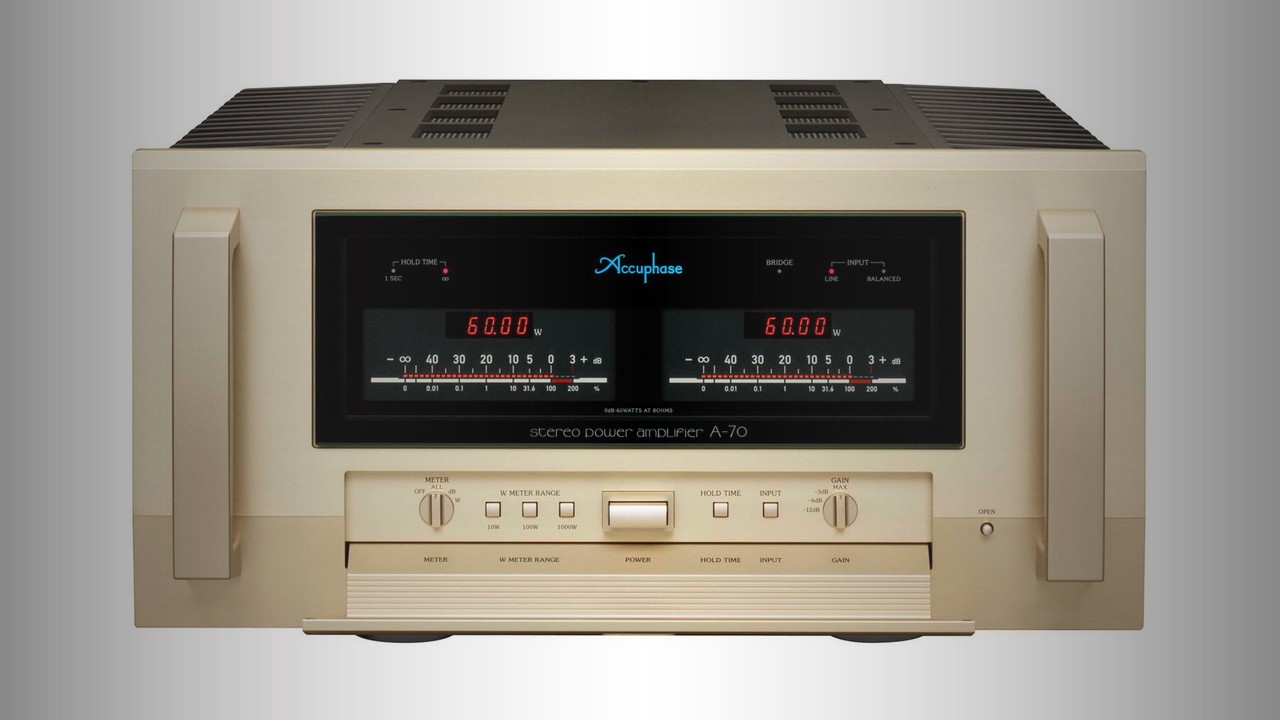
5. Accuphase A-75: Massive Stereo Amplifier from the Japanese Company
The Accuphase A-75 is a large stereo amplifier from the specialist Japanese high-end manufacturer.
The Accuphase A-75 is presented as a large stereo amplifier from a Japanese high-end manufacturer whose production emphasizes specialist assembly rather than high-volume manufacturing.
The supplied article concentrates primarily on Accuphase’s history, naming and commitment to high-fidelity reproduction, rather than providing the A-75’s circuit type, output ratings, connections or operating modes.
It therefore belongs on a specialist shortlist, but meaningful system matching requires more technical information than the source provides.
Best for: Specialist high-end systems assessed with full dealer or manufacturer specifications
- Large stereo-amplifier format
- Produced by a specialist high-end manufacturer
Verdict: The A-75 carries clear specialist positioning, although the supplied material is too limited for a detailed technical comparison.

6. McIntosh MA12000: The Company’s Most Powerful Integrated Amplifier
The McIntosh MA12000 combines four 12AX7A preamplifier tubes with 350-watt solid-state output stages and an onboard digital module.
The McIntosh MA12000 is a hybrid integrated amplifier combining a preamplifier built around four 12AX7A dual triodes with solid-state power stages.
It delivers 350 watts to each channel across supported speaker impedances from 2 to 8 ohms.
Its extensive feature set includes an eight-band analog tone control, a High Drive headphone amplifier with crossfeed, home-theater PassThru, speaker-protection systems and the DA2 digital audio module. USB playback extends to DSD512 and PCM at 384 kHz, while its coaxial and optical inputs accept signals up to 24-bit/192 kHz.
Best for: Large, feature-rich systems needing high output and analog-digital integration
- 350 watts per channel across 2 to 8 ohms
- Tube preamplifier and solid-state power stages
- DA2 digital audio module
- Eight-band analog tone control
Verdict: The MA12000 combines unusually high integrated-amplifier output with tube preamplification, digital playback and extensive control features.

7. Synthesis FCO-300B: Tube Amplifier Using 300B Triodes from Italy
The Synthesis FCO-300B is a dual-mono, single-ended Class A integrated amplifier built around 300B output triodes.
The Synthesis FCO-300B is a single-ended, dual-mono integrated amplifier designed specifically for high-sensitivity speakers.
Its pure Class A output stages use Electro-Harmonix 300B directly heated triodes, supported by 12AU7 and 12AX7 preamplifier tubes, 6CG7 driver tubes and a 5U4G rectifier.
A toroidal power transformer, double C-core output transformers and separate 4- and 8-ohm speaker terminals address the practical needs of a traditional tube design. Automatic bias adjustment reduces routine setup, and the supplied remote handles volume and input selection.
Best for: High-sensitivity speakers and listeners committed to 300B tube amplification
- Single-ended pure Class A operation
- Dual-mono architecture
- Separate 4- and 8-ohm speaker terminals
- Automatic bias adjustment
Verdict: The FCO-300B is a purpose-built choice for efficient loudspeakers, with traditional 300B circuitry and helpful automatic bias control.

8. SMSL AO200 MKII: Amplifier with Bluetooth 5.0
The SMSL AO200 MKII is a compact Class D amplifier with Bluetooth 5.0, XLR and RCA inputs, and a subwoofer output.
The SMSL AO200 MKII is a compact Class D integrated amplifier based on the Infineon MA5332MS module.
It is rated at 160 watts per channel into 4 ohms and provides both unbalanced RCA and balanced XLR inputs.
Bluetooth 5.0 supports direct wireless streaming, while an RCA subwoofer output allows the amplifier to anchor a 2.1-channel system. Eight equalizer presets and manual bass and treble adjustment provide more tuning flexibility than a minimalist analog amplifier.
Best for: Compact 2.1 systems needing Bluetooth and balanced input support
- 160 watts per channel into 4 ohms
- Balanced XLR and unbalanced RCA inputs
- Bluetooth 5.0 streaming
- Subwoofer output and tone adjustment
Verdict: The AO200 MKII offers substantial rated output, wireless playback and practical system tuning in a compact Class D design.
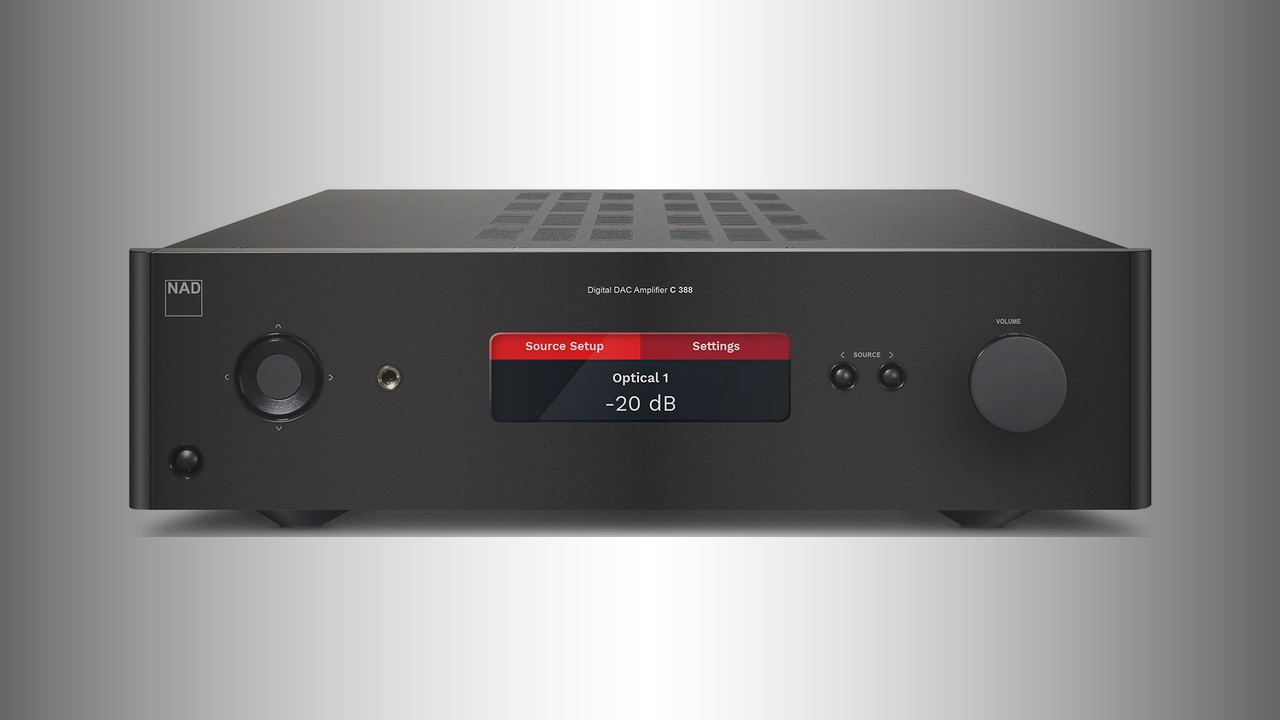
9. NAD C 388: Integrated Amplifier and Wireless Multiroom Center
The NAD C 388 integrates Hypex UcD amplification with a moving-magnet phono stage, headphone amplification and multiroom functionality.
The NAD C 388 combines a Hypex UcD Class D amplifier with digital conversion, analog source support and a dedicated headphone stage.
Its output exceeds 150 watts per channel into 8 ohms, while the low-output-impedance headphone amplifier is intended to accommodate a broad range of headphone impedances.
Vinyl users receive a low-noise moving-magnet phono stage with accurate RIAA equalization, high overload capability and a subsonic filter designed to suppress infrasonic movement without affecting the wanted signal. Its positioning as a wireless multiroom center makes it the network-oriented option in this selection.
Best for: Mixed digital, vinyl, headphone and multiroom listening
- More than 150 watts per channel into 8 ohms
- Moving-magnet phono stage
- Dedicated low-impedance headphone amplifier
- Wireless multiroom positioning
Verdict: The C 388 is the broad-system option here, combining strong Class D output with phono, headphone and multiroom functions.

10. DALI PHANTOM CI AMP-4125 DSP: Rack-Friendly DSP Amplifier
The DALI PHANTOM CI AMP-4125 DSP places four 125-watt Class D channels and integrated processing in a half-rack chassis.
The DALI PHANTOM CI AMP-4125 DSP is designed for custom installation rather than a conventional two-channel listening room.
Its half-rack, 1U-high chassis contains four Class D channels rated at 125 watts each, with integrated digital signal processing for configuration and commissioning.
High efficiency and low heat generation suit enclosed equipment racks, while the four-channel layout can serve multiroom zones, surround channels or distributed commercial audio. It is the most installation-specific amplifier in this guide.
Best for: Professionally configured multi-zone, surround or distributed-audio systems
- Four channels of 125 watts
- Integrated digital signal processing
- Half-rack, 1U-high chassis
- Efficient Class D operation for rack installations
Verdict: The PHANTOM CI AMP-4125 DSP is a compact four-channel platform for rack-based custom installations rather than a traditional standalone stereo system.
Quick comparison
The central distinction is not simply output power but system role.
The Fezz and Synthesis models target tube-oriented listening with appropriately matched speakers, while the Yamaha, Arcam, McIntosh, SMSL and NAD products integrate source control and amplification.
Teac’s AP-507 is a configurable power amplifier, the Accuphase A-75 is presented as a specialist high-end stereo model, and the DALI is built for rack-based custom installation.
| Product | Best for | Verdict |
|---|---|---|
| Fezz Audio Luna Evo and Luna Mini Evo | Efficient speakers and compact tube-based systems | The documented Luna Mini Evo supplies 10-watt Class A operation, three RCA inputs and a subwoofer output. |
| Yamaha A-S1200 | Analog-focused integrated-amplifier systems | A discrete MOSFET design with separated channel boards and up to 160 watts per channel into 4 ohms. |
| Arcam A25 | Modern systems requiring Bluetooth, USB-C and Class G amplification | A 100-watt integrated amplifier that operates in Class A up to 20 watts per channel. |
| Teac AP-507 | Compact modular systems and configurable power-amplifier use | A Class D power amplifier supporting stereo, bi-amp and 230-watt bridged mono operation. |
| Accuphase A-75 | Specialist high-end stereo systems | A large Accuphase stereo amplifier for which the supplied source provides limited model-specific detail. |
| McIntosh MA12000 | High-output systems needing extensive analog and digital facilities | A 350-watt hybrid integrated amplifier with tube preamplification and a replaceable digital audio module. |
| Synthesis FCO-300B | High-sensitivity speakers and single-ended tube systems | A dual-mono pure Class A integrated amplifier using 300B output triodes and automatic bias adjustment. |
| SMSL AO200 MKII | Compact Bluetooth and 2.1-channel systems | A 160-watt-per-channel Class D model with XLR, RCA, Bluetooth and subwoofer connectivity. |
| NAD C 388 | Vinyl, headphones, digital sources and multiroom audio | A versatile Class D integrated amplifier with more than 150 watts per channel, MM phono support and a dedicated headphone stage. |
| DALI PHANTOM CI AMP-4125 DSP | Rack-mounted custom and distributed-audio installations | A four-channel, 125-watt-per-channel Class D installation amplifier with integrated DSP. |
Frequently asked questions
Should I choose an integrated amplifier or a power amplifier?
An integrated amplifier combines source selection, volume control and power amplification in one chassis.
A power amplifier such as the Teac AP-507 requires a separate preamplifier or controller but offers greater freedom to build or expand a modular system.
How much amplifier power do I need?
Match output to speaker sensitivity, impedance, listening distance, room size and desired volume rather than choosing by wattage alone.
The 10-watt Fezz Luna Mini Evo and the 300B-based Synthesis are intended for efficient speakers, whereas the higher-powered solid-state models provide more scope for demanding loads or larger listening spaces.
Does the amplifier class determine sound quality?
Class A, Class G, Class AB and Class D describe circuit operation, efficiency and power-delivery approaches, but the class alone does not establish overall quality.
Compare the complete design, speaker compatibility, required features and operating conditions.
Which connections should I check before buying?
List every source and system component first.
Depending on the system, priorities may include RCA or XLR analog inputs, USB or optical digital inputs, Bluetooth, a moving-magnet phono stage, headphone output, subwoofer connection, speaker impedance terminals or home-theater integration.
How to Choose the Right Amplifier for Serious Listening
Begin with the loudspeakers.
Confirm their impedance, sensitivity and recommended amplifier range, then consider room size and normal listening distance.
This is especially important for the low-powered Fezz Luna Mini Evo and Synthesis FCO-300B, both of which are positioned for efficient or high-sensitivity speakers. Higher output can provide useful headroom, but a large wattage figure does not replace careful matching. Next, decide whether the amplifier must act as the system hub. The Arcam A25 and SMSL AO200 MKII add Bluetooth, the NAD C 388 covers vinyl, headphones and multiroom use, and the McIntosh MA12000 combines extensive analog control with advanced digital playback. The Yamaha A-S1200 takes a more analog-centered approach, while the Teac AP-507 belongs in a modular system with a separate preamplifier. DALI’s PHANTOM CI AMP-4125 DSP should be considered when rack mounting, multiple channels and professional configuration are central requirements. Finally, compare practical details that are easy to overlook: chassis size, heat, ventilation, remote operation, headphone support, subwoofer connectivity and the number and type of inputs. Tube amplifiers also require attention to speaker matching and valve-related operation, although features such as preheating or automatic bias can simplify ownership. Where the available source information is incomplete, as it is for the Accuphase A-75, obtain the full model specification before making a system decision.


Join the discussion
Share your thoughts, listening impressions or product experience.