OePhi Lounge 2 and Lounge 2.5: Danish Speakers Built Around Timing and Neutrality
OePhi’s Lounge 2 and Lounge 2.5 bring the Danish company’s focus on neutrality, timing, and low coloration into two practical loudspeaker formats: a compact 2-way standmount and a larger 2.5-way floorstander.

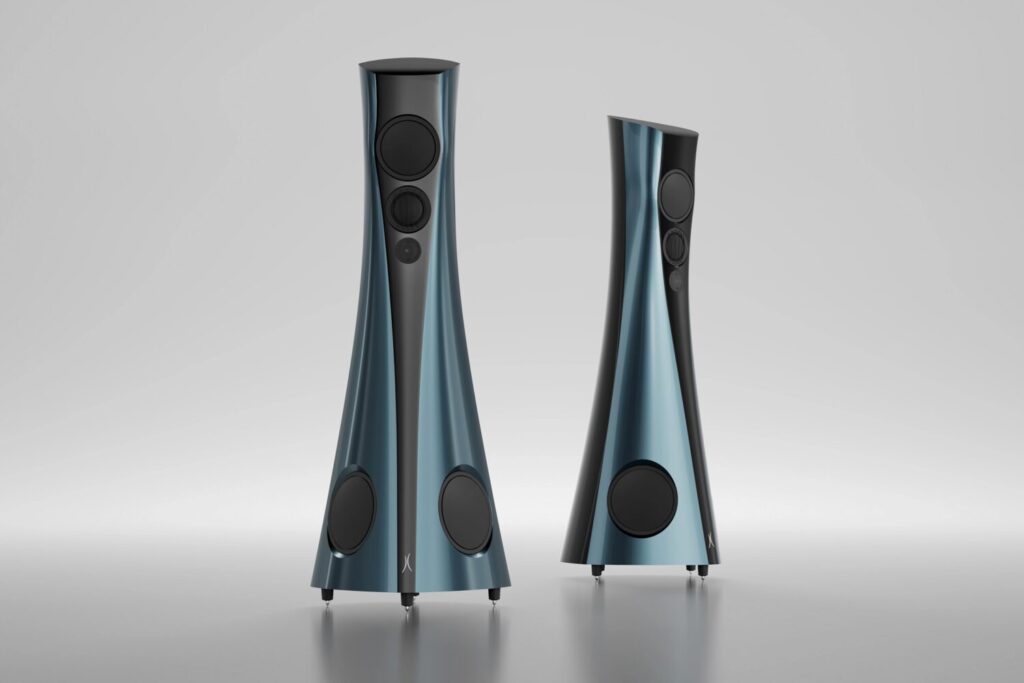
The OePhi Lounge 2 and Lounge 2.5 are designed for listeners who want a loudspeaker that puts acoustic discipline ahead of visual drama. Introduced by the Danish audio specialist at the 2025 High End Show in Munich, the Lounge series applies OePhi’s core priorities—neutrality, low coloration, timing accuracy, and clean Scandinavian design—to two different room and system contexts. The Lounge 2 is the compact bookshelf model, while the Lounge 2.5 is the larger floorstanding version for broader scale and deeper bass extension. Together, they form a concise loudspeaker range with a clear engineering identity rather than a long list of variants.
A two-model range with a clear purpose
The Lounge series is deliberately simple: one compact 2-way loudspeaker and one larger 2.5-way floorstanding loudspeaker. That distinction matters because it gives prospective owners a straightforward choice based on room size, placement needs, amplifier matching, and desired low-frequency reach.
The Lounge 2 is intended for smaller listening environments. At just under 14 inches tall and weighing around 14 pounds, it is a compact speaker that can fit into rooms where a floorstander might be visually or acoustically excessive. Its 2-way layout, 45 Hz to 27 kHz stated frequency response, 87 dB sensitivity, 8-ohm impedance, and power handling up to 75 watts make it the more space-conscious member of the pair.
The Lounge 2.5, by contrast, is the speaker for owners who want a larger acoustic footprint. Its 2.5-way floorstanding configuration extends bass response down to a stated 35 Hz, increases sensitivity to 89.5 dB, and supports up to 150 watts of power handling. Standing one meter tall and weighing approximately 33 pounds, it is physically and electrically positioned for larger rooms and more demanding systems. The choice between the two models is therefore not merely aesthetic; it is about matching the speaker’s scale to the room and the electronics driving it.
Neutrality as the organizing idea
OePhi’s stated design philosophy centers on what it describes as “true sound,” with a particular emphasis on reducing distortion and coloration. For a prospective owner, this matters because loudspeakers are not only transducers; they are also interpretive devices. Cabinet behavior, crossover design, driver integration, and electrical noise can all influence how music is presented. OePhi’s approach, as documented for the Lounge series, is to address those areas with technologies intended to preserve timing, transparency, and natural tone.
This does not mean the Lounge 2 or Lounge 2.5 should be understood as lifestyle accessories with audio performance as an afterthought. Their minimalist appearance is paired with an engineering narrative that focuses on phase alignment, transient behavior, and enclosure control. In practical terms, the attraction is that the speakers are designed to suit listeners who value a less editorialized presentation and who want the loudspeaker to interfere as little as possible with the source material.

Time Compensated XO crossover design
One of the key documented technologies in both models is OePhi’s Time Compensated XO crossover. The purpose of this crossover is to ensure precise phase alignment between the drivers. In a multi-driver loudspeaker, the crossover is not just a frequency-splitting network; it determines how the drivers hand over musical information to one another. If timing and phase behavior are not well managed, the result can be a less coherent presentation, particularly through the critical regions where drivers overlap.
For the Lounge series, OePhi’s emphasis on time compensation is consistent with its broader focus on coherent imaging and timing. While the source information does not provide circuit topology or component-level detail, the design goal is clear: to make the drivers behave as an integrated system rather than as separate units occupying the same cabinet. For listeners building a two-channel system around stereo imaging and musical flow, that kind of crossover priority may be especially relevant.
Transient Integrity Circuitry and dynamic preservation
The Lounge 2 and Lounge 2.5 also include OePhi’s Transient Integrity Circuitry. This technology is described as being designed to preserve the full dynamic range of music while suppressing unwanted electrical noise. Transients are the leading edges of musical events: the initial strike of a piano note, the snap of a drum, or the articulation of a plucked string. Preserving them is important because they help define rhythm, texture, and the sense of musical immediacy.
Electrical noise management is another useful design priority, particularly in systems where source, amplification, and cables are chosen with care. A loudspeaker cannot correct problems elsewhere in the chain, but its internal electrical behavior can either support or obscure the information it receives. By placing transient integrity and noise suppression among the Lounge series’ core technologies, OePhi is positioning these speakers for systems where detail and dynamic nuance are part of the ownership goal.

Cabinet materials and resonance control
Both Lounge models use enclosures constructed with low energy storage materials. Cabinet design is central to loudspeaker performance because the enclosure can store and release energy after the musical signal has moved on. That delayed energy may contribute to coloration or internal resonance if not adequately controlled. OePhi’s use of low energy storage materials is intended to reduce those internal resonances and help maintain a clean, open soundstage.
This is a particularly important area for speakers intended to sound neutral. A visually beautiful cabinet is not enough if it adds audible character of its own. The Lounge series combines a restrained Scandinavian exterior with an engineering purpose: reduce the cabinet’s tendency to impose itself on the sound. For owners who prefer understated design, that combination may be part of the appeal. The speaker does not need to look visually complex to be technically considered.
Lounge 2: compact format for smaller listening spaces
The Lounge 2 is the more compact and placement-friendly model. Its bookshelf format makes it suitable for smaller rooms, apartments, studios, or living spaces where a floorstanding loudspeaker would dominate. With a stated frequency response of 45 Hz to 27 kHz, it is specified to reach low enough for many music-focused systems while maintaining a compact cabinet size. Its 8-ohm impedance is also a practical figure for system matching, as many amplifiers are designed to operate comfortably into that nominal load.
The 87 dB sensitivity and 75-watt power handling suggest a speaker intended for thoughtful system pairing rather than brute-force output. Prospective owners should consider room size and listening distance, but the Lounge 2’s documented profile points toward a speaker for near-to-moderate listening setups where refinement, coherence, and space efficiency are more important than maximum physical scale. Its approximately 14-pound weight also makes it more manageable for installation than larger designs, while still suggesting a cabinet of substance rather than an ultra-light decorative speaker.

Lounge 2.5: greater scale and deeper extension
The Lounge 2.5 takes the same family concept into a floorstanding format. Its 2.5-way configuration, one-meter height, approximately 33-pound weight, 35 Hz to 27 kHz stated frequency response, 89.5 dB sensitivity, 6-ohm impedance, and power handling up to 150 watts place it in a different usage category from the Lounge 2. The practical benefit is greater bass extension, higher sensitivity, and the ability to work in larger rooms or with more ambitious systems.
The 35 Hz bass specification is notable within the context of the information supplied because it gives the Lounge 2.5 a lower stated reach than the bookshelf model. For listeners who want a full-range stereo presentation without immediately planning around a subwoofer, that extra extension may be attractive. The higher sensitivity may also help in systems where amplifier power is available but not unlimited, although its 6-ohm impedance should still be considered when matching electronics. As with any loudspeaker, owners should choose amplification appropriate to the speaker’s load and intended playback levels.
Conclusion
The OePhi Lounge 2 and Lounge 2.5 are best understood as two expressions of the same design philosophy: minimalist Danish loudspeakers built around neutrality, timing, resonance control, and practical room matching. The Lounge 2 is the compact choice for smaller spaces and systems where a bookshelf speaker makes the most sense, while the Lounge 2.5 offers greater scale, deeper stated bass extension, higher sensitivity, and more power handling for larger rooms. Both models share OePhi’s Time Compensated XO crossover, Transient Integrity Circuitry, low energy storage enclosure approach, and a restrained selection of finishes including oak, walnut, black ash, and matte white. With U.S. pricing listed at $3,500 USD per pair for the Lounge 2 and $5,800 USD per pair for the Lounge 2.5, the series is aimed at listeners who value clean design and a carefully documented pursuit of transparent, uncolored reproduction.