Which DAC Should You Choose for Your System?
A practical guide to choosing the right DAC for your system, covering desktop converters, portable DAC/amps, streamer DACs, CD-focused options, balanced outputs, DSD, MQA, and headphone use.

Choosing a DAC is less about chasing a single universal winner and more about matching the converter to the way you actually listen.
A desktop system with active monitors, a CD-based setup, a headphone desk, and a phone-driven portable rig all place different demands on inputs, outputs, power, size, and format support.
The models below cover a wide spread of DAC use cases: full-size desktop converters, DAC/headphone amplifiers, a CD player with a built-in DAC section, compact USB units, and pocketable dongles. Some emphasize elaborate multi-DAC architecture and balanced analogue stages; others focus on practical smartphone compatibility, simple USB-C operation, or support for DSD and MQA. This guide stays close to the supplied product information. Where a specification or capability is not stated, it is not assumed. Use the recommendations as a way to narrow the field by system role first, then by the digital formats, connections, and headphone or preamp needs that matter in your setup.
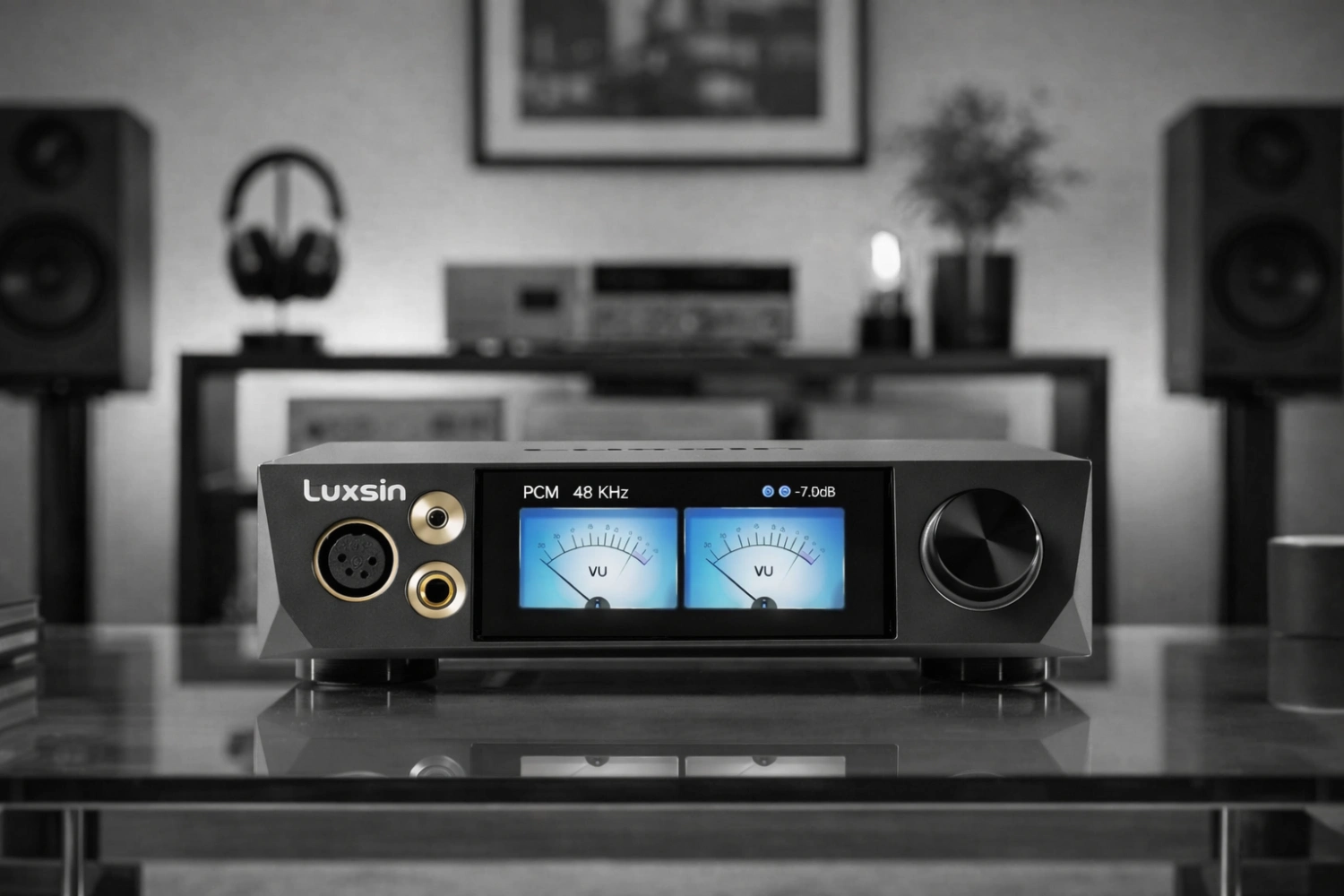
1. Luxsin X8
Luxsin X8 desktop DAC/amp with an eight-DAC architecture and separated channel layout.
The Luxsin X8 is the most technically ambitious desktop DAC/amp in this selection, built around eight Cirrus Logic CS43198 DAC chips in a dual-mono parallel layout.
Four DACs per channel feed a summed analogue output, with separated left and right signal paths, independent power delivery, dedicated buffering, clock distribution, individual DAC shielding, and a fully separated linear power supply.
The source also cites nearly 5 watts per channel of output power, making this a serious option for listeners who want a DAC/amp with substantial headphone-driving capability rather than a simple line-level converter.
Best for: Desktop listeners who want a high-output DAC/headphone amplifier
- Eight CS43198 DAC chips in dual-mono parallel architecture
- Separated left and right power delivery and signal paths
- Dedicated clock distribution and individual DAC shielding
- Nearly 5 watts per channel of output power
Verdict: Choose the Luxsin X8 if your priority is a heavily engineered desktop DAC/amp with a multi-DAC layout and substantial output power.
2. T+A DAC 8 DSD
T+A DAC 8 DSD compact desktop converter with aluminium construction and integrated preamp functionality.
The T+A DAC 8 DSD is a compact but serious converter designed as a universal digital hub rather than a basic computer accessory.
It supports signals up to DSD512 and uses a discrete True 1-bit DSD DAC for DSD playback, while PCM conversion is handled by four separate PCM DACs per channel.
The design also includes a precision clock generator, separate power circuits for digital and analogue sections, a fully analogue preamplifier stage, and a headphone amplifier described as suitable for high-impedance headphones. Its aluminium case is compact for a full desktop component, with a square footprint measuring 270 mm per side and a height of 95 mm.
Best for: Compact high-end desktop systems with PCM, DSD, preamp, and headphone needs
- Supports DSD up to DSD512
- Discrete True 1-bit DSD conversion
- Four PCM DACs per channel
- Analogue preamplifier section and headphone amplifier
Verdict: The T+A DAC 8 DSD is a strong fit when you want advanced DSD handling, a compact chassis, and integrated analogue control in one DAC.

3. Gustard DAC-X30
Gustard DAC-X30 streamer and DAC built around four ESS ES9039SPRO conversion chips.
The Gustard DAC-X30 combines DAC, streamer, and preamplifier functions in a component aimed at complex digital systems.
Its conversion stage uses four ESS ES9039SPRO DAC chips, arranged as two per channel for a fully balanced architecture with independent power and grounding.
Volume is handled through an R2R relay in a passive analogue preamp arrangement, and the unit can connect directly to active studio monitors or power amplifiers. The digital side is also extensive, with FPGA logic for clock control and digital processing, a SHARC-based DSP filter, and the CelWare bridge system built around an optimized Linux kernel intended to reduce latency and jitter.
Best for: Systems needing a DAC, streamer, and analogue volume control in one component
- Four ESS ES9039SPRO DAC chips
- Balanced architecture with two DAC chips per channel
- R2R relay volume control in a passive analogue preamp
- Streamer platform with FPGA and SHARC-based processing
Verdict: The Gustard DAC-X30 is the most system-integrated choice here for users who want conversion, streaming, balanced architecture, and direct power-amp or monitor connection.

4. Rega Saturn-R
Rega Saturn-R CD player and DAC with top-loading transport and multiple digital inputs.
The Rega Saturn-R is different from most entries here because it combines a top-loading CD transport and a DAC on a shared chassis.
Both sections are controlled by the Solaris remote, and the digital input selection is broad for a CD-focused component: two optical inputs, two coaxial inputs, asynchronous USB, and a direct digital output from the CD transport.
Its digital interfaces support audio streams up to 24-bit/192 kHz, while conversion is handled by two Wolfson WM8742 DACs connected in parallel. Rega also specifies a highly stable quartz oscillator and low-jitter design elements, making the Saturn-R especially relevant to listeners who still value CD playback but also want external digital inputs.
Best for: CD listeners who also need a capable external DAC
- Combines CD transport and DAC in one chassis
- Two optical, two coaxial, and asynchronous USB inputs
- Digital interfaces support up to 24-bit/192 kHz
- Two parallel Wolfson WM8742 DACs
Verdict: The Rega Saturn-R makes the most sense if disc playback remains central to your system but you also want digital-input flexibility.

5. xDuoo Link10
xDuoo Link10 portable DAC/amp with 3.5 mm and 4.4 mm headphone outputs in a lightweight aluminium case.
The xDuoo Link10 is a compact DAC/headphone amplifier for phones, computers, tablets, and game consoles.
It uses dual CS43131 DAC chips and supports PCM up to 32-bit/384 kHz and DSD256.
Despite its small aluminium body and 25 g weight, the source lists output power up to 300 mW through the balanced connection, with both 3.5 mm and 4.4 mm headphone outputs included. It is powered by the connected device rather than an internal battery, and its UAC 1.0 and UAC 2.0 modes broaden compatibility across computers, players, and game systems.
Best for: Portable wired listening from phones, laptops, tablets, and game consoles
- Dual CS43131 DAC chips
- PCM up to 32-bit/384 kHz and DSD256 support
- 3.5 mm and 4.4 mm outputs
- 25 g aluminium body
Verdict: The xDuoo Link10 is a practical pocket DAC/amp when you want balanced output, broad device compatibility, and high-resolution format support in a very small body.

6. TEAC UD-301-X
TEAC UD-301-X compact dual-mono USB DAC with Burr-Brown conversion and balanced analogue outputs.
The TEAC UD-301-X is a compact USB DAC built around a dual-mono circuit using Burr-Brown PCM1795 DAC chips from Texas Instruments, one per channel.
It follows a more traditional hi-fi component approach than the portable dongles, with a toroidal transformer power supply, optical and coaxial digital inputs, USB playback, and analogue outputs on both RCA and XLR.
Via USB it works with DSD 2.8 MHz and 5.6 MHz files, while PCM support reaches 24-bit/192 kHz through USB, optical, and coaxial inputs. The circuit can also upsample incoming signals to 192 kHz, with the option to disable that conversion.
Best for: Desktop hi-fi systems needing a compact USB DAC with balanced outputs
- Dual-mono design with one Burr-Brown PCM1795 DAC per channel
- Toroidal transformer power supply
- RCA and XLR analogue outputs
- Optional upsampling to 192 kHz
Verdict: The TEAC UD-301-X is a sensible choice for a conventional hi-fi setup where USB, optical, coaxial, RCA, and XLR connectivity all matter.

7. Hidizs SD2
Hidizs SD2 ultra-compact USB-C DAC/headphone amplifier with a single 3.5 mm output.
The Hidizs SD2 is the simplest and smallest portable DAC/headphone amplifier in this guide.
It is built around the ESS ES9270 chip and uses a USB-C connection for phones, computers, tablets, and game consoles.
The single 3.5 mm headphone output can also feed powered speakers, and the stated output is 70 mW + 70 mW into 32 ohms. Format support is strong for such a small device, with PCM up to 384 kHz/32-bit and native DSD64/128. Its 34.5 x 20 x 10 mm dimensions make it suited to users who want an external DAC without carrying a larger dongle or battery-powered amp.
Best for: Minimalist portable setups using wired 3.5 mm headphones
- ESS ES9270 DAC chip
- USB-C connection for multiple device types
- PCM up to 384 kHz/32-bit and native DSD64/128
- Very small 34.5 x 20 x 10 mm body
Verdict: The Hidizs SD2 is the straightforward choice when you need a tiny USB-C DAC/amp with a standard 3.5 mm output.

8. Luxman DA-06
Luxman DA-06 digital-to-analog converter with aluminium front panel and multiple optical and coaxial inputs.
The Luxman DA-06 is presented as a dedicated DAC that can serve as the central digital link in a modern audio system.
Its appeal in the supplied material is less about portable convenience and more about component-level construction: a small metal case, shaped aluminium front panel, LED display, non-magnetic chassis to help protect the electronics from external interference, and massive supports intended to reduce mechanical resonance.
The source highlights two optical and two coaxial inputs, making it relevant for systems with several conventional digital sources.
Best for: Traditional hi-fi systems with several optical and coaxial digital sources
- Two optical and two coaxial digital inputs
- Metal non-magnetic chassis
- Aluminium front panel with LED display
- Massive supports for mechanical stability
Verdict: The Luxman DA-06 is best considered when you want a dedicated component DAC with robust construction and multiple standard digital inputs.

9. The Best Portable DACs: Pocket Hi-Fi Done Right
Portable DACs are designed to bring wired headphone support and external conversion to phones, laptops, and compact desktop setups.
This source is a portable DAC buying-guide article rather than a single product, so it is most useful as context for readers deciding whether a pocket DAC is the right direction.
Its core argument is practical: as phone headphone jacks disappear, a portable DAC/headphone amplifier can act as both an adapter and a sound-focused upgrade for wired headphones.
The article frames dongle DACs as devices for phones, laptops, and desktops, with options ranging from affordable entry-level choices to more ambitious portable units. It also identifies the FiiO KA11 as a starting point in the portable DAC conversation, without requiring users to carry a full digital audio player.
Best for: Readers comparing the broader portable DAC category before choosing a model
- Focuses on pocketable DAC/headphone amplifiers
- Useful for phone, laptop, and desktop listening
- Covers both affordable and more ambitious portable options
- Highlights wired headphones as the intended use case
Verdict: Use this guide-style entry if you are still deciding whether a dongle DAC is the right alternative to wireless headphones or a full digital audio player.

10. SMSL RAW-MDA1
SMSL RAW-MDA1 DAC/headphone amplifier with display, Bluetooth support, and balanced analogue output options.
The SMSL RAW-MDA1 is a feature-rich DAC/headphone amplifier for users who need both wired and wireless digital inputs.
It uses two ESS ES9039Q2M DAC chips, an XMOS XU-316 USB interface, and supports MQA and MQA-CD.
Wireless support is handled by Qualcomm Bluetooth 5.1 with LDAC, aptX HD, SBC, and AAC, while physical inputs include USB, optical, and coaxial. Outputs cover RCA, XLR, and headphones, and the headphone amplifier is specified at up to 2.5 W x 2 into 16 ohms. USB mode support is also flexible: USB 2.0 reaches up to 768 kHz/32-bit PCM and DSD512 with driver installation, while USB 1.1 supports up to 96 kHz/16-bit PCM without drivers.
Best for: Desktop users who want one DAC/amp for USB, Bluetooth, line output, and headphones
- Dual ESS ES9039Q2M DAC chips
- USB, optical, coaxial, and Bluetooth inputs
- RCA, XLR, and headphone outputs
- MQA, MQA-CD, LDAC, and aptX HD support
Verdict: The SMSL RAW-MDA1 is the flexible modern desktop option here, especially if you need Bluetooth, MQA support, balanced outputs, and a powerful headphone stage together.
Quick comparison
The clearest way to compare these DACs is by system role.
Some are full desktop hubs with balanced outputs and preamp functions, some are portable USB-C headphone solutions, and one is a CD player with an integrated DAC section.
The table below keeps the distinctions high-level and limited to capabilities stated in the supplied material.
| Product | Best for | Verdict |
|---|---|---|
| Luxsin X8 | High-output desktop headphone listening | Eight CS43198 DAC chips, separated channel architecture, linear power supply, and nearly 5 watts per channel make it the power-focused DAC/amp choice. |
| T+A DAC 8 DSD | Compact desktop systems with strong DSD requirements | DSD512 support, discrete True 1-bit DSD conversion, PCM multi-DAC processing, analogue preamp, and headphone amp give it broad high-end desktop appeal. |
| Gustard DAC-X30 | Integrated DAC, streamer, and preamp setups | Four ES9039SPRO chips, balanced architecture, R2R relay volume, and streamer architecture make it the most system-hub-like component. |
| Rega Saturn-R | CD-based systems with extra digital sources | A top-loading CD transport and external DAC section on one chassis make it the obvious choice for listeners who still use discs. |
| xDuoo Link10 | Portable balanced headphone use | Dual CS43131 DACs, 3.5 mm and 4.4 mm outputs, UAC modes, and 25 g weight make it a compact phone-and-laptop DAC/amp. |
| TEAC UD-301-X | Compact hi-fi systems needing RCA and XLR outputs | Dual-mono Burr-Brown conversion, toroidal power supply, optical, coaxial, USB, RCA, and XLR connectivity suit a traditional desktop hi-fi role. |
| Hidizs SD2 | Tiny USB-C 3.5 mm headphone setups | The ESS ES9270 chip, USB-C input, 3.5 mm output, and very small case make it the most minimal portable DAC/amp here. |
| Luxman DA-06 | Component systems with multiple optical and coaxial sources | A dedicated chassis, LED display, two optical inputs, and two coaxial inputs make it a straightforward digital hub for conventional sources. |
| The Best Portable DACs: Pocket Hi-Fi Done Right | Readers deciding between portable DAC approaches | This is a category guide rather than a product, useful for understanding why dongle DACs suit wired headphones, phones, laptops, and compact desktops. |
| SMSL RAW-MDA1 | Feature-rich desktop DAC/amp use with wired and wireless sources | Dual ESS conversion, Bluetooth with LDAC and aptX HD, MQA support, RCA, XLR, and headphone outputs make it the broadest connectivity option. |
Frequently asked questions
Should I choose a desktop DAC or a portable DAC?
Choose a desktop DAC if your system needs fixed analogue outputs, balanced XLR connections, preamp functions, or a more permanent place in a hi-fi rack or headphone desk.
Choose a portable DAC such as the xDuoo Link10 or Hidizs SD2 if the main source is a phone, tablet, laptop, or game console and you want a small USB-powered device for wired headphones.
Do I need balanced outputs on a DAC?
Balanced outputs are useful when your amplifier, active monitors, or headphone setup can accept them, but they are not mandatory for every system.
In this selection, desktop models such as the Gustard DAC-X30, TEAC UD-301-X, and SMSL RAW-MDA1 include balanced line-level options, while the xDuoo Link10 offers a 4.4 mm balanced headphone output alongside 3.5 mm.
How important are DSD and MQA support?
They matter only if you own or stream material in those formats.
The T+A DAC 8 DSD is notable for DSD512 and discrete True 1-bit DSD conversion, while the SMSL RAW-MDA1 supports MQA and MQA-CD as well as high-rate USB playback.
If your library is mostly standard PCM from a computer, CD transport, or streamer, input compatibility and analogue outputs may be more important than rare format support.
Can a DAC replace a preamplifier?
Only if it provides suitable volume control and outputs for your amplifier or active speakers.
The Gustard DAC-X30 is specifically described with passive analogue preamp functionality and the ability to connect directly to active studio monitors or power amplifiers.
The T+A DAC 8 DSD includes a fully analogue preamplifier section. Other DACs may be better treated as source components feeding a separate integrated amplifier, preamp, or headphone amp.
How to Make the Right DAC Choice
Start with the source you use most.
A phone-first listener should not overbuy a rack component when a compact USB-C DAC/amp such as the Hidizs SD2 or xDuoo Link10 covers the job.
A desktop headphone listener should pay closer attention to amplifier output, headphone connectors, and whether the unit is powered from the host device or from its own supply. That points toward products such as the Luxsin X8 or SMSL RAW-MDA1 when stronger headphone capability and broader desktop connectivity are required. For a conventional hi-fi system, outputs and system integration matter as much as chip choice. The TEAC UD-301-X is appealing when RCA and XLR outputs, optical and coaxial inputs, USB, and dual-mono construction are the priorities. The Luxman DA-06 is aimed at a more traditional digital-source setup with multiple optical and coaxial inputs and robust component construction. If you use active monitors or a power amplifier directly, the Gustard DAC-X30 is the clearest fit here because its preamp role is explicitly part of the design. Disc listeners should look separately at the Rega Saturn-R, because it is not just an external DAC. Its value lies in combining a top-loading CD transport with a DAC section and several digital inputs, making it a hybrid source component for systems where CDs remain important. For listeners with extensive DSD libraries, the T+A DAC 8 DSD stands out for its DSD512 support and dedicated DSD conversion approach. The safest buying method is to list your required inputs, outputs, headphone needs, and formats before comparing conversion hardware. A DAC with the wrong connections is the wrong DAC no matter how impressive its internal architecture looks. Once compatibility is settled, choose the model whose role best matches your system: portable adapter, headphone DAC/amp, desktop digital hub, preamp-capable streamer DAC, or CD-and-DAC source component.