
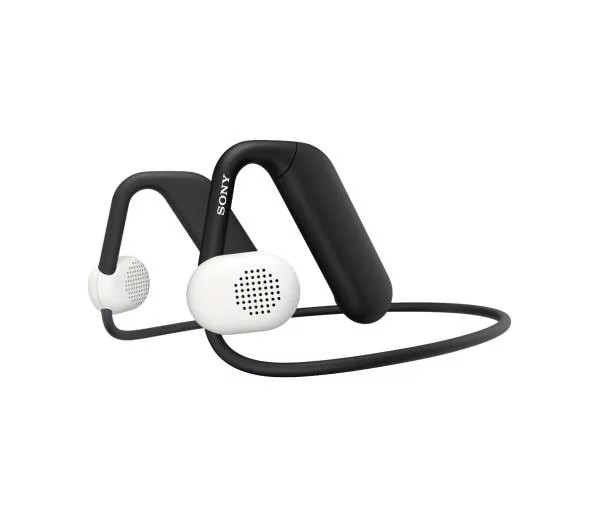
Sony Float Run is an example of a sports headphone designed from the outside in. Instead of beginning with a conventional in-ear shape and adding fins, hooks, or tighter tips to keep it in place, Sony has built the Float Run around an “out-of-the-ear” concept. The drivers sit near the ear rather than inside the ear canal, while a behind-the-ear support structure and flexible rear band keep the system in position. For runners and active users, that design choice is the central point of interest: it aims to reduce the intrusive feel of in-ear headphones while maintaining a secure, purpose-built form for movement.
A different answer to the running headphone problem
Running headphones have to solve a different set of problems from home audio products. They must stay put through repeated motion, avoid becoming uncomfortable over longer sessions, and remain simple enough to use when attention is divided between pace, route, weather, and surroundings. The Float Run addresses those needs with a suspension-style frame rather than a conventional earbud shell that depends on a seal inside the ear canal.
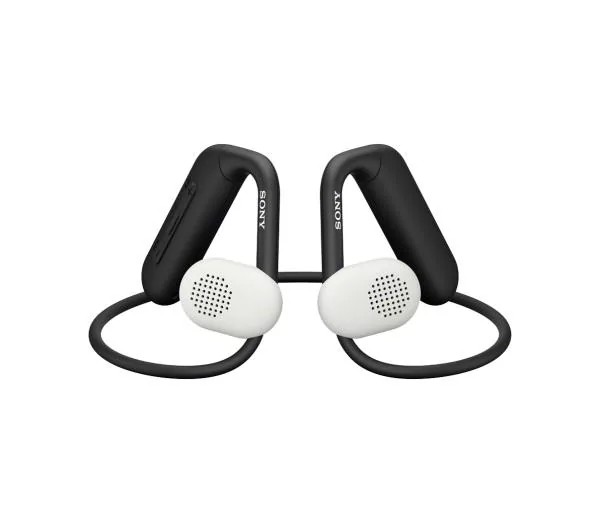
The headphones are connected by a flexible jumper and use behind-the-ear temples, giving the overall structure something of the feel of sports glasses. That is a useful reference point because the design is not meant to disappear into the ear. It is intended to sit as a stable wearable frame, distributing contact around the ears rather than concentrating it at the ear canal.
This matters because fit is often the deciding factor for exercise headphones. An earbud that sounds promising but loosens during a run quickly becomes a distraction. Sony’s approach with Float Run is to remove the need for a deep in-ear fit altogether. For listeners who dislike ear tips, pressure in the ear canal, or the sensation of blocked ears during exercise, the design itself is the product’s most distinctive feature.
Out-of-the-ear wearing and everyday awareness
The Float Run does not include Active Noise Cancellation. In a conventional lifestyle headphone, that omission might be seen as a limitation. In a running-focused design, however, it aligns with the product’s intended use. These headphones are not built around isolation from the environment; they are built around movement and comfort. By avoiding an in-ear seal and ANC, the Float Run is positioned for users who want music or spoken audio while staying more physically aware of their surroundings.
That distinction is important for runners, walkers, and outdoor exercisers. Many people do not want their ears fully blocked when training near traffic, cyclists, other pedestrians, or announcements. The out-of-the-ear format can be attractive because it avoids the sealed-off sensation that comes with many true wireless earbuds. Sony is not presenting Float Run as a noise-cancelling travel product, and its feature set reflects that.
This also has a usability benefit. Without ear tips that must be sized, inserted, adjusted, and reseated, the wearing experience is conceptually simpler. The user puts on the frame, positions the headphone assembly, and begins moving. For anyone who has struggled with sweat, loose tips, or pressure points during exercise, that less intrusive arrangement may be more appealing than another sealed earbud.
Large 16mm drivers in an open sports format
One of the more notable technical details is Sony’s use of 16mm drivers. That is large for a lightweight sports headphone and gives the Float Run a clear engineering talking point. Sony claims the driver arrangement is intended to provide natural sound without compromise, although the open, out-of-the-ear design should be understood as a different proposition from sealed in-ear monitors or noise-cancelling earbuds.
The driver size may matter because an open-wearing sports headphone has to project sound from a position that is not sealed inside the ear canal. Larger drivers can be part of that design strategy, giving Sony more physical driver area to work with in a product that deliberately avoids the acoustic advantages of a tight in-ear seal. The exact listening result will depend on fit, environment, source material, and user expectations, but the decision to use 16mm drivers shows that the Float Run is not merely a convenience-focused accessory; its acoustic hardware is a documented part of the design.
For prospective owners, the key point is not that Float Run should be judged against indoor audiophile headphones. Rather, it is a sports-oriented wireless product with an unusually open form factor and drivers sized to support that concept. Its appeal lies in combining music playback with a fit that is less invasive than traditional earbuds.
Lightweight construction for longer sessions
Weight is another important part of the Float Run’s identity. At 33 grams, the headphone system is light enough to suit the product’s active purpose. A running headphone does not need to be featherweight in the same way as a single true wireless earbud, because the structure distributes weight differently, but low mass still matters. The less weight resting around the ears and back of the head, the less likely the frame is to feel cumbersome during repetitive movement.
This is where the glasses-like design may be useful. Instead of two separate earpieces that must each remain lodged in place, the Float Run uses a connected frame. That can help make the product feel like a single wearable object rather than two independent components competing with motion and sweat. For users who frequently adjust earbuds mid-run, the promise of a stable, lightweight frame is central to the product’s appeal.
The 33-gram figure also supports longer activity sessions. The stated battery life is up to 10 hours, so the hardware is clearly designed for more than a short commute or a brief gym visit. Whether used for running, walking, training blocks, or general active listening, the combination of low weight and extended battery life gives the Float Run a practical foundation.
Wireless features and device compatibility
The Float Run uses Bluetooth 5.0 and supports SBC and AAC codecs. That makes it straightforward for typical smartphone pairing, including common Android and iOS use cases. The codec list is not presented as an enthusiast-grade hi-res wireless package, and Sony does not position the product that way in the available information. Instead, the connectivity is pragmatic: wireless audio, broad compatibility, and a feature set suited to active use.
For a sports headphone, reliability and simplicity are often more important than format complexity. Bluetooth 5.0 gives the Float Run a modern wireless platform, while SBC and AAC cover the codecs many everyday users will rely on. This keeps the product focused on its primary mission: being easy to wear and use while exercising.
The stated battery life of up to 10 hours also supports the wireless design. Many runners will not need that full duration in a single session, but a longer runtime reduces charging anxiety across several workouts or a long day of mixed use. It also makes Float Run more practical for people who use one pair of headphones for exercise, walking, errands, and casual listening rather than only for timed training.
Splash resistance for active conditions
Sony gives the Float Run an IPX4 splash-resistance rating. That rating is a relevant feature for a product aimed at runners and athletes because sweat and light exposure to moisture are part of the intended environment. It does not make the headphones a swimming product, and it should not be treated as full waterproofing, but it does address ordinary active-use concerns.
The value of IPX4 is confidence. A prospective owner considering headphones for outdoor runs or gym sessions will want to know that the product is designed with moisture exposure in mind. Sweat, mist, and light splashes are realistic conditions for exercise headphones. The Float Run’s rating helps place it in that category rather than in the more delicate world of general-purpose home or office wireless audio.
This is also consistent with the product’s wider design language. The frame, open fit, low weight, and splash rating all point in the same direction: Float Run is designed first for movement. It is not trying to be every type of headphone at once.
Who the Sony Float Run is most suitable for
The Float Run is most suitable for runners, walkers, gym users, and active listeners who dislike the feeling of sealed in-ear headphones. It may be especially attractive to people who have had trouble keeping earbuds in place during exercise or who prefer not to insert tips into the ear canal. The behind-the-ear support and connected frame are meant to create stability without depending on a tight internal fit.
It also suits users who value environmental awareness more than isolation. Because the Float Run lacks ANC and uses an out-of-the-ear format, it is not the obvious choice for someone seeking maximum quiet on flights, trains, or in noisy offices. It is also not aimed at listeners who want a sealed earbud experience with strong passive isolation. Its strengths are comfort during motion, open wearing, and a purpose-built sports form.
At a stated price of $130 and available in black, the Float Run occupies a focused position: not a fashion-first luxury product, not a noise-cancelling travel model, and not a conventional true wireless earbud. Its appeal is narrower but clearer. It is for people who want a running-oriented wireless headphone that looks and wears differently because the use case demands different priorities.
Conclusion
Sony Float Run stands out because it treats running headphones as a design challenge rather than simply shrinking a standard earbud. Its documented strengths are the out-of-the-ear wearing style, behind-the-ear suspension frame, light 33-gram construction, 16mm drivers, Bluetooth 5.0 connectivity, SBC and AAC support, IPX4 splash resistance, and up to 10 hours of battery life. It is best suited to active users who prioritize comfort, stability, and a less intrusive fit over noise cancellation or deep in-ear isolation. For runners and fitness-minded listeners who want wireless audio without the plugged-ear feeling, Float Run offers a distinctive and carefully targeted alternative.