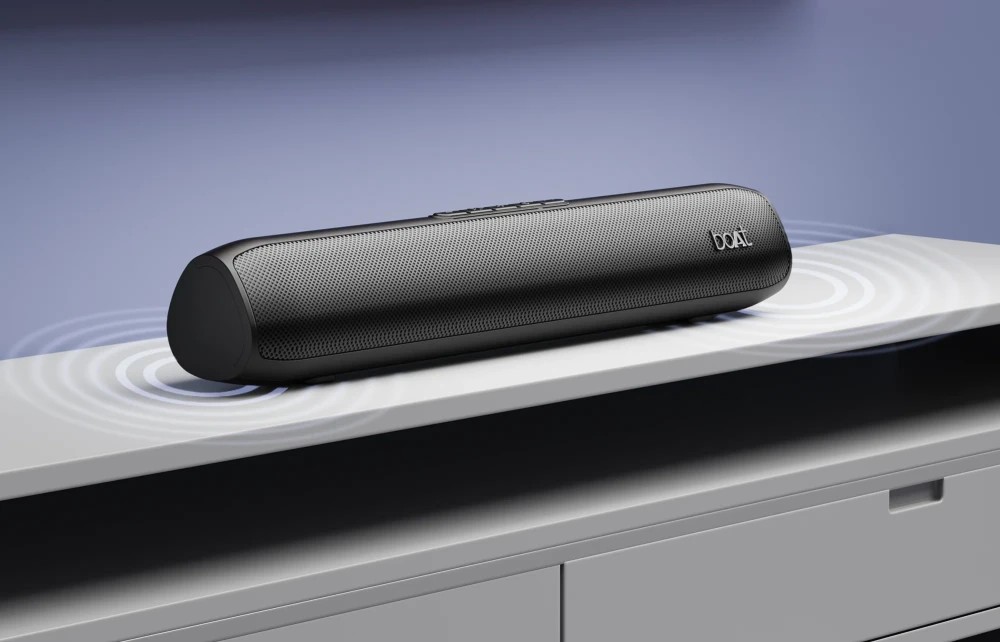
The BoAt Aavante Bar 520 is a straightforward product with a clear idea behind it: make the soundbar format less dependent on permanent installation. Rather than centering on a home-cinema specification sheet with multichannel decoding or a separate subwoofer, this budget 2.0 bar focuses on everyday usability. Its most distinctive feature is a built-in rechargeable battery, rated for up to six hours of operation from a full charge. That single design choice changes how the product can be used, because it allows the Aavante Bar 520 to serve as more than a fixed TV accessory. It can be moved between rooms, placed where mains power is inconvenient, or used as a compact speaker for casual listening from a phone, computer, USB source, or analog output.
A soundbar format without the usual fixed-location assumption
Most soundbars are designed around a single permanent position, usually below a television. The Aavante Bar 520 keeps the familiar horizontal form, but its rechargeable battery makes that form more flexible. A six-hour operating claim is not intended to replace a full-day portable speaker, but it is enough to cover a film, an evening playlist, a gaming session, or a few hours of background audio without requiring the product to stay tethered to the wall.
That matters most in homes where audio needs are not confined to one system. A compact soundbar can be useful on a desk, a bedroom shelf, a kitchen counter, or under a small TV. With battery operation, the owner is not forced to choose the nearest power socket as the listening position. For renters, students, shared households, and anyone who wants to avoid additional cabling, this is a practical advantage rather than a cosmetic one. The product’s appeal comes from reducing setup friction.
2.0 simplicity and full-range drivers
The Aavante Bar 520 is a 2.0-channel soundbar, meaning it is built around left and right channels without a separate subwoofer channel. This is a modest configuration, but it is also easy to understand and easy to place. There is no satellite speaker wiring, no external bass module to position, and no extra component to power. For users who mainly want a single-box audio upgrade or a convenient speaker for everyday content, that simplicity can be a strength.
Its acoustic section is described as using full-range speakers loaded with two passive radiators. Full-range drivers are a common solution in compact audio products because they allow a small enclosure to cover a broad portion of the audible spectrum without dividing the signal among multiple specialized driver types. Passive radiators, meanwhile, are often used in compact cabinets to support low-frequency output without relying on a conventional open port. The published operating range of 82 Hz to 20,000 Hz indicates the design is intended to cover everyday voice, music, and media playback within the limitations of a compact 2.0 enclosure.
The amplifier power is specified at 16 watts total. That figure places the Aavante Bar 520 firmly in the small-room and near-field category rather than suggesting it is meant to energize a large home theater. In context, the specification aligns with the rest of the design: a budget soundbar for convenient use, not a large-scale cinema system.
Connectivity that favors common sources
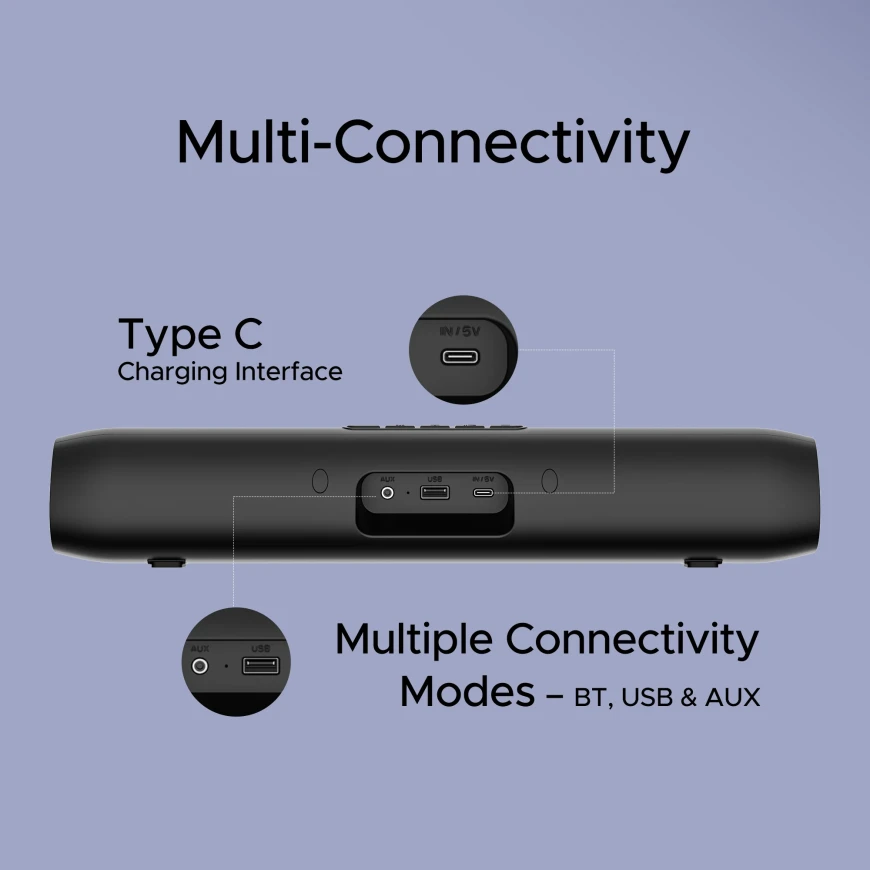
BoAt has equipped the Aavante Bar 520 with three practical connection options: Bluetooth 5.0, USB, and AUX. This is a useful spread for a product aimed at broad everyday use. Bluetooth 5.0 covers phones, tablets, laptops, and many other wireless sources, allowing the soundbar to function as a general-purpose speaker without a physical connection. For many owners, that will be the most convenient mode because it supports quick switching from video clips, streaming apps, podcasts, and music services on personal devices.
USB adds another route for digital media or direct source connection, depending on how the user wants to feed the soundbar. It is particularly relevant for listeners who keep audio files on removable storage or prefer a wired digital path where supported. The AUX input is equally important because it preserves compatibility with older or simpler devices that still provide an analog output. That could include televisions, desktop monitors with headphone outputs, portable players, or computers where Bluetooth is not the preferred option.
The key point is not that the Aavante Bar 520 offers every connection a home theater buyer might expect. It does not need to be positioned that way. Its documented inputs are better understood as a flexible everyday set: wireless for convenience, USB for direct source use, and AUX for broad analog compatibility.
Top-panel controls for immediate access
All controls are placed on the top panel. This is a small but sensible usability decision for a compact bar that may not always sit in a fixed TV position. Top-mounted controls are easy to find when the speaker is on a desk, shelf, or table, and they reduce reliance on a remote control or phone app for basic operation. For a product designed around simple connection and occasional movement, direct access to controls supports the intended use.
This kind of control layout also makes the soundbar more approachable for shared spaces. A family member or guest can adjust operation without learning a menu system. In a budget product, the value of a clear physical interface should not be overlooked: it keeps the product useful even when the source device is not immediately in hand.
Why the battery changes the ownership experience
The built-in rechargeable battery is the Aavante Bar 520’s defining feature because it expands the possible role of the soundbar. A conventional budget soundbar is often bought for one television and left there. This model can be treated more like a movable audio utility: attach it to a laptop over Bluetooth, connect a phone wirelessly, use AUX from a compact display, or play from a USB source, then move it elsewhere when needed.
For small apartments or multifunction rooms, that flexibility can be more valuable than a long list of cinema features. The battery also helps in situations where power outlets are scarce or inconveniently placed. It can simplify temporary setups, such as watching on a secondary screen, listening on a balcony or covered indoor-outdoor area, or using the soundbar during a gathering where a permanent audio system is not available. The published six-hour figure gives the product a practical operating window for these scenarios while keeping expectations realistic.
Who the BoAt Aavante Bar 520 is most suitable for
The Aavante Bar 520 is best suited to listeners who want a compact, affordable, and easy-to-move soundbar rather than a complex home theater component. Its strengths line up with casual TV use, desktop audio, small-room listening, and wireless playback from mobile devices. It should also appeal to buyers who prefer a single enclosure with no separate subwoofer and no elaborate setup process.
It is less clearly aimed at users building a full surround system, those who require specialist home-cinema connectivity, or listeners who want a large external bass unit. The stated 16-watt amplifier power and 2.0 layout indicate a product designed for convenience and moderate-scale use. Prospective owners should therefore think of it as a flexible everyday soundbar with battery power, not as a replacement for a larger component audio system.
A budget product with a practical identity
What makes the Aavante Bar 520 distinctive is not an exotic specification but the way its features work together. Battery power, Bluetooth 5.0, USB, AUX, full-range drivers, passive radiators, and top-panel controls all support the same goal: easy audio in places where a traditional fixed soundbar may be inconvenient. The product’s identity is coherent. It offers the soundbar shape, but it borrows some of the freedom normally associated with portable speakers.
That combination gives it a clear market position. It is a budget 2.0 soundbar for people who want fewer cables, broader placement options, and simple compatibility with common sources. Within that role, the documented design choices are purposeful and easy to understand.
Conclusion
The BoAt Aavante Bar 520 stands out for its practical mix of a 2.0 soundbar layout and built-in rechargeable battery power. Its rated six-hour operation, Bluetooth 5.0 connectivity, USB support, AUX input, full-range driver arrangement with passive radiators, 16-watt amplification, and top-panel controls all point toward a product designed for simple, flexible everyday listening. It is most appealing for users who want a compact soundbar that can move between rooms and connect easily to common devices, rather than a fixed, feature-heavy home theater system.