


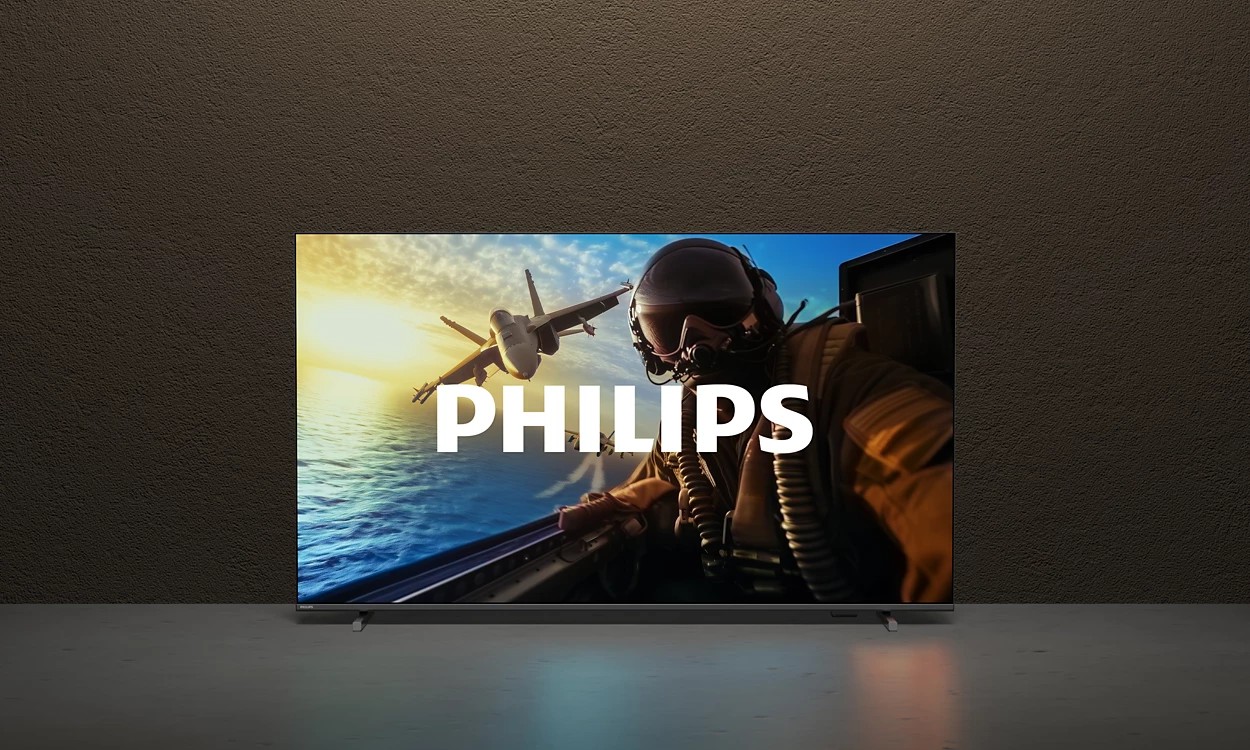
The Philips PUS7000 series sits at the very bottom of the brand’s 2025 4K lineup. It’s designed for one main purpose: delivering Ultra HD resolution at the lowest possible price. This is not a feature-packed home-cinema screen or a gaming powerhouse. Instead, it’s a straightforward smart TV aimed at buyers who want an affordable upgrade from an older Full HD set.
In this review, we focus on the 55-inch version, a model built around a VA panel and basic HDR support. The real question is whether the low price comes with acceptable compromises—or simply too many limitations.

Design and build quality
As expected from a budget model, the PUS7000 keeps things simple. The chassis is thicker than on more expensive TVs, and the overall construction is clearly focused on cost efficiency rather than premium materials.
From the front, however, the TV looks perfectly respectable. The slim black bezels help it blend into a modern living room, and most users will never notice the plastic-heavy construction once the screen is on.
The included feet are sturdy and provide good stability, which is especially important in homes with children or pets. Wall mounting is supported via a standard VESA mount, although the thicker cabinet means the TV won’t sit especially close to the wall.
One practical issue is the very low clearance under the screen. There’s only about 20 mm of space, which makes it difficult to place a soundbar without partially blocking the picture.

Smart features and remote
The PUS7000 runs Philips’ new Titan OS platform. It provides access to the essential streaming services, including major platforms like Netflix, YouTube, and Prime Video.
In everyday use, the system feels basic. Navigation is slower than on more mature platforms like webOS, Tizen, or Google TV. App selection is also more limited, which may matter to users who rely heavily on streaming services.
The included remote control is comfortable and practical, with direct buttons for popular streaming apps. It also supports voice control through Amazon Alexa and works with Google Home systems.
For viewers who mostly watch live TV, the interface is straightforward and easy to navigate, with a clear program guide and responsive teletext.

Picture quality
The 55-inch PUS7000 uses a VA panel, which is a welcome choice at this price. Without local dimming, the panel itself is responsible for contrast performance—and it does a respectable job.
Native contrast reaches around 6000:1, delivering deeper blacks than most IPS-based budget TVs. In a dim room, movies look noticeably better than on many competing models.
However, the panel’s limitations quickly become obvious.

Brightness and HDR
Peak brightness is around 200 nits, which is very low by modern standards. In bright rooms, the image can look washed out, and HDR performance is extremely limited.
Although the TV supports HDR10+ and HLG, the hardware simply isn’t bright enough to deliver a true HDR experience. Highlights lack intensity, and the overall image doesn’t gain much depth from HDR content.
In practice, the TV performs best with standard SDR content.
Color performance
Out of the box, the Cinema mode shows some weaknesses, especially in red tones. The image can look slightly cold and less vibrant than expected.
The good news is that the panel responds well to calibration. After adjustments, colors become more natural, and most visible errors are reduced significantly. Still, the TV lacks any wide-color-gamut technology, so color saturation remains limited compared to QLED or Mini LED models.
Processing and upscaling
Philips’ image processing is competent for this class. Upscaling from lower-resolution sources produces a smooth, slightly soft image. This softness is typical of Philips TVs and can be adjusted through the sharpness settings.
Gradients look clean in brighter scenes, but darker tones can show visible banding and stepping between shades.
Motion and gaming
Motion handling is one of the PUS7000’s weakest areas. The panel has a native 60Hz refresh rate, which is expected at this price, but the bigger issue is the lack of motion smoothing features.
There’s no effective motion interpolation for films or sports, so fast scenes can appear slightly choppy or blurred.
Gaming performance, however, is surprisingly decent for a budget TV. The PUS7000 includes:
-
VRR (Variable Refresh Rate)
-
ALLM (Auto Low Latency Mode)
-
Input lag around 12 ms
These features make it a perfectly usable display for casual console gaming, even if it lacks the higher refresh rates of more advanced models.
Sound quality
The built-in 20-watt stereo speakers deliver clear dialogue and a balanced midrange. For everyday TV watching, news, and streaming shows, the sound is perfectly acceptable.
However, there’s very little bass, and movie soundtracks lack impact. The TV supports Dolby Atmos and DTS:X formats, but to truly benefit from them, you’ll need an external sound system or soundbar.
Connectivity
The PUS7000 offers a practical set of connections:
-
3 × HDMI 2.0 (one with eARC/ARC)
-
2 × USB ports
-
Optical audio output
-
Ethernet
-
Headphone jack
-
Wi-Fi and Bluetooth 5.2
This is a solid selection for a budget model, though there’s no HDMI 2.1 support.

Price (USD)
Approximate pricing:
-
50-inch: about $520
-
55-inch: about $580
-
65-inch: about $880
-
75-inch: about $1,250
Conclusion
The Philips PUS7000 is exactly what it claims to be: a very affordable entry point into 4K smart TVs. It delivers decent contrast, solid everyday performance, and useful gaming features at a low price.
However, the compromises are clear. Brightness is extremely limited, HDR performance is weak, motion handling is basic, and the smart platform feels underdeveloped.
For buyers upgrading from an older Full HD TV or looking for a simple, inexpensive 4K screen, the PUS7000 can still make sense. Just don’t expect it to compete with brighter QLED, Mini LED, or OLED models.

