Stereoindex Speaker Favorites for Distinctive Systems
Stereoindex highlights distinctive speaker choices across floorstanders, bookshelf models, in-wall cinema speakers, soundbar Atmos control, and sealed or wireless subwoofers.

The speaker category is broad enough to include compact bookshelf monitors, ambitious floorstanders, in-wall cinema models, soundbars, and dedicated subwoofers.
This selection brings together Stereoindex editorial picks drawn from the supplied product coverage, with the emphasis on what each model is actually built to do rather than on unsupported performance claims.
Some of these products are traditional passive loudspeakers intended for stereo systems. Others solve specific installation or system-building problems, such as adding controlled low bass, hiding cinema speakers in walls, or adjusting height effects from a Dolby Atmos soundbar. The differences matter: a beautifully engineered bookshelf speaker is not trying to solve the same problem as a sealed active subwoofer or a flagship multi-module statement system. Because the source material is product-reporting rather than comparative lab testing, the recommendations below focus on documented design choices, driver technology, enclosure approach, placement flexibility, and system role. Treat this as an editorial shortlist for narrowing the field before matching speakers to your room, electronics, and installation needs.

1. Raidho X2t: An updated version of the popular speaker
Raidho X2t floorstanding speakers use a ribbon tweeter and tantalum-coated woofer cones in a compact cabinet.
The Raidho X2t is a compact floorstanding speaker that updates the earlier X2 with technologies said to be drawn from Raidho’s higher-tier designs.
Its most eye-catching element is the Danish-made ribbon tweeter, described as a planar driver using 11 micron foil and capable of handling signals up to 82 kHz.
The X2t also adds a pair of 5.25-inch tantalum-coated woofers, a design choice intended to increase cone stiffness without adding weight. For listeners who want a refined floorstander without moving into a very large cabinet, the X2t stands out for its combination of compact proportions and premium driver thinking.
Best for: Listeners wanting a compact high-end floorstander with advanced driver materials
- Compact and elegant floorstanding format
- Danish-made ribbon tweeter
- Tantalum-coated 5.25-inch woofer cones
- Updated replacement for the earlier X2
Verdict: The Raidho X2t is the most technology-led traditional floorstander in this selection, with a clear emphasis on ribbon-tweeter refinement and stiff, lightweight bass drivers.

2. Dolby Atmos volume control added to Sonos Arc soundbar
Sonos Arc soundbar users can adjust the level of the upward-facing Dolby Atmos speakers through the updated app.
The Sonos Arc entry is different from the passive speaker models here because the source focuses on a firmware update rather than a new cabinet design.
Its practical value is still clear: owners gained the ability to adjust the volume of the two upward-facing Dolby Atmos speakers through the Sonos app, rather than relying only on automatic Trueplay handling for those channels.
For users who already live with an Arc, this adds a useful layer of control over height effects without changing hardware.
Best for: Sonos Arc owners who want more control over Dolby Atmos height effects
- Adjustable upward-facing Atmos speaker volume
- Control added through the Sonos app
- Useful for tailoring height-channel balance
Verdict: The Sonos Arc earns its place here as a system-improvement pick, not a conventional speaker upgrade, because the added Atmos adjustment directly improves user control.

3. Seawave AM 23: Bookshelf speakers with beryllium super tweeter
Seawave AM 23 bookshelf monitors combine a beryllium super tweeter with an aluminum alloy enclosure and horn-loaded high-frequency hardware.
The Seawave AM 23 is a passive 3-way bookshelf monitor with a specification that leans heavily into high-frequency engineering and rigid construction.
The proprietary beryllium super tweeter extends the stated operating range to 35 kHz, while the driver complement also includes a 50 mm horn compression tweeter and a 200 mm Eton Hexacone mid/bass driver.
The aluminum alloy AC4C enclosure is described as fully inert, and Seawave’s solderless NST internal connection approach is intended to avoid the drawbacks the company associates with soldered signal paths. This is a compact speaker for buyers who are interested in materials, crossover parts, and construction details as much as format.
Best for: Buyers seeking a technically ambitious bookshelf speaker with extended high-frequency design
- Beryllium super tweeter
- Passive 3-way bookshelf design
- AC4C aluminum alloy cabinet
- Patented solderless internal connections
Verdict: The Seawave AM 23 is the specialist bookshelf choice here, combining a beryllium super tweeter, aluminum enclosure, and detailed internal construction.

4. DALI Menuet: Top notch speakers from Denmark
DALI Menuet speakers use a 4.5-inch wood-pulp woofer, 28 mm silk-dome tweeter, and rear angled bass-reflex port.
The DALI Menuet is a compact loudspeaker built around a 4.5-inch long-fiber cellulose woofer and a 28 mm silk-dome tweeter related to DALI’s senior models.
The cabinet uses solid wood construction and a rear bass-reflex port set at an angle, a detail intended to reduce sensitivity to internal box resonances.
The source also highlights gold-plated terminals and notes that the Menuet can work with DALI Rubicon-series speakers in a coordinated home-cinema setup, including rear or front-channel use. Its appeal is straightforward: a small, carefully specified Danish speaker for rooms and systems where size matters.
Best for: Small-room stereo systems or compact DALI-based home-cinema layouts
- Compact cabinet
- Long-fiber cellulose woofer
- 28 mm silk-dome tweeter
- Can be used as front or rear channels in a matching cinema setup
Verdict: The DALI Menuet is the compact traditional speaker pick, notable for its small size, solid cabinet work, and versatile channel use.

5. DALI Oberon 3: Perfected Danish Bookshelf Speakers
DALI Oberon 3 bookshelf speakers feature a 7-inch wood-fiber woofer and a 25 mm soft fabric dome tweeter.
The DALI Oberon 3 is positioned as the successor to the Zensor 3 and is described as a compact bookshelf speaker designed to deliver a vibrant, immersive presentation without giving up bass weight for its class.
Its 7-inch woofer uses a pressed paper-pulp cone reinforced with wood fibers, combining rigidity, resonance control, and low mass.
A 25 mm soft fabric dome tweeter sits on a metal chassis that supports heat dissipation and mechanical stability. Compared with the smaller DALI Menuet, the Oberon 3 is the more bass-oriented bookshelf option in this list.
Best for: Bookshelf-speaker buyers who want a larger woofer and stronger bass emphasis
- 7-inch wood-fiber paper-pulp woofer
- 25 mm soft fabric dome tweeter
- Compact bookshelf format
- Designed for deep bass within its category
Verdict: The DALI Oberon 3 is a sensible compact-speaker choice when bookshelf placement is needed but bass output remains a priority.

6. JBL SUB80P: Active wireless Subwoofer with 8 inch driver
JBL SUB80P active subwoofer uses a downward-facing 8-inch driver and a wireless receiver for flexible installation.
The JBL SUB80P is an active wireless subwoofer designed to add bass with flexible placement.
Its closed-box acoustic design is described by the developers as more musical than comparable alternatives, while the downward-facing 8-inch driver is intended to distribute sound evenly through 360 degrees and reduce dependence on exact room position.
A built-in 2.4 GHz wireless receiver simplifies installation, and rear-panel controls include level, crossover bypass, phase, and auto-power switches. For systems where running a long signal cable is inconvenient, the SUB80P is the placement-friendly subwoofer option in this selection.
Best for: Adding bass where wireless placement flexibility is important
- Closed-box acoustic design
- Downward-facing 8-inch driver
- Built-in 2.4 GHz wireless receiver
- Rear-panel level, phase, and auto-power controls
Verdict: The JBL SUB80P is a practical subwoofer pick for users who want easier placement and straightforward bass-system controls.

7. Alare Labs Remiga 1: Beautiful floor standing speakers from Italy
Alare Labs Remiga floorstanding speakers combine transmission-line bass loading with ceramic and beryllium driver technology.
The Alare Labs Remiga article presents the Remiga floorstanding concept as a compact Italian design carrying over technical ideas from the larger model.
The low-frequency section uses custom 8-inch and 6-inch polypropylene-cone drivers in a transmission-line acoustic design, while the midrange is handled by a 5-inch Accuton ceramic driver in a controlled internal volume.
A 1.3-inch beryllium tweeter is specified for high-frequency reproduction, and the enclosure uses layered sandwich construction with damping adhesive plus an internal frame made of steel rods. This is the artisanal engineering pick among the floorstanders, with clear attention paid to cabinet vibration control and premium driver materials.
Best for: Listeners drawn to Italian floorstanders with elaborate cabinet and driver engineering
- Transmission-line bass design
- Accuton ceramic midrange driver
- 1.3-inch beryllium tweeter
- Layered damped enclosure with internal steel frame
Verdict: The Alare Labs Remiga 1 coverage highlights a floorstanding design built around transmission-line bass, ceramic midrange reproduction, and extensive cabinet damping.

8. Sonus Faber Suprema: Flagship speakers you can’t afford
Sonus Faber Suprema is a multi-module flagship speaker system with separate low-frequency cabinets and luxury cabinet finishes.
The Sonus Faber Suprema is a statement-scale loudspeaker system rather than a conventional single-pair upgrade.
The complete Suprema 2.2 package includes two main floorstanding speakers and two separate low-frequency modules, while a Suprema 2.1 configuration uses one low-frequency module.
The source describes multi-layer plywood and aluminum cabinets finished with wood veneer and genuine leather, plus mechanical floor decoupling through a pedestal developed with IsoAcoustics. It also notes a 4.5-band configuration and a separate active crossover housing for the subwoofers. This is the reference-level luxury entry in the selection, defined by scale, materials, and system architecture.
Best for: Ultra-luxury systems where space, budget, and installation complexity are not limiting factors
- Main speakers plus separate low-frequency modules
- Multi-layer plywood and aluminum cabinets
- Wood veneer and genuine leather finishes
- Pedestal developed with IsoAcoustics for floor decoupling
Verdict: The Sonus Faber Suprema is the no-compromise statement system here, distinguished by separate bass modules, lavish construction, and large-scale architecture.
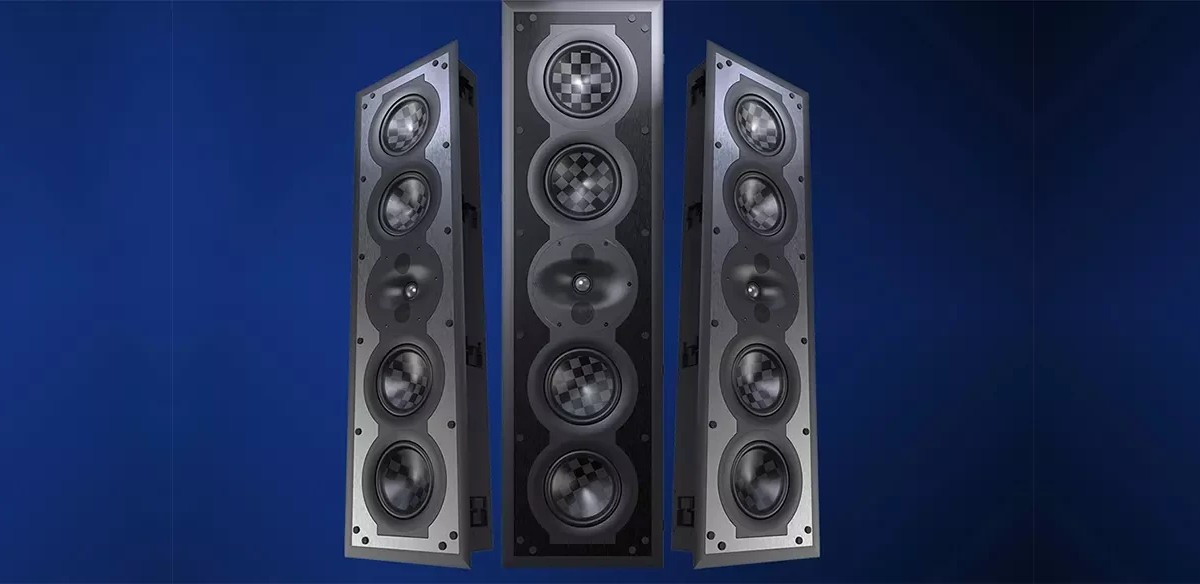
9. New models of Perlisten built-in acoustics from the S-Series and R-Series
Perlisten S-Series and R-Series in-wall speakers are designed for discreet high-level home theater installations.
Perlisten’s expanded S-Series and R-Series in-wall models are aimed at high-level home cinema installations where the speakers need to remain visually discreet.
The source emphasizes that the new built-in models borrow technology and component quality from Perlisten’s bookshelf and floorstanding speakers.
The S7i sits at the top of the new range, is based on the S7t floorstanding model, and carries THX Certified Dominus certification. It also has a shallow 10 cm installation depth and an extruded aluminum enclosure intended to reduce vibration transfer to the wall and adjacent rooms. For dedicated cinema rooms where in-wall placement is essential, Perlisten offers the strongest installation-focused case in this guide.
Best for: High-performance home cinemas requiring discreet in-wall speakers
- In-wall design for discreet cinema systems
- Technology shared with conventional Perlisten speakers
- S7i has THX Certified Dominus certification
- Shallow 10 cm installation depth on S7i
Verdict: Perlisten’s S-Series and R-Series in-wall models are the installation-first choice, especially for cinema systems that need serious hardware without visible speaker boxes.
10. PS Audio Foundry F12: Sealed Subwoofer Focused on Control and Accuracy
PS Audio Foundry F12 is a sealed active subwoofer designed for controlled bass integration in real listening rooms.
The PS Audio Foundry F12 is an active sealed subwoofer designed around control, integration, and predictable bass rather than maximum-output spectacle.
PS Audio describes the F12 as a closed-back powered subwoofer intended for real listening rooms, with a long-throw driver developed for the application, a powerful internal amplifier, and onboard DSP to manage low-frequency behavior.
The design goal is bass that blends with the main speakers while preserving timing and tonal balance at normal listening levels. Among the subwoofers here, it is the more explicitly accuracy-focused option.
Best for: Systems needing controlled, well-integrated bass rather than ported-room excitement
- Sealed enclosure
- Long-throw driver developed for the subwoofer
- Onboard DSP
- Designed for music and home theater integration
Verdict: The PS Audio Foundry F12 is the control-minded subwoofer pick, with a sealed design and DSP-led approach to integration.
Quick comparison
These products are not interchangeable.
The strongest choice depends on whether you need full-range stereo speakers, compact monitors, hidden cinema channels, a soundbar adjustment, or low-frequency reinforcement.
The table below keeps the distinctions practical and grounded in the supplied product information.
| Product | Best for | Verdict |
|---|---|---|
| Raidho X2t | Compact high-end floorstanding stereo systems | A refined floorstander built around a Danish ribbon tweeter and tantalum-coated woofers. |
| Sonos Arc Dolby Atmos volume control | Existing Sonos Arc soundbar setups | A useful software-based improvement that gives owners direct control over upward-firing Atmos channel volume. |
| Seawave AM 23 | Technically ambitious bookshelf-speaker systems | A passive 3-way monitor with a beryllium super tweeter, aluminum alloy cabinet, and solderless internal connections. |
| DALI Menuet | Small rooms and compact stereo or cinema channels | A compact Danish speaker with a wood-pulp woofer, silk-dome tweeter, and flexible front or rear channel use. |
| DALI Oberon 3 | Bookshelf placement with stronger bass ambitions | A larger bookshelf design using a 7-inch wood-fiber woofer and soft fabric dome tweeter. |
| JBL SUB80P | Wireless bass reinforcement with flexible placement | An active closed-box subwoofer with a downward-firing 8-inch driver and 2.4 GHz wireless receiver. |
| Alare Labs Remiga 1 | Premium floorstanding systems with advanced cabinet construction | A floorstanding design centered on transmission-line bass, ceramic midrange technology, and a beryllium tweeter. |
| Sonus Faber Suprema | Statement luxury systems with separate bass modules | A large multi-module flagship system with premium cabinet materials and dedicated low-frequency modules. |
| Perlisten S-Series and R-Series in-wall models | Discreet high-level home cinema installations | In-wall speakers using technologies related to Perlisten’s conventional models, led by the THX Certified Dominus S7i. |
| PS Audio Foundry F12 | Controlled subwoofer integration for music and home theater | A sealed active subwoofer with DSP and a design brief focused on accuracy and consistency. |
Frequently asked questions
Should I choose floorstanding speakers or bookshelf speakers?
Choose floorstanding speakers when you have the room space and want a larger cabinet approach, as seen with models such as the Raidho X2t and Alare Labs Remiga.
Bookshelf speakers such as the Seawave AM 23, DALI Menuet, and DALI Oberon 3 make more sense when space is limited or when stand, shelf, or compact system placement is the priority.
When does a subwoofer make sense in a speaker system?
A subwoofer is useful when the main speakers need help with low-frequency extension or when a home theater system needs dedicated bass support.
The JBL SUB80P emphasizes wireless placement flexibility, while the PS Audio Foundry F12 focuses on sealed-box control, DSP management, and integration with main speakers.
Are in-wall speakers only about hiding the system?
Not necessarily.
Perlisten’s S-Series and R-Series in-wall models are designed for discreet home cinema installations, but the source also stresses that they use technology and high-quality components related to Perlisten’s bookshelf and floorstanding speakers.
The S7i adds THX Certified Dominus certification and a shallow installation depth, making it a purpose-built cinema option rather than simply a space-saving compromise.
Do driver materials matter when comparing speakers?
They matter when they are part of a coherent design.
The supplied products use materials such as tantalum-coated woofer cones, beryllium tweeters, ceramic midrange drivers, wood-fiber paper-pulp woofers, silk domes, and aluminum enclosures.
These choices can indicate the designer’s priorities, but they should be considered alongside cabinet design, crossover approach, placement needs, and system matching.
How to choose from these Stereoindex speaker favorites
Start with the role the speaker must play.
For a main stereo pair in a conventional room, the Raidho X2t and Alare Labs Remiga 1 coverage point toward compact but ambitious floorstanding designs, with the Raidho emphasizing ribbon-tweeter and tantalum-cone technology and the Alare Labs entry emphasizing transmission-line bass, ceramic midrange reproduction, beryllium treble, and damped cabinet construction.
If the system needs compact speakers, compare the three bookshelf paths carefully. The DALI Menuet is the smallest, most flexible compact option in this selection and is also described as suitable for front or rear channel use in a DALI-based cinema setup. The DALI Oberon 3 offers a larger 7-inch wood-fiber woofer and is presented as a bookshelf model with notable bass for its category. The Seawave AM 23 is the most technically elaborate monitor, with a passive 3-way layout, beryllium super tweeter, horn compression tweeter, aluminum alloy cabinet, and solderless internal connections. For cinema and installation systems, the decision becomes more practical. Sonos Arc owners should pay attention to the added ability to adjust upward-facing Dolby Atmos speaker volume, because it gives more direct control over height-channel balance. For custom theaters, Perlisten’s S-Series and R-Series in-wall models are the discreet option, with the S7i standing out through THX Certified Dominus certification, shallow installation depth, and an extruded aluminum housing. Low bass deserves separate thought. The JBL SUB80P is the more convenience-oriented subwoofer here, with wireless signal reception, a downward-facing 8-inch driver, and placement-friendly controls. The PS Audio Foundry F12 is the more integration-focused sealed option, described around control, predictable room behavior, onboard DSP, and compatibility with both music and home theater systems. Finally, do not let prestige or exotic materials override system fit. The Sonus Faber Suprema is a multi-module statement system for an exceptional installation context, not a universal upgrade path. The most satisfying choice will be the one that fits the room, placement requirements, electronics, and listening priorities while using the documented strengths of the product rather than relying on reputation alone.