AV Receivers Worth Serious Attention for a Capable Home Cinema
A selective, source-grounded guide to AV receivers that deserve attention, led by Onkyo TX-NR6100, Onkyo TX-NR7100, and McIntosh MHT300, with practical advice on channels, HDMI, Atmos layouts, and system expansion.
A good AV receiver should do more than switch inputs and decode surround formats.
It has to match the speaker layout you plan to build, handle current video sources cleanly, and provide enough amplification or expansion flexibility for the room.
The strongest choices in the supplied material fall into three clear lanes: a well-equipped value-oriented Onkyo, a more ambitious nine-channel Onkyo for larger immersive layouts, and a McIntosh receiver aimed at high-end home theater installations. This guide focuses only on products in the source material that are genuinely AV receivers. Several supplied articles cover related hi-fi subjects such as network streaming protocols, zone amplification, speakers, subwoofers, desktop systems, and turntables; those can matter in a broader system, but they are not treated here as AV receiver recommendations. The recommendations below are therefore intentionally selective. Each model is described according to the features directly supported by the source: channel configuration, surround-format support, amplification approach, video compatibility, and installation flexibility.

1. Onkyo TX-NR6100: Fully equipped AV receiver at a reasonable price
Onkyo TX-NR6100 AV receiver with seven-channel amplification and extensive HDMI connectivity.
The Onkyo TX-NR6100 is the most accessible all-rounder in this selection, combining a seven-channel configuration with broad surround and HDMI support.
Its output stages are built from discrete elements and are described as capable of delivering significant current, with compatibility for 4-ohm speakers also stated in the source.
Onkyo’s zero phase shift technology, shortened power and ground buses, separation of digital and analog circuits, and custom transformer all point to a receiver designed with more than basic feature-counting in mind. For home cinema, the TX-NR6100 supports major surround formats including Dolby Atmos and DTS:X, with Dolby Atmos and DTS:X playback possible in a 5.2.2 layout. It also offers Dolby Height Virtualizer and DTS Virtual:X for users who want a form of 3D presentation without installing height speakers. The HDMI specification is a major practical advantage: seven HDMI inputs and two outputs are listed, with support for 8K video transmission, Dolby Vision, and HDR10.
Best for: Feature-rich home cinema on a sensible budget
- Seven-channel configuration
- Dolby Atmos and DTS:X support
- Seven HDMI inputs and two outputs
- Supports 8K video, Dolby Vision, and HDR10
Verdict: The TX-NR6100 is the pragmatic choice here: widely equipped, surround-ready, and positioned as a reasonably priced foundation for movies and music.

2. Apple VS Google: Which Network Offers Superior Sound Quality
Network audio protocols such as AirPlay2 and Chromecast can influence how an AV receiver fits into a home system.
This source article is not an AV receiver review, but it addresses an important decision for modern receiver buyers: network audio protocol support.
It explains that AirPlay2 and Chromecast are commonly found in hi-fi network components and multi-room devices, sometimes together, and that both use Wi-Fi or Ethernet for data transmission rather than relying on a short-range Bluetooth-style connection.
The article also places AirPlay, Google Cast, Spotify Connect, and DTS Play-Fi in the broader context of UPnP and DLNA, standards intended to help networked devices communicate and share media. For AV receiver shopping, the practical point is simple: check which streaming and multi-room protocols fit the devices already used at home rather than assuming one ecosystem is automatically better for every system.
Best for: Understanding network audio choices before buying a receiver
- Covers AirPlay2 and Chromecast
- Explains Wi-Fi and Ethernet streaming context
- Discusses multi-room compatibility
- Frames protocols through UPnP and DLNA
Verdict: This is useful background reading for AV receiver buyers, but it is not a receiver recommendation.

3. Onkyo TX-NR7100: AV receiver that guarantees high quality sound
Onkyo TX-NR7100 AV receiver suited to nine-channel immersive home theater layouts.
The Onkyo TX-NR7100 steps up from the TX-NR6100 with a nine-channel configuration and a stronger focus on installed AV systems.
The source notes that it has passed THX certification and uses Onkyo’s Dynamic Amplification technology over an extended frequency range.
Its output stages are mounted on aluminum heat sinks with low resonance rates, and the power supply uses a custom transformer. The main appeal is layout flexibility. The TX-NR7100 decodes common surround formats including Dolby Atmos and DTS:X, and can support 3D systems up to 5.2.4 without external amplifiers. It also provides Dolby Atmos Height Virtualizer for virtual surround processing and includes correct processing of IMAX content. The source also notes an important limitation compared with the earlier model it resembles: the multi-channel output to a power amplifier has been removed, so buyers planning extensive external amplification should account for that.
Best for: Larger immersive systems without separate power amplifiers
- Nine-channel configuration
- THX certified
- Supports up to 5.2.4 without external amplifiers
- Dolby Atmos, DTS:X, and IMAX content processing
Verdict: The TX-NR7100 is the most compelling Onkyo choice in the source material for a fuller Atmos/DTS:X speaker layout built around the receiver itself.

4. Yamaha XDA-AMP5400RK: Amplifier with eight channels of audiophile-quality
Yamaha XDA-AMP5400RK rack amplifier for zone expansion with compatible Yamaha AV receivers.
The Yamaha XDA-AMP5400RK is not an AV receiver, but it is relevant for some AV receiver systems because the source specifically describes it as compatible with Yamaha AV receivers that have zone pre-outs.
It is designed for custom home audio integration and can expand speaker support, increase output power, or extend coverage into an additional zone when used with suitable Yamaha equipment.
Its eight channels of amplification are housed in a slim 1U rack design, and the four audio I/O buses can be combined for different speaker and zone configurations. Each of the four amplification zones can also operate in bridge mode. Buyers should view it as an expansion amplifier for distributed audio or zone coverage, not as a substitute for a surround-sound AV receiver.
Best for: Expanding zones from compatible Yamaha AV receivers
- Eight channels of amplification
- Slim 1U rack design
- Works with Yamaha AV receivers equipped with zone pre-outs
- Bridge mode available for each amplification zone
Verdict: The XDA-AMP5400RK belongs beside an AV receiver in a custom installation, rather than replacing one.

5. Canton Ergo SUB 650: Classic subwoofer with a vintage look
Canton Ergo SUB 650 subwoofer, a system component rather than an AV receiver.
The Canton Ergo SUB 650 article is about a subwoofer rather than an AV receiver, so it should be treated as system-matching context only.
Subwoofers are central to home theater performance, and an AV receiver’s bass-management and subwoofer outputs will determine how easily a subwoofer can be integrated into a surround setup.
The supplied excerpt focuses on the long-running Ergo design language, including wooden cases, rounded edges, stamped metal grilles, and the engineering continuity of the series. It does not provide AV receiver specifications, so it cannot support a receiver recommendation.
Best for: System context for buyers planning bass support
- Classic Ergo design language
- Wooden casework described
- Rounded edges and stamped metal grille
- Relevant as a home-theater subwoofer component
Verdict: The Ergo SUB 650 may be part of a theater system, but it is outside the AV receiver category.

6. Yamaha TSX-N237D: Updated version of the desktop audio system MusicCast 200
Yamaha TSX-N237D desktop system showing how MusicCast can extend beyond AV receivers.
The Yamaha TSX-N237D is a desktop audio system, not an AV receiver.
Its relevance to receiver buyers lies in Yamaha MusicCast, which the source describes as a multi-room system that can include compatible Yamaha components such as sound bars, AV receivers, wireless speakers, and hi-fi systems.
The TSX-N237D supports Wi-Fi, MusicCast, AirPlay, Bluetooth, USB, CD, and digital radio according to the supplied article. Those features make it a useful example of how a broader multi-room ecosystem can work, but it should not be confused with a surround-processing receiver for home cinema.
Best for: Understanding Yamaha multi-room ecosystem options
- Supports MusicCast
- Includes Wi-Fi and AirPlay support
- Includes Bluetooth, USB, CD, and digital radio
- Illustrates Yamaha multi-room integration
Verdict: The TSX-N237D is relevant to whole-home audio planning, but it is not an AV receiver.

7. Denon DP-450USB: Versatile and easy-to-use turntable
Denon DP-450USB turntable, a vinyl source component for a broader hi-fi or theater system.
The Denon DP-450USB is a turntable and therefore sits outside the AV receiver category.
It is still useful context for buyers who want a receiver-based system that also accommodates vinyl, because the source highlights easy recording from records to USB and a fully automated operating design.
The excerpt states that the DP-450USB can record to a USB flash drive in MP3 or WAV quality and can play those files through computers, cars, or Denon home hi-fi components including HEOS wireless speakers. For AV receiver selection, the practical lesson is to confirm how analog sources and digital music workflows will connect to the rest of the system.
Best for: Vinyl listeners planning source connectivity
- Records directly to USB storage
- MP3 or WAV recording options
- Fully automated operation
- Anti-vibration legs and dust cover described
Verdict: The DP-450USB is a source component to connect around a receiver, not a receiver itself.
8. McIntosh MHT300: Absolute Hi-End class AV receiver
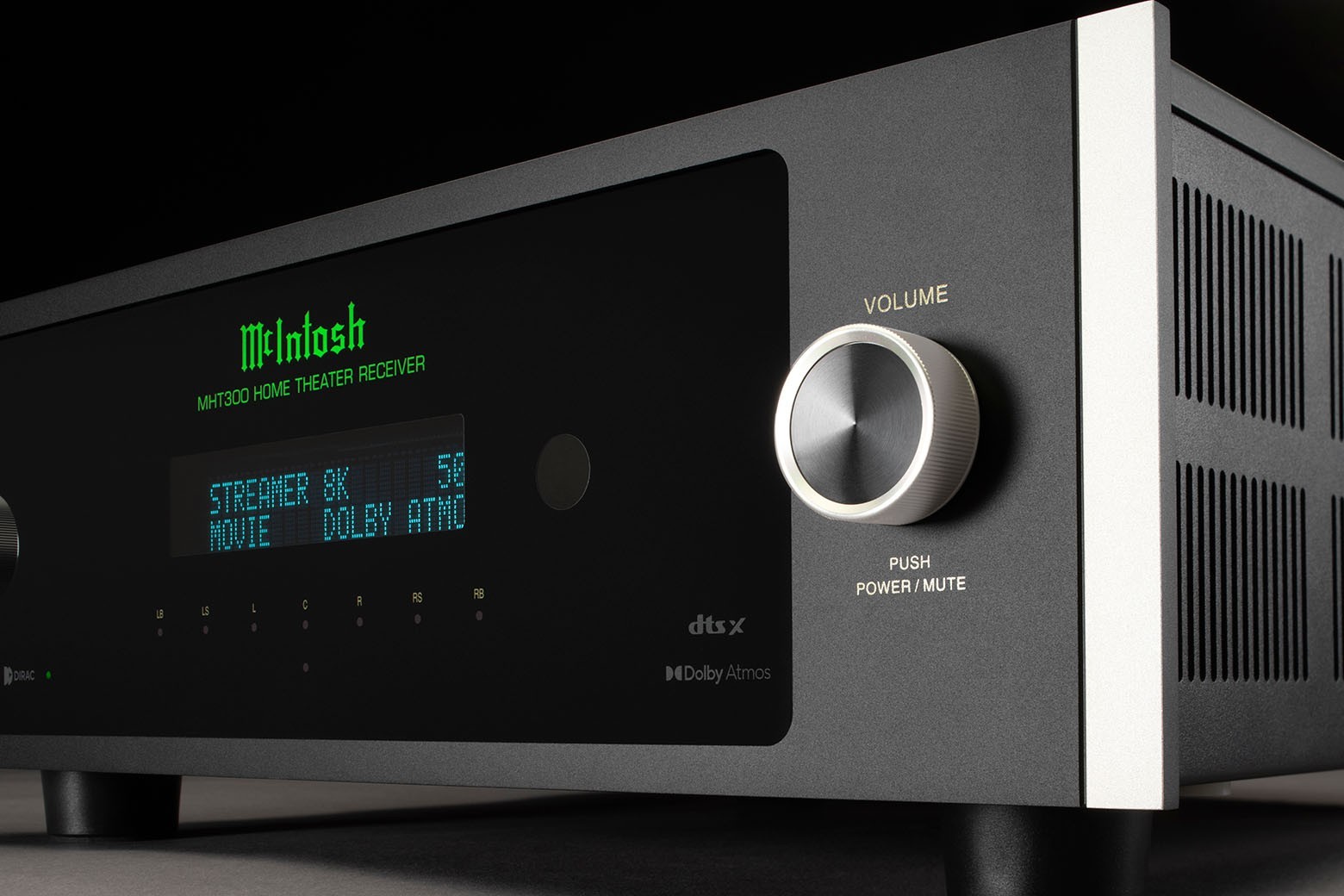
McIntosh MHT300 home theater receiver with 7.2 or 5.2.2 channel configuration and high-power amplification.
The McIntosh MHT300 is positioned very differently from the two Onkyo receivers.
It is described as a high-end home theater receiver that brings McIntosh’s cinema approach into a single device rather than requiring a separate home theater processor and multi-channel power amplifier.
Its channel options are listed as 7.2 or 5.2.2, with Dolby Atmos and DTS:X support. Power and video capability are the headline points in the supplied article. The MHT300 is specified at 7 x 120 watts per channel into 8 ohms, and it supports UHD 4K at 120fps and 8K at 60fps. The source also notes that it has pre-outs for use with a power amplifier, which matters for more complete installations that may need to grow beyond the receiver’s built-in amplification.
Best for: High-end single-box home theater with expansion potential
- 7.2 or 5.2.2 channel operation
- Dolby Atmos and DTS:X support
- 7 x 120 watts per channel into 8 ohms
- Supports 4K 120fps and 8K 60fps
Verdict: The MHT300 is the premium pick from the supplied AV receiver material, especially for buyers who want McIntosh amplification and modern video support in one chassis.

9. Pro-Ject T2 W: A wireless turntable designed for authentic high-fidelity sound
Pro-Ject T2 W wireless turntable for streaming vinyl within a networked audio setup.
The Pro-Ject T2 W is also a turntable, not an AV receiver.
Its most relevant feature for receiver shoppers is its network capability: the source describes integrated Wi-Fi streaming from vinyl records to network audio playback devices using proprietary streaming technology.
The article also notes its belt-drive design, 9-inch aluminum tonearm, moving magnet cartridge, glass platter, electronic speed stabilization, and simultaneous playback across multiple UPnP devices at 24 bits / 48 kHz. Those details matter for vinyl and network-audio planning, but they do not establish any AV receiver capability.
Best for: Vinyl streaming in a networked audio system
- Integrated Wi-Fi module
- Streams vinyl to UPnP devices
- 9-inch aluminum tonearm
- Electronic 33/45 rpm speed switching
Verdict: The T2 W is an interesting network-capable source, but it should not be evaluated as an AV receiver.

10. Canton Ergo 690: Classic floorstanding speakers
Canton Ergo 690 floorstanding speaker, a loudspeaker choice that influences receiver matching.
The Canton Ergo 690 article concerns floorstanding speakers, not an AV receiver.
It is still relevant to receiver buying in one respect: speaker choice affects how much amplifier capability and system flexibility a receiver should provide.
The supplied excerpt emphasizes the continuity of the Canton Ergo series, including wooden cabinets, rounded edges, stamped metal grilles, narrow front proportions, S-shaped driver suspension, and careful driver matching. It does not provide receiver data, so the Ergo 690 should be considered a speaker-system partner rather than a candidate in this AV receiver guide.
Best for: Speaker matching context for receiver buyers
- Classic floorstanding speaker design
- Wooden cabinet construction described
- S-shaped driver suspension noted
- Relevant to amplifier matching considerations
Verdict: The Ergo 690 can shape receiver requirements, but it is not itself an AV receiver.
Quick comparison
The comparison below separates the true AV receiver recommendations from supporting or background articles that may still influence a home-theater system.
The most meaningful distinctions are channel count, immersive-audio layout, video support, and whether the product is actually a receiver or a related component.
| Product | Best for | Verdict |
|---|---|---|
| Onkyo TX-NR6100 | Feature-rich home cinema on a sensible budget | Seven-channel receiver with Dolby Atmos/DTS:X, strong HDMI provision, 8K video support, and a source-supported reasonable-price positioning. |
| Onkyo TX-NR7100 | Larger immersive systems without separate power amplifiers | Nine-channel THX-certified receiver that can run up to a 5.2.4 layout without external amplification, though multi-channel power-amp output is not included. |
| McIntosh MHT300 | High-end single-box home theater with expansion potential | Premium 7.2 or 5.2.2 receiver with 7 x 120 watts into 8 ohms, Dolby Atmos/DTS:X, modern video support, and pre-outs for further amplification. |
| Yamaha XDA-AMP5400RK | Expanding zones from compatible Yamaha AV receivers | Eight-channel rack amplifier for custom integration and zone expansion; useful with suitable Yamaha AV receivers but not a receiver itself. |
| Apple VS Google: Which Network Offers Superior Sound Quality | Understanding network audio choices before buying a receiver | Background article on AirPlay2, Chromecast, UPnP, DLNA, and related protocols rather than an AV receiver product review. |
| Canton Ergo SUB 650 | System context for buyers planning bass support | Subwoofer article that may inform theater-system planning but provides no AV receiver recommendation. |
| Yamaha TSX-N237D | Understanding Yamaha multi-room ecosystem options | Desktop MusicCast audio system that illustrates Yamaha ecosystem integration but is not a surround receiver. |
| Denon DP-450USB | Vinyl listeners planning source connectivity | USB-recording turntable relevant to source planning, not receiver selection. |
| Pro-Ject T2 W | Vinyl streaming in a networked audio system | Network-capable turntable with UPnP streaming; useful as a source component, not as an AV receiver. |
| Canton Ergo 690 | Speaker matching context for receiver buyers | Floorstanding speaker article that can influence amplifier and receiver matching but is not part of the receiver category. |
Frequently asked questions
How many channels should an AV receiver have for Dolby Atmos or DTS:X?
Choose the channel count around the speaker layout you will actually install.
The Onkyo TX-NR6100 is a seven-channel receiver and supports Dolby Atmos/DTS:X in a 5.2.2 configuration, while the Onkyo TX-NR7100 has nine channels and can build up to a 5.2.4 system without external amplifiers.
The McIntosh MHT300 is listed for 7.2 or 5.2.2 operation.
Is a nine-channel receiver always the better choice?
Not necessarily.
A nine-channel model such as the Onkyo TX-NR7100 is useful if you want more height speakers or a fuller immersive layout.
If the room and speaker plan suit 5.2.2, a seven-channel receiver such as the Onkyo TX-NR6100 or McIntosh MHT300 may be sufficient.
What video features should I check before buying?
Match the receiver to your sources and display.
The Onkyo TX-NR6100 is specified with seven HDMI inputs, two outputs, 8K video transmission, Dolby Vision, and HDR10.
The McIntosh MHT300 supports UHD 4K at 120fps and 8K at 60fps. If gaming or high-resolution video switching matters, these details should be checked before choosing.
When do external amplifiers or zone amplifiers matter?
They matter when the system needs more power, more speakers, or separate-zone coverage than the receiver alone can provide.
The McIntosh MHT300 includes pre-outs for use with a power amplifier, while the Yamaha XDA-AMP5400RK can expand speaker support or zone coverage with Yamaha AV receivers that have zone pre-outs.
The Onkyo TX-NR7100, by contrast, is specifically described as lacking the multi-channel output to a power amplifier found on the earlier model it resembles.
How to Choose the Right AV Receiver From This Shortlist
Start with the speaker layout, not the spec sheet.
If the plan is a straightforward but modern 5.2.2 Atmos/DTS:X room, the Onkyo TX-NR6100 has the most immediately practical mix of channel count, HDMI connectivity, 8K video support, and reasonable-price positioning in the supplied material.
It is the sensible starting point for many movie-and-music systems. Move to the Onkyo TX-NR7100 if the room justifies more speakers and you want up to 5.2.4 immersive audio without adding external amplifiers. Its nine-channel configuration, THX certification, Dynamic Amplification technology, IMAX content processing, and virtual height option make it the more installation-minded Onkyo. The important caveat is expansion: the source notes that multi-channel output to a power amplifier has been removed, so it is best suited to systems powered primarily by the receiver itself. Choose the McIntosh MHT300 when the priority is a premium single-box receiver with substantial rated amplification and modern video handling. Its 7 x 120 watts per channel into 8 ohms, 7.2 or 5.2.2 operation, Dolby Atmos/DTS:X support, 4K 120fps and 8K 60fps compatibility, and pre-outs give it a different role from the Onkyo models: fewer built-in channels than the TX-NR7100, but a more explicitly high-end positioning and a path toward external amplification. Finally, consider the wider system. Network protocols such as AirPlay2 and Chromecast affect everyday music playback; MusicCast, HEOS, UPnP, and DLNA-style integration can shape multi-room use; subwoofers and floorstanding speakers affect amplifier demands; and vinyl sources may require the right input or network workflow. An AV receiver sits at the center of that system, so the safest choice is the one that fits the intended room, sources, speakers, and expansion plan rather than the one with the longest unsupported feature list.