

An amplifier should be chosen around the system it will serve, not simply by comparing power figures.
Speaker requirements matter, but so do source connections, room-correction needs, headphone use and the distinction between an integrated amplifier, a power amplifier and a preamplifier.
The recommendations below cover a deliberately broad range of applications. They include compact Class D designs, full-size integrated amplifiers, a network-capable preamplifier, portable DAC and headphone amplifiers, room-correcting all-in-one electronics and a multizone installation model. That variety makes direct ranking less useful than identifying the right product for a particular role. Before deciding, check that the amplifier has the inputs your sources require and the outputs needed for future expansion. Turntable owners should confirm cartridge compatibility, television users may value HDMI ARC, and systems affected by difficult room acoustics can benefit from integrated DSP or room correction.
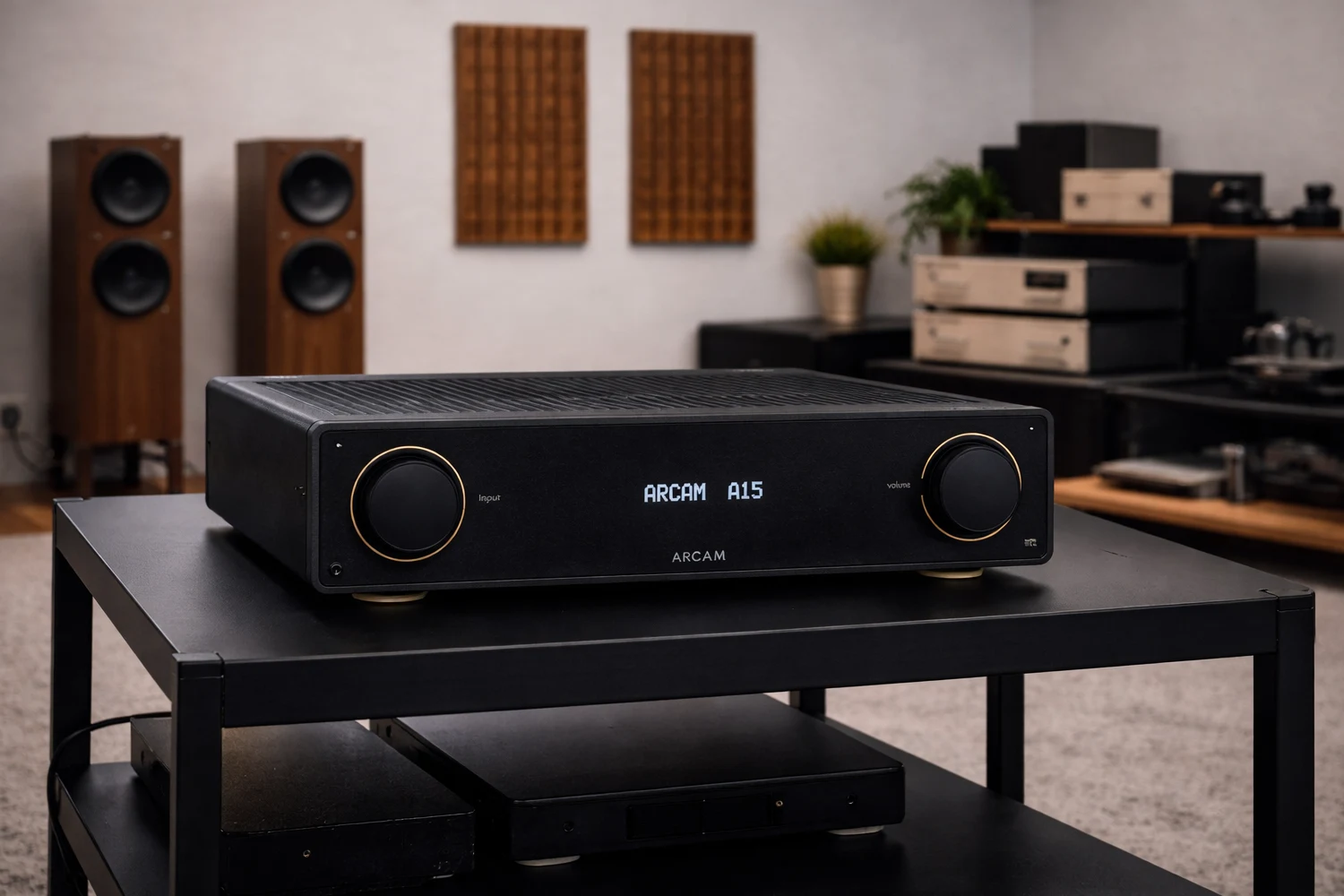
1. Arcam A15+: The One Amplifier That Quietly Upgrades Your Entire Hi-Fi System
The Arcam Radia A15+ integrated amplifier combines analog, digital, television and Bluetooth connectivity.
The Arcam Radia A15+ is a modern integrated amplifier designed to accommodate both digital and analog listening.
Its extensive input selection includes three RCA line inputs, an MM phono stage, HDMI ARC, two coaxial inputs, optical, USB and Ethernet.
Bluetooth 5.4 with aptX Adaptive supports wireless playback at up to 24-bit resolution, while Bluetooth transmission allows the amplifier to send audio to compatible headphones. A pre-out and 12V trigger provide useful scope for integration and expansion.
Best for: Mixed digital, vinyl and television systems
- HDMI ARC and multiple digital inputs
- Built-in MM phono stage
- Bluetooth reception and headphone transmission
- Pre-out and 12V trigger
Verdict: A well-connected integrated amplifier for listeners who want one component to manage a varied collection of wired and wireless sources.

2. Fosi Audio V3: Compact and affordable amplifier
The compact Fosi Audio V3 uses a vented enclosure and a TI TPA3255 Class D amplification chip.
The Fosi Audio V3 takes a focused approach: one stereo RCA input, speaker terminals, a 3.5mm pre-out and a volume control.
Its Class D circuit is built around the TI TPA3255 amplification chip, with Elna and Wima capacitors and socket-mounted NE5532 op-amps that can be exchanged.
The specified output reaches 2 x 225 watts into 4 ohms. Top and bottom vents work with an internal heatsink to improve airflow during sustained use.
Best for: Compact systems needing a simple power-focused amplifier
- Compact Class D design
- Specified output of up to 2 x 225 watts into 4 ohms
- Socket-mounted, replaceable op-amps
- Vented case with internal heatsink
Verdict: The V3 concentrates on compact dimensions, substantial specified output and straightforward analog connectivity rather than extensive source handling.

3. The very best portable DACs/Headphone Amplifiers
Portable USB DAC and headphone amplifiers can add dedicated conversion and amplification to a phone or computer.
This source is a broader guide to portable USB DAC and headphone-amplifier combinations rather than a review of one model.
The devices covered are intended to add dedicated digital conversion and headphone amplification to a smartphone or computer.
One documented example, the FiiO Jade Audio KA2, uses dual Cirrus Logic CS43131 chips, accepts PCM up to 32-bit/384kHz and DSD256, and provides a single balanced 4.4mm headphone output. Its restricted connector format makes headphone-plug compatibility especially important.
Best for: Headphone listening from phones and computers
- Covers portable DAC and headphone-amplifier combinations
- Includes connection and format information
- FiiO KA2 supports PCM up to 32-bit/384kHz and DSD256
- FiiO KA2 has a lightweight aluminum body
Verdict: A useful category guide for choosing portable headphone electronics, provided output format and device compatibility are checked carefully.

4. Arcam A15: Compact and powerful integrated amplifier
The Arcam A15 provides 80 watts per channel alongside analog, digital, phono and Bluetooth source options.
The Arcam A15 is an 80-watt-per-channel integrated amplifier with three analog RCA inputs, an MM phono stage, two coaxial digital inputs, optical, USB and wired Ethernet.
Adaptive aptX Bluetooth enables 24-bit wireless streaming from compatible devices, and the amplifier can transmit to Bluetooth headphones.
A preamplifier output and trigger input support system expansion, while the anodized-aluminum body and aluminum controls give the design a substantial physical specification.
Best for: Conventional stereo systems with several source types
- 80 watts per channel
- Built-in MM phono stage
- Adaptive aptX Bluetooth
- Analog and digital input selection
Verdict: The A15 is a broadly equipped integrated amplifier suited to users balancing speaker-driving requirements with vinyl, digital and Bluetooth playback.

5. Lyngdorf TDAI-2170: An extremely versatile device
The Lyngdorf TDAI-2170 integrates digital amplification, DSP and RoomPerfect acoustic correction.
The Lyngdorf TDAI-2170 combines digital amplification with DSP-based system control.
Its power stage is specified at 2 x 170 watts into 4 ohms with 0.07 percent distortion, while the signal path converts input PCM into a pulse-width-modulated signal that controls the output stage.
The defining feature is Lyngdorf's RoomPerfect room-correction system, which is designed to address the interaction between the loudspeakers and listening space. This makes the TDAI-2170 particularly relevant where room behavior is a central system concern.
Best for: Systems that need integrated room correction
- RoomPerfect room correction
- Specified 2 x 170-watt output into 4 ohms
- DSP-based signal processing
- Direct digital amplification approach
Verdict: The TDAI-2170 stands out for combining substantial specified output with Lyngdorf's room-correction and DSP technologies.

6. Premiera X1S PRO: High-quality preamplifier with a built-in network player
The Premiera X1S PRO combines network playback, DAC, phono and HDMI ARC functions in a dedicated preamplifier.
The Premiera X1S PRO is a preamplifier and network player rather than a speaker-driving integrated amplifier, so it must be partnered with a separate power amplifier or active speakers.
Its feature set includes an MM/MC phono stage, an ES9018K2M-based DAC, Bluetooth, Wi-Fi, AirPlay 2 and HDMI ARC.
Twelve selectable sources and balanced and unbalanced variable outputs make it suitable for complex systems, while a dedicated mono output supports an active subwoofer. Front-panel and remote operation provide access to tone controls, loudness compensation, display settings and software updates.
Best for: Source-rich systems using separate power amplification
- Built-in network player
- MM and MC phono compatibility
- HDMI ARC, Wi-Fi and AirPlay 2
- Balanced, unbalanced and subwoofer outputs
Verdict: The X1S PRO is a versatile control center for listeners who need streaming, phono, television and DAC functions in a dedicated preamplifier.

7. O-Noorus D3: Class D compact amplifier with Bluetooth launched
The compact O-Noorus D3 offers USB-C, optical and Bluetooth inputs plus an RCA subwoofer output.
The O-Noorus D3 is a compact Class D integrated amplifier based on the TPA3255 chip, with a stated output of 2 x 130 watts into 4 ohms.
It accepts optical, USB-C, 3.5mm analog and Bluetooth sources, with the QCC3034 receiver supporting SBC, AAC, aptX and aptX HD.
The USB-C interface supports PCM rates up to 32-bit/384kHz on the listed computer platforms without additional drivers. An RCA subwoofer output makes the D3 suitable for a compact 2.1-channel arrangement.
Best for: Compact desktop, television or 2.1-channel systems
- Specified 2 x 130-watt output into 4 ohms
- Optical, USB-C and Bluetooth inputs
- aptX and aptX HD support
- Dedicated RCA subwoofer output
Verdict: The D3 provides practical digital connectivity, Bluetooth codec support and a subwoofer output in a small Class D design.
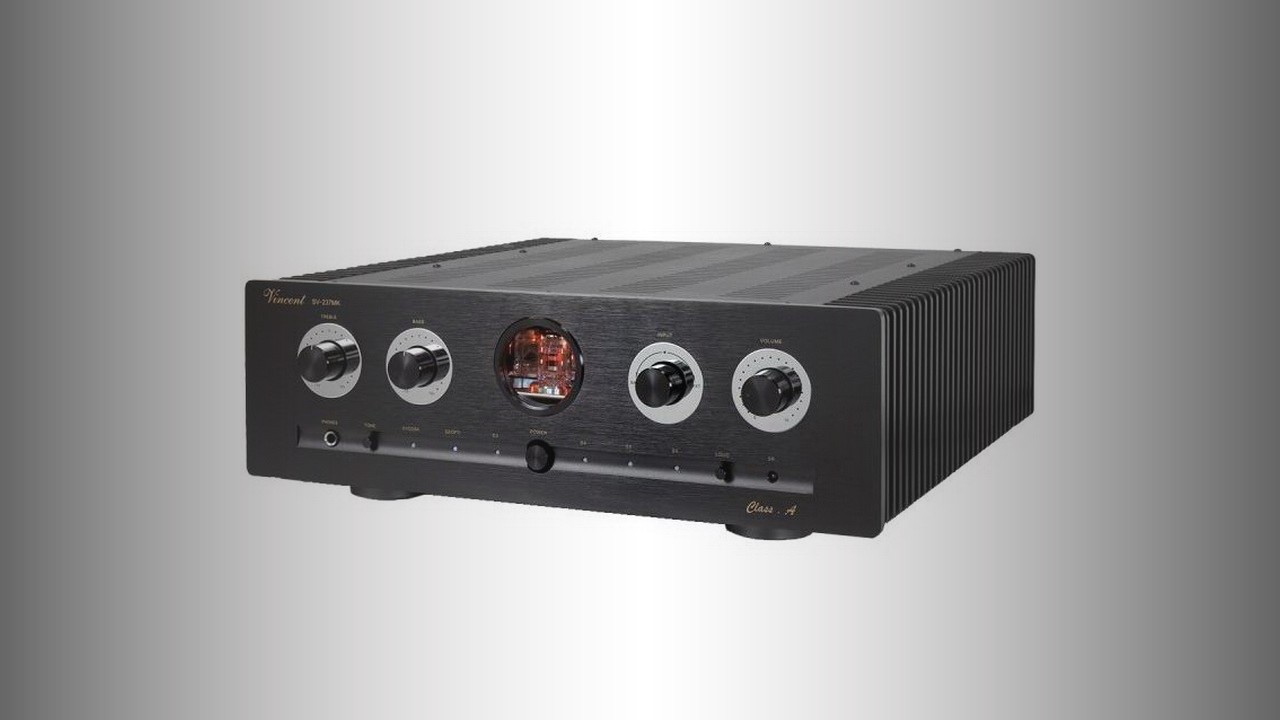
8. Vincent SV-237MK: Amplifier boasting incredible sound realism
The Vincent SV-237MK is a hybrid integrated amplifier with a two-tube preamplifier stage and digital inputs.
The Vincent SV-237MK is a hybrid integrated amplifier whose preamplifier section uses two 6N1P tubes.
It is specified to deliver 250 watts per channel into 4 ohms or 150 watts per channel into 8 ohms, with the first 10 watts into 8 ohms available in pure Class A operation.
Four RCA inputs are joined by coaxial and optical digital connections supporting files up to 24-bit/192kHz, and a front-panel headphone output adds private-listening convenience. Preamp, recorder and trigger connections broaden its integration options.
Best for: Listeners seeking a high-output hybrid integrated amplifier
- Tube-based preamplifier section
- Specified 250 watts per channel into 4 ohms
- Coaxial and optical digital inputs
- Front-panel headphone output
Verdict: The SV-237MK combines tube preamplification, substantial specified output and useful digital and headphone connections.

9. Anthem MDX-16: A 16-Channel DSP Powerhouse Built for Smart Homes
The Anthem MDX-16 supplies 16 amplified channels with independent processing for eight audio zones.
The Anthem MDX-16 is designed for installed multizone audio rather than a conventional two-channel listening room.
Its 16 Class D channels serve eight independently configurable zones, with each zone receiving separate Anthem Room Correction, subwoofer output, tone adjustment and volume control.
Output is specified at 60 watts per channel into 8 ohms or 120 watts into 4 ohms, with bridging available at 200 watts into 8 ohms. Digital and analog input routing, Ethernet, RS-232 and 12V-trigger support address distributed-audio and automation requirements.
Best for: Professionally planned whole-home audio installations
- Sixteen channels across eight zones
- Independent Anthem Room Correction by zone
- Flexible analog and digital signal routing
- Ethernet, RS-232 and trigger integration
Verdict: The MDX-16 is a specialized choice for multizone systems requiring independent processing, routing and room correction.

10. miniDSP SHD POWER: All-in-one device that includes a network streamer
The miniDSP SHD Power integrates network streaming, stereo amplification, DSP and Dirac Live room correction.
The miniDSP SHD Power combines a network streamer, DAC, DSP, volume control and stereo power amplification in one enclosure.
It accepts digital audio from SPDIF, AES/EBU, USB, network storage, web radio and supported online streaming sources.
Its SHARC processor runs Dirac Live room correction and also provides per-channel parametric equalization, crossover control, compression and limiting, plus a 2 x 4 mixing matrix. Two analog outputs allow connection of up to two active subwoofers, although Dirac calibration requires a compatible UMIK measurement microphone that is sold separately.
Best for: Compact digital systems requiring advanced DSP
- Streaming, DAC, DSP and amplification in one unit
- Dirac Live room correction
- Outputs for up to two active subwoofers
- Broad selection of digital sources
Verdict: SHD Power is a comprehensive digital system hub for listeners who want streaming, amplification, subwoofer integration and room correction in one component.
Frequently asked questions
How much amplifier power do I need?
Start with the loudspeaker manufacturer's impedance and amplification guidance, then consider room size and listening distance.
Power ratings should only be compared at the same impedance and under equivalent conditions; a larger figure alone does not establish that one amplifier is the better system match.
Do I need an integrated amplifier or a preamplifier?
An integrated amplifier combines source control and speaker-driving power.
A preamplifier such as the Premiera X1S PRO requires a separate power amplifier or active speakers, while products such as the Arcam A15 and miniDSP SHD Power can drive passive speakers directly.
Which connections should I prioritize?
Match the inputs to the sources you actually use.
HDMI ARC is practical for television sound, an MM or MM/MC phono stage is needed for a compatible turntable cartridge, USB and optical serve digital sources, and a pre-out or subwoofer output can simplify later expansion.
When is room correction worth considering?
Room correction is most relevant when speaker placement and room acoustics create uneven bass or tonal balance.
The Lyngdorf TDAI-2170, Anthem MDX-16 and miniDSP SHD Power provide correction systems, but setup requirements differ and the SHD Power needs a separately purchased UMIK measurement microphone for calibration.
How to choose the right amplifier
Begin by identifying the product type your system requires.
A simple analog amplifier such as the Fosi Audio V3 makes sense when source selection is handled elsewhere, whereas the Arcam models combine amplification with phono, digital and Bluetooth facilities.
The Premiera X1S PRO belongs in a separates system because it is a preamplifier, and the Anthem MDX-16 is intended for distributed multizone installations rather than a single stereo pair. Next, create a connection checklist. Include every current source, from a turntable and television to a computer, streamer or game console, then account for headphones, subwoofers and possible power-amplifier expansion. HDMI ARC, Bluetooth transmission, balanced outputs and phono support are useful only when they solve a real system requirement. Speaker matching still needs careful attention. Compare output specifications at the impedance relevant to your speakers, and consult both manufacturers' guidance where possible. Room-correction platforms such as RoomPerfect, Anthem Room Correction and Dirac Live can be valuable when acoustics are difficult, but they do not remove the need for sensible speaker placement. The strongest choice is the amplifier whose role, inputs, outputs and setup demands align most closely with the complete system.


Join the discussion
Share your thoughts, listening impressions or product experience.