
Slovenian audio specialist MK Analogue is entering digital conversion with the DA-CON, its first DAC. Known for moving-coil transformers and phono components, the company has placed particular emphasis on what happens after the digital signal is converted: the fully balanced analog stage includes a filter modeled on the combination of an MC transformer and an MM phono amplifier. The DA-CON also takes an elaborate approach to power, with six encapsulated toroidal transformers arranged across its two channels. AES/EBU, coaxial, optical and USB inputs make it a dedicated conversion component for systems with a range of digital sources.
A digital source, filtered through phono thinking
The DA-CON’s most distinctive idea is its analog filter. MK Analogue modeled the topology on playback through a moving-coil transformer and a moving-magnet phono amplifier, drawing a direct connection between the DAC and the products on which the company has built its reputation. The filter sits within a fully balanced analog section that combines operational amplifiers with discrete parts, including silver-mica capacitors.
The stated goal is an analog presentation that feels relaxed while retaining dynamic range and impulse precision. That is a design objective rather than a listening result: the supplied information does not establish how the DAC sounds in a system. What it does establish is that MK Analogue considers the analog circuitry more than an afterthought to the conversion chip.
The designers also describe the DA-CON as an attempt to combine qualities associated with R2R and delta-sigma converters. They cite musicality and fullness on one side, and precision, resolution and impulse response on the other. The hardware uses PCM1794 converter chips in a dual-mono architecture; the comparison describes the designers’ aims, not a claim that the unit contains both converter topologies.
Six transformers for separate circuit supplies
Power distribution is the other major feature of the design. The chassis houses six encapsulated toroidal transformers, with three assigned to each channel. The analog section, digital input section and converters each have their own supply, while a total of 48 diodes handle rectification.
There are further divisions within that arrangement: the input section and the analog current outputs of each PCM1794 are supplied through separate secondary windings. Rather than relying on one common supply for every stage, MK Analogue has organized the power system around the different jobs those circuits perform. The published details describe the architecture, although they do not establish an independently measured benefit from it.
Isolation and timing receive similar attention in the digital path. Multiple galvanic isolation stages and short signal paths between the sample-rate converter, clock generator and DAC chip are intended to minimize interference and jitter. An advanced phase-locked loop is used for clock generation, and the clock generators have a specified frequency accuracy of ±2.5 ppm.

Six digital inputs and two simultaneous outputs
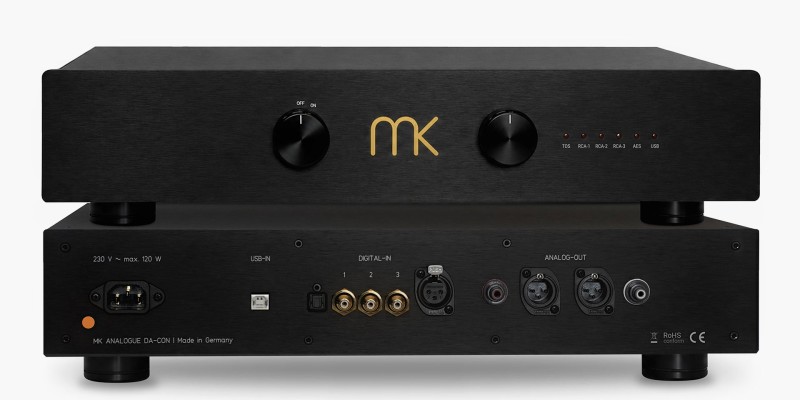
The input selection covers AES/EBU, three coaxial S/PDIF connections, optical Toslink and USB. That gives an owner several ways to connect digital sources without changing cables whenever they switch between components. The DA-CON supports linear PCM at 16 to 24 bits and sampling rates from 44.1 to 192 kHz; the supplied specifications do not break those limits down by individual input.
On the analog side, balanced XLR and RCA outputs are available simultaneously. The XLR connections use rhodium-plated Furutech connectors, while the RCA sockets are WBT-0210-Cu nextgen types. Having both output formats active gives the owner flexibility when planning connections, though the available information does not specify other output controls or operating modes.
Bistable relay muting is intended to make changes between sources and sampling frequencies noise-free. It is a small but relevant feature for a DAC expected to handle several inputs and files at different rates: the switching behavior is part of daily use, not just a detail on a specifications sheet.

A substantial chassis with one finish
The DA-CON weighs 12 kg and is housed in a solid aluminum chassis. Four bfly-Audio Pure feet, specified as matched to the unit’s weight, support it. MK Analogue offers the DAC only in black.
A 1.5-meter Supra LoRAD Excalibur power cable is included. Together with the transformer count and the range of physical inputs, the package points toward a standalone component intended to take its place alongside other equipment, rather than a compact converter designed around a single connection.
For an owner considering the DA-CON, the key question is whether its emphasis on the analog output stage and separated power supplies fits the rest of the system and the sources they use. Its input selection accommodates several connection types, while simultaneous XLR and RCA outputs provide options on the amplifier side. The phono-derived filter gives the DAC a clear link to MK Analogue’s existing work, but its intended sonic character remains a manufacturer design goal until heard in context. The supplied announcement does not give a USD price or regional availability details, and it does not specify per-input sample-rate limits. Those are useful points to check with a dealer before planning a purchase or relying on a particular source connection.