



A digital-to-analog converter should fit the architecture of a system rather than merely satisfy a specification checklist.
Input requirements, output configuration, volume control and component integration are often more consequential than headline sampling rates.
A DAC intended for a smartphone and wired headphones serves a fundamentally different role from one designed to feed balanced separates. This selection reflects that breadth. It includes modular multibit and balanced R2R designs, a preamplifier with onboard conversion, minimalist studio-oriented hardware, portable USB DACs and components able to drive a power amplifier directly. The order is preserved from the supplied source material, but each entry is differentiated by its practical system role. Before choosing, identify every digital source you plan to connect, whether you need RCA or XLR outputs, and where volume control will occur. Also check whether streaming, headphone amplification or analog input switching is required, because several of these products deliberately omit one or more of those functions.

1. Schiit Audio Gungnir 2
The Schiit Audio Gungnir 2 combines a balanced multibit conversion stage with modular input, processing and analog boards.
Gungnir 2 is a balanced multibit DAC built around four DAC8812CRUZ converters, a balanced analog multiplication stage and Schiit Audio’s proprietary digital filter.
Its modular input, processing and removable analog boards distinguish it as a system-oriented design, while two USB connections make it possible to leave separate USB sources attached.
The high-speed Unison 384 input supports PCM up to 32-bit/384 kHz and DXD, and a selectable NOS mode bypasses the digital filter.
Best for: Multisource systems needing modularity
- Balanced multibit architecture
- Two USB inputs
- Selectable NOS mode
- Modular internal boards
Verdict: A flexible multibit DAC for listeners who value two USB inputs, selectable filtering and an upgrade-conscious modular structure.

2. Denafrips Ares 12TH-1
The Denafrips Ares 12TH-1 houses its balanced resistor-ladder conversion circuitry in a compact anodized aluminum enclosure.
The Ares 12TH-1 is a balanced R2R DAC constructed with 480 selected precision resistors and an Altera FPGA.
It accommodates USB-B, I2S over HDMI, coaxial and optical sources, with both balanced XLR and single-ended RCA outputs.
Users can choose NOS or oversampling operation, making this compact aluminum component particularly adaptable for systems built around discrete ladder conversion.
Best for: Listeners seeking a compact balanced R2R DAC
- Balanced R2R conversion
- NOS and oversampling modes
- USB, I2S, coaxial and optical inputs
- XLR and RCA outputs
Verdict: A connectivity-rich ladder DAC that offers both NOS and oversampling operation without limiting users to one analog output format.

3. Primare PRE35 DAC
The Primare PRE35 DAC pairs an OLED-equipped preamplifier platform with an AKM-based digital conversion module.
The PRE35 DAC combines digital conversion with the switching and volume-control duties of a full preamplifier.
Its onboard media module uses an AKM AK4497 DAC supporting PCM up to 32-bit/768 kHz and DSD256, while the chassis provides balanced and single-ended analog connectivity alongside control connections including IR, trigger and RS232.
Configurable input names, input disabling and per-input volume reduction help it serve as the control center of a larger system.
Best for: Systems needing a DAC and analog preamplifier
- Preamplifier and DAC in one component
- Balanced and RCA connectivity
- PCM up to 32-bit/768 kHz and DSD256 support
- Configurable input settings
Verdict: A practical choice when digital conversion, analog source management and system control need to reside in one chassis.
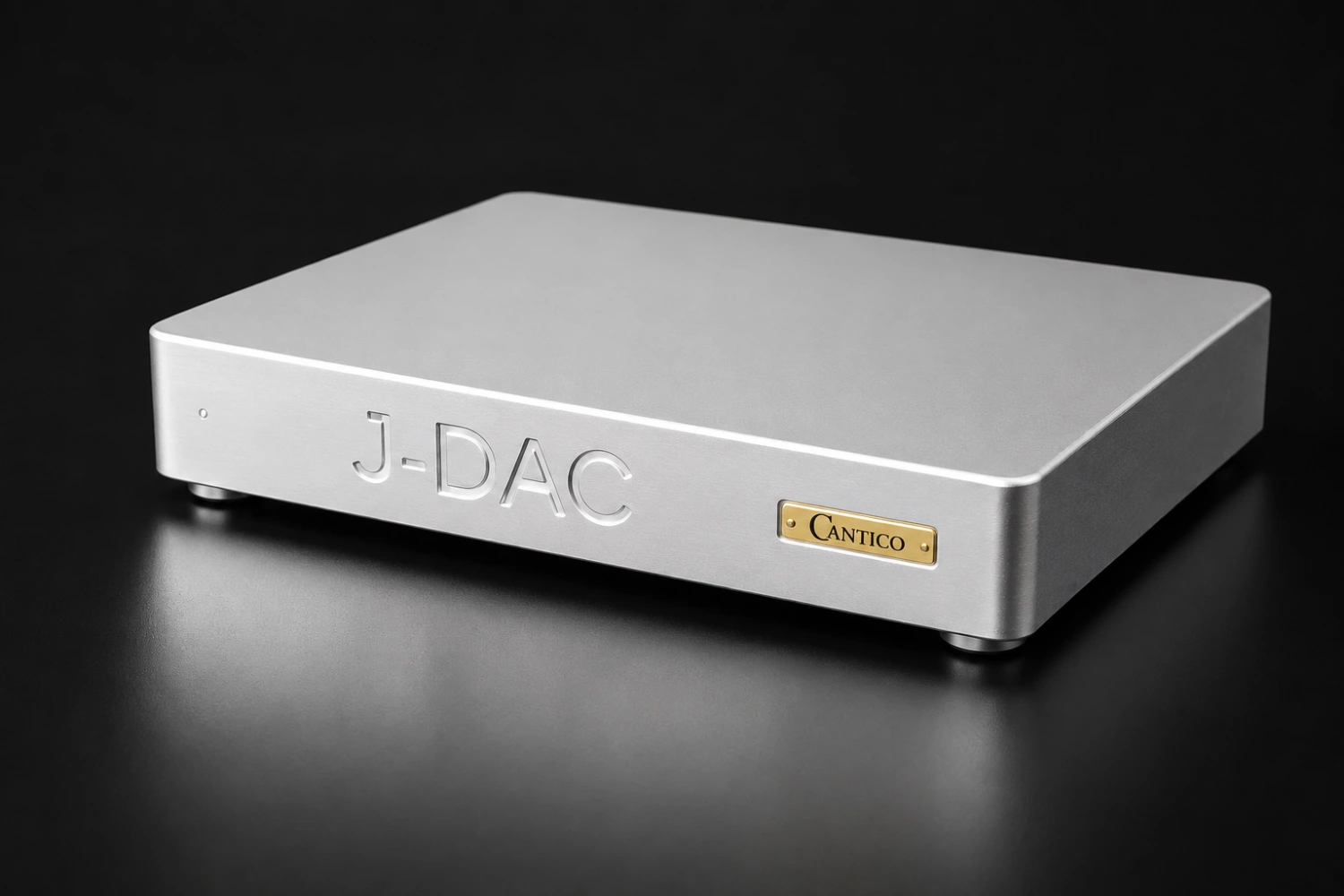
4. Cantico J-DAC
The Cantico J-DAC uses a substantial single-piece aluminum body and a transformer-coupled output stage for both connection formats.
Developed and manufactured in Ponderano, Italy, the J-DAC emphasizes a short signal path, galvanic isolation and separate power supplies for key sections.
Each channel places a single JFET between the conversion resistors and a custom output transformer.
Both XLR and RCA connections are provided, although a rear-panel switch means only one output type can be active at a time.
Best for: Purist systems centered on isolated analog outputs
- Transformer-coupled output stage
- Galvanic isolation
- Separate power supplies for key modules
- XLR and RCA connections
Verdict: A specialized, hand-assembled DAC whose transformer-coupled output stage and deliberately simplified routing take priority over simultaneous output flexibility.

5. Weiss DAC205 MK2
The Weiss DAC205 MK2 is a minimalist converter with balanced and unbalanced outputs but no USB or streaming facilities.
The DAC205 MK2 takes a deliberately narrow approach: it has no streaming and no USB input, and supports PCM up to 24-bit/192 kHz.
Its ESS ES9028PRO implementation runs four DAC cores in parallel for each channel, while the revised analog stage has near-zero output impedance.
Balanced and unbalanced outputs allow it to integrate with domestic or studio-oriented systems that already have suitable digital sources.
Best for: Established systems with dedicated digital transports
- Four parallel DAC cores per channel
- Reworked low-impedance analog stage
- Balanced and unbalanced outputs
- Focused, processing-light feature set
Verdict: A focused conversion component for users who already have compatible digital sources and do not need USB or streaming in the DAC.

6. Hidizs SD2
The compact Hidizs SD2 connects over Type-C and provides a single-ended 3.5 mm output for headphones or powered speakers.
The SD2 combines an ES9270 DAC and built-in headphone amplifier in a compact Type-C device.
It connects to smartphones, computers, tablets and game consoles, then feeds wired headphones or powered speakers through a single-ended 3.5 mm output.
Format support reaches PCM 32-bit/384 kHz and native DSD128, while rated output is 70 mW per channel into 32 ohms.
Best for: Portable listening with wired headphones
- Compact Type-C design
- Built-in headphone amplifier
- PCM up to 32-bit/384 kHz and DSD128
- 3.5 mm headphone output
Verdict: A straightforward pocket DAC and headphone amplifier for adding a 3.5 mm output to compatible Type-C devices.

7. Soundaware DAM1 15TH
The Soundaware DAM1 15TH offers five digital input types, selectable processing modes and a choice of external power supplies.
The DAM1 15TH is built around Soundaware’s proprietary Jingling DSP and provides USB, optical, coaxial, AES/EBU and I2S digital inputs.
Balanced XLR and unbalanced RCA outputs broaden its system compatibility, while four operating modes provide different approaches to PCM and DSD processing.
Power is supplied by a choice of separate external units, either the LP1 15TH or LPX 15TH.
Best for: Advanced systems requiring varied digital interfaces
- Five digital input formats
- Proprietary Jingling DSP
- Four operating modes
- Balanced and unbalanced outputs
Verdict: A configurable DAC for users who need broad digital connectivity and want control over how incoming PCM and DSD data are processed.

8. Neutron HiFi DAC V1
The Neutron HiFi DAC V1 uses a Gorilla Glass-covered OLED to show playback format and operating status.
The Neutron HiFi DAC V1 is a USB converter supporting PCM up to 32-bit/384 kHz and DSD256.
Its hardware combines an ESS DAC chip, an ultra-low-noise power supply and dual master clocks, with an ARM Cortex-M4 controller running Neutron HiFi firmware.
A Gorilla Glass 3-covered OLED reports the audio format and device status, while the aluminum enclosure protects the internal hardware.
Best for: USB playback with visible format information
- PCM up to 32-bit/384 kHz and DSD256
- Informative OLED display
- Dual master clocks
- Durable aluminum enclosure
Verdict: A compact USB DAC distinguished by its status display, high-resolution format support and firmware-controlled hardware platform.

9. Exposure DAC
The Exposure DAC combines extensive S/PDIF connectivity with XLR and RCA outputs and a 99-step digital volume control.
Exposure’s standalone DAC omits streaming and analog inputs but adds a 99-step digital volume control, allowing connection directly to a power amplifier.
Its digital interface selection includes seven S/PDIF inputs supporting PCM up to 192 kHz, plus USB handling PCM up to 32-bit/768 kHz and DSD256.
Both RCA and XLR analog outputs are provided for integration with single-ended or balanced systems.
Best for: Digital-only systems without a separate preamplifier
- 99-step digital volume control
- Direct power-amplifier connection
- Seven S/PDIF inputs
- RCA and XLR outputs
Verdict: A strong system-hub option for digital sources when direct power-amplifier connection matters more than streaming or analog input switching.

10. Eversolo DAC-Z10
The Eversolo DAC-Z10 features a large front display, dual-mono AKM conversion and resistor-ladder volume control.
The DAC-Z10 combines a DAC, preamplifier and headphone amplifier in one component.
Its dual-mono layout uses separate AK4191 and AK4499 converter combinations for the left and right channels, while three toroidal transformers independently supply the channels and system circuitry.
Volume is managed by a dual R2R resistor network rather than digital attenuation, and the large front display can show operating information or selectable VU-meter graphics.
Best for: Integrated digital systems with headphone listening
- DAC, preamplifier and headphone amplifier
- Dual-mono converter architecture
- Dual R2R volume control
- Large information display
Verdict: A multifunction component for listeners who want conversion, preamplifier control and headphone amplification built around separated channel architecture.
Quick comparison
These ten products address markedly different systems.
The Hidizs and Neutron models concentrate on compact USB use, while the Primare and Eversolo combine conversion with broader control functions.
Schiit, Denafrips, Cantico, Weiss and Soundaware pursue more specialized conversion architectures, and the Exposure stands out for its extensive digital inputs and direct power-amplifier capability.
| Product | Best for | Verdict |
|---|---|---|
| Schiit Audio Gungnir 2 | Modular multibit systems with two USB sources | Balanced multibit conversion, selectable NOS operation and modular boards provide unusual configuration flexibility. |
| Denafrips Ares 12TH-1 | Compact balanced R2R systems | Combines resistor-ladder conversion with NOS and oversampling modes plus USB, I2S and S/PDIF connectivity. |
| Primare PRE35 DAC | Combined DAC and preamplifier duties | Adds AKM-based high-resolution conversion to a fully equipped analog preamplifier and system-control platform. |
| Cantico J-DAC | Transformer-coupled purist systems | Prioritizes galvanic isolation, separate power supplies and a short analog path, with one output format active at a time. |
| Weiss DAC205 MK2 | Dedicated transports and studio-oriented installations | A minimalist 24-bit/192 kHz converter with parallel DAC cores and a revised low-impedance output stage. |
| Hidizs SD2 | Type-C devices and wired headphones | Portable conversion and headphone amplification are delivered through a simple 3.5 mm output. |
| Soundaware DAM1 15TH | Systems with multiple professional and consumer digital interfaces | Five input formats, proprietary DSP and several operating modes support a configurable digital front end. |
| Neutron HiFi DAC V1 | Compact high-resolution USB playback | Pairs PCM and DSD support with dual clocks, dedicated firmware and an informative OLED display. |
| Exposure DAC | Digital-only systems driving a power amplifier | A 99-step volume control and numerous S/PDIF inputs make it suitable as a digital control center. |
| Eversolo DAC-Z10 | Combined DAC, preamplifier and headphone systems | Integrates three component roles with dual-mono conversion, resistor-ladder volume control and a large display. |
Frequently asked questions
Should sampling-rate support determine which DAC I buy?
Not by itself.
Confirm that a DAC supports the formats your sources actually output, then prioritize the required inputs, analog outputs, volume control and system role.
Extremely high supported rates offer little practical value if the product cannot connect conveniently to the rest of the system.
When is a DAC with volume control useful?
Volume control is useful when the DAC will feed a power amplifier directly or act as the main controller in a digital-only system.
The Exposure DAC explicitly supports direct power-amplifier connection, while products such as the Primare PRE35 DAC and Eversolo DAC-Z10 incorporate broader preamplifier functions.
Do I need balanced XLR outputs?
Choose XLR when the partnering equipment has balanced inputs and that connection suits the system layout.
RCA remains appropriate for single-ended equipment.
Several products here provide both, but the Cantico J-DAC requires users to select one output type at a time.
What is the difference between NOS and oversampling operation?
NOS bypasses oversampling or digital-filter processing, while oversampling applies digital processing before conversion.
The Schiit Audio Gungnir 2 provides a selectable NOS mode, and the Denafrips Ares 12TH-1 offers both NOS and oversampling choices, allowing users to select the operating approach that fits their preference.
How to Choose the Right DAC for Your System
Begin with connections rather than conversion technology.
List the outputs of every source and the inputs on the downstream amplifier, preamplifier, headphones or powered speakers.
A USB-only portable device is appropriate for a phone or computer, whereas a main hi-fi system may require coaxial, optical, AES/EBU, I2S or multiple USB connections. Balanced XLR outputs are useful only when the receiving equipment can accommodate them. Next, decide which component will control volume. A fixed-output DAC normally feeds a preamplifier or integrated amplifier. A model with suitable volume control can simplify a digital-only system, and the Exposure DAC is specifically designed to connect directly to a power amplifier. The Primare PRE35 DAC and Eversolo DAC-Z10 go further by combining conversion with preamplifier functions, while the Eversolo also incorporates headphone amplification. Architecture should narrow the shortlist only after these practical questions are resolved. The Schiit provides balanced multibit conversion and modular construction; the Denafrips uses a balanced R2R network with selectable NOS and oversampling; the Cantico concentrates on transformer coupling and galvanic isolation; and the Weiss follows a deliberately minimalist approach. For portable use, the Hidizs SD2 provides a Type-C connection and 3.5 mm headphone output, while the Neutron HiFi DAC V1 adds an informative OLED to its USB-focused design. Finally, avoid paying for functions already handled elsewhere. A system with a capable streamer does not necessarily need streaming inside the DAC, while a collection of legacy digital transports may make broad S/PDIF support essential. The most suitable choice is the one that accepts every necessary source, interfaces correctly with the amplifier and places volume and headphone duties where you want them.


Join the discussion
Share your thoughts, listening impressions or product experience.