

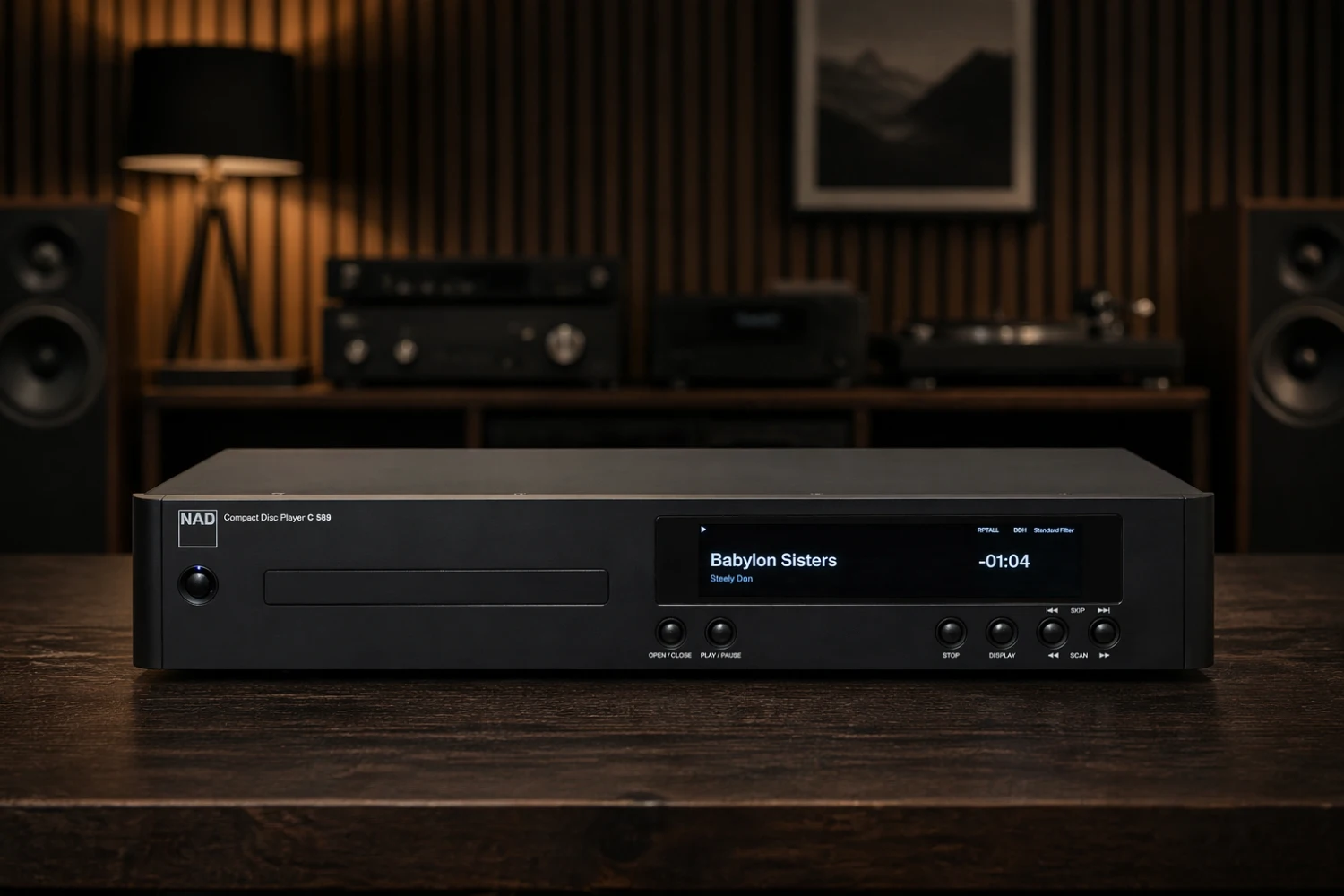
The NAD C 589 arrives at a moment when CD playback occupies an interesting place in hi-fi. Streaming dominates daily listening for many people, yet the compact disc remains a durable, widely owned, and tactile music format. For collectors, long-time CD owners, and younger listeners discovering physical media, a dedicated player still offers a simple promise: place a disc in the tray, press play, and hear the album as a self-contained object rather than a file in a library. NAD’s C 589 is designed for that audience, but it is not simply a nostalgic machine. As part of the company’s Classic product line, it combines conventional CD playback with modern digital processing, an ESS-based digital-to-analog conversion stage, balanced and unbalanced analog outputs, and multiple digital outputs for use as a transport. Its appeal lies in how it treats the CD player as both a complete source component and a flexible part of a larger hi-fi system.
A CD Player for the Continuing Life of Physical Music
The most obvious attraction of the NAD C 589 is its commitment to a format that has never really disappeared. There are still hundreds of millions of CDs in circulation, and many music listeners own collections built over decades. A dedicated player gives those discs a clear role in a modern system instead of leaving them stored away or played through aging hardware.
That matters because CDs remain practical. They are compact, robust, easy to catalogue, and often include albums, masterings, and editions that listeners may not find in the same form through streaming services. The C 589 speaks to people who want the experience of choosing a physical album while still expecting a contemporary level of engineering from the playback hardware.
NAD’s decision to place the C 589 in its Classic line also helps define its position. This is not presented as a lifestyle accessory or a multi-format streaming hub. It is a focused CD player, intended for systems where disc playback is treated as a serious source rather than an afterthought. That focus is part of the product’s appeal: it does one main job, but it does it with several useful integration options.
QRONO d2a Processing and the Importance of Timing
One of the distinctive technologies in the C 589 is QRONO d2a processing, developed by MQA Labs and implemented here by NAD. The technology is described as addressing the time-domain behavior of digital-to-analog conversion, with the aim of preserving important timing information in the audio signal. In practical hi-fi terms, time-domain accuracy is relevant because music is not just a sequence of tones; it is also a sequence of starts, stops, decays, spatial cues, and transient events.
NAD places QRONO d2a at the center of the C 589’s design story. According to the company’s description, the processing is intended to support clarity, imaging, and a more natural sense of musical flow, particularly in recordings where acoustic detail and spatial information matter. Those claims should be understood as NAD’s stated design goals rather than independent listening findings, but they do explain the engineering direction of the player.
For a prospective owner, the significance is not that the C 589 adds a new format or turns a CD into something else. Instead, the attraction is that NAD has used a modern processing approach to revisit a mature format. The compact disc is a fixed 16-bit/44.1 kHz medium, but the quality of playback still depends on clocking, conversion, filtering, mechanical stability, and analog output design. QRONO d2a is NAD’s way of emphasizing that the conversion process remains an area where careful engineering may matter.
ESS-Based Conversion and Analog Output Choices
The C 589 uses a digital-to-analog converter built around an ESS design, described by NAD as engineered for low noise, low distortion, and strong dynamic range. The DAC stage is central for listeners who plan to connect the player directly to an integrated amplifier or preamplifier through its analog outputs. In that setup, the C 589 is not merely reading the disc; it is also responsible for converting the digital data into the analog signal the rest of the system will amplify.
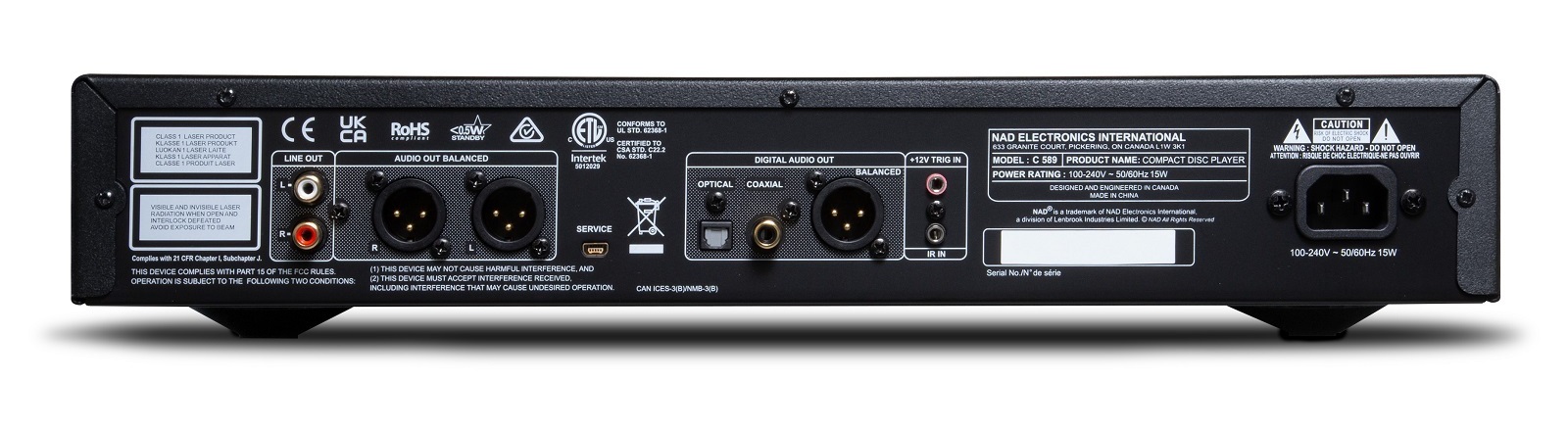
The inclusion of both RCA and balanced XLR outputs is especially useful. RCA remains the standard connection for many integrated amplifiers, preamplifiers, and receivers, so the C 589 can slot into a wide range of conventional systems. Balanced XLR outputs, meanwhile, make the player more attractive for systems built around components that support balanced connections. In some installations, balanced cabling can be useful for longer cable runs or for matching the connection standard of higher-end preamps and integrated amplifiers.
The key point is flexibility. A CD player with only one analog output type may force the owner to adapt around it. The C 589 gives users a choice, making it more likely to remain useful if the rest of the system changes over time. That is an important consideration for a product based on a physical media library: many CD collections last longer than individual amplifiers or DACs.
Digital Outputs for Use as a Dedicated Transport
NAD has also equipped the C 589 with AES/EBU, coaxial, and optical digital outputs. These connections allow the player to function as a CD transport feeding an external digital-to-analog converter. That broadens the product’s role substantially. Someone may buy the C 589 for its complete internal playback chain, but later choose to use a standalone DAC without replacing the disc mechanism.
The presence of AES/EBU is notable because it gives the player a connection often associated with more system-oriented or professional-style digital setups. Coaxial and optical outputs provide more common consumer options, making the C 589 easier to pair with a wide range of DACs, integrated amplifiers with digital inputs, or digital preamplifiers.
Just as important is what the C 589 does not try to be. The source information states that it has digital outputs but no digital inputs. That means it is not intended to serve as a general-purpose DAC for streamers, computers, or televisions. Its digital section is focused on CD playback, either through its own analog outputs or as a disc transport. For buyers who want a multi-input digital control center, that limitation matters. For buyers who want a purpose-built CD source, the narrower focus may be a benefit.
Disc Mechanism, Display, and Day-to-Day Usability
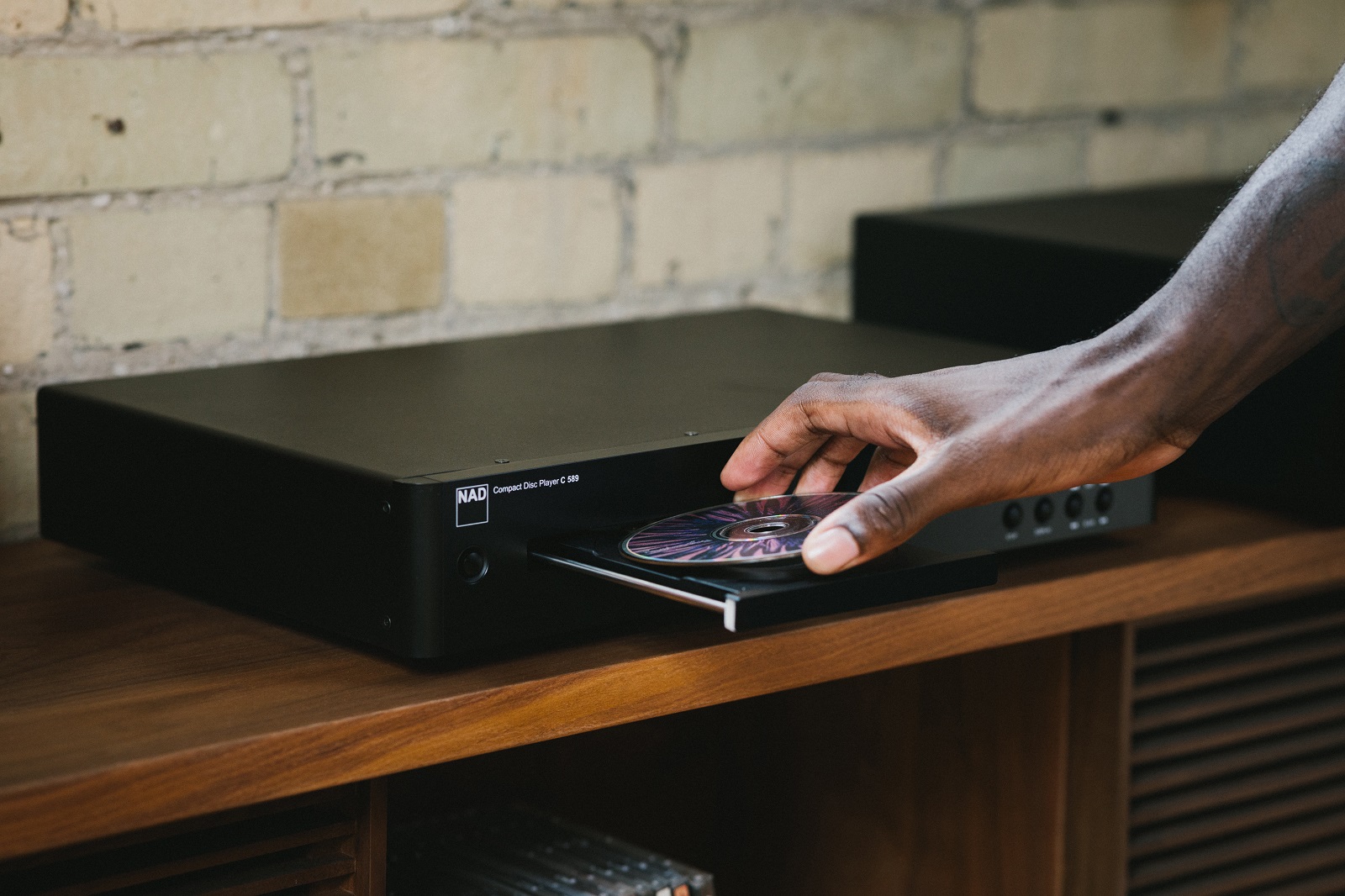
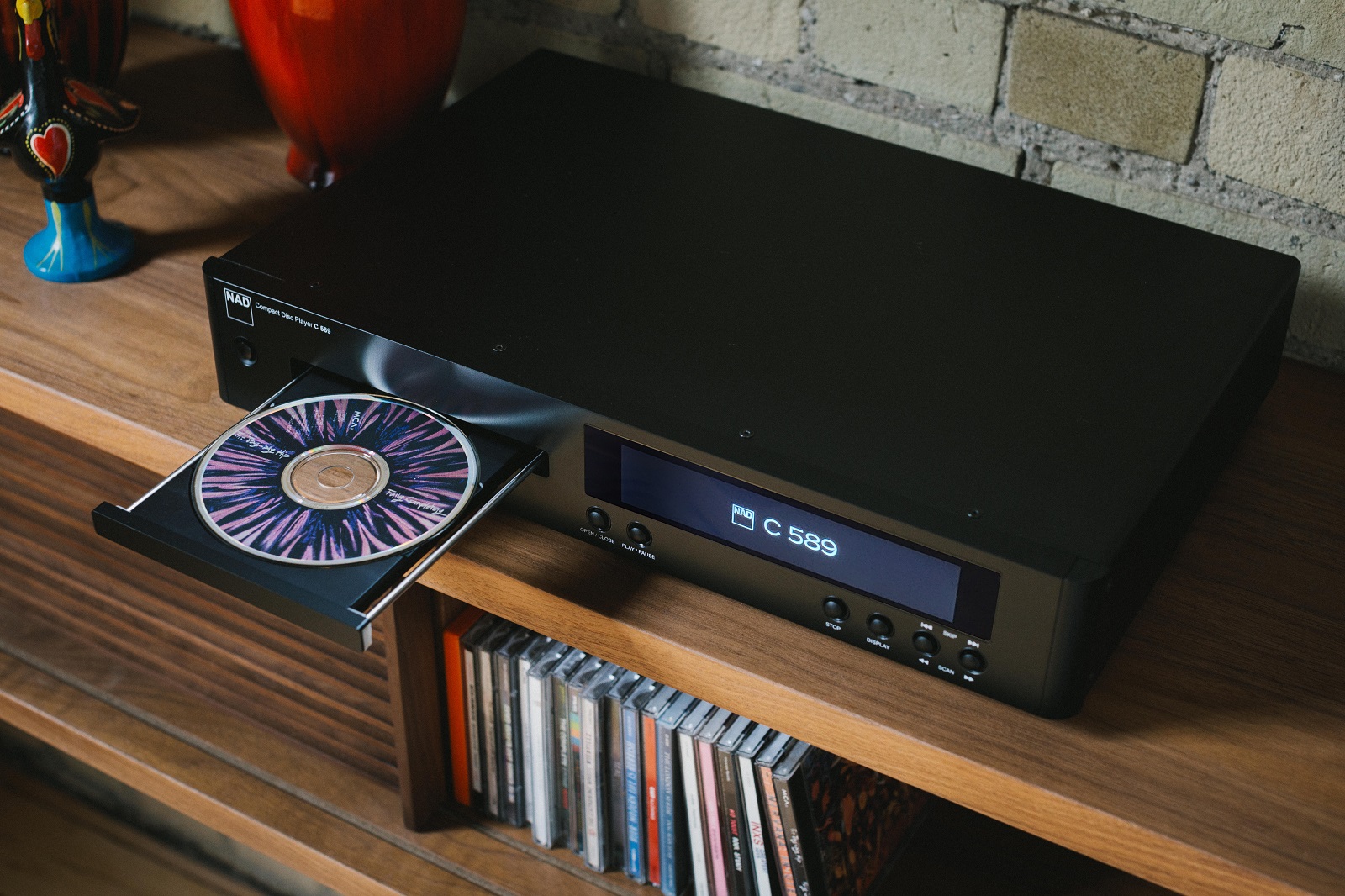
A good CD player also depends on mechanical confidence. NAD describes the C 589’s CD drive as designed for smooth, quiet, and reliable operation, with a quality loader and laser pickup intended to support accurate disc tracking and stable playback across a wide range of CDs. Those details are not glamorous, but they are essential to the everyday experience of using a disc player.
Mechanical stability matters because the physical act of reading an optical disc is the foundation of everything that follows. A reliable loader, stable tracking, and quiet operation contribute to making the player feel like a dependable component rather than a delicate accessory. For listeners with large CD libraries, that kind of reliability is part of the appeal.
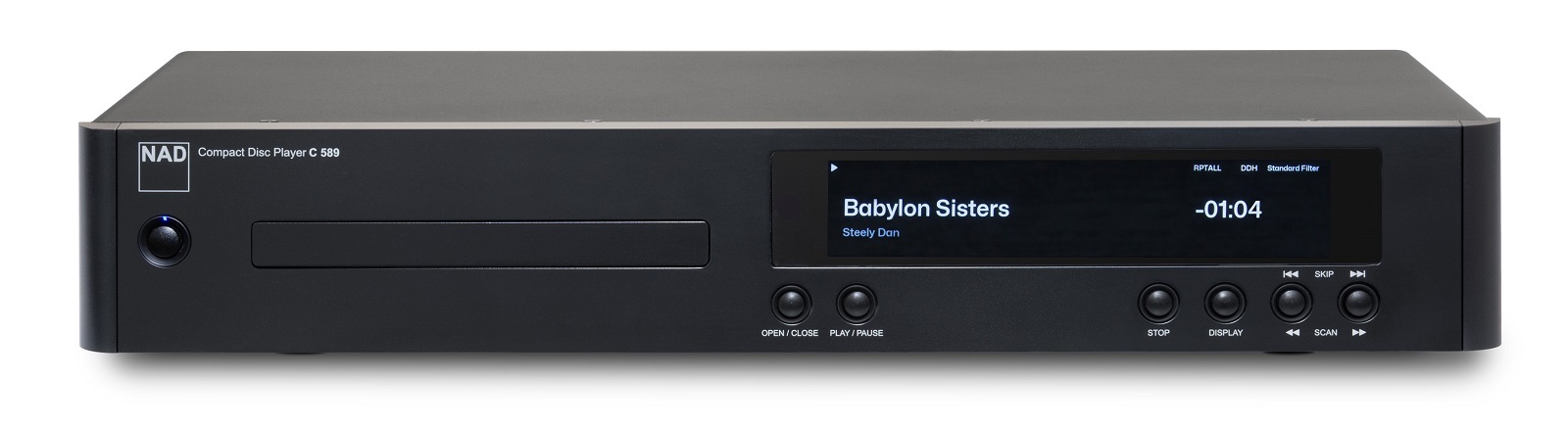
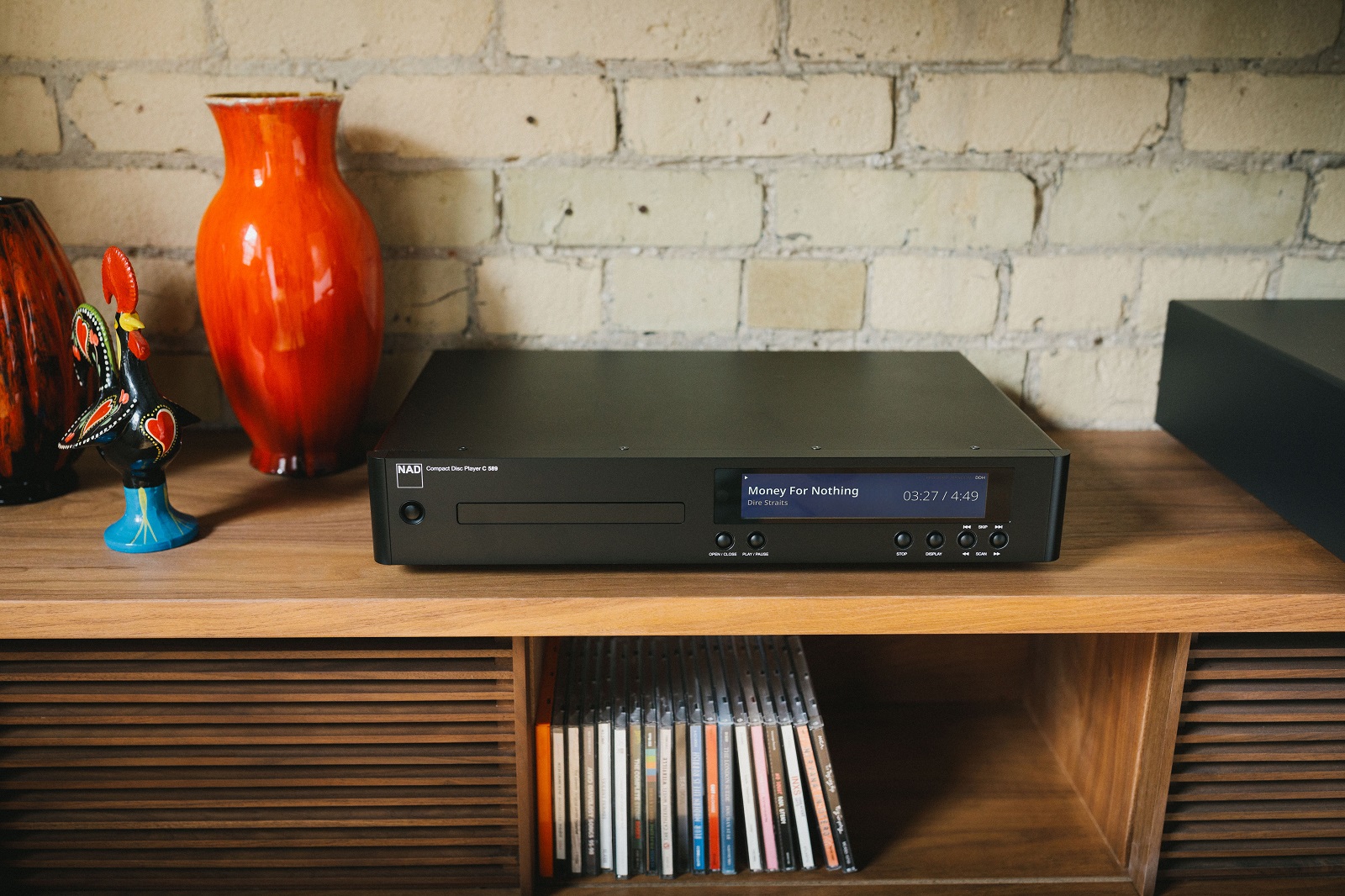
The front panel includes a large display that can show artist and track information when such data is available on the inserted disc. This is a practical touch for daily use. CD playback is often album-oriented, but readable front-panel information helps when navigating tracks, confirming a disc, or using the player from across the room. An included IR remote control further supports traditional hi-fi operation, allowing playback control from the listening position without requiring an app or network connection.
System Matching and Long-Term Flexibility
The C 589 is likely to be easiest to understand as a source component for a two-channel hi-fi system. It can connect directly to an integrated amplifier or preamplifier through RCA or XLR, or it can feed a separate DAC through AES/EBU, coaxial, or optical digital output. That makes it adaptable to several system architectures without turning it into an all-in-one product.
For a relatively straightforward system, the analog outputs allow the C 589 to serve as the sole disc source. In a more modular system, its digital outputs allow the owner to choose a DAC separately. This flexibility is valuable because digital preferences and system configurations can change. A listener might start with the internal ESS-based conversion and later experiment with an external DAC while keeping the same disc transport.
The lack of digital inputs also simplifies its identity. It is not competing with streaming DACs or network players on feature count. Instead, it is aimed at owners who want a dedicated CD component that can integrate into both traditional analog systems and more elaborate digital front ends.
Who the NAD C 589 Is Most Suitable For
The NAD C 589 is best suited to listeners with meaningful CD collections, or to those who are actively building one and want a dedicated player rather than relying on a universal disc machine or an older transport. It will also appeal to owners of NAD Classic systems who want a visually and functionally coherent CD source, as well as to hi-fi users who value both balanced analog output and transport capability.
It is also a sensible match for listeners who prefer physical media but still care about modern digital engineering. QRONO d2a processing, ESS-based conversion, and multiple output paths make the C 589 more than a basic disc spinner. Its feature set supports both immediate use and future system changes.
It is less suitable for someone whose main priority is streaming, network playback, or using one DAC for multiple external digital sources, because the C 589 does not include digital inputs and is not described as a network device. Buyers looking for a universal player for multiple disc formats would also need to confirm their needs elsewhere, since the documented focus here is CD playback.
Conclusion
The NAD C 589 is attractive because it treats CD playback as a current, worthwhile part of hi-fi rather than a legacy function. Its strongest documented qualities are its focused Classic-series design, QRONO d2a processing, ESS-based conversion, balanced XLR and RCA analog outputs, and AES/EBU, coaxial, and optical digital outputs for use as a transport. Add in a quiet, reliable disc mechanism, a useful front display, and remote control operation, and the result is a purpose-built CD source for listeners who want to keep physical media central in a serious stereo system. It is especially well suited to CD collectors, two-channel system owners, and anyone who wants a dedicated disc player with both analog completeness and digital flexibility.



Join the discussion
Share your thoughts, listening impressions or product experience.