
A digital-to-analog converter can be a pocket accessory, a desktop hub, a full preamplifier, or a statement-level digital system.
The most interesting DACs are not always defined by one headline specification; they stand out because their form, controls, inputs, conversion architecture, or system role solves a real problem.
This guide follows that curiosity. Some entries are tiny USB DACs intended to travel with a phone or laptop. Others are built for headphone desks, two-channel systems, televisions, SACD/CD transports, or ambitious multi-box digital installations. The common thread is that each model brings a clearly identifiable idea to the category. The recommendations below are grounded only in the supplied source material. Where a product is described by the manufacturer, the language stays appropriately cautious; where the source provides concrete details, those details are used to help separate one DAC from another.

1. Shanling UA1 II: A Tiny USB DAC With Balanced Power, Dual DACs and a Built-In Screen
The Shanling UA1 II combines a tiny aluminum body with glass window detailing, a color screen, and physical controls.
The Shanling UA1 II is notable because it brings features usually associated with larger portable DACs into a very small USB dongle.
The source describes it as weighing just under 18 grams, with a slim aluminum body, rounded edges, and glass windows that give it more visual identity than a basic adapter-style DAC.
Its most practical distinction is control: the built-in color display and physical buttons allow standalone operation for volume, playback, and menu navigation rather than relying entirely on a phone screen or companion app. For listeners who want a pocketable DAC that still feels like a proper device, the UA1 II is the compact option here with the clearest everyday usability angle.
Best for: Pocketable phone, tablet, and laptop listening
- Extremely compact body at just under 18 grams
- Built-in color display
- Physical buttons for standalone control
- Aluminum body with glass window details
Verdict: The Shanling UA1 II is the small DAC to consider when you want dongle convenience without giving up onboard controls and a real display.

2. Primare PRE35 DAC: Preamplifier and DAC combined
The Primare PRE35 DAC places digital conversion inside a minimalist preamplifier chassis with OLED display and balanced connectivity.
The Primare PRE35 DAC is less about portable convenience and more about system architecture.
It combines preamplifier duties with a built-in DAC section, making it suitable for listeners who want digital conversion and analog control in one full-size hi-fi component.
The source highlights a durable steel alloy body, minimalist front panel, OLED display with adjustable brightness, balanced XLR connectivity, multiple RCA inputs and outputs, and a setup menu that can rename or disable inputs and adjust volume for each one. Its DAC module uses an AKM AK4497 and supports PCM up to 32-bit/768 kHz and DSD256/11.2 MHz. It is also described as a natural partner for Primare’s A35.2 power amplifier and CD35 CD player in a balanced system.
Best for: Two-channel systems needing a DAC-equipped preamplifier
- Combines preamplifier and DAC functions
- Balanced XLR inputs and output
- Configurable inputs through the setup menu
- AKM AK4497 DAC module with high-resolution PCM and DSD support
Verdict: The Primare PRE35 DAC is the right fit when the DAC is expected to serve as the control center of a serious stereo system.

3. Topping D900: $1,800 Flagship DAC With Discrete 1-Bit PSRM Technology and True High-End Build
The Topping D900 uses a full aluminum chassis and Topping’s discrete 1-bit PSRM conversion platform.
The Topping D900 stands out for its conversion architecture.
Rather than using the standard DAC chips common in many competing products, it is built around Topping’s proprietary discrete 1-bit Precision Stream Reconstruction Matrix, or PSRM.
The source explains that this approach processes single-bit values at very high speed and is presented by Topping as fundamentally different from conventional chip-based delta-sigma implementations. The hardware presentation also aims above the compact desktop class: the chassis uses three-millimeter aluminum panels, an eight-millimeter front panel, side cooling fins, vibration-absorbing feet, and a remote control milled from a single block of aluminum. Among the DACs here, it is the one most clearly defined by a proprietary conversion platform and a full-width hi-fi component feel.
Best for: Listeners interested in a flagship DAC built around non-standard conversion technology
- Proprietary discrete 1-bit PSRM conversion architecture
- Substantial aluminum chassis construction
- Side cooling fins and vibration-absorbing feet
- Aluminum remote control milled from a single block
Verdict: The Topping D900 is the choice for systems where the appeal lies in a proprietary discrete 1-bit DAC architecture and more substantial component-grade construction.

4. Shanling UA7: Tiny Tube DAC with ESS Power and 577mW Output
The Shanling UA7 packages an ESS-based DAC, tube output stage, OLED display, and 4.4 mm balanced output in a compact aluminum body.
The Shanling UA7 is the most unusual portable DAC in this selection because it uses tubes in the output stage.
Shanling pairs two JAN6418 tubes with an ESS ES9069 DAC and a compact headphone amplifier section, creating a small DAC/amp that aims for a distinctive analogue-stage character without abandoning modern format support.
The source specifies PCM support up to 32-bit/768 kHz and DSD512, along with output power up to 577 milliwatts into 32 ohms from the balanced 4.4 mm output and 195 milliwatts into 32 ohms from the 3.5 mm output. Practical details include a redesigned aluminum housing with a shock-absorbing structure to protect the tubes, a multifunction control knob, and an OLED display for inputs, filters, and gain settings.
Best for: Portable headphone users curious about a tube-equipped DAC/amp
- Tube output stage with two JAN6418 tubes
- ESS ES9069 DAC with PCM and DSD support
- Balanced 4.4 mm output rated up to 577 milliwatts into 32 ohms
- OLED display with direct control of inputs, filters, and gain
Verdict: The Shanling UA7 is the portable pick for listeners who want a compact DAC/amp with tube output circuitry and substantial balanced output power.
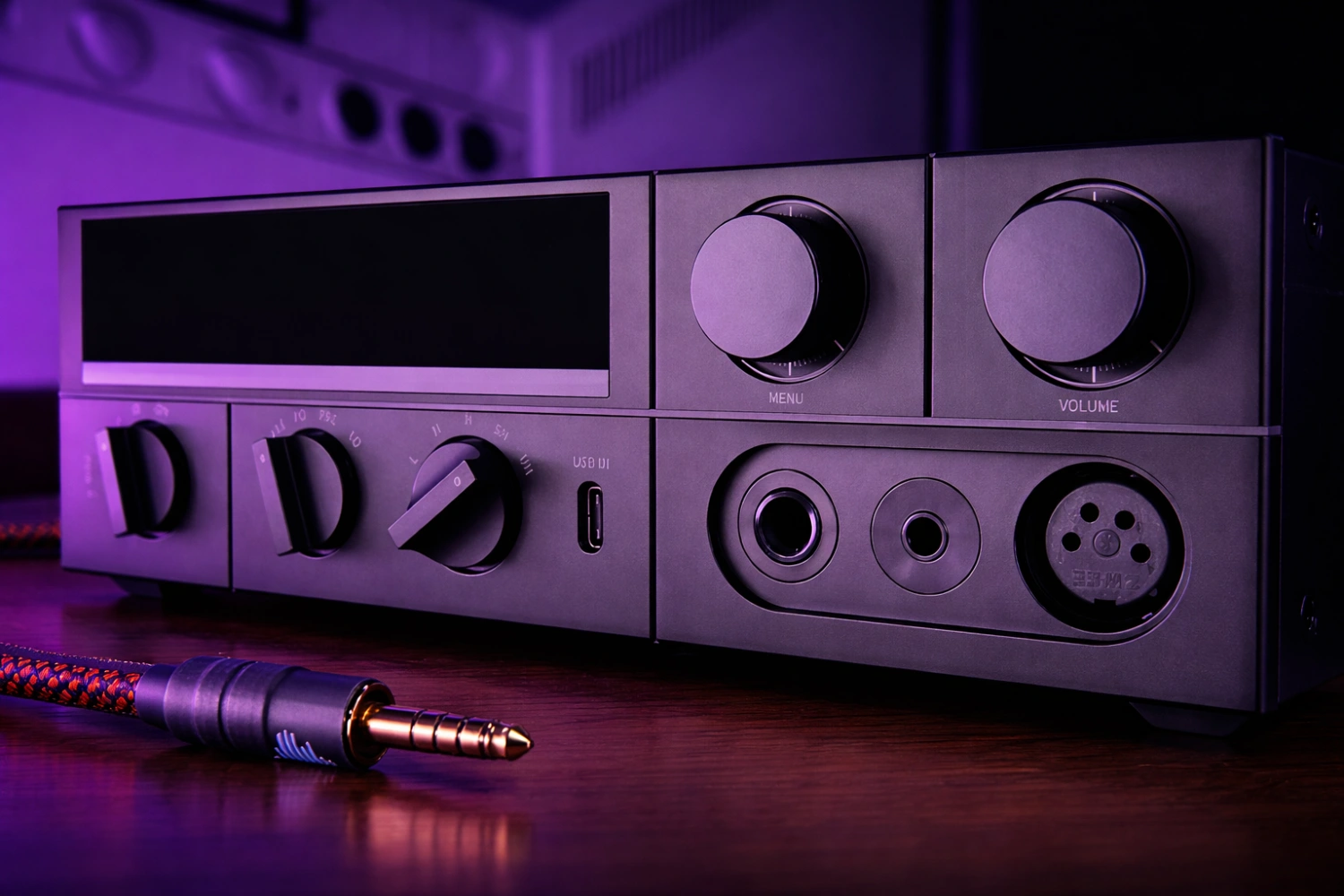
5. FiiO K17 Review: High-End Desktop DAC/Amp with Serious Flexibility
The FiiO K17 is described as a compact, solid desktop DAC/amp with tactile controls and a practical accessory set.
The FiiO K17 is presented in the source as a desktop DAC/amp designed to act as a complete listening centerpiece rather than a simple converter.
The emphasis is on build, interaction, and practical completeness: the chassis is described as dense, solid, compact, and restrained in its retro-inspired design, while the knobs, encoders, and buttons are singled out for their tactile feel.
The included package also reflects real-world use, with high-quality cables, a solid power cord, adapters, a remote control, a spare fuse, and an XLR plug. The source does not provide detailed conversion specifications in the supplied excerpt, so the recommendation rests on its role as a serious desktop hub with strong physical design and unusually thorough accessories.
Best for: Desktop listeners wanting a substantial DAC/amp hub
- Dense, solid, compact chassis
- Tactile knobs, encoders, and buttons
- Remote control included
- Practical accessory package with cables, adapters, spare fuse, and XLR plug
Verdict: The FiiO K17 is best viewed as a complete desktop DAC/amp centerpiece with strong ergonomics and a thoughtful real-world package.

6. iFi Hip-Dac 3 Stealth Edition: New version of the portable DAC launched
The iFi Hip-Dac 3 Stealth Edition uses a matte black portable chassis and is specified for up to 12 hours of playback.
The iFi Hip-Dac 3 Stealth Edition targets travel, commuting, and daily portable listening with a self-powered DAC/headphone amplifier format.
The supplied source highlights its matte black casing, coordinated hardware, and up to 12 hours of playback time.
Internally, the Stealth Edition is described as using upgraded components for a quieter power supply, while retaining iFi’s True Balanced circuit design and Burr Brown DAC chip. It also includes new capacitors, an updated GMT clock circuit with a new oscillator, and support for PCM up to 384 kHz, DSD up to DSD256, and DXD. Compared with tiny USB dongles, its key advantage is battery-powered portability with a more substantial portable amplifier form factor.
Best for: Battery-powered listening on commutes and travel
- Portable DAC/headphone amplifier design
- Up to 12 hours of playback time
- True Balanced circuit design
- Supports PCM up to 384 kHz, DSD256, and DXD
Verdict: The iFi Hip-Dac 3 Stealth Edition suits listeners who prefer a dedicated portable DAC/amp with its own battery rather than a minimalist dongle.

7. McIntosh MDA200: Upgraded DAC built on flagship technology
The McIntosh MDA200 combines the DA2 digital audio module with HDMI ARC, MCT input, balanced outputs, and classic McIntosh styling.
The McIntosh MDA200 is a dedicated home DAC built around the company’s DA2 digital audio module, technology cited in the source as appearing in other upper-tier McIntosh components.
Its strongest appeal is integration: seven digital inputs include two coaxial, two optical, USB, an MCT input for McIntosh MCT Series SACD/CD transports, and HDMI Audio Return Channel for audio from a television.
It also provides balanced and unbalanced analog outputs and is Roon Tested. Through USB, the source specifies native DSD playback up to DSD512 and DXD files up to 384 kHz, while coaxial and optical inputs support up to 24-bit/192 kHz. With the brand’s black glass front panel, illuminated logo, rotary controls, and aluminum end caps, it is the most clearly McIntosh-system-oriented DAC in the group.
Best for: McIntosh-based systems, TV audio, and digital source integration
- Seven digital inputs including HDMI ARC and MCT
- Balanced and unbalanced analog outputs
- Roon Tested certification
- USB support for native DSD512 and DXD up to 384 kHz
Verdict: The McIntosh MDA200 is a strong system DAC when multiple digital sources, HDMI ARC, and McIntosh transport compatibility matter.

8. Mytek Brooklyn DAC+: Compact and powerful DAC
The Mytek Brooklyn DAC+ uses a compact chassis with dual OLED screens and an illuminated perforated Mytek logo.
The Mytek Brooklyn DAC+ is a compact DAC whose significance lies in a substantial revision from the earlier Brooklyn DAC.
The source identifies the move from a Sabre ES9018K2M to an ES9028Pro DAC chip, along with changes to the power supply.
The front panel is also unusually distinctive for a compact component, using illuminated perforations to form the Mytek logo, with adjustable color and brightness. A dual OLED display presents information, while four buttons around the screens handle mode selection and changes. For buyers who want a compact DAC with a more expressive interface than a plain black box, the Brooklyn DAC+ has a strong identity in both circuitry update and visual design.
Best for: Compact systems needing a feature-rich DAC with a distinctive interface
- Updated ES9028Pro DAC chip
- Power supply changes from the earlier version
- Dual OLED display
- Adjustable illuminated logo on the front panel
Verdict: The Mytek Brooklyn DAC+ is a compact DAC with meaningful internal revisions and an unusually characterful front-panel design.
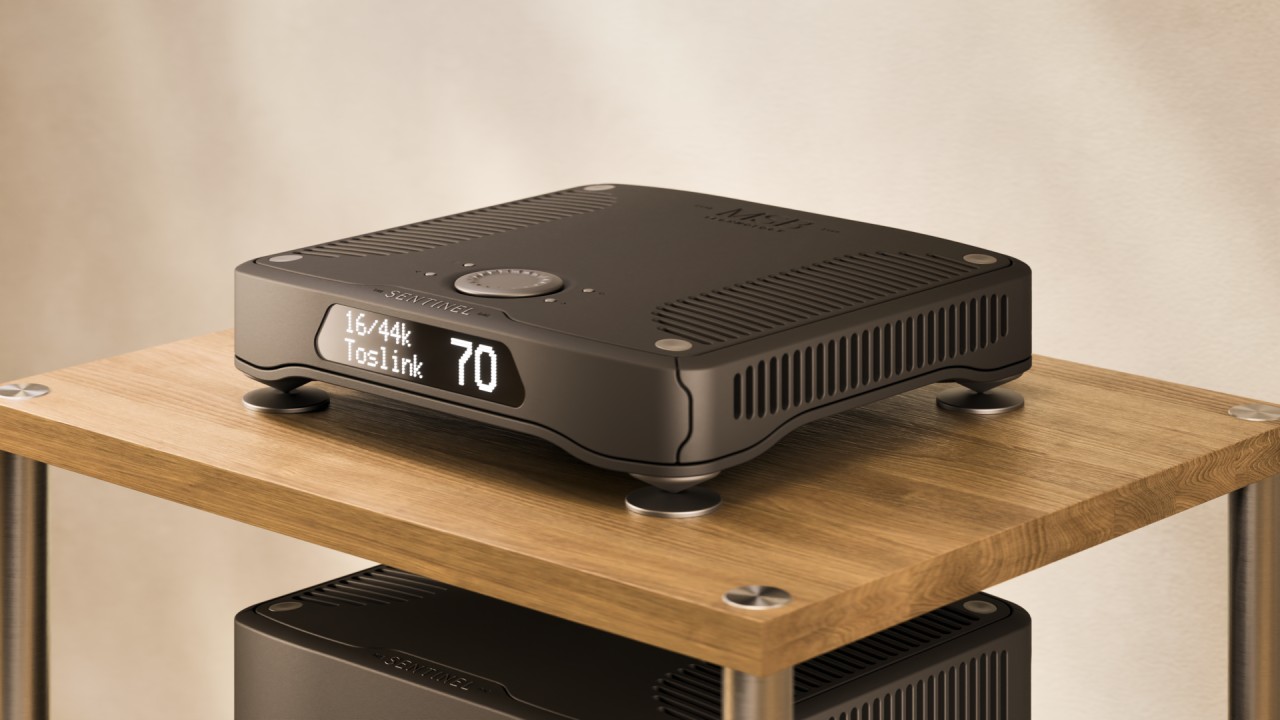
9. MSB Technology Sentinel: The World’s Most Advanced Digital-to-Analog Converter
The MSB Technology Sentinel is described as a three-body DAC system with hidden internal layouts and a smooth matte exterior.
The MSB Technology Sentinel is a statement digital-to-analog converter system, presented in the source as a no-compromise design shaped by more than three decades of company experience.
The supplied material is largely manufacturer-led and does not provide conventional specifications, pricing, or delivery details, so it should be understood as a conceptual and architectural recommendation rather than a practical value choice.
Its defining feature is a three-body system intended to maximize electrical synergy, supported by hidden and complex 3D layouts that the designers say reduce system clutter while enhancing electronic interactions. The smooth matte exterior is described as concealing the underlying complexity. Among the products here, Sentinel occupies the extreme high-end, system-as-object end of the DAC category.
Best for: Unconstrained statement digital systems
- Three-body DAC system architecture
- Design brief centered on performance above all else
- Hidden 3D layouts intended to reduce system clutter
- Smooth matte exterior concealing complex internal design
Verdict: The MSB Technology Sentinel is for the rare system where the DAC is conceived as a multi-box reference-level platform rather than a conventional component.

10. Topping E50 II: A Smarter, More Flexible DAC for Desktop and Hi-Fi
The Topping E50 II is a compact DAC for desktop and hi-fi use with AKM conversion, XMOS USB, LDAC Bluetooth, and FPGA-based clock control.
The Topping E50 II is the flexible compact desktop and hi-fi DAC in this selection.
It uses an AKM AK4497S DAC chip with an XMOS XU316 USB controller, supports PCM up to 32-bit/768 kHz and DSD512, and adds wireless playback through integrated Bluetooth with LDAC compatibility.
The source also describes an internal signal-processing architecture built around a proprietary FPGA platform and PLL-based clock generation, with Topping naming the clock and jitter-reduction technologies TopSync and JitterNull. The appeal is not one dramatic hardware gesture but a useful mix of compact size, wired high-resolution playback, Bluetooth convenience, and broader system compatibility.
Best for: Compact desktop and hi-fi systems needing wired and wireless inputs
- AKM AK4497S DAC with XMOS XU316 USB controller
- PCM up to 32-bit/768 kHz and DSD512 support
- Bluetooth with LDAC compatibility
- FPGA-based TopSync and JitterNull clocking architecture
Verdict: The Topping E50 II is the practical compact DAC for users who want high-resolution USB playback plus LDAC Bluetooth in one small unit.
Quick comparison
These DACs differ less by basic function than by where they are meant to live.
The key distinction is whether the DAC is a portable accessory, a headphone hub, a full hi-fi control component, or an ambitious high-end digital platform.
| Product | Best for | Verdict |
|---|---|---|
| Shanling UA1 II | Ultra-compact USB listening with onboard controls | A tiny dongle DAC distinguished by its color display, physical buttons, and premium-feeling pocketable body. |
| Primare PRE35 DAC | Stereo systems needing DAC and preamplifier functions together | A full preamplifier with digital conversion, balanced connectivity, configurable inputs, and strong Primare system compatibility. |
| Topping D900 | Component systems centered on proprietary discrete conversion | A flagship-style DAC defined by Topping’s discrete 1-bit PSRM architecture and substantial aluminum construction. |
| Shanling UA7 | Portable headphone use with a tube output stage | A compact DAC/amp that combines ESS conversion, JAN6418 tubes, OLED control, and strong balanced output capability. |
| FiiO K17 | Desktop DAC/amp setups that value physical controls and accessories | A solid, compact desktop hub with tactile operation and an unusually complete practical package. |
| iFi Hip-Dac 3 Stealth Edition | Battery-powered portable DAC/amp listening | A travel-friendly DAC/headphone amplifier with up to 12 hours of playback and True Balanced circuit design. |
| McIntosh MDA200 | Home systems with many digital sources, TV audio, or McIntosh transports | A dedicated DAC with HDMI ARC, MCT input, Roon Tested status, and balanced and unbalanced outputs. |
| Mytek Brooklyn DAC+ | Compact hi-fi systems wanting a distinctive display and updated DAC section | A compact DAC with an ES9028Pro update, dual OLED display, and adjustable illuminated logo treatment. |
| MSB Technology Sentinel | Statement-level, unconstrained digital systems | A three-body DAC system presented as an extreme architecture-led design rather than a conventional value proposition. |
| Topping E50 II | Compact desktop or hi-fi systems needing USB and Bluetooth flexibility | A small DAC with AKM conversion, XMOS USB, LDAC Bluetooth, and proprietary clocking technologies. |
Frequently asked questions
Should I choose a portable DAC or a desktop DAC?
Choose a portable DAC if the main source is a phone, tablet, or laptop used away from a rack.
The Shanling UA1 II is the smallest approach here, while the iFi Hip-Dac 3 Stealth Edition adds battery-powered operation and the Shanling UA7 adds a more ambitious headphone amplifier section.
Choose a desktop or hi-fi DAC when you need more inputs, stronger system integration, or a fixed listening position.
Do I need a DAC with balanced outputs?
Balanced outputs are useful when the rest of the system supports them or when a portable headphone DAC offers a separate balanced headphone connection.
In this guide, products such as the Primare PRE35 DAC and McIntosh MDA200 include balanced analog outputs for hi-fi systems, while the Shanling UA7 specifies a 4.4 mm balanced headphone output.
If your amplifier or headphones do not use balanced connections, unbalanced outputs can still be entirely appropriate.
How important are high-resolution PCM and DSD specifications?
High-resolution support matters most when your music library or playback software actually uses those formats.
Several DACs here support very high PCM and DSD rates, including the Primare PRE35 DAC, Shanling UA7, iFi Hip-Dac 3 Stealth Edition, McIntosh MDA200, and Topping E50 II.
Format support alone should not decide the purchase; inputs, controls, system role, and headphone or amplifier matching are usually more important day to day.
Which DAC features matter most for a living-room system?
For a living-room system, look first at inputs and control.
HDMI ARC can be useful for improving television sound, which makes the McIntosh MDA200 notable in this group.
A preamplifier-style unit such as the Primare PRE35 DAC can simplify a stereo setup by combining input control, volume control, analog connectivity, and DAC functions. Compact DACs can still work well, but they may need a separate preamp or integrated amplifier to manage the system.
How to choose the right DAC from this list
Start with the role the DAC must play.
If it only needs to improve phone or laptop listening with minimal bulk, the Shanling UA1 II is the most pocket-friendly choice, especially because its screen and physical buttons make it more self-contained than a basic dongle.
If portable listening needs a dedicated battery and longer sessions away from the source device, the iFi Hip-Dac 3 Stealth Edition is the more appropriate portable DAC/amp. If headphone drive and the novelty of a tube output stage are part of the attraction, the Shanling UA7 is the more distinctive portable option. For a desk, decide whether the DAC should be a small converter or the center of the workspace. The Topping E50 II is the compact, flexible route, with USB, LDAC Bluetooth, AKM conversion, and Topping’s clocking architecture. The FiiO K17 is the more substantial desktop DAC/amp choice in this guide, especially if tactile controls, a solid chassis, a remote, and a full accessory package matter. For a main hi-fi system, integration becomes the priority. The Primare PRE35 DAC is the strongest fit when you want a preamplifier and DAC in one component, with balanced connectivity and configurable inputs. The McIntosh MDA200 is better suited to systems with several digital sources, especially if HDMI ARC, Roon Tested compatibility, or McIntosh MCT transport connection is relevant. The Mytek Brooklyn DAC+ serves the compact component buyer who values its ES9028Pro update, dual OLED display, and distinctive illuminated interface. At the more architecture-led end, the Topping D900 and MSB Technology Sentinel appeal for different reasons. The D900 is defined by Topping’s proprietary discrete 1-bit PSRM conversion and substantial aluminum construction. The Sentinel is described as a three-body, performance-first digital system and should be considered only in the context of an unconstrained statement setup. In practical terms, the right DAC is not the one with the most dramatic specification; it is the one whose inputs, outputs, controls, size, and system role match the way you actually listen.



Sound Off
0Join the discussion if you have something to add.