
The Niimbus US 5 and US 5 Pro sit at the top of CMA Audio’s Niimbus headphone amplifier range, and their appeal is not built around a single headline feature. Instead, these models bring together a set of design choices that matter in serious headphone systems: a fully symmetrical dual-mono circuit layout, substantial power-supply architecture, balanced and unbalanced connectivity, adjustable pre-amplification, low output impedance, and the ability to function as a preamplifier. They are also differentiated by two distinct approaches to volume control, giving prospective owners a clear reason to consider which version better fits their system priorities.
A dual-mono architecture aimed at demanding headphone use
At the core of both the Niimbus US 5 and US 5 Pro is a completely symmetrical dual-mono circuit. In practical system terms, a dual-mono layout treats the left and right channels with a high degree of separation, an approach often used in high-end amplification to support channel independence and stable operation. Niimbus combines this with a 50 V working supply voltage, two toroidal transformers, and capacitor storage specified at 50,000 uF.
The documented result is high output power, and the company positions both models as reference headphone amplifiers intended to work with almost any type of headphone. That breadth is important because headphone systems can vary dramatically: some headphones require little voltage or current, while others are more demanding and benefit from an amplifier designed with generous electrical headroom. Without making any listening claims, the architecture suggests that Niimbus has built the US 5 and US 5 Pro for owners who want one amplifier platform to cover a wide range of headphone loads rather than a narrowly optimized pairing.
Adjustable pre-gain for better headphone matching
One of the most useful documented features is the pre-amplification adjustment range of -18 dB to +24 dB. Gain control is not always glamorous, but in a headphone amplifier it can be central to everyday usability. Too much gain can make volume adjustment overly sensitive with efficient headphones; too little gain can limit useful range with harder-to-drive designs. By allowing the pre-gain to be set across a broad range, the US 5 and US 5 Pro give the user a way to tailor the amplifier’s behavior to different headphones and source levels.
This is especially relevant for listeners with more than one pair of headphones. A system built around efficient dynamic headphones, planar magnetics, or other demanding designs may need different gain behavior depending on the headphone in use. The Niimbus approach acknowledges that a flagship headphone amplifier is often expected to serve as a long-term control center rather than a one-headphone accessory.
Low output impedance and balanced push-pull operation
Both amplifiers are specified with low output impedance, which Niimbus links to a high damping factor. For prospective owners, this matters because output impedance can influence how consistently an amplifier interacts with different headphone impedances. A low output impedance is generally desirable when the goal is predictable electrical behavior across a variety of headphones, particularly when the amplifier is intended to be broadly compatible rather than limited to a small set of loads.
In balanced connection, the US 5 and US 5 Pro operate in push-pull mode. Balanced operation is not automatically a guarantee of better results, but it is a meaningful design path when implemented as part of a fully symmetrical amplifier architecture. For users who already own balanced headphone cables or balanced source equipment, the Niimbus models provide a signal path that aligns with that style of system building.
Connectivity that supports both headphone and preamp roles
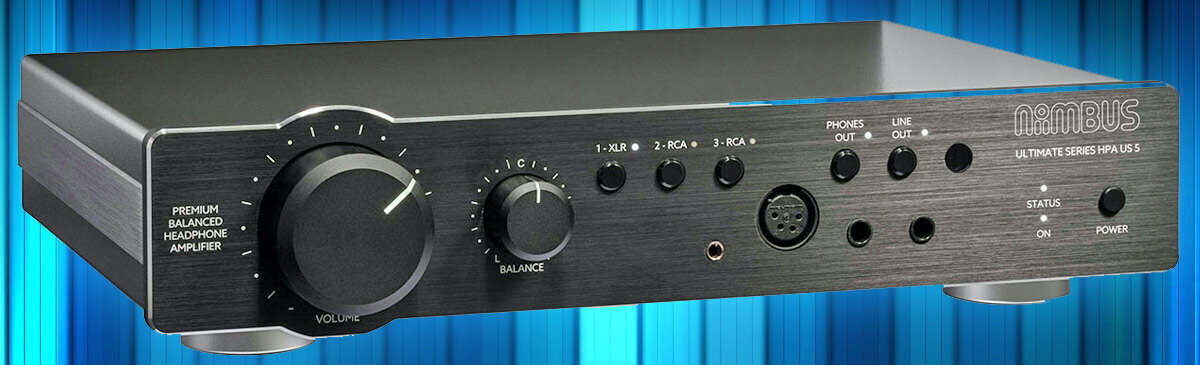
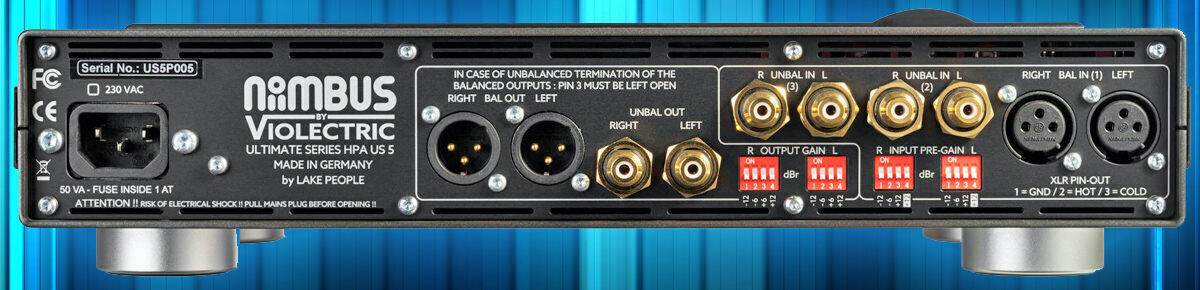
The US 5 and US 5 Pro are not limited to a single-source headphone setup. Each model includes one balanced stereo input and two unbalanced stereo inputs, giving owners room to connect multiple sources. This could include, for example, a DAC with balanced output alongside additional unbalanced components, though the exact system arrangement will depend on the owner’s equipment.
The output side is similarly flexible. Balanced and unbalanced line outputs allow the amplifiers to be used as preamplifiers, and the line outputs can be set to fixed or variable mode. That distinction is valuable. A fixed output can be useful when passing signal onward at a consistent level, while a variable output allows the Niimbus unit to control volume for downstream equipment. In a compact high-end desktop system or headphone-first listening room, this means the US 5 or US 5 Pro can serve as more than a headphone amplifier; it can become the central analog control point.
Two approaches to volume control
The clearest functional difference between the US 5 and the US 5 Pro is the volume-control system. The US 5 uses a motorized potentiometer. This is a familiar and intuitive solution, and the motorized implementation enables remote control while retaining a conventional volume-control feel.
The US 5 Pro takes a more elaborate route. Its volume control is connected to a microcomputer, which controls a network of fixed resistors through non-wearing reed relays. This system provides 256 discrete volume levels. For users who value repeatability and precise level setting, a stepped arrangement can be attractive because it allows the volume position to be selected in defined increments rather than by a continuously variable potentiometer. The Pro model’s relay-and-resistor design is therefore not just a cosmetic distinction; it is a different control philosophy aimed at precision and durability of operation.
Choosing between the two depends on what the owner values most. The US 5 offers the simplicity and familiarity of a motorized potentiometer, while the US 5 Pro adds a digitally governed resistor-network volume system with discrete steps. Both are remote-controllable, but they serve slightly different expectations about tactile feel, repeatability, and long-term control architecture.
Industrial design and German manufacturing
Both amplifiers share nearly identical metal enclosures with 10 mm anodized aluminum front bezels. This kind of construction gives the US 5 and US 5 Pro a purposeful, substantial appearance appropriate to their position in the Niimbus range. The design is not described as ornamental; it is a straightforward high-end component approach, with metalwork that emphasizes solidity and long-term use.
The remote controls follow the same design language and are made from a single piece of metal. That detail matters because headphone amplifiers are frequently used within arm’s reach, yet remote operation becomes valuable when the unit also functions as a preamplifier or sits in a rack or on a shelf away from the listening position. A matching metal remote reinforces the sense that the control experience was considered as part of the product, not added as an afterthought.
The US 5 and US 5 Pro are manufactured in southern Germany. For buyers who pay attention to production location and brand lineage, that detail will be part of the appeal, particularly given the connection between CMA Audio, Lake People, Violectric, and the circuit approaches adopted within Niimbus.
Who the Niimbus US 5 and US 5 Pro are most suitable for
The Niimbus US 5 and US 5 Pro make the most sense for headphone listeners building a serious stationary system around multiple headphones, balanced and unbalanced sources, and possibly a pair of downstream active speakers or a power amplifier. Their gain flexibility, low output impedance, balanced operation, and preamp-capable line outputs all point toward a component intended to remain useful as a system evolves.
They are also well suited to users who want one amplifier to accommodate a range of headphone requirements rather than selecting a narrowly focused amplifier for a single pairing. The broad pre-gain range and the company’s stated intent that the models work with almost any type of headphone are central to that appeal.
They are less likely to be the right fit for listeners who need a portable solution, a minimal single-input amplifier, or a simple desktop device with digital features built in. The documented strengths here are analog amplification, control precision, connectivity, and system integration. Prospective buyers looking for streaming, DAC functions, or compact all-in-one convenience would need to consider those needs separately.
Conclusion
The Niimbus US 5 and US 5 Pro are attractive because they combine serious analog amplifier architecture with practical system flexibility. Their symmetrical dual-mono design, substantial power supply, adjustable pre-gain, low output impedance, balanced push-pull operation, and fixed or variable line outputs all support use in demanding headphone-centered systems. The US 5 offers a motorized potentiometer, while the US 5 Pro adds a relay-controlled fixed-resistor volume system with 256 steps. For listeners seeking a stationary flagship headphone amplifier that can also operate as an analog preamplifier, these Niimbus models present a carefully specified and highly flexible option.