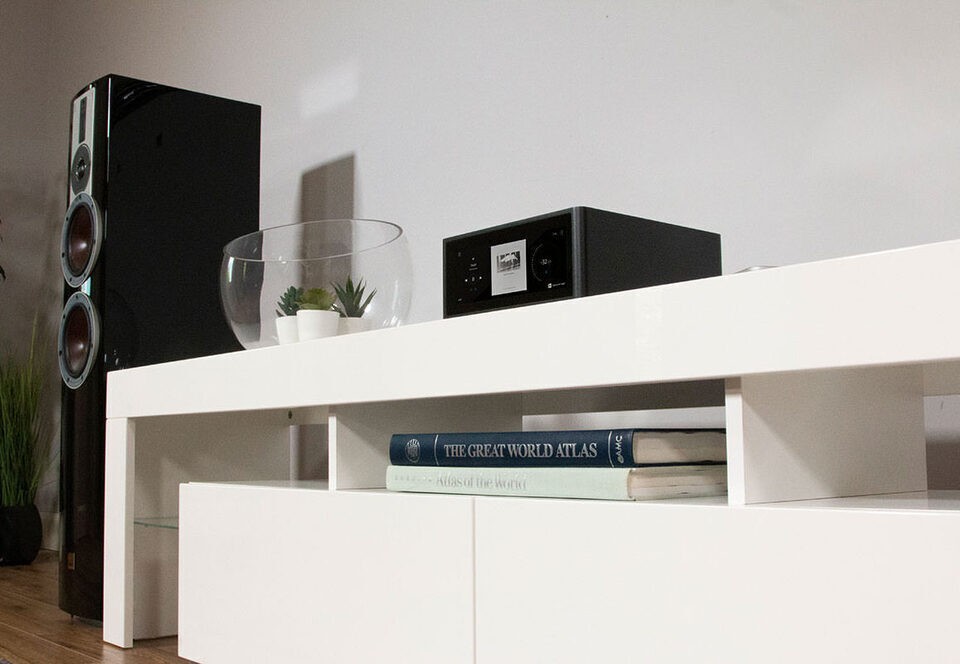
The NAD Masters M10 V2 is designed around a simple idea: a serious hi-fi system does not always need a rack full of separate components. By combining a BluOS network streamer, DAC, integrated amplifier, wireless features, room correction and TV-friendly connectivity into one compact chassis, it aims to serve as the central hub of a modern listening space. Add speakers, connect sources as needed, and the M10 V2 becomes a flexible control point for music, television audio and multiroom playback. Its appeal lies less in any single headline feature than in the way NAD has assembled a broad set of current technologies into a compact, lifestyle-friendly amplifier without abandoning core hi-fi functions.
A one-box system with real hi-fi intent
The Masters M10 V2 sits in the increasingly important category of streaming amplifiers: products intended to reduce system complexity while preserving the essentials of a capable stereo setup. NAD positions it as a universal music device that requires only loudspeakers to complete the main system. That is a useful proposition for listeners who want a clean installation, fewer cables and a more intuitive daily experience, but who still need proper speaker terminals, meaningful power output and support for external sources.
Its rated output of up to 100 watts per channel gives the M10 V2 the kind of specification prospective owners will look for when pairing it with passive loudspeakers. The source material identifies nCore-based amplifier modules inside the unit, a notable design choice because it reflects NAD’s focus on efficient, compact amplification. In practical system-building terms, that combination of compact size and integrated power means the M10 V2 can sit comfortably in spaces where a conventional amplifier, streamer and DAC stack may not be desirable.
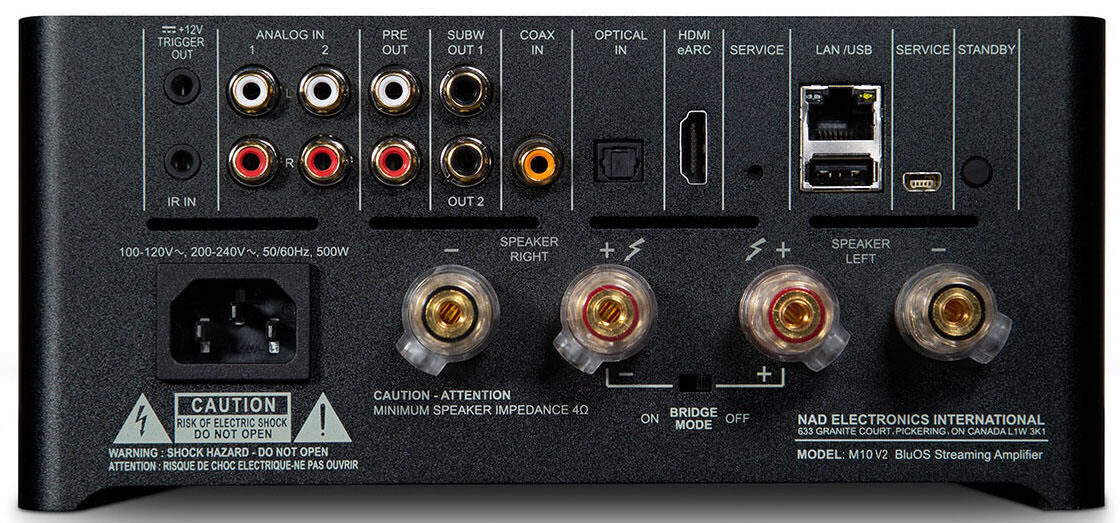
The inclusion of a Bridge Mode switch at the main speaker terminals also points to flexibility in how the amplifier section can be deployed. The source does not provide operational details beyond the presence of the switch, so it should not be treated as a substitute for consulting NAD’s manual, but its inclusion suggests that NAD has considered users who may want configuration options beyond a fixed stereo layout.
BluOS at the center of the experience
The operating heart of the Masters M10 V2 is BluOS. That matters because the user experience of a modern amplifier is increasingly shaped by software as much as hardware. BluOS allows playback from online music services and local storage, giving the M10 V2 access to both subscription-based listening and privately maintained music libraries. For many owners, this can remove the need for a separate network player or computer-based playback chain.
The platform also supports multiroom use within the BluOS ecosystem, making the M10 V2 more than a standalone stereo amplifier. In a home with compatible BluOS products, it can become part of a broader distributed audio system while still functioning as the main amplifier in a primary listening room. That dual role is one of the more attractive aspects of a product like this: it can support casual daily listening, whole-home music and more focused stereo use from the same interface.
The M10 V2 also supports AirPlay 2 and is Roon compatible. These are important because they give users multiple ways to integrate the amplifier into existing habits. AirPlay 2 is useful for households built around Apple devices, while Roon compatibility will interest listeners who manage music libraries through Roon’s interface. The point is not that one method replaces another, but that the M10 V2 does not force a single playback route.
Digital, analog and TV connections in one compact chassis
Connectivity is one of the M10 V2’s strongest documented qualities. On the wired side, NAD includes RCA, optical, coaxial, HDMI eARC and USB connections. This range gives the amplifier a role beyond pure streaming. A turntable with an appropriate external phono stage could feed the RCA input, while digital sources such as CD transports, TVs or media devices can connect through the optical, coaxial or HDMI eARC paths where appropriate.
HDMI eARC is especially relevant for owners who want a hi-fi system to handle television audio without building a traditional AV receiver-based installation. With eARC, a compatible television can send audio back to the amplifier through HDMI, simplifying daily use in a living-room system. That makes the M10 V2 well suited to spaces where music and TV share the same loudspeakers and where ease of operation matters.
Wireless connectivity is also covered through Bluetooth with aptX HD, and the unit can both transmit and receive a Bluetooth signal. That two-way capability can be useful in different scenarios: receiving audio from a phone or tablet for quick playback, or sending audio onward to compatible Bluetooth headphones or devices. Bluetooth is not the only streaming method here, but its inclusion adds convenience for guests and casual listening situations where opening a dedicated app is not always desired.
Expansion for bass and system integration
The presence of a preamp output and a subwoofer jack gives the Masters M10 V2 useful expansion potential. A subwoofer output is particularly helpful in compact or multipurpose systems, where owners may want small main speakers for visual or spatial reasons but still want the option of deeper bass support. The source does not specify bass management details, so expectations should be based on NAD’s own documentation, but the dedicated connection itself is a practical inclusion.
The preamp output can also matter for users who want to incorporate external amplification or connect the M10 V2 into a broader system. In an all-in-one product, these outputs are important because they help prevent the device from feeling like a closed box. A prospective owner may begin with the M10 V2 driving speakers directly, then later explore additional amplification or system changes without replacing the central streaming and control platform.
NAD also lists support for control systems such as Crestron, Lutron and Control4. That makes the amplifier more relevant for custom installation environments, where lighting, shades, displays and audio systems may be managed from a unified control interface. For a product with a compact, domestic-friendly form factor, this level of integration support broadens its usefulness beyond the traditional hi-fi rack.
Surround capability without a conventional AV receiver
One of the distinctive elements of the M10 V2 is support for Dolby Digital Surround sound with compatible wireless speakers. This gives the product a pathway into home theater use while retaining the character of a compact streaming amplifier. For listeners who want a system centered on stereo music but also want a more immersive movie or TV experience, this is a notable design direction.
The important point is that the M10 V2 is not presented as a full-size AV receiver replacement with every surround format and connection type. Instead, it offers a simpler route: keep the main system compact, use HDMI eARC for TV integration, and add compatible wireless speakers for surround playback where supported. That approach may appeal to people who do not want rear speaker cables running across a room, or who prefer a music-first component that can also serve entertainment needs.
As always with wireless surround ecosystems, prospective buyers should verify compatibility with the specific speakers and layout they intend to use. The documented feature is valuable, but it is most useful when planned as part of a compatible system rather than assumed to work with any wireless speaker.
DAC, format support and Dirac room correction
Inside the Masters M10 V2, NAD specifies an ESS Sabre DAC with 32-bit / 384 kHz capability. The source also notes support for almost all lossless formats and compatibility with MQA. These details matter because a streamer amplifier is only as useful as the range of files and services it can handle. Broad file support reduces friction for owners with mixed libraries, high-resolution downloads or streaming services that use different delivery formats.
The inclusion of Dirac sound correction is another significant part of the design. Room acoustics can strongly affect what reaches the listener, especially in real homes where speaker placement is constrained by furniture, architecture and shared living needs. Built-in correction gives the M10 V2 a toolset for adapting to different rooms and setups. The ability to save up to five Dirac profiles adds further practicality, since users may want different configurations for seating positions, speaker arrangements or listening preferences.
It is important not to treat room correction as a guarantee of any specific sonic result, and the source does not provide measurements or listening outcomes. What can be said is that integrating Dirac into a compact streaming amplifier gives owners an adjustment tool that would otherwise require extra hardware, software or a more complex system design.
Design and day-to-day usability
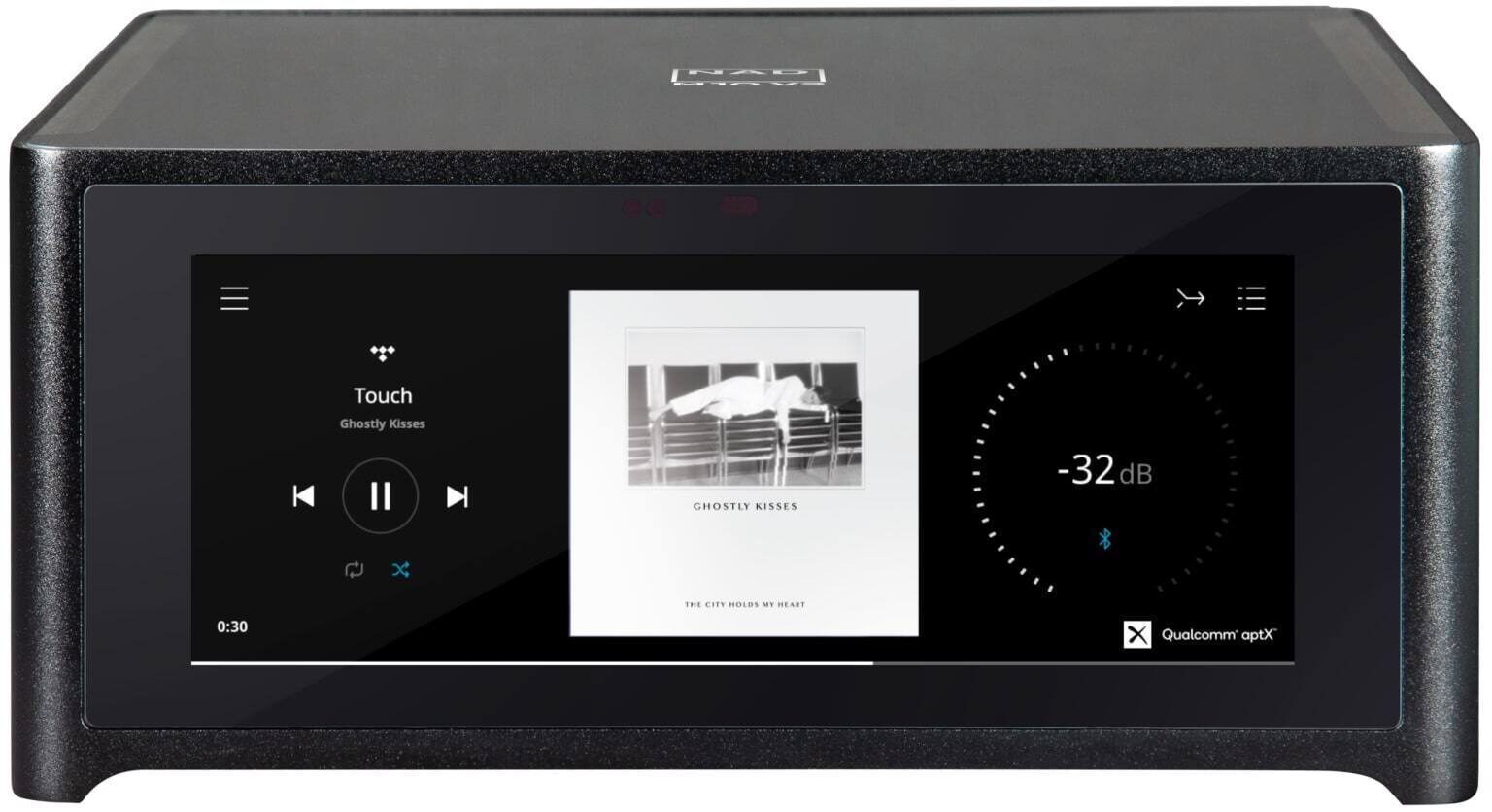
The physical design choices reinforce the M10 V2’s role as a visible, living-space component rather than a hidden black box. NAD uses an aluminum chassis, and the front touch panel is protected by Gorilla Glass. These materials suggest attention to durability and presentation, both of which matter for a component likely to sit on a sideboard, media console or open shelf.
A front touch interface can also reduce dependence on external controllers for basic interaction. In practice, a product like this will often be controlled through apps, voice assistants, AirPlay, Roon or an integrated home-control system, but the presence of a tactile front interface is still valuable. It makes the unit feel more self-contained and approachable, particularly for household members who may not want to navigate a hi-fi app every time they adjust the system.
Voice assistant support further expands the ways the M10 V2 can fit into modern homes. The source does not specify which assistants are supported or the precise scope of voice functions, so buyers should confirm details for their region and ecosystem. Still, the inclusion aligns with the product’s broader theme: multiple control paths, minimal box count and flexible everyday access.
Conclusion
The NAD Masters M10 V2 is most suitable for listeners who want a compact but capable hub for streaming, stereo amplification and TV audio in one system. Its documented strengths include BluOS streaming, AirPlay 2 and Roon compatibility, 100 watts per channel, HDMI eARC, Bluetooth aptX HD transmit and receive capability, wired digital and analog inputs, subwoofer and preamp outputs, Dirac room correction with up to five profiles, and support for compatible wireless surround speakers. It will be especially appealing to owners who value a clean installation, modern control options and the ability to combine music and home entertainment without assembling a large stack of components. Those seeking a highly configurable traditional AV receiver or a purely separates-based system may prefer another route, but for a music-first living-room system with strong connectivity and thoughtful integration features, the M10 V2 presents a well-rounded and distinctive proposition.