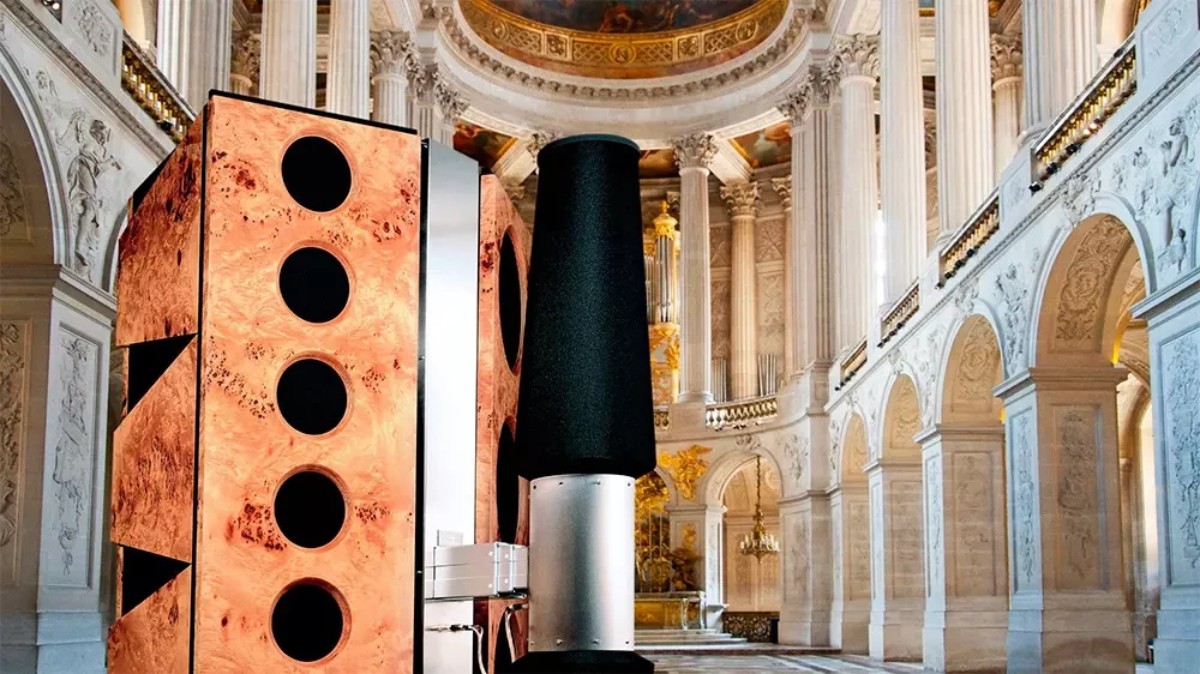
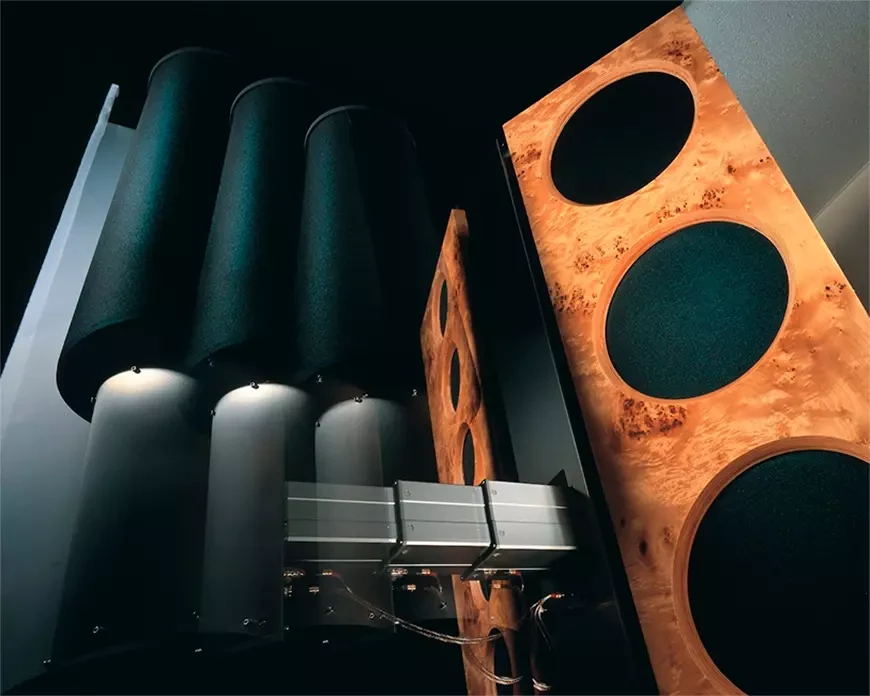
The German Physiks Gaudi MK III is not being positioned as an ordinary loudspeaker update. It is the third generation of a design lineage that began in 1996, when the original Gaudi established itself as a statement product for the German brand. The concept has always been unusually ambitious: to approach the scale, dynamic freedom, and spatial impression associated with live orchestral performance through an omnipolar loudspeaker architecture capable of wide bandwidth and high sound pressure. The forthcoming MK III continues that direction while focusing on greater adjustment flexibility and active system control. Its most distinctive documented features are the use of four DDD drivers in a moving array, an active three-way configuration, and a German Physiks Emperor DSP-X digital crossover designed to manage the DDD array, bass sections, and subwoofer elements.
A loudspeaker concept built around scale
The Gaudi series has long been associated with the idea of reproducing music at full scale rather than presenting it as a narrowly focused point source. The first-generation model was documented as reaching down to 15 Hz and producing sound pressure levels of 120 dB, figures that help explain why German Physiks treated the Gaudi as a flagship expression of its loudspeaker philosophy. Those historical details matter because they frame the MK III not simply as a new cabinet or cosmetic refresh, but as the continuation of a loudspeaker family created for wide bandwidth, dynamic capacity, and a room-filling presentation.
The MK III is described as an omnipolar loudspeaker system, which is central to its identity. Unlike conventional forward-firing loudspeakers that primarily project energy toward the listener, an omnipolar design radiates sound more broadly into the room. For a prospective owner, the attraction is not merely novelty. Broad radiation can be part of a design strategy intended to create a more expansive acoustic field, particularly in systems aimed at large-scale music and realistic spatial impression. That approach also places particular importance on room interaction, placement, and adjustment, which is where the MK III’s moving driver array and DSP-based configuration become especially relevant.
The DDD driver array defines the design
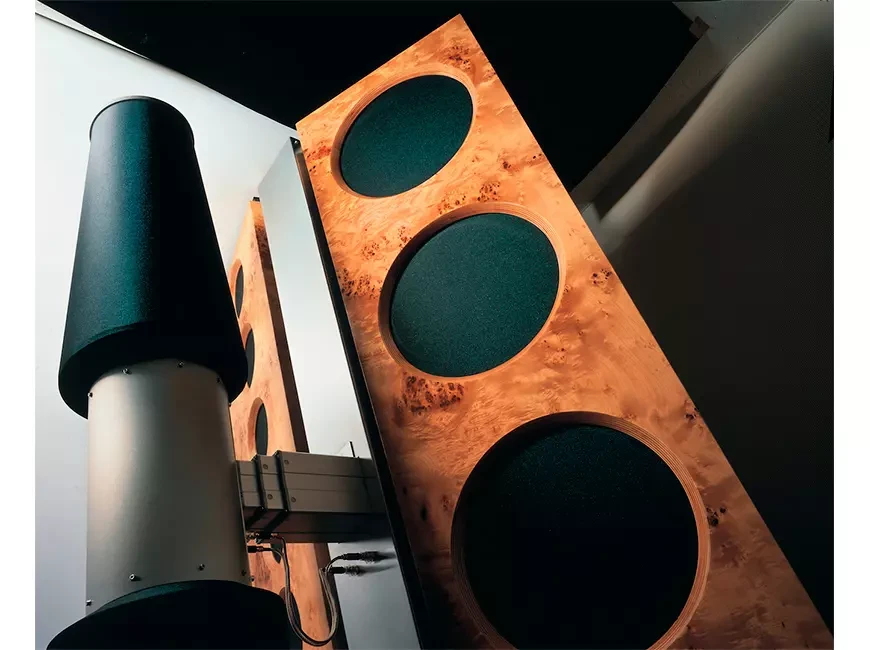
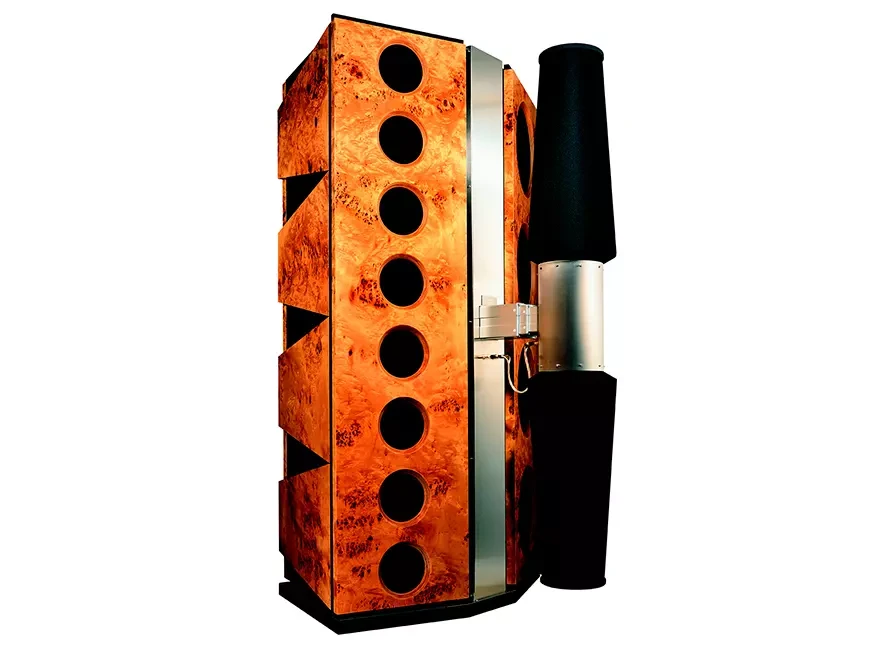
At the heart of the Gaudi MK III is the same moving array of four DDD drivers used in the Gaudi MK II and Emperor MK II. The DDD driver is significant because it covers a very wide frequency range, from 180 Hz to 24 kHz. That span includes almost the entire audio band above the bass region, allowing the loudspeaker to avoid a crossover point in the midrange. This is a meaningful engineering choice because crossover transitions in the midband can be difficult to integrate seamlessly in many loudspeaker designs. By assigning such a broad portion of the spectrum to the DDD array, German Physiks reduces the need to divide critical vocal and instrumental frequencies between different driver types.
The source material states that, because the DDD array covers almost the full audio range, moving the array is essentially equivalent to moving the whole loudspeaker. This is an important practical point. In very large loudspeakers, physical repositioning can be inconvenient or unrealistic once the speaker is installed. The Gaudi MK III addresses that challenge by allowing the listener to adjust the position of each DDD driver array from the listening position using a remote control. That documented feature is particularly useful in a loudspeaker of this scale, where small alignment and positioning changes may influence the balance between direct and room-reflected sound, but moving the complete system would be physically demanding.
Remote adjustment for real-world installation
A loudspeaker weighing hundreds of kilograms, as referenced in relation to typical positioning challenges, is not something most owners will want to slide around the room repeatedly during setup. The MK III’s remote-adjustable DDD arrays therefore stand out as a user-oriented design choice. It acknowledges that fine-tuning is part of extracting the intended performance from a highly revealing and room-interactive loudspeaker, but it avoids making that process dependent entirely on manual repositioning of an extremely heavy object.
This is not a substitute for thoughtful installation, suitable room dimensions, or careful system planning. However, it gives the owner or installer a more flexible tool after the loudspeaker is in place. The ability to make adjustments from the listening position is especially relevant because it allows changes to be evaluated from the seat where they matter most. For a product conceived for large-scale reproduction, that kind of usability is not a minor convenience; it is part of making an ambitious design more manageable in a domestic high-end environment.
Active architecture and DSP control
The Gaudi MK III will be available only as an active loudspeaker system. In this context, active does not mean that amplification is necessarily built into the loudspeaker cabinet; rather, the design uses an active three-way arrangement controlled by the German Physiks Emperor DSP-X digital crossover. The DSP-X will drive the DDD driver array, the low-frequency sections, and the subwoofer. This structure gives the loudspeaker system a defined electronic architecture rather than relying on a conventional passive crossover network inside the speaker.
The documented advantage is flexibility. The level of each channel can be varied by ±6 dB, allowing customization according to the acoustic characteristics of the listening room. That matters because a loudspeaker with very wide bandwidth and omnipolar radiation will inevitably interact strongly with its environment. The ability to adjust channel levels gives the system a method for adapting to room behavior, speaker placement, and listener preference without changing the fundamental loudspeaker design. It also reinforces that the Gaudi MK III is intended as a system to be configured carefully, not simply placed casually and forgotten.
Amplification choices and system matching
Because the Gaudi MK III uses an active three-way design, each speaker requires three power amplifiers. The owner may use power amplifiers of their choice, which gives the system a degree of flexibility for those who already have amplification preferences or an established high-end electronics chain. At the same time, German Physiks recommends amplifiers from its Emperor series, stating that they are ideally suited to take advantage of the Gaudi MK III’s transparency and dynamic range.
For prospective owners, the key point is that the loudspeaker should be considered as part of a complete system plan. This is not a simple pair of passive speakers to connect to a single stereo amplifier. It requires multiple amplifier channels, a DSP crossover, and careful integration. That complexity may be a positive for listeners who want a highly configurable reference-level setup, but it also means the MK III belongs in systems where space, electronics, setup expertise, and installation planning are all taken seriously.
Who the Gaudi MK III is most suitable for
The Gaudi MK III is most suitable for listeners and system builders who are drawn to large-scale, room-filling loudspeaker concepts and who value engineering approaches outside the conventional box-speaker template. Its omnipolar radiation, wide-range DDD driver array, active DSP crossover, and remote-adjustable driver positioning all point toward an owner who wants more than a straightforward plug-and-play loudspeaker. It is likely to appeal to those building a dedicated high-end listening room where installation can be optimized and where the loudspeaker’s scale and adjustment options can be used properly.
It will be less suitable for listeners seeking a compact system, a simple passive loudspeaker, or a minimal electronics chain. The need for three power amplifiers per speaker and the presence of DSP-based configuration make it a product for carefully planned systems. Its strengths, as documented, are not convenience in the ordinary sense, but adjustability, bandwidth management, dynamic ambition, and the ability to tailor the speaker-room relationship more deeply than many conventional designs allow.
A distinctive position in the high-end landscape
What makes the Gaudi MK III distinctive is the combination of continuity and specialization. It continues a loudspeaker family that has represented German Physiks since the original Gaudi appeared in the 1990s, but it also sharpens the concept around active operation and remote adjustability. The four-driver DDD moving array remains the centerpiece, while the Emperor DSP-X crossover gives the system a modern framework for controlling the handoff between the wide-range array, bass sections, and subwoofer.
There are no documented photos, launch-date specifics, or announced price for the MK III in the supplied information. That leaves some practical questions unanswered. Even so, the available details make its direction clear: this is a no-compromise-style omnipolar loudspeaker project aimed at listeners who want scale, sophisticated setup control, and a design that avoids a midrange crossover by relying on the unusually broad operating range of the DDD driver.
Conclusion
The German Physiks Gaudi MK III’s strongest documented qualities are its omnipolar architecture, four-driver moving DDD array, broad 180 Hz to 24 kHz DDD operating range, active three-way DSP-based configuration, ±6 dB channel-level adjustment, and remote-controlled driver-array positioning. These features make it an unusually flexible large-scale loudspeaker concept, particularly for dedicated systems where room interaction, amplifier matching, and precise setup are treated as central parts of the ownership experience. It is best suited to serious high-end listeners who want a configurable, ambitious loudspeaker system built around German Physiks’ distinctive DDD technology rather than a conventional passive speaker design.