


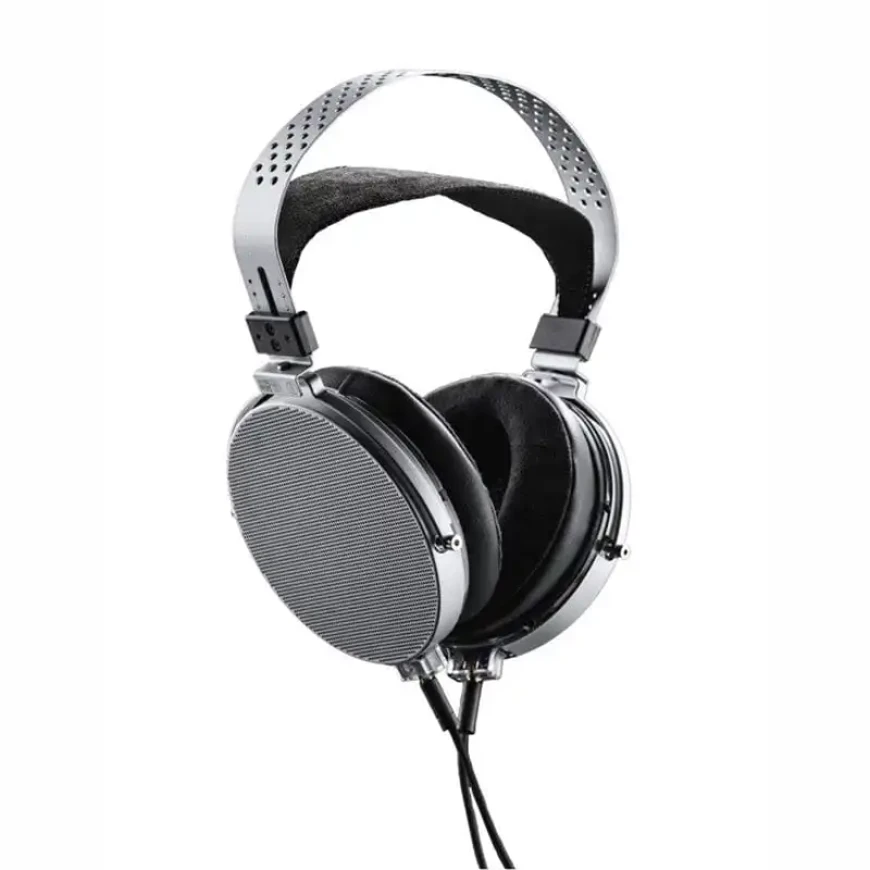
The Moondrop PARA is positioned as a more accessible entry into full-size planar headphones without stripping away the engineering details that tend to attract headphone enthusiasts in the first place. Built around isodynamic drivers of Moondrop’s own design, PARA combines large 100 mm thin diaphragms, silver voice coils, an N52 neodymium magnetic system, and a chassis borrowed from the company’s flagship Venus model. At $299, it is notable not because it promises to be everything to everyone, but because its documented specification set focuses on several areas that matter in everyday ownership: driver architecture, amplifier compatibility, comfort, cable practicality, and a clearly stated tuning target.
A full-size planar design with 100 mm diaphragms
The central attraction of the Moondrop PARA is its planar, or isodynamic, driver architecture. Unlike a conventional dynamic headphone driver that uses a voice coil attached to a cone or dome, a planar design typically uses a very thin diaphragm driven across a larger surface area by a magnetic structure. In PARA, Moondrop specifies 100 mm thin diaphragms, which makes the driver assembly one of the defining elements of the product.
The size of the diaphragm matters from a design perspective because it gives the manufacturer a large radiating surface to work with. That does not automatically determine sound quality, and it should not be treated as a guarantee of a particular sonic outcome. However, it does show that PARA is not simply a compact lifestyle headphone with planar branding attached. It is a full-size design built around a substantial transducer platform.
Moondrop also specifies a silver voice coil for the PARA driver. The source material does not provide further electrical or mass data for the coil, so the important point for a prospective owner is not to infer unlisted performance advantages. Rather, it underlines that Moondrop is drawing attention to the driver assembly as an engineered system: diaphragm, conductive element, and magnetic motor are all presented as deliberate design choices rather than off-the-shelf decoration.
N52 neodymium magnets and finite element optimization
The PARA driver is powered by an N52 neodymium magnetic system. N52 refers to a high-grade neodymium magnet material, and in headphone design the magnetic system is critical because it provides the field that drives the diaphragm. For a planar headphone, the arrangement of that magnetic field is especially important, since the diaphragm must be controlled across a broad area.
Moondrop states that the magnet placement is optimized by finite element analysis. In practical terms, finite element analysis is a computer-aided engineering method used to model complex physical behavior before and during product development. In this context, the stated use of FEA suggests that the magnet layout was not chosen by guesswork alone, but refined through simulation of the magnetic structure.
For the buyer, the significance is not that simulation replaces listening or manufacturing quality control. It is that PARA’s design story is rooted in transducer engineering. The magnetic system, diaphragm, and drive geometry are the foundation of a planar headphone, and Moondrop is making those parts of the product’s identity rather than treating them as background details.
Compatibility-focused electrical specifications
A common concern with planar headphones is amplification. Some planar models are known for needing capable headphone amplifiers, while others are easier to integrate into a desktop or portable system. PARA’s published figures point toward broad compatibility: sensitivity is listed at 101 dB, while impedance is specified at 8 ohms.
The combination of relatively high sensitivity and low impedance is presented by Moondrop as beneficial for compatibility with various amplifiers. That may appeal to listeners who do not want to build a system around a difficult headphone load. It also makes PARA relevant to owners who may use different sources in different settings, such as a dedicated desktop headphone amplifier in one location and another compact source elsewhere.
At the same time, the 8-ohm impedance is worth noting carefully. Low impedance can help a headphone draw power from certain sources, but it also means the amplifier should be comfortable driving low-impedance loads. Prospective owners should check the output capability and recommended load range of their existing equipment rather than assuming universal compatibility. The positive point is that Moondrop has clearly aimed PARA at practical system matching instead of making amplification a mystery.
A chassis derived from the Venus flagship
Another distinctive element is the physical platform. Moondrop borrowed the PARA chassis from the flagship Venus model, and the source material specifically links this to comfort and light weight. That matters because planar headphones can be physically demanding if the frame, headband, and earcup design are not handled carefully.
Comfort is not just a luxury feature in a full-size headphone. It affects how often the product is used, how long listening sessions can remain enjoyable, and whether the owner reaches for the headphone in ordinary daily situations. A technically ambitious driver is less useful if the frame discourages extended use. By basing PARA on the Venus chassis, Moondrop appears to be carrying down a more developed ergonomic platform into a less expensive model.
The lightweight aspect is also important for a planar design. Large drivers and magnetic assemblies can add mass, so any attention to reducing the burden on the listener is welcome. The available information does not provide an exact weight, so it would be inappropriate to overstate the point. Still, Moondrop’s emphasis on a comfortable, lightweight chassis is one of PARA’s most practical documented strengths.

Tuning guided by Moondrop’s VSDF curve
Moondrop says PARA’s sound signature was set up around its proprietary VSDF curve, with the goal of natural sound, a high degree of detail, and comfort. Without independent listening or measurement data, those claims should be understood as design intent rather than verified performance. Even so, the presence of a named target curve is useful information.
A tuning target gives a headphone a defined design direction. Instead of presenting PARA only as a collection of impressive parts, Moondrop is saying that the final voicing was guided by a particular acoustic preference. For many buyers, that matters because headphone ownership is not only about driver type or magnet grade; it is also about whether the tonal balance is intended to remain comfortable over time.
The reference to detail and comfort is especially relevant in the planar category, where buyers may be seeking clarity without wanting a fatiguing presentation. Again, the source does not provide measurements or listening impressions, so the responsible takeaway is limited: PARA is designed around Moondrop’s established VSDF concept, and its tuning brief prioritizes naturalness, detail, and long-term listening comfort.
Detachable cable practicality
The PARA package includes a universal detachable cable equipped with 3.5 mm mini-jacks on both sides. Detachable cabling is a small but meaningful ownership feature. It can simplify storage, make replacement easier if the cable is damaged, and give the user more flexibility than a permanently attached lead.
The use of 3.5 mm mini-jacks is also practical because the connector format is familiar and widely used. The supplied information does not state balanced wiring, cable length, or alternative terminations, so those details should not be assumed. What can be said is that Moondrop has chosen a straightforward cable arrangement that supports everyday serviceability.
For users who keep headphones for years, cable design can matter almost as much as headline specifications. A detachable cable does not make a headphone more advanced by itself, but it does reduce one common point of long-term inconvenience. In PARA’s case, it fits the broader theme of a planar headphone designed to be approachable rather than fragile or overly specialized.

Who the Moondrop PARA is most suitable for
The Moondrop PARA is most likely to interest listeners who want a full-size planar headphone with clear engineering credentials at a relatively accessible price. Its 100 mm isodynamic drivers, N52 neodymium magnetic system, and finite-element-optimized magnet placement give it a strong technical identity, while the Venus-derived chassis and detachable cable address daily usability.
It may be especially appealing to owners who already have a headphone amplifier but do not want a headphone that appears demanding on paper. The 101 dB sensitivity and 8-ohm impedance suggest that Moondrop considered compatibility with a range of amplifiers, though users should still confirm that their source equipment is appropriate for such a low-impedance load.
PARA is less suitable for buyers who need a complete set of published measurements before making a decision, because the available information here centers on design features rather than laboratory data. It is also not the right product to choose solely on assumptions about planar headphones as a category. The more grounded reason to consider it is the combination of documented driver technology, practical chassis design, and a price of $299.
Conclusion
Moondrop PARA stands out as an accessible full-size planar headphone built around meaningful documented choices: in-house 100 mm isodynamic drivers, thin diaphragms with silver voice coils, an N52 neodymium magnetic system shaped with finite element analysis, a Venus-derived lightweight chassis, and a detachable 3.5 mm cable system. Its 101 dB sensitivity and 8-ohm impedance point toward broad amplifier compatibility, while the VSDF-based tuning brief gives the product a clear design direction. For listeners looking for a technically focused planar headphone at $299, especially those who value comfort, serviceable cabling, and sensible system matching, PARA offers a well-defined and practical proposition.

