

Choosing a DAC for serious listening starts with the system around it.
A dedicated converter for a component rack has different priorities from a USB dongle for a phone, while a combined DAC and headphone amplifier may remove the need for several separate boxes.
Inputs, output connections, headphone requirements and streaming support therefore matter as much as the conversion architecture itself. The products gathered here cover that full range. Rockna, Leema, Topping and Esoteric concentrate on ambitious home systems; FiiO and Marantz combine conversion with broader desktop duties; HiBy, Kiwi Ears, Astell&Kern and xDuoo address listening away from a conventional rack. Their approaches include resistor ladders, discrete 1-bit conversion, conventional DAC chips and hybrid tube amplification. This is not a like-for-like performance ranking. Instead, the ordering is preserved from the supplied source material, with each recommendation focused on its documented design, connectivity and intended use. Before choosing, check that the DAC accepts your sources, provides the outputs your amplifier or headphones require and fits the way you actually listen.

1. Rockna Wavedream Reference
Rockna Wavedream Reference, a discrete R2R DAC with FPGA processing, five digital inputs and an integrated network renderer.
Rockna’s Wavedream Reference is a highly developed standalone DAC built around proprietary processing and discrete resistor-ladder conversion.
An AMD ZYNQ device works with four FPGAs, with each FPGA controlling its own ladder module and two assigned to each channel.
Rockna also uses its own PLL clock system rather than typical asynchronous sample-rate conversion. Its five digital inputs cover optical and coaxial S/PDIF, AES/EBU, USB and I2S. Incoming signals are upsampled before conversion, and listeners can select linear, minimum-phase or hybrid-phase filtering. An integrated network renderer adds LAN streaming through services and protocols including Roon, UPnP, OpenHome, AirPlay, HQPlayer NAA and Spotify Connect, making this the most comprehensively network-equipped design in the selection.
Best for: Reference-level networked hi-fi systems
- Proprietary FPGA-controlled R2R conversion
- Five digital input types
- Three selectable digital filters
- Integrated network renderer
Verdict: The Wavedream Reference combines an elaborate channel-separated ladder architecture with unusually broad digital and network connectivity.

2. Leema Constellation Libra
Leema Constellation Libra, featuring a replaceable Quattro Infinity DAC module and dual RJ45-based I2S inputs.
The full-size Constellation Libra is designed as a flagship DAC for both domestic and more specialized systems.
Its proprietary Quattro Infinity conversion section is fully balanced and arranged in dual mono, while the replaceable DAC module gives Leema a route for future hardware development.
Integration with the company’s LIPS control and monitoring system makes it particularly relevant to an all-Leema rack. Connectivity includes two I2S interfaces on RJ45 sockets, one of which is fully configurable, alongside asynchronous USB. The cited digital support extends to 24-bit/384 kHz PCM, DXD, DSD64 and DSD128 over USB and I2S. Prospective owners should verify I2S compatibility carefully because connector shape alone does not guarantee that two components use the same configuration.
Best for: Flagship Leema systems and configurable digital sources
- Fully balanced dual-mono design
- Replaceable Quattro Infinity DAC module
- Two I2S interfaces, including one configurable input
- LIPS system integration
Verdict: The Libra stands out for its balanced dual-mono architecture, configurable I2S connection and close integration with other Constellation components.

3. HiBy Digital D1
HiBy Digital D1, a compact aluminum USB DAC and headphone amplifier with a 3.5 mm output and physical volume buttons.
The HiBy Digital D1 is a compact USB DAC and headphone amplifier intended to improve wired-headphone listening from mobile devices and computers.
It uses a CS46L41 DAC chip, supplies up to 65 mW into 32 ohms and provides a conventional 3.5 mm headphone socket in a small aluminum chassis.
Physical buttons offer volume adjustment across 50 steps, while the design’s stated low power consumption is intended to limit the drain on a connected smartphone. Compatibility with the HiByMusic app provides access to settings and USB audio on Android and iOS, and a PC USB DAC mode extends its usefulness to desktop listening.
Best for: Simple phone and computer headphone listening
- Compact aluminum chassis
- 50-step physical volume control
- HiByMusic support on Android and iOS
- PC USB DAC mode
Verdict: The Digital D1 is a straightforward choice for listeners who want a small, low-power USB DAC with precise physical volume adjustment.

4. Kiwi Ears Allegro
Kiwi Ears Allegro, a gamepad-styled USB-C DAC and headphone amplifier with 3.5 mm and balanced 4.4 mm outputs.
Kiwi Ears gives the Allegro a distinctive gamepad-inspired case, but its practical appeal lies in the combination of single-ended and balanced headphone connections.
The unit uses an ES9028Q2M DAC and offers both 3.5 mm and 4.4 mm outputs, accommodating a broad selection of wired headphones without requiring an adapter between those two standards.
Its USB Type-C interface is documented as compatible with Android devices running version 5.1 or later. Format support reaches 32-bit/384 kHz PCM and DSD256, while the supplied specification lists THD+N at 0.0015 percent into a 32-ohm load.
Best for: Android users with balanced or single-ended headphones
- Both 3.5 mm and 4.4 mm outputs
- USB Type-C connection
- PCM support up to 32-bit/384 kHz
- DSD support up to DSD256
Verdict: The Allegro pairs wide format support and two useful headphone outputs with a notably unconventional portable design.
5. FiiO K17 R2R
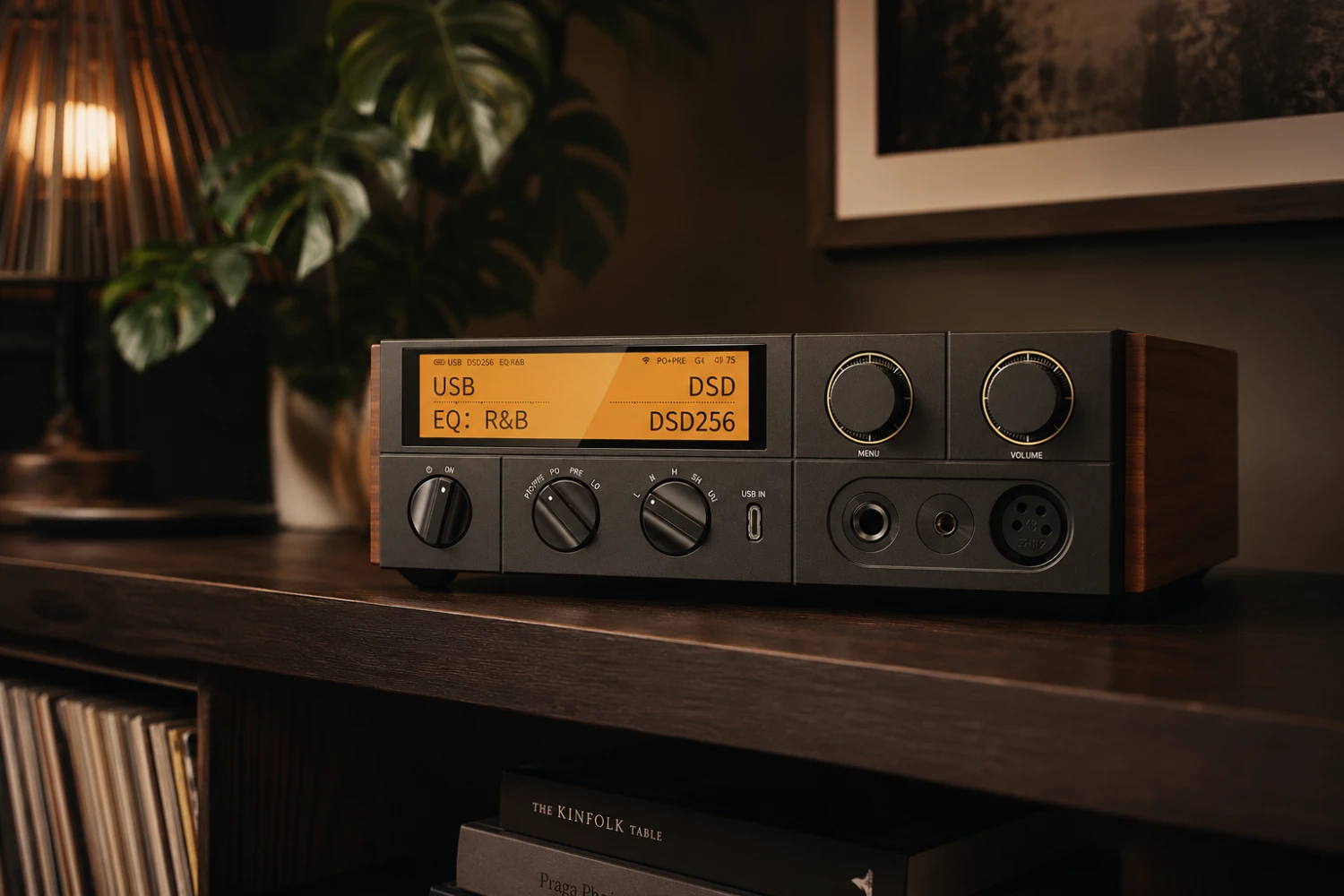
FiiO K17 R2R desktop hub, combining segmented resistor-ladder conversion, network streaming and discrete class AB headphone amplification.
The FiiO K17 R2R brings several desktop functions together in one component: digital-to-analog conversion, network streaming and headphone amplification.
Its defining feature is FiiO’s proprietary segmented R2R PRO resistor matrix, specified as a 24+5-bit design.
The upper five bits use 31 resistors with thermometer coding, an arrangement intended by FiiO to reduce accumulated error compared with a conventional ladder. Headphone duties are handled by a fully discrete class AB amplifier stage using an op-amp-based circuit with transistor current amplification. An aluminum body and real-wood side panels give the unit a more traditional component-like appearance, with white ash used for the silver version and walnut for the black finish.
Best for: A consolidated desktop streaming and headphone system
- Proprietary segmented R2R PRO conversion
- Integrated network streaming
- Fully discrete class AB headphone amplifier
- Aluminum chassis with real-wood side panels
Verdict: The K17 R2R is a versatile desktop hub for listeners seeking FiiO’s resistor-ladder conversion alongside streaming and headphone amplification.

6. Marantz HD-DAC1
Marantz HD-DAC1, with a thick aluminum front panel, circular display, natural-wood side pieces and dedicated source and volume controls.
The Marantz HD-DAC1 combines digital conversion and headphone amplification in a full-width design shaped by the company’s established component styling.
Its digital section uses Advanced AL32 signal processing and supports conversion up to 32-bit/192 kHz, drawing on technology associated with Marantz CD and SACD players.
Construction includes a metal case, a thick aluminum front panel, natural-wood side pieces and anti-resonance supports. A round display shows operating information, while separate rotary controls select the source and adjust volume. It is an appealing proposition for listeners who want desktop DAC and headphone functions without the utilitarian appearance of many compact converters.
Best for: Traditional hi-fi styling with headphone capability
- Advanced AL32 signal processing
- Conversion up to 32-bit/192 kHz
- Integrated headphone amplifier
- Metal, aluminum and natural-wood construction
Verdict: The HD-DAC1 combines Marantz digital processing and headphone amplification in a substantial, classically styled enclosure.

7. Topping D900
Topping D900, a full-size DAC built around proprietary discrete 1-bit PSRM conversion and an all-aluminum chassis.
Rather than relying on an off-the-shelf conversion chip, the Topping D900 uses the company’s proprietary discrete 1-bit Precision Stream Reconstruction Matrix, or PSRM.
This topology processes single-bit values at high switching speeds and is presented as Topping’s alternative to the familiar multibit delta-sigma architectures used by many DAC chips.
The construction is equally deliberate. Three-millimeter aluminum chassis panels surround an eight-millimeter front panel, with cooling fins running along both sides. Its 330 mm-wide enclosure follows component-style proportions, and the included remote is machined from a single block of aluminum rather than made from plastic with a metallic finish.
Best for: Systems seeking a discrete alternative to standard DAC chips
- Proprietary discrete 1-bit PSRM conversion
- Thick all-aluminum enclosure
- Component-width chassis proportions
- Milled aluminum remote control
Verdict: The D900 differentiates itself through Topping’s discrete 1-bit conversion system and unusually substantial aluminum construction.

8. Esoteric D-05X
Esoteric D-05X, featuring separate channel power transformers, eight AK4497 chips and proprietary digital and analog connections.
The Esoteric D-05X is an extensively engineered standalone converter whose internal design emphasizes channel separation and substantial power delivery.
Separate large toroidal transformers serve the left and right channels, while the enlarged DAC circuit uses four differential subcircuits per channel and a total of eight AK4497 conversion chips.
Digital facilities include proprietary ES-LINK4, direct DSD processing and a 34-bit conversion algorithm for PCM. The analog side incorporates the company’s HCLD high-current buffer circuitry and ES-LINK analog transmission system. DSD support reaches 22.5 MHz, making the D-05X one of the most technically elaborate dedicated DACs represented here.
Best for: Elaborate high-end systems with compatible Esoteric connections
- Separate toroidal transformers for each channel
- Eight AK4497 DAC chips
- 34-bit PCM conversion algorithm
- DSD support up to 22.5 MHz
Verdict: The D-05X is a dedicated, heavily separated design with extensive PCM and DSD processing and proprietary Esoteric interfaces.

9. Astell&Kern AK HC5
Astell&Kern AK HC5 portable USB DAC, using separate AK4499EX conversion and AK4191EQ digital-processing chips.
The Astell&Kern AK HC5 packages conversion and headphone amplification into a portable USB cable-style device.
Its central distinction is the pairing of an AK4499EX DAC with an AK4191EQ digital processor, an architecture taken from the company’s higher-end digital audio players rather than its more compact portable accessories.
The two-chip arrangement separates digital and analog signal-processing responsibilities. For the buyer, the practical attraction is access to that architecture in a form intended to sit between a USB source and wired headphones, rather than requiring a separate player or desktop component.
Best for: Portable listening with Astell&Kern’s two-chip architecture
- AK4499EX DAC
- Separate AK4191EQ digital processor
- Portable USB cable-style form
- Integrated headphone amplification
Verdict: The AK HC5 brings a conversion system derived from Astell&Kern’s premium players into a much smaller USB headphone accessory.

10. xDuoo XD05T
xDuoo XD05T portable DAC and amplifier, built around miniature tubes, a transistor output stage and three selectable gain levels.
The xDuoo XD05T takes a different approach to portable conversion by adding miniature tubes to a hybrid tube-and-transistor amplifier circuit.
The tubes are intended to contribute harmonic character, while the transistor stage supplies the output needed for a wider range of headphones.
The source specifies support for headphones with impedances up to 300 ohms and output power up to 556 mW. Three gain settings accommodate headphones with differing sensitivity, and a switchable Bass On function provides optional low-frequency emphasis. A built-in battery enables portable use, but the XD05T can also operate from an external power source as a stationary unit. USB, Bluetooth 5.1, AUX and balanced connections broaden its role beyond that of a basic travel DAC.
Best for: Listeners wanting portable tube-flavored headphone amplification
- Hybrid tube-and-transistor amplification
- Three adjustable gain levels
- Battery-powered and stationary operation
- USB, Bluetooth 5.1, AUX and balanced connectivity
Verdict: The XD05T is the specialist portable option here, combining DAC duties with hybrid tube amplification, adjustable gain and broad connectivity.
Frequently asked questions
Should I buy a standalone DAC or a DAC with a headphone amplifier?
Choose a standalone DAC when you already have suitable amplification and mainly need digital-to-analog conversion for a component system.
For direct headphone listening, an integrated amplifier is more convenient; examples here range from small USB models such as the HiBy Digital D1 to desktop hubs such as the FiiO K17 R2R.
Which digital inputs should I prioritize?
Match the DAC to the sources you use now.
USB is relevant to phones and computers, optical or coaxial S/PDIF suits many conventional digital components, AES/EBU appears in more specialized systems, and a network renderer can reduce the need for a separate streamer.
Treat I2S with particular care because implementations may be configurable or otherwise differ between manufacturers.
Do I need a balanced headphone output?
Only if your headphones have compatible balanced wiring and you intend to use it.
The Kiwi Ears Allegro provides both 3.5 mm and 4.4 mm outputs, which is useful when you own headphones using both connection types, but the presence of a balanced socket should not replace checks for practical compatibility and appropriate amplification.
Should maximum PCM and DSD rates decide which DAC I buy?
Confirm that a DAC supports the formats produced by your source and used in your library, but do not select it on the largest number alone.
Connectivity, volume control, headphone requirements, streaming support, physical size and integration with the rest of the system are usually more consequential day to day.
How to choose the right DAC for serious listening
Begin with a connection audit.
List every digital source you expect to use, including computers, phones, disc transports, televisions and network services, then identify the required inputs.
If I2S is involved, verify the exact implementation rather than assuming that matching sockets guarantee compatibility. Network listeners should also confirm that the renderer supports their preferred control system or streaming protocol. Next, decide where amplification belongs. The Rockna Wavedream Reference, Leema Constellation Libra, Topping D900 and Esoteric D-05X are primarily compelling as dedicated conversion components. The FiiO K17 R2R and Marantz HD-DAC1 combine DAC and headphone duties in desktop-friendly enclosures, while the HiBy Digital D1, Kiwi Ears Allegro and Astell&Kern AK HC5 emphasize portability. The xDuoo XD05T is more specialized, adding hybrid tube amplification, selectable gain and battery operation. Conversion architecture can help narrow the field, but it should not be treated as a guarantee of a particular result. This selection includes Rockna and FiiO resistor-ladder designs, Topping’s discrete 1-bit system, multichip and dual-chip implementations, and familiar integrated DAC solutions. The most defensible choice is the one whose inputs, outputs, control scheme and form factor fit the complete system. After that, compare amplification requirements and supported formats before assigning weight to architecture or appearance.


Join the discussion
Share your thoughts, listening impressions or product experience.