10 Amplifier Paths Compared: Monoblocks, Integrated Designs, Class D and Desktop Power
Compare 10 amplifier-related options by role, including high-power monoblocks, versatile integrated amplifiers, modern Class D designs, a tube preamplifier, multichannel power, and an active desktop 2.1 system.

Amplifiers differ more than their basic job description suggests.
A monoblock built to grip difficult loudspeakers, a multichannel power amp for an immersive system, a purist tube preamplifier, and a powered desktop 2.1 package all sit under the broader amplification umbrella, but they solve very different problems.
This guide compares ten supplied Stereoindex amplifier-related articles by role rather than treating them as interchangeable alternatives. Some are full-size power amplifiers, some are integrated amplifiers, one is a preamplifier, one is an active desktop system with built-in amplification, and one is a wider Class D overview. That variety is useful, because the right choice starts with system architecture, speaker demands, available space, and the number of channels required. The recommendations below stay close to the source material. Where a manufacturer claim is central to the article, it is identified as such; where specifications are given, they are used to clarify positioning rather than to imply listening results not present in the source.

1. Electrocompaniet AW400: Extreme power amplifier
Electrocompaniet AW400 monoblock power amplifier with a high-capacity power supply design.
The Electrocompaniet AW400 is a monoblock power amplifier aimed at systems that need very high current delivery and load tolerance.
Its design is described as being based on the same technical solutions and design approach as the AW180 M, with manufacturer-declared Class A operation.
The source places particular emphasis on the power supply: a proprietary 650 VA transformer using FTT floating transformation technology, a claimed doubling of current delivery compared with conventional supplies, 400 W rated output power, and total power-supply capacitance of 150,000 µF. The standout practical detail is its stated ability to remain operational down to a 0.5 Ohm load, which positions it for difficult loudspeaker pairings where amplifier stability is a priority.
Best for: Demanding stereo systems using difficult loudspeaker loads
- Monoblock power-amplifier architecture
- Manufacturer-declared Class A operation
- 650 VA proprietary transformer with FTT technology
- Stated operation down to 0.5 Ohm loads
Verdict: The AW400 is the high-current choice here for listeners building around separate monoblocks and speakers that require serious amplifier stability.

2. Klipsch ProMedia Heritage 2.1: Desktop Bluetooth Triphonic
Klipsch ProMedia Heritage 2.1 desktop system with two satellites and a powered subwoofer.
The Klipsch ProMedia Heritage 2.1 is not a conventional hi-fi amplifier, but it belongs in this comparison as a fully active desktop audio system with built-in Class D amplification.
The 2.1 layout combines two compact satellites with a larger subwoofer, and the source lists 2 x 35 W for the satellites plus 150 W for the subwoofer.
It is clearly positioned for multimedia and desktop use, with USB, Bluetooth streaming, and RCA analog input options. The vintage-inspired design and Tractrix Horn-equipped satellites make it a self-contained alternative to separates where simplicity and small-system integration matter more than component flexibility.
Best for: Desktop users wanting an all-in-one powered 2.1 system
- Fully active 2.1 desktop system
- Class D amplification built in
- USB, Bluetooth, and RCA input options
- Separate subwoofer with 150 W amplifier channel
Verdict: The ProMedia Heritage 2.1 is the convenience pick, trading separates-style upgrade paths for a compact powered speaker-and-subwoofer package.

3. McIntosh MC2.1KW: Anniversary edition monoblock power amplifier launched
McIntosh MC2.1KW monoblock power amplifier with triple-chassis construction and blue power meter.
The McIntosh MC2.1KW is a monophonic power amplifier built around a large triple-chassis layout.
According to the source, the signal circuits are divided between two upper blocks, while the third section carries the traditional blue meter along with the connection hardware.
The amplifier is specified at watts and includes three pairs of speaker terminals to match 2 Ohm, 4 Ohm, or 8 Ohm nominal loudspeaker impedance. Tempered glass, steel, aluminum, and four passive cooling radiators underline that this is a large-scale monoblock intended for systems where output capability and impedance matching are central considerations.
Best for: Large high-end systems needing an extremely powerful single-channel amplifier
- Monoblock amplifier with triple-chassis construction
- Specified -watt output
- Speaker terminals for 2, 4, and 8 Ohm nominal loads
- Four passive cooling radiators
Verdict: The MC2.1KW is the most overtly heavyweight monoblock in this list, built around very high stated output and dedicated impedance terminal options.
4. Best Class D Amplifiers of: From Budget Hi-Fi to High-End Excellence
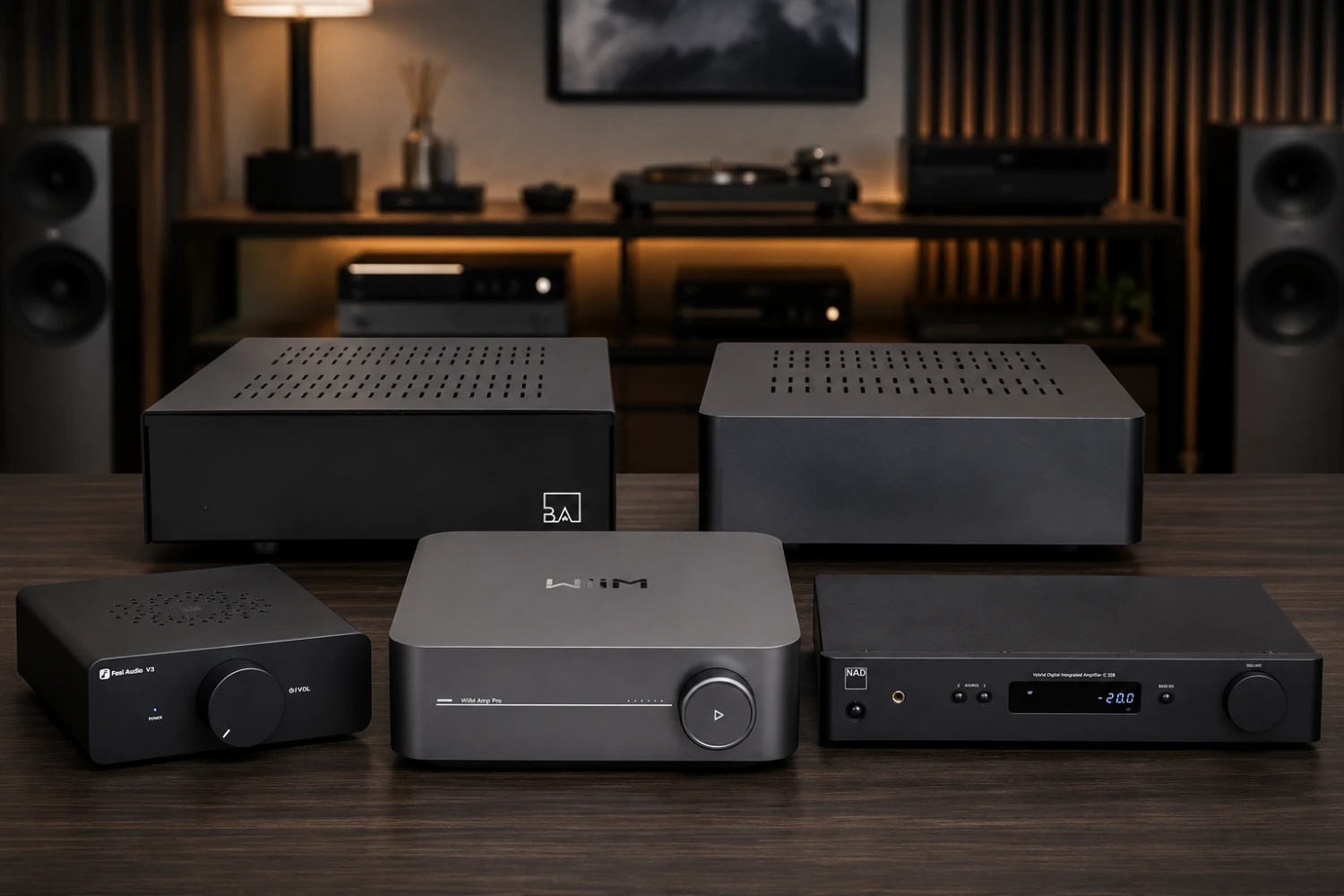
Class D amplifier overview comparing modern switching designs with traditional amplifier classes.
This source article is a category overview rather than a single amplifier recommendation, so its value here is contextual.
It explains why modern Class D amplification has moved beyond its older reputation for sterile or bright sound in the eyes of many enthusiasts, highlighting engineering from companies such as Purifi, Hypex, Orchard Audio, and AGD Productions.
The article contrasts amplifier classes: Class A prioritizes linearity but is inefficient, Class AB improves efficiency and remains common in high-end audio, while Class D uses switching amplification to achieve high efficiency and compact power delivery. As a buying reference, it helps frame why products such as the Lyngdorf MXA-8400 and Technics SU-G700M2 rely on advanced Class D approaches rather than traditional topologies.
Best for: Readers choosing between amplifier topologies before selecting a product
- Useful overview of Class D design progress
- Explains differences between Class A, Class AB, and Class D
- Highlights efficiency as a core Class D advantage
- Connects modern Class D with compact and high-power applications
Verdict: This overview is the planning tool in the group, useful when deciding whether Class D suits a system before comparing individual amplifiers.
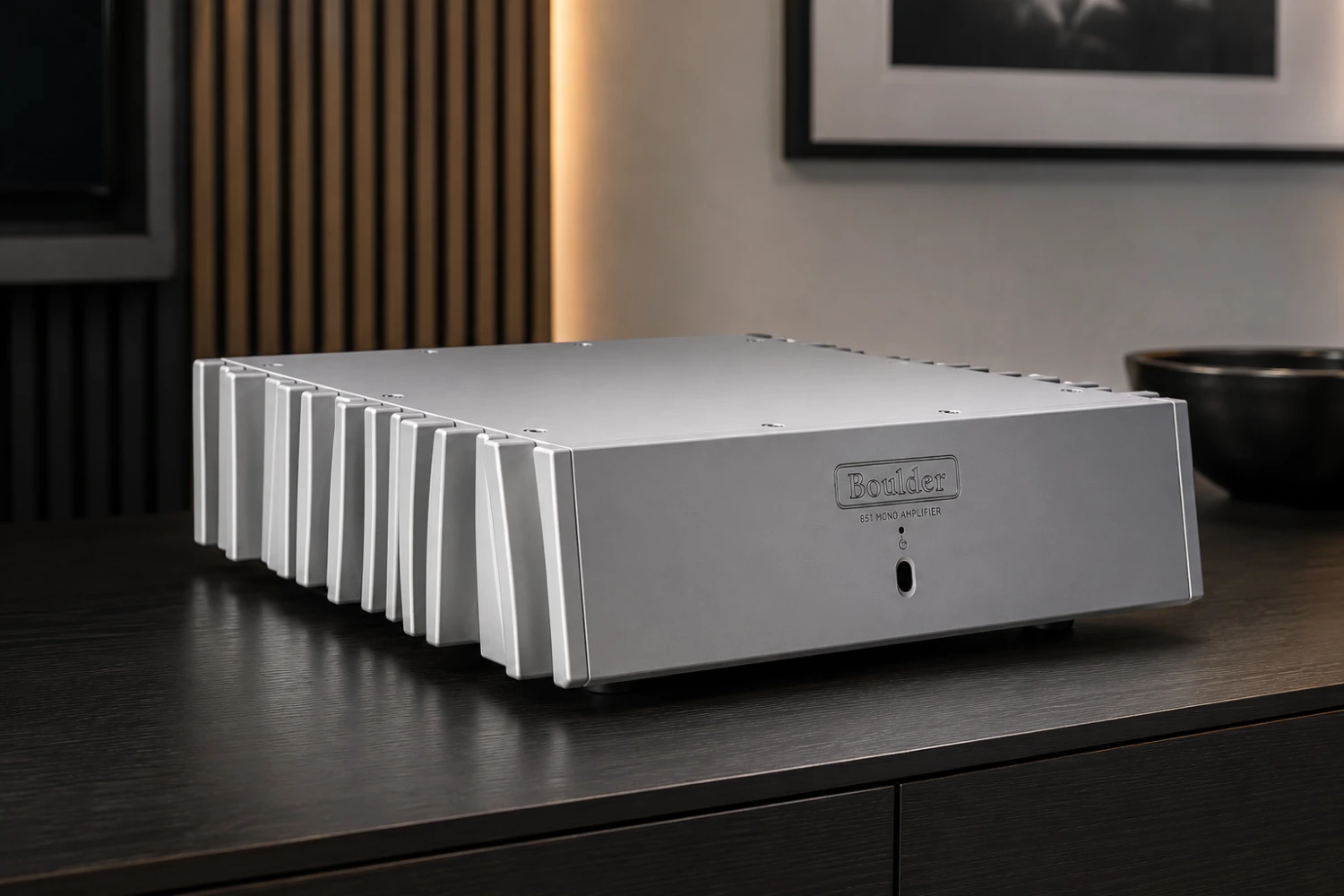
5. Boulder 851 & 808 Expand the 800 Series with Compact High-End Performance
Boulder 851 monoblock amplifier and Boulder 808 phono preamplifier in matching 800 Series casework.
This article covers two Boulder 800 Series components, but the amplifier focus is the Boulder 851 monoblock power amplifier.
The 851 translates engineering principles from the Boulder 861 stereo power amplifier into a dedicated single-channel design and is specified at 100 W into 8 Ohms, 200 W into 4 Ohms, and peak power up to 350 W into demanding 2 Ohm loads.
Boulder also introduces its Smart Current output stage in the 800 Series with this model, described as supporting wider bandwidth, lower distortion, and improved operating behavior. The broader appeal is compact high-end integration: the 851 is designed to match the dimensions and styling of the existing 800 Series, including the 812 DAC Preamplifier, while the 808 adds MM/MC phono preamplification for vinyl systems.
Best for: High-end systems needing compact monoblocks with matching 800 Series components
- Compact monoblock design within Boulder’s 800 Series
- 100 W into 8 Ohms and 200 W into 4 Ohms
- Peak power stated up to 350 W into 2 Ohms
- Introduces Boulder Smart Current output stage to the 800 Series
Verdict: The Boulder 851 is the compact monoblock option here, aimed at serious separates systems where rack space and system matching both matter.

6. Audio Research LS-2: Pure Class A Tube Preamplifier with Modern Touchscreen Control
Audio Research LS-2 tube preamplifier with modern touchscreen control and a purist line-stage design.
The Audio Research LS-2 is a preamplifier rather than a power amplifier, but it is relevant to amplifier system-building because it sits upstream of the power amp and defines source control.
The source describes it as a pure tube line-stage preamplifier operating in full Class A, with no semiconductors in the signal path and no global negative feedback.
Its circuit uses a pair of 6H30 double triodes in cathode follower configuration to keep output impedance low, supporting compatibility with a wide range of power amplifiers and cable lengths. A fully balanced architecture and modern touchscreen control make it a purist control component rather than a feature-heavy hub.
Best for: Separate systems needing a purist tube preamplifier before the power amp
- Pure tube line-stage preamplifier
- Full Class A operation
- No semiconductors in the signal path
- No global negative feedback
Verdict: The LS-2 is the control-stage choice, suited to listeners who want Audio Research’s tube line-stage approach feeding a separate power amplifier.
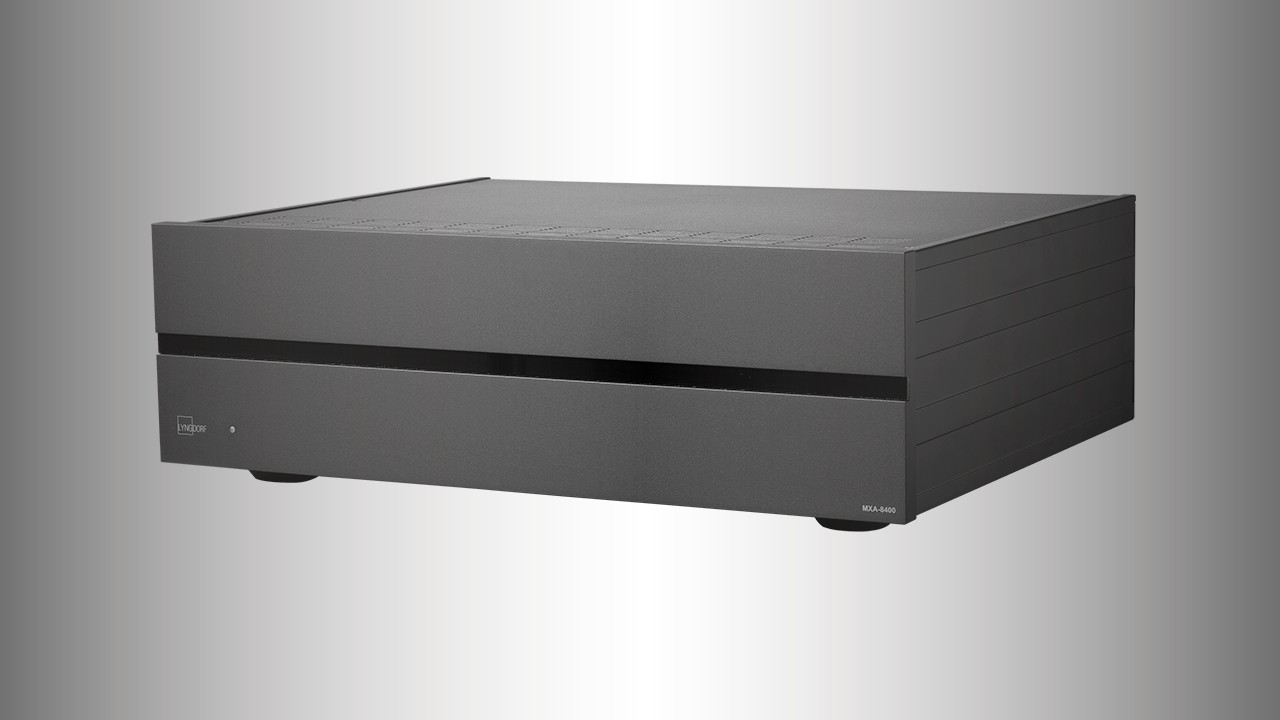
7. Lyngdorf MXA-8400: A new benchmark in multichannel amplifiers
Lyngdorf MXA-8400 multichannel amplifier with eight 400 W channels and Purifi EIGENTAKT technology.
The Lyngdorf MXA-8400 is the clearest multichannel power amplifier in this selection.
It delivers 8 x 400 W and uses Purifi EIGENTAKT technology with EIGENTAKT ErrorCorrection, alongside Lyngdorf’s PowerPerfect power supply, low-noise analog input stages, and a four-layer main PCB optimized for signal purity and grounding.
The source presents it as Lyngdorf Audio’s most powerful product, with 3.2 kW of combined output across eight Purifi amplifier channels. Its role is straightforward: when a system needs many high-power channels from one chassis, this is the dedicated multichannel solution among the supplied articles.
Best for: High-power multichannel music or cinema systems
- Eight-channel power amplifier
- 8 x 400 W stated output
- Purifi EIGENTAKT technology with ErrorCorrection
- PowerPerfect power supply design
Verdict: The MXA-8400 stands apart as the multichannel powerhouse, designed for systems that need eight strong amplification channels in one component.

8. Luxman L-505Z: Integrated Class AB amplifier unveiled
Luxman L-505Z integrated Class AB amplifier with analog inputs, phono input, speaker terminals, and headphone outputs.
The Luxman L-505Z is a traditional integrated amplifier in Class AB, combining source switching, preamplification, and power amplification in one chassis.
The source lists four RCA line inputs, one XLR input, a turntable input, two pairs of speaker terminals, and two front-panel headphone jacks, making it one of the more broadly equipped components in this group.
Luxman’s LIFES technology, based on the company’s ODNF feedback concept, is described as a next-generation amplifier design intended to achieve strong static characteristics without feeding the musical input signal back to the main amplifier. For buyers who want a complete integrated hub rather than separates, the L-505Z is the most conventional full-system amplifier here.
Best for: Stereo listeners wanting a versatile integrated amplifier with analog connectivity
- Class AB integrated amplifier
- Four RCA line inputs and one XLR input
- Turntable input included
- Two speaker-terminal pairs and two headphone jacks
Verdict: The L-505Z is the practical integrated choice, combining Luxman’s Class AB platform with a wide spread of everyday system connections.
9. Merrill Audio ELEMENT 110: Powerful monoblock with a large touch screen
Merrill Audio ELEMENT 110 monoblock amplifier with rose-gold front panel and large capacitive touchscreen.
The Merrill Audio ELEMENT 110 is a monophonic power amplifier positioned as a lower-output model derived from technologies used in the larger ELEMENT 118.
Its stated output is 600 W into 2 Ohms, 300 W into 4 Ohms, and 150 W into 8 Ohms, and the source says it can handle load impedance down to 1 Ohm.
The amplifier also includes a 7-inch capacitive touch display with mute, brightness control, and VU meter functions, plus a vibration-proof case, IsoAcoustics GAIA III isolation mounts, an XLR input, and WBT rhodium-plated copper speaker terminals. Compared with the more traditional monoblocks in the list, its distinguishing feature is the combination of high load tolerance and a modern touchscreen interface.
Best for: Systems needing a modern monoblock with strong low-impedance capability
- Monoblock power-amplifier design
- 600 W into 2 Ohms, 300 W into 4 Ohms, and 150 W into 8 Ohms
- Stated handling of 1 Ohm load impedance
- 7-inch capacitive touch display with VU meter function
Verdict: The ELEMENT 110 is the touchscreen-equipped monoblock option, pairing substantial stated power with unusually detailed front-panel control.

10. Technics SU-G700M2: Reference class amplifier
Technics SU-G700M2 integrated amplifier with signal meters, anti-resonance chassis, LAPC, and JENO Engine technology.
The Technics SU-G700M2 is an integrated amplifier from the Grand series, built in a metal case on an anti-resonance chassis and fitted with front signal-level meters.
It operates in Class D and uses Load Adaptive Phase Calibration, or LAPC, to optimize the amplifier’s phase behavior according to the connected speaker load.
The source explains that speaker impedance changes with frequency and that conventional switching amplifiers may struggle with difficult impedance behavior; Technics addresses this by measuring the amplifier and connected speakers, then applying digital signal processing based on the amplitude-phase frequency response. The SU-G700M2 also features Technics JENO Engine technology, described as reducing issues associated with digital amplification.
Best for: Listeners wanting a modern integrated Class D amplifier with speaker-load calibration
- Integrated Class D amplifier
- Load Adaptive Phase Calibration for speaker-load optimization
- JENO Engine technology
- Metal case with anti-resonance chassis
Verdict: The SU-G700M2 is the technically adaptive integrated choice, built around Technics’ approach to Class D amplification and loudspeaker matching.
Quick comparison
These products and articles are not direct substitutes, so the most useful comparison is by system role.
The Electrocompaniet, McIntosh, Boulder, and Merrill Audio entries are monoblock power amplifiers; the Lyngdorf is a multichannel power amplifier; the Luxman and Technics are integrated amplifiers; the Audio Research is a preamplifier; the Klipsch is an active desktop 2.1 system; and the Class D article is a topology guide rather than hardware.
| Product | Best for | Verdict |
|---|---|---|
| Electrocompaniet AW400: Extreme power amplifier | Difficult speaker loads in a separate monoblock stereo system | Prioritizes high-current power-supply design, 400 W output, and stated stability down to 0.5 Ohm. |
| Klipsch ProMedia Heritage 2.1: Desktop Bluetooth Triphonic | Compact desktop audio with built-in amplification | A self-contained active 2.1 system with Class D power, USB, Bluetooth, RCA input, and a powered subwoofer. |
| McIntosh MC2.1KW: Anniversary edition monoblock power amplifier launched | Very large single-channel high-end amplification | Uses a triple-chassis monoblock format, 2000-watt stated output, and terminals for 2, 4, and 8 Ohm speaker matching. |
| Best Class D Amplifiers of: From Budget Hi-Fi to High-End Excellence | Understanding whether Class D suits a planned system | Provides topology context, explaining the efficiency and design evolution of modern Class D amplification. |
| Boulder 851 & 808 Expand the 800 Series with Compact High-End Performance | Compact high-end separates using Boulder 800 Series components | The 851 monoblock offers 100 W into 8 Ohms, 200 W into 4 Ohms, and compact matching casework. |
| Audio Research LS-2: Pure Class A Tube Preamplifier with Modern Touchscreen Control | Tube line-stage control ahead of a separate power amplifier | A pure Class A tube preamplifier with no semiconductors in the signal path and no global negative feedback. |
| Lyngdorf MXA-8400: A new benchmark in multichannel amplifiers | High-power multichannel systems | Combines eight 400 W channels, Purifi EIGENTAKT technology, ErrorCorrection, and Lyngdorf’s PowerPerfect supply. |
| Luxman L-505Z: Integrated Class AB amplifier unveiled | Versatile analog stereo integrated amplification | A Class AB integrated amplifier with RCA, XLR, phono, dual speaker terminals, and headphone outputs. |
| Merrill Audio ELEMENT 110: Powerful monoblock with a large touch screen | Modern monoblock systems needing low-impedance handling | Combines stated output up to 600 W into 2 Ohms with 1 Ohm load handling and a 7-inch touchscreen. |
| Technics SU-G700M2: Reference class amplifier | Integrated Class D systems with adaptive speaker-load calibration | Uses LAPC and JENO Engine technology to address speaker-load behavior in a modern integrated amplifier. |
Frequently asked questions
Should I choose an integrated amplifier or separate preamp and power amps?
Choose an integrated amplifier such as the Luxman L-505Z or Technics SU-G700M2 when you want source control and power amplification in one chassis.
Choose separates when you need a dedicated preamplifier such as the Audio Research LS-2, monoblocks such as the Electrocompaniet AW400, Boulder 851, McIntosh MC2.1KW, or Merrill Audio ELEMENT 110, or a multichannel power amplifier such as the Lyngdorf MXA-8400.
Are Class D amplifiers only for compact or budget systems?
No.
The supplied material describes modern Class D as having advanced significantly, with engineering from firms such as Purifi and Hypex changing expectations around efficiency, power, and measured performance.
In this selection, Class D appears in very different roles, from the Klipsch desktop system to the Lyngdorf MXA-8400 multichannel amplifier and the Technics SU-G700M2 integrated amplifier.
What matters most when matching an amplifier to difficult speakers?
Look for load stability, appropriate impedance support, power delivery, and the design of the power supply.
The Electrocompaniet AW400 is stated to operate down to 0.5 Ohm, the Merrill Audio ELEMENT 110 down to 1 Ohm, the McIntosh MC2.1KW provides separate terminals for 2, 4, and 8 Ohm nominal loads, and the Technics SU-G700M2 uses LAPC to adapt to the connected speaker load.
When does a multichannel amplifier make more sense than stereo monoblocks?
A multichannel amplifier is the practical route when one system needs several powered channels from a single chassis, as in a surround or multi-speaker installation.
The Lyngdorf MXA-8400 is the dedicated example here, with eight 400 W channels, while monoblocks are better suited to systems where each channel is handled by its own separate amplifier.
How to choose among these amplifier options
Start with system layout.
If the goal is a conventional two-channel system with fewer boxes, the Luxman L-505Z and Technics SU-G700M2 are the natural integrated-amplifier candidates.
The Luxman emphasizes a Class AB platform with broad analog connectivity, including phono and headphone outputs, while the Technics focuses on Class D amplification with LAPC speaker-load calibration and JENO Engine technology. For separate high-end systems, decide whether you need a preamplifier, monoblock power amplifiers, or both. The Audio Research LS-2 is a purist tube line stage rather than a power amp, so it belongs ahead of a suitable amplifier. The Electrocompaniet AW400, McIntosh MC2.1KW, Boulder 851, and Merrill Audio ELEMENT 110 are all monoblocks, but they differ sharply: Electrocompaniet stresses current delivery and extreme low-impedance operation, McIntosh is the ultra-powerful triple-chassis statement, Boulder brings compact 800 Series matching and Smart Current output-stage design, and Merrill combines strong low-impedance specifications with a large touchscreen interface. For many channels, the Lyngdorf MXA-8400 is the clear fit from the supplied material, offering eight 400 W channels in a purpose-built multichannel design using Purifi EIGENTAKT technology and Lyngdorf’s PowerPerfect supply. For a desk or small multimedia setup, the Klipsch ProMedia Heritage 2.1 avoids the separates question entirely by building amplification into a 2.1 speaker-and-subwoofer package. Finally, use the Class D overview as background reading when deciding whether efficiency, compactness, and modern switching-amplifier design align with the rest of your system priorities. The safest buying approach is to match the amplifier type to the system first, then check speaker impedance demands, required inputs, number of channels, available rack space, and whether you want upgrade flexibility. A powerful monoblock is unnecessary for a desktop system, a powered 2.1 package will not replace a high-end separates chain, and a preamplifier still needs a power amplifier downstream. The right amplifier is the one whose architecture matches the job before its specifications are even compared.