Bluesound Node 2025: A Compact Streaming Hub With Serious Headphone Ambitions
The Bluesound Node 2025 combines network streaming, headphone amplification, digital conversion, TV connectivity and multi-room control in a compact BluOS component designed to sit at the center of a modern hi-fi system.

The Bluesound Node 2025 is best understood as a compact control point for today’s mixed listening habits. It is not only a network streamer, and it is not only a headphone amplifier. It is a BluOS-based source component with wired and wireless networking, app-platform compatibility, digital and analog outputs, HDMI eARC for television audio, Bluetooth 5.2 with aptX Adaptive, an ESS SABRE DAC, and a dedicated THX AAA headphone amplifier section. That combination makes it interesting for listeners who want a single component to bridge traditional hi-fi, desktop listening, TV sound, multi-room audio and headphone use without turning the system into a stack of boxes.
A streamer built around broad day-to-day access
The most immediately useful aspect of the Node 2025 is its wide streaming compatibility. It supports AirPlay 2, Spotify Connect, TIDAL Connect and Roon Ready operation, alongside Bluesound’s own BluOS platform. For many users, that matters more than any single specification because it determines how naturally the product fits into daily routines. One person in a household may prefer Spotify Connect, another may use AirPlay 2 from an iPhone or Mac, while a more library-focused listener may run Roon. The Node 2025 is designed to accept those different approaches rather than forcing every listener through one control path.
BluOS compatibility also positions the Node 2025 as part of a wider multi-room ecosystem. That is important for listeners who want the main hi-fi system to participate in whole-home playback without giving up conventional stereo outputs. The unit can function as the networked source in a traditional amplifier-based setup, but it can also be controlled remotely from iOS, Android, Windows and macOS devices. In practical terms, the component can sit with the hi-fi rack while playback, volume-related system control and source selection are handled from a phone, tablet or computer.
Headphone output with a dedicated amplifier stage
One of the distinctive features of this Node generation is the use of a THX AAA amplifier chip for headphone listening. The published output figures are 160mW into 16 ohms, 230mW into 32 ohms, 53mW into 250 ohms and 22mW into 600 ohms, delivered through a 6.3mm headphone jack. Those numbers indicate that Bluesound has treated headphone use as a central part of the product, not merely as an afterthought convenience socket on the front or rear of a streamer.
For prospective owners, the value is flexibility. A listener can use the Node 2025 as the streaming source for loudspeaker playback through an amplifier, then plug in headphones when quiet listening is needed. This is especially useful in apartments, shared homes, late-night listening rooms or offices where speakers cannot always be used freely. The range of stated output power across different impedances also gives buyers useful context when matching headphones, particularly if they already own models with higher impedance ratings.

ESS conversion and high-resolution file support
Digital-to-analog conversion is handled by an ESS ES9039Q2M SABRE DAC chip. The Node 2025 supports PCM playback up to 24-bit/192kHz and DSD up to DSD256. It also supports a wide list of file formats, including MP3, AAC, WMA, WMA-L, OGG, ALAC, OPUS, FLAC, MQA, WAV, AIFF and MPEG-4 SLS. That breadth is useful because real music collections are rarely perfectly uniform. Some users have legacy compressed libraries, some store lossless ALAC or FLAC files, and others may access high-resolution files through network or local storage workflows.
The inclusion of USB-A for external storage, specified for external storage only with local server mode, adds another practical route into a library. Rather than relying solely on cloud streaming services, the Node 2025 can also be part of a system built around locally stored music. The internal ARM Cortex A53 quad-core processor running at 1.8GHz per core provides the computing platform for BluOS operation and associated playback functions. While the processor specification is not, by itself, a guarantee of user experience, it shows that the Node 2025 is designed as a networked computing audio component rather than a simple digital input selector.

Connectivity for hi-fi, TV and system integration
The rear-panel connectivity gives the Node 2025 much of its appeal as a system hub. Network access is available through dual-band Wi-Fi 5 and wired Ethernet with Gigabit capability. Bluetooth 5.2 is bidirectional and supports aptX Adaptive, which can be useful both for receiving audio from compatible devices and for wireless listening scenarios where Bluetooth is appropriate. Physical inputs include HDMI eARC, USB-A for storage, a Mini TOSLINK combo input and a 3.5mm jack input.
Outputs are equally important. The Node 2025 provides stereo RCA analog output, a subwoofer output, coaxial and optical digital outputs, USB-A audio output and the 6.3mm headphone output. This means it can feed an integrated amplifier or powered speakers through analog RCA, pass digital audio to an external DAC, connect to a subwoofer-supported stereo system, or serve headphones directly. HDMI eARC is especially relevant for listeners who want a television to share the same audio system used for music. Instead of maintaining separate TV and hi-fi arrangements, the Node 2025 can act as a bridge between screen-based entertainment and a two-channel audio system.
A 12V trigger is also included, which can help coordinate power behavior with compatible amplifiers or other components. For custom-installed systems, the listed control-system compatibility is extensive: Crestron, Control4, RTI, ELAN, URC and Lutron are supported. Amazon Alexa voice control is also specified. These features broaden the Node 2025’s role beyond a simple standalone streamer, making it relevant for more integrated home-audio environments.

Dirac Live readiness for room-aware setup
The Node 2025 is Dirac Live Ready, which is a notable addition for a compact streamer. Room acoustics can strongly affect speaker playback, especially in the bass region and in rooms with reflective surfaces or awkward placement options. Dirac Live is designed to measure the room and apply acoustic correction, helping address issues such as standing waves, reverberant behavior and other room-related distortions. For owners who cannot freely redesign a room, move walls, or place speakers far into the space, room correction can be a useful tool.
It is important to note the practical requirement: calibration needs a compatible high-sensitivity microphone sample pack. Dirac Live readiness should therefore be seen as an expandability feature rather than a complete out-of-the-box calibration system by itself. Even so, its presence gives the Node 2025 a path toward more considered loudspeaker-room integration, which is not always available in compact streaming components.

Compact form and understated placement
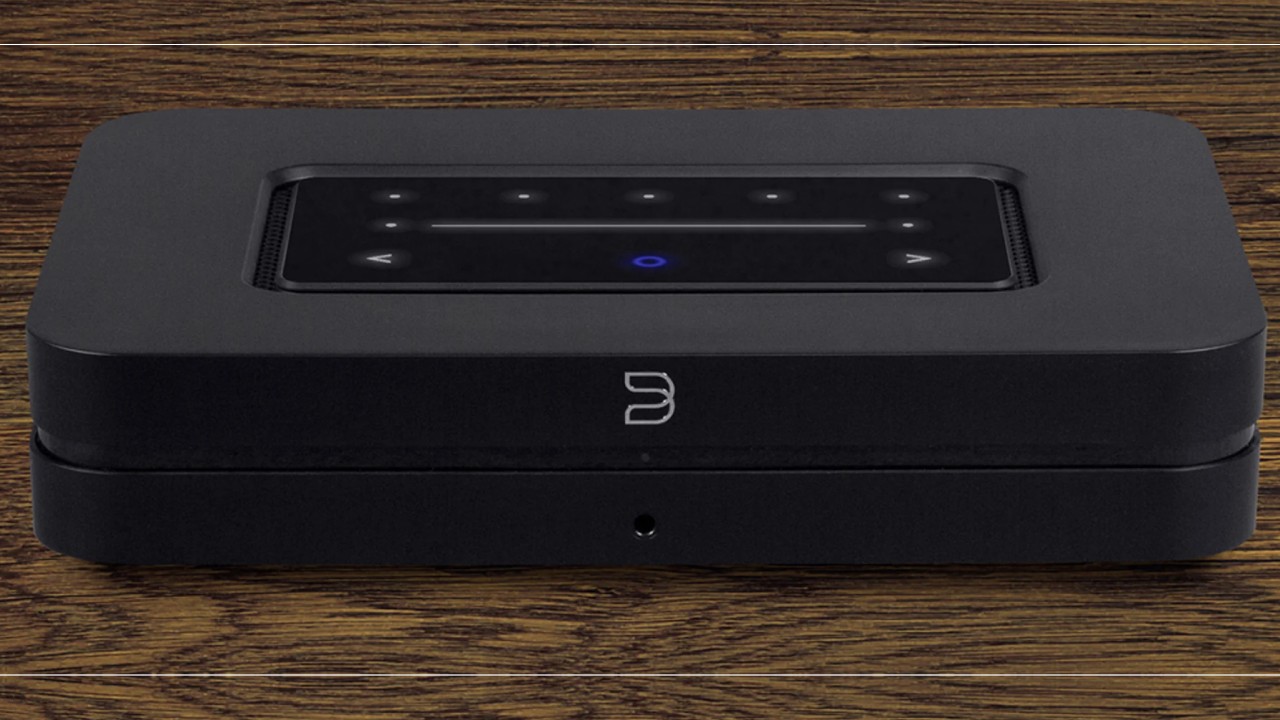
The physical design is compact, with stated dimensions of 220 x 46 x 146mm and a weight of 1.09kg. The black finish and low-profile shape make the Node 2025 easy to place on a shelf, desktop, media console or equipment rack. Its size is part of the product’s appeal: it can add streaming, DAC, headphone and TV-audio functions without requiring the footprint of a full-width component.
The power supply accepts 100-240V AC at 50/60Hz, which supports use across different mains regions where the product is sold with the appropriate cable and regulatory version. The overall concept is one of consolidation. Instead of adding separate streamers, Bluetooth receivers, DACs and headphone amplifiers, the Node 2025 gathers several commonly needed functions into one enclosure while still offering outputs for more traditional hi-fi components.
Who the Bluesound Node 2025 is most suitable for
The Node 2025 is most suitable for listeners who want a modern digital front end that can serve more than one role. It makes sense for someone with an existing amplifier or powered speaker system who wants BluOS streaming, app flexibility, high-resolution file support and TV integration through HDMI eARC. It is also attractive for headphone users who want a network streamer with a dedicated 6.3mm headphone output and specified THX AAA amplification rather than a basic convenience jack.
It may also suit households with multiple streaming habits, because AirPlay 2, Spotify Connect, TIDAL Connect and Roon Ready support cover several common playback ecosystems. Custom-install users and those planning integrated smart-home audio may appreciate the control-system compatibility, 12V trigger and Alexa voice-control support. On the other hand, buyers seeking a purely analog preamplifier, a power amplifier for passive speakers, or a product with room correction fully supplied without additional calibration hardware should look carefully at the Node 2025’s role and requirements. Its strengths are strongest when used as a digital streaming, conversion, headphone and system-control hub.
Conclusion
The Bluesound Node 2025 stands out through documented versatility rather than a single headline feature. Its combination of BluOS multi-room streaming, AirPlay 2, Spotify Connect, TIDAL Connect, Roon Ready support, ESS ES9039Q2M conversion, THX AAA headphone amplification, HDMI eARC, extensive digital and analog outputs, aptX Adaptive Bluetooth and Dirac Live readiness makes it a compact but capable centerpiece for a contemporary hi-fi setup. It is best suited to listeners who want one well-connected component to manage music streaming, local files, headphone sessions, TV audio and integration with an existing stereo system, while preserving room to expand through external amplification, subwoofer use, digital outputs or acoustic calibration.