
These Standout Amplifiers Span Desktop, Headphone, Stereo and Home Theater Systems
A practical amplifier guide covering compact integrated designs, DAC/headphone amplifiers, stereo power amps, a reference preamplifier, home theater amplification and a self-contained wireless speaker with built-in amps.

Amplifiers are not one-size-fits-all components.
The source material here ranges from tiny desktop integrated amplifiers and DAC/headphone units to serious power amplifiers, a reference-grade preamplifier, a multichannel home theater amplifier and even a wireless speaker with its own internal amplification.
The right choice depends less on category labels and more on what the amplifier must actually drive, what sources it must accept and how much system flexibility you need. For a compact passive-speaker setup, connectivity and speaker support matter as much as rated power. For headphones, the key distinction is whether you need a simple DAC/headphone amplifier or a more ambitious balanced design. In a separates-based hi-fi system, power amplifiers and preamplifiers bring different responsibilities: one supplies current to speakers, the other manages source selection, signal integrity and control. The recommendations below preserve the supplied ordering while clarifying where each product fits. Specifications and claims are limited to the provided material, so this guide is best read as an editorial map of use cases rather than a ranking by absolute performance.

1. FX-Audio XL01: Compact Class D integrated amplifier with Bluetooth
The FX-Audio XL01 is a compact black aluminum Class D integrated amplifier with 2.1-channel speaker output and front-panel tone adjustment.
The FX-Audio XL01 is a small Class D integrated amplifier aimed at simple 2.1 systems.
Its 2.1-channel layout, passive subwoofer output and rated power of 2×40 W plus 1×75 W at 4 ohms make it a practical match for a compact speaker-and-subwoofer arrangement in a small or medium-sized listening room.
Connectivity is deliberately simple, with stereo RCA input, speaker terminals and Bluetooth for wireless playback from a phone or tablet. Bass and treble controls add useful adjustment for room, speaker and taste matching.
Best for: Small 2.1 speaker systems
- Compact 2.1 integrated amplifier layout
- Bluetooth plus stereo RCA input
- Passive subwoofer output
- Bass and treble tone controls
Verdict: A straightforward compact amplifier for listeners who want passive speakers, a passive subwoofer output and Bluetooth in one small box.

2. HIFIMAN EF400: Headphone amplifier with Himalaya R2R DAC
The HIFIMAN EF400 combines digital inputs, line outputs and multiple headphone outputs in a compact DAC/headphone amplifier chassis.
The HIFIMAN EF400 combines a headphone amplifier with the brand’s Himalaya R2R DAC module, making it a source and amplifier solution for desktop headphone systems.
The supplied specification highlights a four-channel differential structure integrating DAC, buffer and active filter stages, with balanced and single-ended outputs for both line-level and headphone use.
USB-B and USB-C inputs keep the digital side focused, while the output selection is unusually broad, including RCA, balanced XLR, 6.35 mm, 3.5 mm, balanced 4.4 mm and four-pole balanced XLR headphone connections.
Best for: Desktop headphone systems with balanced output needs
- Himalaya R2R DAC module
- USB-B and USB-C inputs
- Balanced and single-ended headphone outputs
- RCA and balanced XLR line outputs
Verdict: A feature-rich DAC/headphone amplifier for users who want R2R conversion and a wide spread of headphone and line-output options.
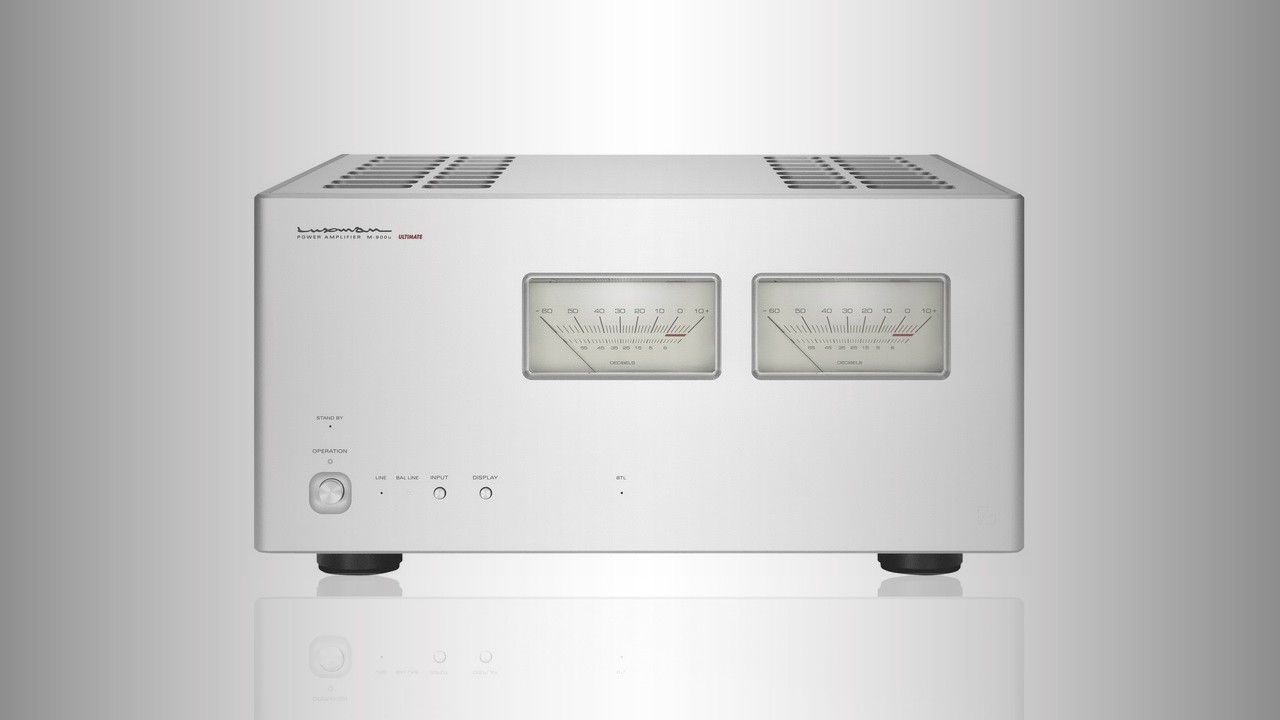
3. Luxman M-900u: Another masterpiece from Japanese engineers
The Luxman M-900u features a minimalist front panel with illuminated analog level meters and a heavily damped chassis on gradient supports.
The Luxman M-900u is presented as a substantial stereo power amplifier with a minimalist, retro-leaning design and a heavily damped chassis.
The source emphasizes its 48-kilogram case, aluminum front panel, illuminated level meters, bridge-mode indication and cast-iron gradient legs intended to reduce resonance and vibration.
Internally, the description focuses on a large power supply with four 20,000 µF capacitors and a 1250 VA transformer. This is a dedicated power amplifier for systems where the preamplifier or source control is handled separately.
Best for: High-end stereo separates systems
- Stereo power amplifier design
- Large 48-kilogram chassis
- Front level meters with white LED backlighting
- Power supply with four 20,000 µF capacitors and 1250 VA transformer
Verdict: A physically substantial stereo power amplifier for listeners building a separates system around heavy construction and a large power supply.

4. FX-AUDIO DAC-X4: High quality headphone amplifier at a very affordable price
The FX-AUDIO DAC-X4 is a small aluminum DAC/headphone amplifier with USB, optical and coaxial inputs plus RCA and 3.5 mm outputs.
The FX-AUDIO DAC-X4 is a compact DAC and headphone amplifier with a simple, practical connection set.
It supports USB-B, optical Toslink and coaxial digital inputs, with stereo RCA line output and a 3.5 mm headphone jack.
The DAC01 conversion chip supports PCM up to 24-bit 192 kHz via optical and coaxial inputs, while USB supports PCM up to 24-bit 96 kHz. The MAX97220 headphone amplifier chip is specified at 2×150 mW into 32 ohms, making this a focused desktop upgrade for digital sources and headphones.
Best for: Affordable desktop DAC and headphone use
- USB-B, optical and coaxial inputs
- RCA line output and 3.5 mm headphone output
- PCM support up to 24-bit 192 kHz via optical and coaxial
- Compact aluminum-alloy shell
Verdict: A compact digital-input DAC/headphone amplifier for users who need simple source conversion and headphone output without system complexity.

5. Marton Opusculum Omni V1.0: Designed to function as three independent devices
The Marton Opusculum Omni V1.0 uses a substantial chassis with cooling fins, mechanical isolation and a configurable amplifier architecture.
The Marton Opusculum Omni V1.0 stands out for configurability.
The supplied material describes it as a dual mono amplifier designed to operate as an integrated stereo amplifier, a stereo power amplifier or a mono power amplifier.
Its engineering emphasis is symmetry, power supply capacity and mechanical isolation, including total smoothing capacity of 528,000 µF, multiple low-noise and ultra-stable power supplies, a 1000 VA toroidal transformer for audio circuits, non-magnetic chassis materials and anti-vibration feet. It is also described as capable of working with low-impedance speakers thanks to high current peaks.
Best for: Flexible high-current stereo systems
- Works as integrated stereo, stereo power or mono power amplifier
- Dual mono design emphasis
- Total smoothing capacity of 528,000 µF
- Designed for low-impedance speaker compatibility
Verdict: A versatile amplifier platform for systems that may need integrated, stereo power or mono power operation from the same design.
6. Primare A60: 4 discrete amplifiers with UFPD technology onboard
The Primare A60 is a stereo power amplifier with a rigid steel chassis, aluminum front panel and balanced UFPD-based amplifier configuration.
The Primare A60 is a Class D power amplifier built around four discrete amplifier modules using UFPD technology in a balanced configuration, with two amplifiers per channel.
The source highlights a rigid steel housing, a 15 mm aluminum front panel and protection from external interference.
Each channel includes unbalanced RCA and balanced XLR inputs, along with WBT Nextgen speaker connectors. The design also includes a switching power supply, short signal paths, optimized grounding, protection against direct current damage and overheating, and automatic shutdown for acoustic outputs.
Best for: Balanced stereo power amplification
- Class D power amplifier with UFPD technology
- Balanced configuration with two amplifier modules per channel
- RCA and Neutrik XLR inputs per channel
- Protection against direct current damage and overheating
Verdict: A technically focused Class D stereo power amplifier for systems that require balanced inputs, robust protection and a separates-based layout.
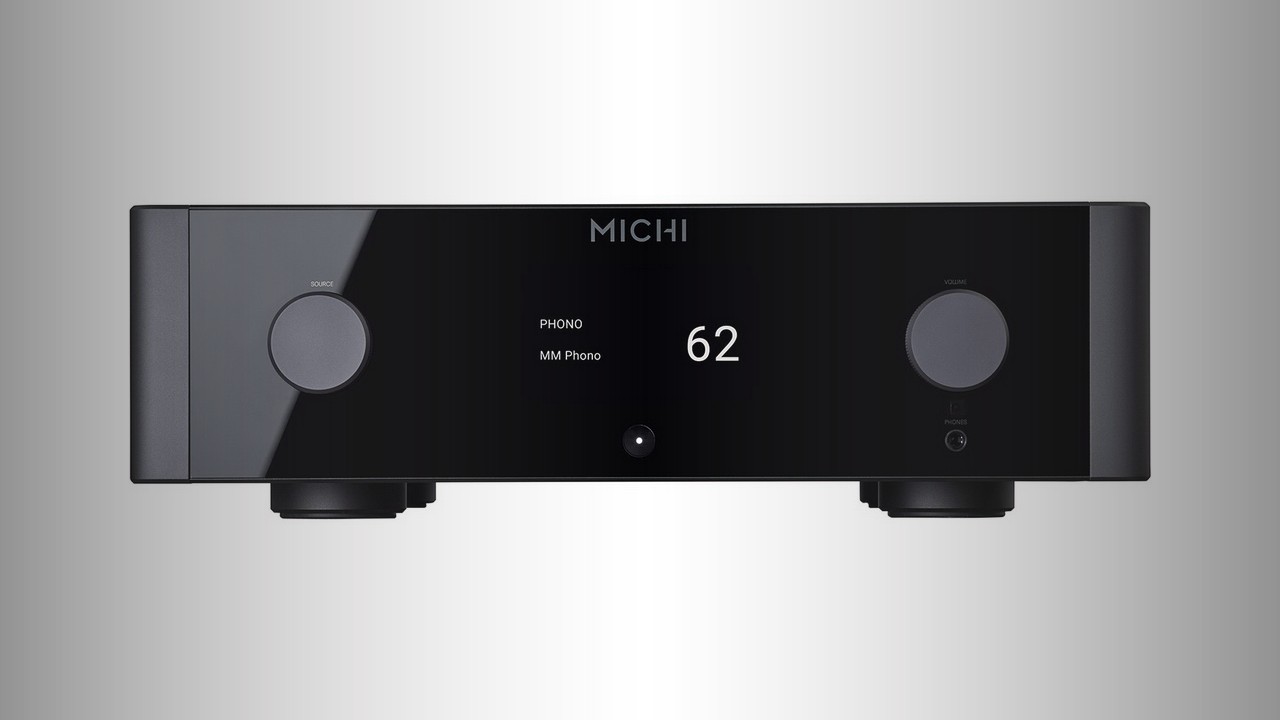
7. Michi P5: Reference-grade preamplifier
The Michi P5 is a reference-grade preamplifier designed for source switching, phono input support and system control in a separates setup.
The Michi P5 is not a power amplifier; it is a reference-grade preamplifier for controlling a higher-end separates system.
The supplied article describes a comprehensive set of analog and digital input switching, support for Master Quality Authenticated technology, an onboard phono preamplifier and system-integration options through RS232 and Ethernet interfaces.
Its role is to manage source selection and signal routing before a power amplifier, making it relevant for listeners assembling a system around separate preamp and power amp components.
Best for: Separates systems needing source control
- Comprehensive analog and digital input switching
- Onboard phono preamplifier
- Supports Master Quality Authenticated technology
- RS232 and Ethernet control interfaces
Verdict: A fully featured preamplifier for users who need analog, digital, phono and control-system integration ahead of a power amplifier.
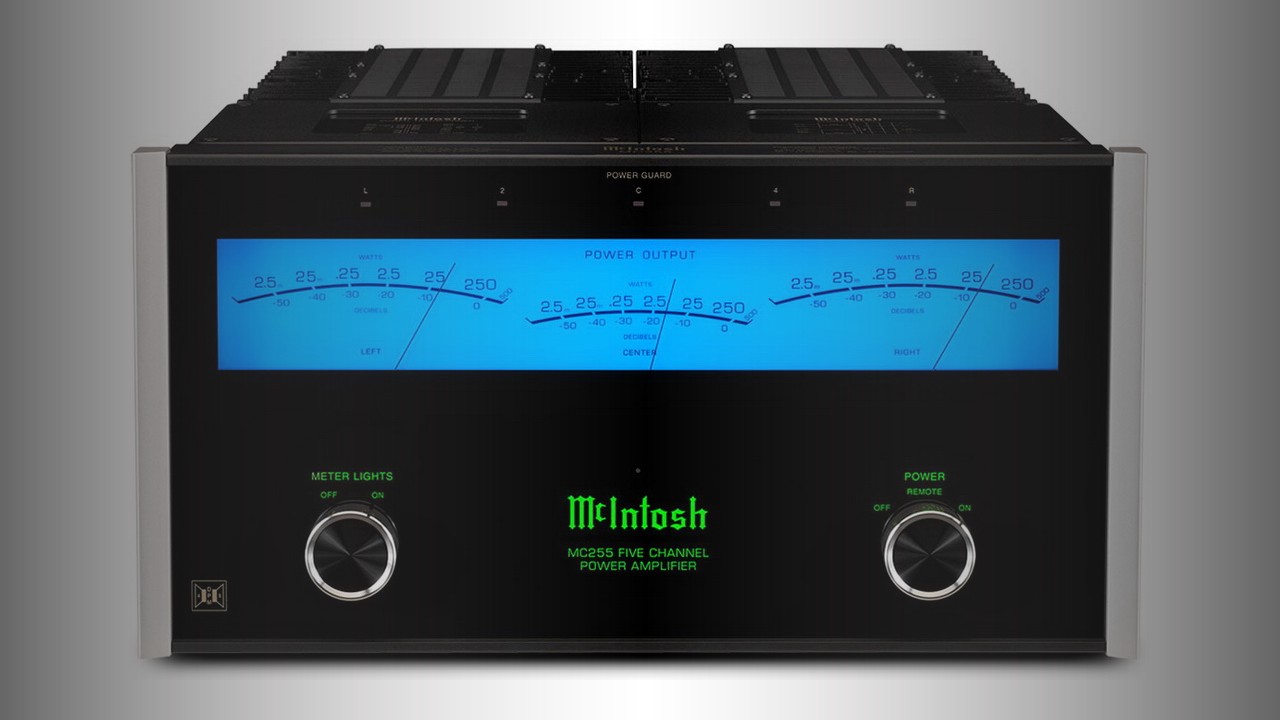
8. McIntosh MC255: Versatile amplifier for any Home Theater system
The McIntosh MC255 features a wide TripleView output meter for the front three channels and five-channel home theater amplification.
The McIntosh MC255 is a five-channel home theater power amplifier with a focus on stable multichannel output and front-channel monitoring.
Its TripleView power output meter displays real-time readings for the three front channels in one wide window.
The supplied material states that all five channels receive 200 watts when used together, while the front left, center and right channels can receive 250 watts when only those three are used. McIntosh Dynamic Power Manager technology is described as maintaining the stated power into 4- or 8-ohm speaker impedances, while four McIntosh radiator heat sinks and a toroidal isolation power transformer are intended to support quiet operation.
Best for: Home theater power amplification
- Five-channel home theater amplifier
- TripleView meter for three front channels
- 200 watts per channel with all five channels used
- Rated power maintained into 4- or 8-ohm speakers through Dynamic Power Manager
Verdict: A multichannel amplifier suited to theater systems that need five channels of power and clear front-channel power monitoring.

9. Topping LA90 Discrete: Compact and elegant amplifier
The Topping LA90 Discrete is a compact amplifier with a front volume control and balanced combination inputs for XLR or 6.35 mm TRS cables.
The Topping LA90 Discrete is a compact amplifier built with a discrete NFCA amplifier circuit and designed for either stereo or mono operation.
The source emphasizes very low THD+N under a 4- or 8-ohm 5 W load, three combined balanced inputs that accept XLR or 6.35 mm TRS cables, variable gain and a front-panel volume control.
The volume control can also be bypassed for use with a hi-fi preamplifier, which is particularly useful when synchronizing two units in mono operation. In mono mode, the minimum speaker impedance is specified as 4 ohms.
Best for: Compact balanced speaker amplification
- Stereo or mono operation
- Combined XLR and 6.35 mm TRS balanced inputs
- Variable gain
- Bypassable volume control for preamplifier use
Verdict: A compact, flexible amplifier for balanced systems where stereo use, mono pairing and preamplifier integration are all relevant.

10. Enkl Speaker: Danish 10kg portable speaker
The Enkl Speaker is a 10 kg transportable wireless speaker with a handle, internal Class D amplification and a large multi-driver cabinet.
The Enkl Speaker is included here because it contains amplification, but it is not a standalone hi-fi amplifier.
It is a wireless portable speaker system with two built-in 140 W Class D amplifiers, Bluetooth 5.2, a battery specified for 80 hours and a rugged cabinet with a carrying handle.
The source also describes two 10-inch woofers, a 1.5-inch tweeter, bass porting, app configuration, user profiles and a karaoke mode using the microphone built into a mobile device. At 10 kg, it is portable in the transportable sense rather than pocketable.
Best for: Transportable wireless music playback
- Two built-in 140 W Class D amplifiers
- Bluetooth 5.2 wireless connection
- Built-in battery specified for 80 hours
- App configuration with user profiles
Verdict: A self-contained wireless speaker system with internal Class D amplification, best considered separately from conventional component amplifiers.
Quick comparison
The clearest way to compare these products is by role.
Some are complete integrated or powered solutions, some are headphone-focused DAC/amplifiers, and others are separates components that require matching preamplifiers, power amplifiers, speakers or sources.
| Product | Best for | Verdict |
|---|---|---|
| FX-Audio XL01: Compact Class D integrated amplifier with Bluetooth | Small passive 2.1 systems | Choose it when Bluetooth, RCA input, passive-speaker output and a passive subwoofer output matter more than extensive source switching. |
| HIFIMAN EF400: Headphone amplifier with Himalaya R2R DAC | Balanced headphone desktop setups | Choose it for a DAC/headphone amplifier with Himalaya R2R conversion, USB inputs and extensive headphone output options. |
| Luxman M-900u: Another masterpiece from Japanese engineers | High-end stereo separates | Choose it as a dedicated stereo power amplifier where heavy construction, damping and a large power supply are priorities. |
| FX-AUDIO DAC-X4: High quality headphone amplifier at a very affordable price | Simple digital-source headphone systems | Choose it for compact USB, optical or coaxial digital conversion with RCA line output and a 3.5 mm headphone jack. |
| Marton Opusculum Omni V1.0: Designed to function as three independent devices | Flexible integrated or power-amplifier roles | Choose it when one amplifier must potentially serve as an integrated stereo amp, stereo power amp or mono power amp. |
| Primare A60: 4 discrete amplifiers with UFPD technology onboard | Balanced stereo power amplification | Choose it for a Class D stereo power amplifier with UFPD technology, RCA and XLR inputs and built-in protection features. |
| Michi P5: Reference-grade preamplifier | Source control in separates systems | Choose it when the system needs a preamplifier with analog, digital, phono and control-system connectivity. |
| McIntosh MC255: Versatile amplifier for any Home Theater system | Five-channel home theater systems | Choose it for multichannel power amplification with front-channel power metering and specified output into 4- or 8-ohm speakers. |
| Topping LA90 Discrete: Compact and elegant amplifier | Compact balanced stereo or mono amplification | Choose it for a small amplifier with balanced inputs, stereo or mono operation and preamplifier-friendly volume bypass. |
| Enkl Speaker: Danish 10kg portable speaker | Transportable wireless playback | Choose it only if you want a self-contained wireless speaker with internal amplification rather than a separate amplifier component. |
Frequently asked questions
Should I choose an integrated amplifier, power amplifier or preamplifier?
Choose an integrated amplifier when you want source input and speaker driving in one unit, as with the FX-Audio XL01 or the configurable Marton Opusculum Omni V1.0.
Choose a power amplifier when another component will handle volume and source selection, as with the Luxman M-900u, Primare A60 or McIntosh MC255.
Choose a preamplifier such as the Michi P5 when you need source switching, phono or digital handling, and control before a separate power amplifier.
What matters most for headphone amplifier buyers?
Start with inputs, outputs and headphone compatibility.
The HIFIMAN EF400 is built around USB digital inputs, an R2R DAC module and many single-ended and balanced headphone outputs.
The FX-AUDIO DAC-X4 is simpler, with USB, optical and coaxial inputs plus RCA and 3.5 mm headphone outputs. The better fit depends on whether you need balanced headphone connections and broader output flexibility or a compact basic DAC/headphone solution.
Is Bluetooth enough for a hi-fi amplifier system?
Bluetooth is convenient, but it should be considered alongside the rest of the system.
The FX-Audio XL01 uses Bluetooth for wireless streaming while also offering RCA input and speaker outputs for a compact 2.1 setup.
The Enkl Speaker also uses Bluetooth 5.2, but it is a self-contained wireless speaker rather than a component amplifier. If you use traditional sources, check for RCA, USB, optical, coaxial, XLR or phono inputs as appropriate.
How should I match these amplifiers to speakers?
Use the supplied impedance and role information first.
The FX-Audio XL01 is specified for 4-8 ohm speakers.
The McIntosh MC255 is described as maintaining its stated power into 4- or 8-ohm speakers. The Topping LA90 Discrete specifies a 4-ohm minimum impedance in mono mode. The Marton Opusculum Omni V1.0 is described as capable with low-impedance speakers. Also confirm whether the product is a speaker amplifier, headphone amplifier, preamplifier or self-contained speaker before planning a system around it.
How to choose from these amplifiers
Begin with the system role, not the brand or the largest number on the specification sheet.
A compact 2.1 room system points naturally toward the FX-Audio XL01 because it combines speaker outputs, passive subwoofer output, RCA input, Bluetooth and tone controls in a small Class D chassis.
A headphone-first desktop system narrows the field to the HIFIMAN EF400 or FX-AUDIO DAC-X4: the EF400 is the more connection-rich option with Himalaya R2R conversion and balanced headphone outputs, while the DAC-X4 is the simpler compact DAC/headphone amplifier with USB, optical and coaxial inputs. For a traditional stereo separates system, decide whether you need power, control or both. The Luxman M-900u, Primare A60 and Topping LA90 Discrete are power-amplification choices with very different positioning: the Luxman is a large stereo power amplifier with heavy construction and a substantial power supply, the Primare is a balanced Class D UFPD design with RCA and XLR inputs, and the Topping is a compact balanced amplifier that can work in stereo or mono mode and can bypass its volume control for preamp use. The Michi P5 belongs upstream as a preamplifier, bringing analog and digital switching, phono support and control interfaces. The Marton Opusculum Omni V1.0 is the outlier for flexibility because it is described as working as an integrated stereo amplifier, stereo power amplifier or mono power amplifier. Home theater buyers should look at channel count before anything else. The McIntosh MC255 is the only conventional multichannel power amplifier in the supplied group, with five channels and TripleView metering for the front three. The Enkl Speaker should be considered in a separate category: it has built-in Class D amplification, Bluetooth and battery power, but it is a complete wireless speaker system rather than an amplifier for external passive speakers. A sensible shortlist comes from matching use case, connection needs and speaker or headphone requirements. Check whether the product accepts your sources, provides the outputs your system requires and supports the impedance or connection type you intend to use. That process will do more to secure a successful purchase than comparing unrelated amplifier types as if they served the same job.