Canton DM 5: A Compact Soundbar Built for Practical TV Audio
The Canton DM 5 is a compact 2.1-channel soundbar designed for users who want stronger TV audio without a large speaker system. Its slim cabinet, flexible placement options, Bluetooth aptX support, dialogue mode, and simple TV-remote operation make it a practical upgrade for smaller living spaces and minimalist AV setups.
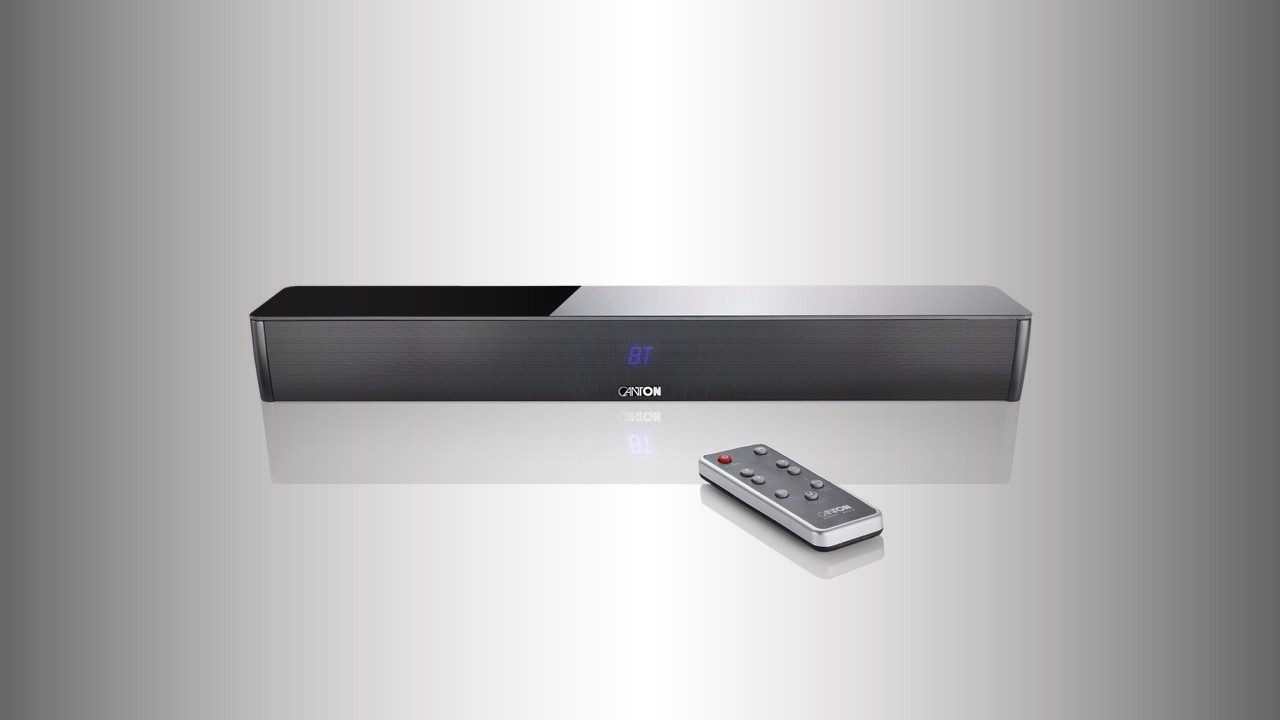
The Canton DM 5 is a soundbar with a clear brief: improve everyday television and music playback while taking up as little space as possible. Rather than presenting itself as a large cinema system, it sits at the compact end of Canton’s DM range, with a cabinet only 55 cm wide, 6.4 cm high, and 9 cm deep. That scale makes it especially relevant for rooms where a conventional loudspeaker setup is not realistic, or where the sound system needs to visually disappear beneath a television. At the same time, Canton has given the DM 5 a useful set of features: 2.1-channel operation, 120 W of stated power, digital and analog inputs, Bluetooth 3.0 with aptX decoding, Dolby Digital compatibility, DTS TruSurround processing, voice enhancement, room-adaptation presets, and a subwoofer output. The result is a compact TV-audio product that places emphasis on usability, placement flexibility, and clean integration rather than system complexity.
A small cabinet designed for real living rooms
The most distinctive aspect of the Canton DM 5 is its size. At 55 x 6.4 x 9 cm and 3.0 kg, it is not trying to dominate a media cabinet or require a dedicated furniture plan. Canton positions it as the most compact model in the DM series, and that matters because many modern televisions sit on relatively narrow stands or are placed in rooms where AV equipment has to share space with bookshelves, cabinets, or general living-room furniture.
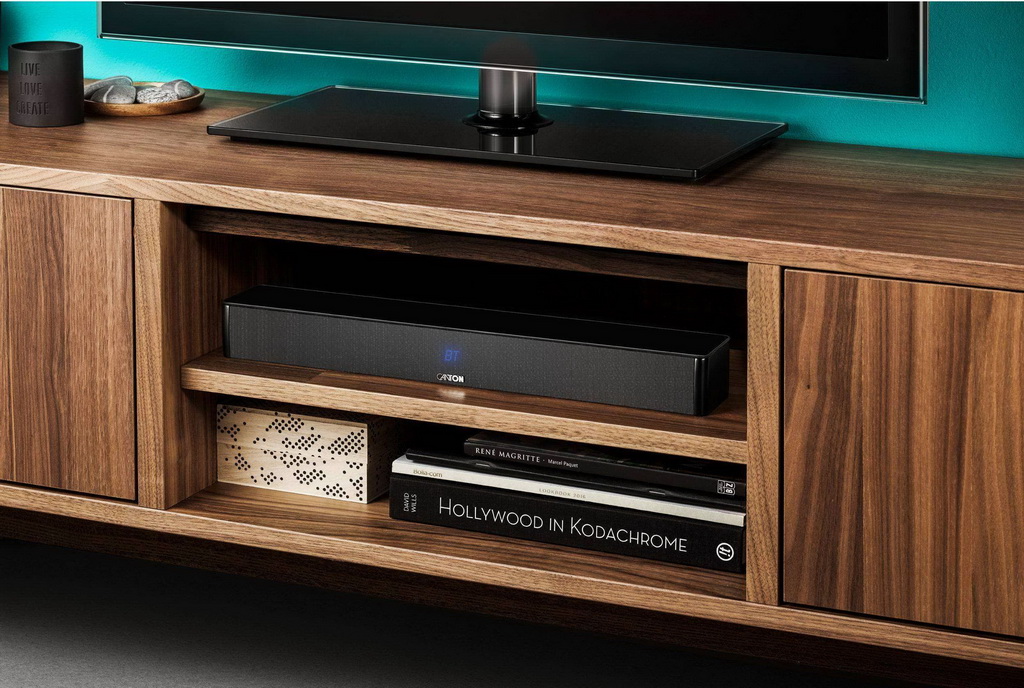
The DM 5 is designed to fit between a cabinet and a TV screen, which is one of the most practical placements for a compact soundbar. In this position, it can keep cables relatively tidy, avoid the visual bulk of separate speakers, and maintain a direct relationship with the screen. Canton also provides an integrated wall-mount option, giving the soundbar a second installation path for wall-mounted televisions. This is particularly useful in rooms where a cabinet is shallow or where the viewer wants a cleaner, floating screen arrangement.
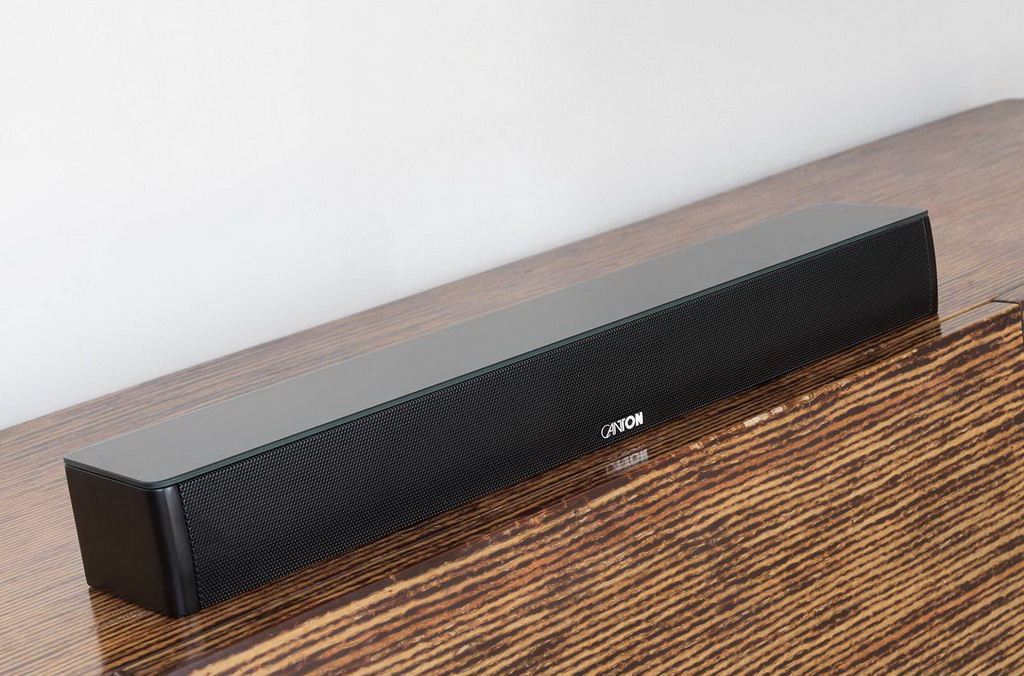
The black and silver lacquered finishes also support the product’s role as a visible but unobtrusive component. A soundbar often sits in a highly visible part of the room, so finish quality and visual restraint are not minor details. The DM 5’s design language is intended to match television hardware and modern interiors without calling too much attention to itself.
2.1-channel architecture in a compact format
Inside the compact enclosure, the Canton DM 5 operates as a 2.1-channel soundbar with a stated power output of 120 W. The driver complement includes two 87 x 46 mm woofers and four 51 mm midrange drivers using cellulose graphite diaphragms. Canton specifies a frequency response of 40 Hz to 23,000 Hz, giving the DM 5 a published operating range that extends well beyond what many built-in television speakers are designed to prioritize.
For a prospective owner, the importance of the 2.1-channel format is not just a channel count. It indicates that Canton has structured the DM 5 to handle left/right information while also providing dedicated low-frequency support within the bar itself. This is relevant for film soundtracks, streamed series, news programming, sports, and music, where television speakers often struggle to deliver a sense of body or scale. The goal is not to replace a full multi-speaker home-theater installation, but to provide a more complete and controlled audio foundation from one compact cabinet.
Canton also includes a subwoofer output. This is a notable piece of flexibility because it allows the DM 5 to remain a simple one-box solution at first, while leaving room for later system expansion. Owners who want more low-frequency presence can add an external subwoofer rather than replacing the entire soundbar. In compact systems, that kind of upgrade path is valuable because it allows the setup to adapt as the room, listening habits, or expectations change.
Inputs that cover TV and wireless sources
The DM 5 provides one optical digital input, one coaxial digital input, and one analog input. This input selection is straightforward but useful. Optical and coaxial connections suit televisions, set-top boxes, disc players, and other digital sources, while the analog input provides compatibility with older or simpler devices that do not offer a digital output. For a compact soundbar, this combination covers the core connection types needed in many everyday systems.
Wireless playback is handled through Bluetooth 3.0 with aptX decoding. That makes the DM 5 more than a TV accessory; it can also function as a compact music playback system for phones, tablets, and compatible computers. Bluetooth is valuable in this type of product because it reduces friction. A user can switch from watching television to playing music without adding a network streamer, receiver, or separate wireless speaker.
The presence of aptX is also worth noting. While results depend on the source device and material, aptX support is a documented feature that can be helpful for users who want Bluetooth convenience while using compatible devices. For households where the soundbar is expected to support both film and casual music listening, this dual role strengthens the DM 5’s usefulness.
Placement presets and modes for everyday use
One of the more practical design decisions in the Canton DM 5 is the inclusion of three equalizer presets for acoustic adaptation. Compact soundbars are rarely installed in ideal conditions. One unit may sit in front of a TV on an open shelf, another may be placed inside a cabinet, and another may be wall-mounted. Each placement can change bass reinforcement, tonal balance, and perceived clarity. Canton’s presets are intended to help the soundbar adapt to these common installation scenarios without requiring the user to perform complicated setup routines.
The DM 5 also includes Voice mode, designed to improve dialogue processing. This is a particularly relevant feature because dialogue intelligibility is one of the most common reasons people move beyond built-in television speakers. Films and streaming series often mix speech against music, effects, and room ambience, while news and daytime television rely heavily on vocal clarity. A dedicated voice mode gives users a simple way to prioritize speech when needed.
Hotel mode is another thoughtful usability feature. It allows the maximum volume level to be set, which can be useful in shared living spaces, apartments, guest rooms, or family homes. Instead of relying on constant manual control, the system can be limited to a chosen ceiling. This is not a glamorous feature, but it reflects an understanding of how soundbars are used in real households.

Simple control and decoding support
The ability to control the Canton DM 5 from a TV remote control is an important convenience. A soundbar that requires a separate remote for every volume adjustment can become frustrating over time, especially for users who want a cleaner and simpler AV experience. TV-remote operation helps the DM 5 feel like part of the television rather than an additional layer of equipment.
Canton also lists Dolby Digital decoding and DTS TruSurround processing. For a compact 2.1-channel soundbar, these technologies are part of making broadcast, streaming, and disc-based audio formats easier to handle. The purpose is not to claim the same experience as a speaker array placed around the room, but to give the single-cabinet system tools for dealing with common soundtrack formats and for creating a broader presentation when suitable.
Stereo and surround-oriented listening modes add another layer of flexibility. Some users may prefer a more focused stereo presentation for music or speech-heavy material, while surround processing may be more appropriate for films or television drama. Having both approaches available allows the DM 5 to serve different types of content without forcing one fixed presentation on every source.
Who the Canton DM 5 is most suitable for
The Canton DM 5 is best understood as a compact TV-audio solution for listeners who want a noticeable step up in functionality and scale from built-in television speakers, but who do not want the size or complexity of a receiver-based system. It is especially suitable for smaller rooms, secondary viewing spaces, apartments, bedrooms, home offices, and minimalist living rooms where separate speakers and speaker cables would be intrusive.
It should also appeal to users who value straightforward operation. The combination of TV-remote control, basic wired inputs, Bluetooth playback, placement presets, voice enhancement, and volume limiting makes the DM 5 accessible for households where not every listener wants to manage a complex AV setup. The wall-mount option and compact dimensions further broaden its appeal for installations where space is limited.
At the same time, the DM 5 is not aimed at someone seeking a full surround speaker system with discrete rear channels, extensive HDMI switching, or a large component stack. Its strengths are compactness, integration, and practical feature design. Prospective owners should see it as a refined one-box soundbar with expansion potential through its subwoofer output, not as a substitute for a dedicated multi-speaker home cinema.
Conclusion
The Canton DM 5 stands out through its compact dimensions, 2.1-channel layout, practical driver configuration, flexible placement options, and useful everyday features. Its optical, coaxial, analog, and Bluetooth aptX inputs allow it to handle both TV sound and wireless music playback, while Voice mode, Hotel mode, room-adaptation presets, Dolby Digital support, DTS TruSurround processing, and TV-remote control make it easy to live with. For listeners who want a slim, visually restrained soundbar for a smaller or cleaner TV setup, and who value simplicity as much as expandability, the DM 5 is a well-considered option within Canton’s compact soundbar range.