
The Sendy Audio Apollo PRO and Bowers & Wilkins PX7 S2e are being compared because both sit in the premium full-size headphone space, yet they approach ownership from opposite directions. The Apollo PRO is a wired, open-back planar magnetic headphone focused on lightweight comfort and high-resolution listening. The PX7 S2e is a wireless Bluetooth headphone with active noise cancellation, app control, microphones, and long battery life. For a buyer choosing one serious pair, the question is less “which is better?” and more “which kind of listening do you actually need?”
| Category | Sendy Audio Apollo PRO | Bowers & Wilkins PX7 S2e |
|---|---|---|
| Original Stereoindex article | Sendy Audio Apollo PRO: Planar Precision With Lightweight Comfort | PX7 S2e: Headphones with a distinct personality |
| Headphone type | Open-back planar magnetic | Wireless noise-canceling headphone with wired option |
| Driver information | 78mm planar magnetic driver with nano-scale composite diaphragm under 800nm | 40mm drivers positioned at an angle inside each earcup |
| Weight | 354g | 307g |
| Frequency response | 20Hz–40kHz | 10Hz–30kHz |
| Connectivity | Detachable cable with 4.4mm balanced termination plus 3.5mm and 6.35mm adapters | Bluetooth 5.2; USB-C to USB-C cable; USB-C to 3.5mm cable for wired connection |
| Wireless codecs | Not applicable / not stated | aptX, aptX Adaptive, aptX HD, SBC, AAC |
| Noise cancellation | Not stated | Yes; six microphones total, four for noise reduction and two for communication |
| Battery | Not applicable / not stated | About 30 hours stated; 2-hour charging time; 15 minutes can provide up to 7 hours |
| Published price in source | £449 / $449 / €499 | Not stated in source |
Design and build: open wood-and-metal hi-fi versus minimalist wireless portability
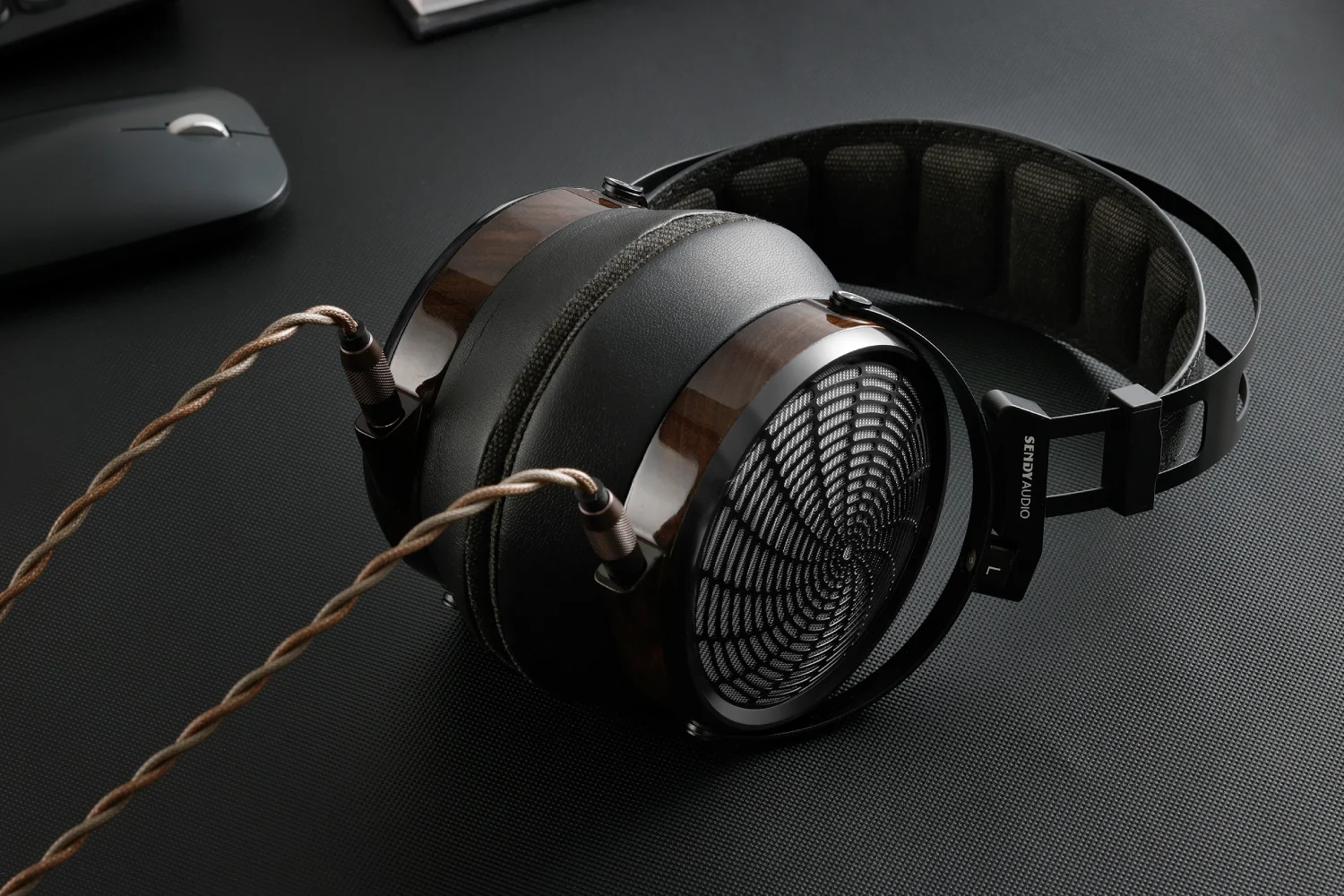
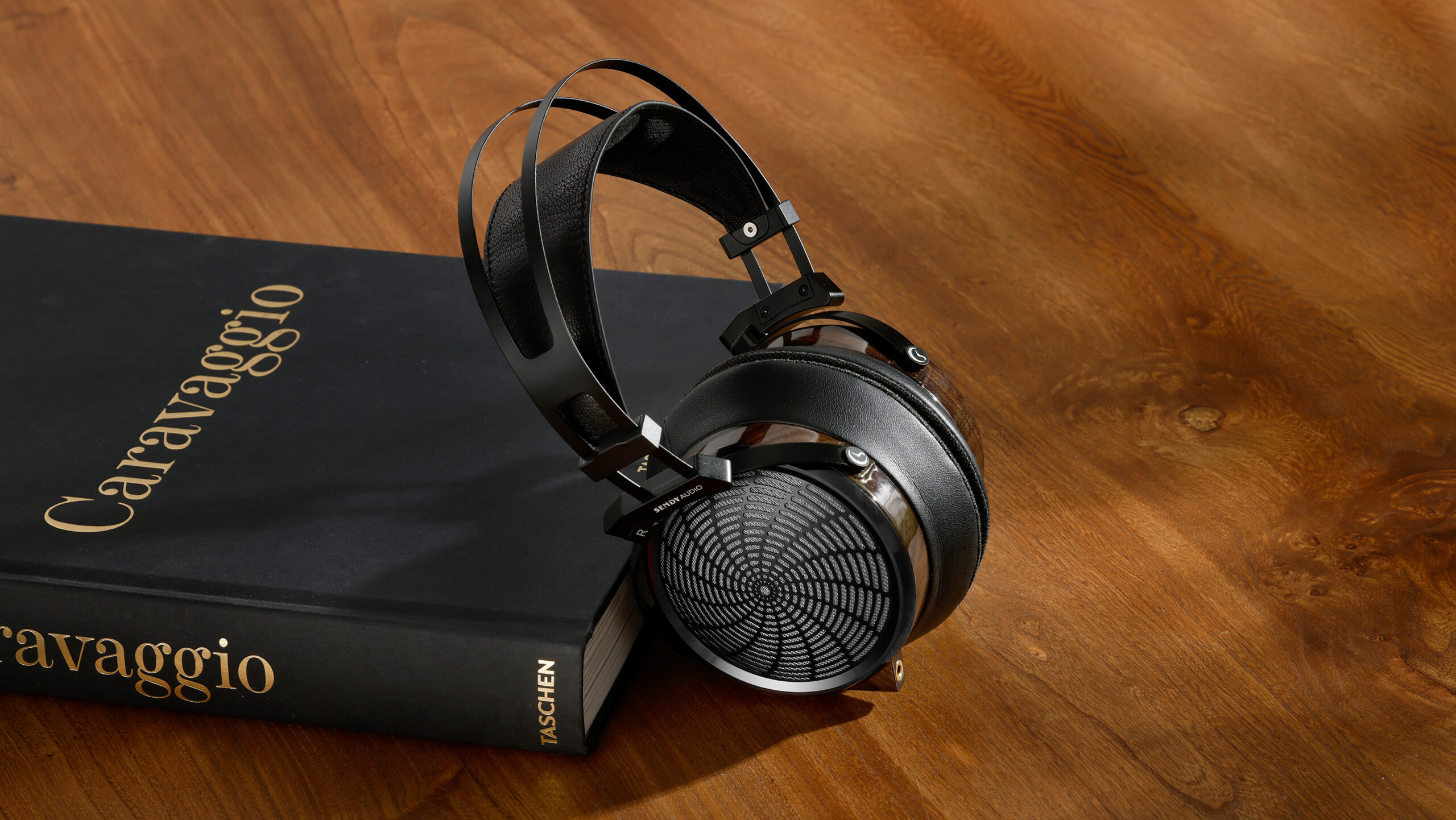
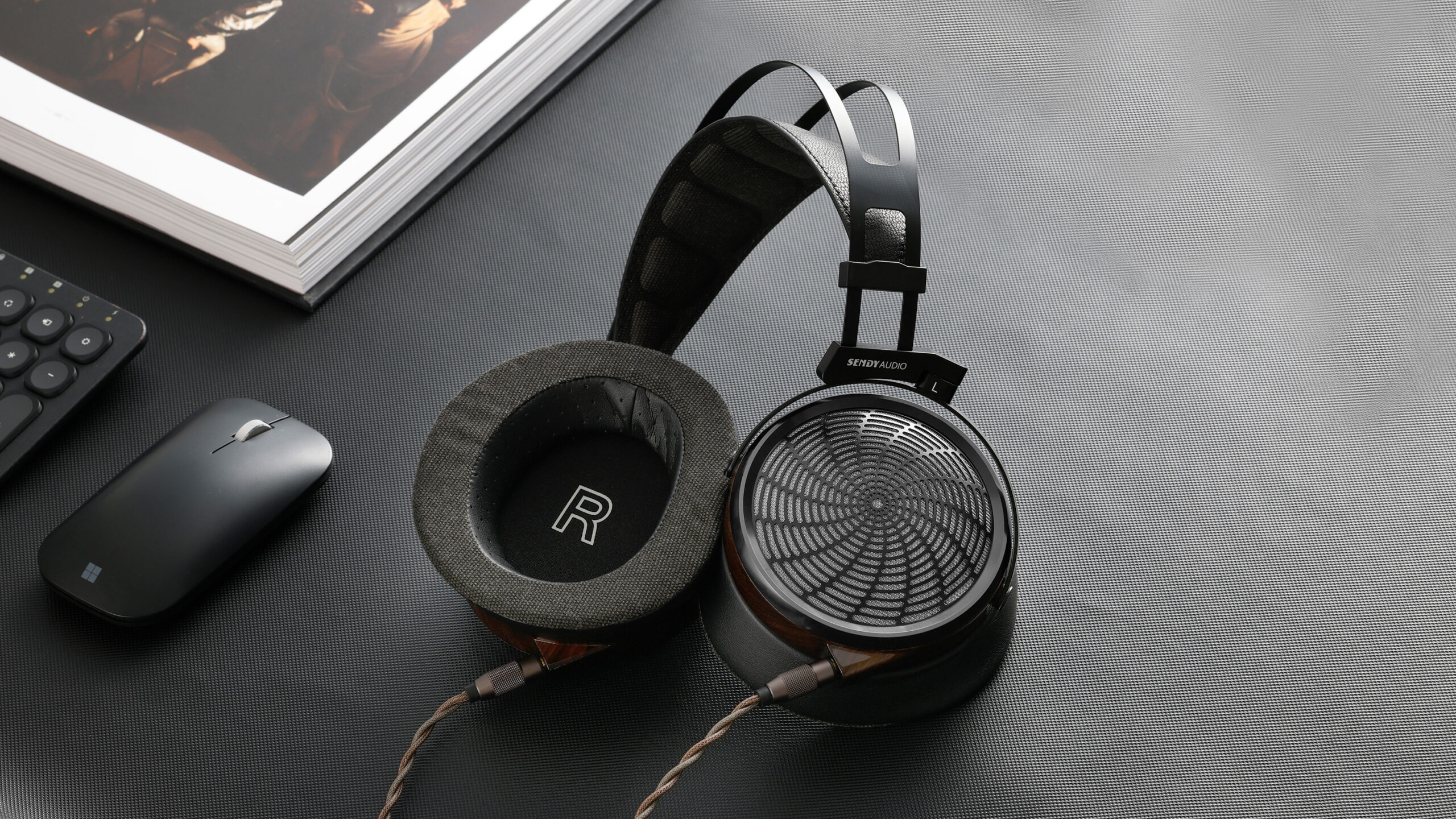
The Apollo PRO is the more traditional audiophile object. Sendy Audio uses handcrafted zebrawood earcups, a sunburst-pattern metal grille, CNC-machined aviation-grade aluminum components, a lambskin leather headband, and breathable velvet ear pads. Its open-back structure is not just visual; the source article states that it is intended to reduce internal reflections and create a more natural sense of space. At 354g, it is also presented as unusually light for a planar magnetic headphone, with an adjustable suspension system intended to distribute weight evenly.
The PX7 S2e has a different design brief. The source describes a classic, stylish minimalist build using high-quality plastic, fabric-covered cups and headband elements, eco-leather on the headband, memory-effect leather ear pads, and a metal ring around the cups. The review notes that the structure feels sturdy, with no creaking or cracking, and that the headband adjustment is smooth and tight. Four color options are listed: Anthracite-black, ocean blue, cloud gray, and forest green.
Comfort is nuanced. The PX7 S2e is lighter at 307g, but the review reports possible early fatigue after around 30 minutes during the first hours of use, possibly related to the headband width or ear-pad angle; this reportedly diminishes after a few days. The Apollo PRO source does not include hands-on impressions, but it does confirm a comfort-oriented build with low planar weight, breathable pads, and a suspension headband. Editorially, the Apollo PRO looks purpose-built for long stationary sessions, while the PX7 S2e is built around transportable daily use.
Features and connectivity: the PX7 S2e is the more complete everyday tool
This is the clearest functional split. The Apollo PRO is a wired headphone supplied with a premium detachable cable made from Furukawa oxygen-free copper, silver-plated copper conductors, enamel-coated gold-plated copper strands, and graphene-enhanced shielding. It includes a 4.4mm balanced termination as standard, with 3.5mm and 6.35mm adapters. That makes it suitable for portable players, headphone amplifiers, DACs, and desktop audio systems, according to the source.
The PX7 S2e is far more feature-heavy. It supports Bluetooth 5.2 and codecs including aptX, aptX Adaptive, aptX HD, SBC, and AAC. It has active noise cancellation, transparency mode, microphones for calls, physical button controls, a Bowers & Wilkins Music app, tone adjustment for low and high frequencies in 0.5dB steps from -6dB to +6dB, device selection, button customization, automatic shutdown, wear-sensor adjustment, renaming, and reset options.
The PX7 S2e also supports a wired connection via USB-C to 3.5mm cable, but the source makes an important ownership point: the headphone must be turned on for wired use, and the sound still passes through the built-in processing. The reviewer states there is no need to buy a DAC for them, because the wired mode is mainly another way to connect to sources without Bluetooth, such as stationary computers. By contrast, the Apollo PRO is the one that naturally belongs with dedicated wired audio hardware.
Sound and performance: confirmed listening impressions favor PX7 S2e detail; Apollo PRO claims are specification-led
The two source articles are different in nature. The Apollo PRO article reports specifications, materials, and manufacturer positioning. It says Sendy Audio’s 78mm planar magnetic driver uses an ultra-thin nano-scale composite diaphragm under 800 nanometers to reduce moving mass, with claimed benefits including faster transient response, improved detail retrieval, microdynamic performance, expansive soundstage, instrument separation, and precise imaging. It also describes an Electron Beam Evaporation Deposition process used to apply an aluminum conductive layer to the diaphragm, intended to improve consistency, reduce resonance, and support greater linearity.
Those are meaningful engineering claims, but they are not listening-test findings in the supplied source. So the safest conclusion is that the Apollo PRO is designed for the classic strengths associated with open-back planar headphones: speed, openness, and resolving ability. That is editorial inference based on the confirmed driver type and open-back architecture, plus Sendy Audio’s stated goals, not an independent audition report from the source.
The PX7 S2e article does include listening impressions. The reviewer describes the sound as balancing warmth and massiveness with emotionality and musicality. Low frequencies are noticeably emphasized, sometimes strongly, and the sound may appeal to listeners who like dominant bass. High frequencies are also accentuated and can occasionally be excessive. The midrange is described as slightly more subdued but still discernible. The app’s bass and treble controls are noted as having a significant effect, allowing users to tune the presentation.
For noise cancellation, the PX7 S2e review reports excellent passive isolation from the snug ear cushions, minimal leakage, and ANC that almost completely removes low-frequency sounds and a significant part of the mid-frequency spectrum in the reviewer’s test. The transparency mode is described as not especially high in level, though timbres are accurately conveyed and electronic processing is barely noticeable. Microphones are described as clean with minimal distortion, though slightly flat in timbre.
Use cases: home listening and spaciousness versus commuting, calls, and isolation
The Apollo PRO is the natural choice for a dedicated listening space. Its open-back design is intended to create a natural sense of space and reduce enclosure coloration. The source also positions it for music, films, and gaming where spaciousness, separation, and imaging are valued. Because it is open-back and has no stated ANC, it is not the practical option for blocking outside noise. That limitation follows directly from its architecture and feature list.
The PX7 S2e is better suited to changing environments. Its Bluetooth support, ANC, transparency mode, microphones, transport case, app controls, and 30-hour stated battery life make it much more flexible for travel, office work, phone calls, and casual listening from a phone or laptop. The source also notes that a 15-minute charge can provide up to 7 hours of operation, although the reviewer adds that real endurance depends on volume and ANC use; with noise reduction active, battery life may drop to around 20 hours.
If you listen mainly at a desk through a DAC/amp and value open presentation, the Apollo PRO’s whole design makes more sense. If you listen while moving between rooms, commuting, taking calls, or needing silence from external noise, the PX7 S2e is the more complete product.

Ownership considerations: amplification, battery, heat, and long-term practicality
The Apollo PRO has no battery to maintain, no app dependency, and no wireless codec compatibility to worry about. Its included cable and adapters cover balanced 4.4mm plus common 3.5mm and 6.35mm outputs. The confirmed price is £449 / $449 / €499. The likely ownership question is not battery life but system matching: the source says it can be used with portable players, headphone amplifiers, DACs, and desktop systems, but it does not specify sensitivity, impedance, or power requirements.
The PX7 S2e ownership experience revolves around convenience. You get a hard fabric-lined case, USB-C charging cable, USB-C to 3.5mm wired cable, and app support. Its physical controls are clearly described, and the lack of touch panels may appeal to buyers who prefer tactile operation. However, wired listening still requires the headphone to be powered on, so battery health remains relevant even if you occasionally connect by cable.
Comfort and heat may matter. The PX7 S2e review notes leather ear pads without perforations, which may make ears perspire slightly. The Apollo PRO uses breathable velvet pads and an open-back build, which suggests better ventilation, but the source does not provide a direct heat comparison or a long-term wear test.
Pros and cons
Sendy Audio Apollo PRO pros:
- Open-back planar magnetic design with large 78mm driver.
- Light for a planar headphone at 354g.
- Premium materials including zebrawood, aluminum, lambskin leather, and velvet pads.
- Detachable balanced cable included, with 3.5mm and 6.35mm adapters.
- No battery, app, or wireless compatibility concerns.
Sendy Audio Apollo PRO cons:
- No ANC, Bluetooth, microphones, or app features stated.
- Open-back design is not aimed at isolation.
- Source provides manufacturer sound claims rather than hands-on listening impressions.
- No impedance, sensitivity, or drive-power information supplied.
Bowers & Wilkins PX7 S2e pros:
- Bluetooth 5.2 with aptX family codecs, SBC, and AAC.
- ANC, transparency mode, six microphones, and call support.
- Physical controls and a useful app with bass/treble adjustment.
- About 30 hours stated battery life, with quick-charge capability.
- Strong isolation and immersive noise reduction reported in the review.
Bowers & Wilkins PX7 S2e cons:
- Wired mode still requires power and internal processing.
- ANC use and higher volume can reduce battery life.
- Leather, non-perforated pads may cause slight perspiration.
- Initial head fatigue was reported during early use.
- Sound balance may be too bass- and treble-forward for some listeners.
Who should buy each?
Buy the Sendy Audio Apollo PRO if you want a dedicated wired headphone for home or desktop listening, especially if you are attracted to planar magnetic technology but are concerned about typical planar weight. It is the better match for someone who already owns, or plans to use, a player, DAC, headphone amplifier, or desktop system and wants an open, spacious design rather than a commuting headphone.
Buy the Bowers & Wilkins PX7 S2e if you need one premium full-size headphone for everyday life: Bluetooth, ANC, calls, app control, physical buttons, a travel case, and enough battery life for long use between charges. It is also the safer option if you listen from phones, tablets, or laptops and do not want to build a separate wired headphone system.

Final verdict: two winners for two different buyers
The Apollo PRO is the more focused hi-fi headphone. Its open-back planar architecture, premium materials, supplied balanced cable, and unusually low planar weight make it the stronger choice for stationary listening where comfort, spaciousness, and wired signal paths matter most. Its main weakness is that the supplied source does not provide independent listening impressions, so its sonic promise rests on confirmed design details and manufacturer claims.
The PX7 S2e is the more versatile headphone. It cannot match the Apollo PRO’s purist wired-open-back brief, but it offers far more daily functionality: ANC, Bluetooth codecs, microphones, app tuning, quick charging, and portable accessories. It also has actual listening and usability impressions in the source, including its warm, weighty, bass-forward personality.
Decisive verdict: choose the Sendy Audio Apollo PRO for serious home listening; choose the Bowers & Wilkins PX7 S2e for travel, calls, noise cancellation, and all-purpose wireless use. If forced to pick one for most buyers, the PX7 S2e is the more practical single-headphone purchase. For a buyer building a dedicated listening setup, the Apollo PRO is the more appropriate and more specialized choice.