
A good AV receiver has to do more than switch HDMI inputs and decode surround formats.
For listeners who care about music as much as movies, the more meaningful questions are about amplification, room correction, layout flexibility, source handling, and whether the receiver has been engineered with the same seriousness normally associated with two-channel hi-fi.
The source material here includes dedicated AV receivers, brand background pieces, and closely related system components such as speakers, a compact hi-fi system, and a universal disc player. Rather than force every entry into the same role, this guide separates true receiver choices from the products and brand stories that help frame a serious home-cinema system. The strongest receiver candidates in this selection are the models with clearly stated surround processing, amplification, calibration, streaming, or installation features. The adjacent entries are still useful: speakers, disc players, and brand context can affect how an AV system is built and how confidently a buyer approaches a particular ecosystem.

1. Marantz
Marantz is presented here through its hi-fi heritage rather than a specific AV receiver model.
The Marantz article is a brand-history piece rather than a review of a specific AV receiver.
Its relevance to this guide is contextual: it describes a company with deep roots in hi-fi audio and a reputation that spans both connoisseurs and everyday listeners.
For buyers considering an AV receiver from a music-first perspective, that heritage helps explain why the name carries weight in serious-listening discussions, but the supplied material does not provide model-level AV receiver specifications or recommendations.
Best for: Brand-context research before choosing an AV receiver
- Longstanding hi-fi audio heritage
- Associated with high-quality sound reproduction
- Strong recognition among audiophiles and general listeners
Verdict: Useful as background on Marantz’s hi-fi identity, but not enough on its own to recommend a specific AV receiver model.

2. NAD T758 V3i: AV Receiver worthy of consideration
NAD T 758 V3i combines surround processing, modular architecture, and room-correction tools in a music-conscious AV receiver.
The NAD T 758 V3i is one of the clearest fits for a serious-listening AV receiver shortlist.
The source describes it as an updated model with AirPlay 2 and Siri support while retaining NAD’s “simpler is better” philosophy.
It is explicitly aimed at both home-theater users and audiophiles, with modular digital audio and video sections designed to be replaceable with newer options. Its feature set is focused on practical performance rather than specification theater. The AM230 audio module supports Dolby Atmos, DTS-HD Master Audio, and MQA processing; Speaker iQ calibration with the included microphone is intended to help the receiver adapt quickly to a room; and Dirac Live room correction adds a more advanced layer of acoustic adjustment. Power is stated as 2 x 120 W into 8 ohms in stereo or 7 x 60 W into 8 ohms with all channels driven, with the source explicitly warning against comparing those figures to inflated marketing claims from some AV receiver brands.
Best for: Music-minded home theater with upgrade-aware design
- AirPlay 2 and Siri support
- Modular digital audio and video sections
- Dolby Atmos, DTS-HD Master Audio, and MQA processing
- Speaker iQ and Dirac Live room correction
Verdict: A particularly compelling choice for buyers who want an AV receiver that treats room correction, honest amplification, and audiophile needs as central priorities.

3. Denon SC-N10: A great alternative to a soundbar
Denon SC-N10 speakers are positioned as compact living-room speakers and a soundbar alternative when paired appropriately.
The Denon SC-N10 is not an AV receiver; it is a compact speaker system intended for small living areas.
Its place in this guide is as a possible speaker partner for a modest receiver-based setup, especially where a soundbar alternative is being considered.
The source describes damped MDF cabinets in black or white, a two-way driver layout, and high sound pressure capability without noticeable distortion. The article also notes that the SC-N10 can work well with acoustic music and can be placed fairly close to a wall thanks to the rear bass-reflex port’s small diameter. Paired with a suitable subwoofer, the speakers are described as a strong soundbar alternative, which makes them relevant for buyers building a compact AV system rather than relying on an all-in-one bar.
Best for: Compact speaker pairing for a small AV setup
- Compact two-way speaker design
- Damped MDF enclosures
- Suited to small living areas
- Can be placed fairly close to a wall
Verdict: Not an AV receiver, but a relevant speaker option for listeners who want a small-room system with more traditional hi-fi structure than a soundbar.

4. Yamaha MCR-N470: A versatile compact HiFi system featuring a wide range of functions
Yamaha MCR-N470 combines a CD receiver, network playback, and matching speakers in a compact hi-fi system.
The Yamaha MCR-N470 is a compact hi-fi system rather than an AV receiver.
It combines the CRX-N470 CD receiver with Yamaha NS-BP150 speakers and offers several music sources, including CD, USB, radio, Wi-Fi, MusicCast, AirPlay, and Bluetooth.
That makes it more relevant to buyers deciding between a compact music system and a fuller AV receiver-based installation. The source emphasizes Yamaha’s hi-fi-oriented circuit approach, including short signal paths, avoidance of signal overlap interference, dedicated circuit boards for CD/DAC and network audio signal paths, and galvanic isolation between key sections. Those design points are useful if two-channel music is the priority, though the article does not describe multichannel AV receiver functions such as surround decoding or home-theater speaker layouts.
Best for: Two-channel listeners considering a compact alternative to an AV receiver
- CD, USB, radio, Wi-Fi, MusicCast, AirPlay, and Bluetooth
- Includes Yamaha NS-BP150 speakers
- Hi-fi-oriented circuit design
- Compact integrated system format
Verdict: A strong compact music-system reference, but not a substitute for a full AV receiver when surround formats and home-theater expansion are required.

5. Denon AVR-X1700H: Fully equipped seven-channel AV receiver
Denon AVR-X1700H is a seven-channel AV receiver suited to modern living-room movie and music systems.
The Denon AVR-X1700H is a true AV receiver and a practical option for buyers building a contemporary movie-and-music system.
The source presents it as a seven-channel receiver with a 7.2 configuration, Dolby Atmos and DTS:X decoding, and support for a 5.2.2 speaker layout.
That makes it suitable for a living-room system where height effects are desired without moving into a larger channel count. The article also highlights Denon’s attention to internal engineering, including work on output transistors, lower output impedance in DAC, preamplifier, and power-amplifier sections, revised capacitors, and reworked power-supply stabilizer circuits for the DAC, DSP, and HDMI board. Dolby Atmos Height Virtualization is included for adding a sense of height when physical height speakers are not used.
Best for: Balanced living-room theater with seven-channel capability
- 7.2-channel configuration
- Dolby Atmos and DTS:X decoding
- Supports 5.2.2 systems
- Dolby Atmos Height Virtualization
Verdict: A well-rounded receiver choice for buyers who want modern surround decoding, practical 5.2.2 support, and a design brief that pays attention to sound quality.

6. Integra
Integra is described through its development from higher-grade hi-fi electronics toward custom AV installation.
The Integra article is a brand and history overview, not a review of a current AV receiver model.
It explains the brand’s association with higher Onkyo hi-fi models, then with demanding home-cinema products and custom AV installation.
For AV receiver buyers, the main value is understanding Integra’s positioning: the source presents it as a name linked to installation-focused solutions and demanding sound-conscious users. Because no specific current receiver specifications are supplied in this article, it should not be used as a direct product recommendation. It is most useful when a buyer is comparing brand philosophies or working with an installer who may suggest Integra electronics for a custom environment.
Best for: Understanding an installation-focused AV receiver brand
- Associated with demanding home-cinema use
- Linked to custom AV installation
- Rooted in higher-grade hi-fi electronics
Verdict: Relevant brand context for custom-installation discussions, but the supplied material does not support a specific Integra receiver recommendation.
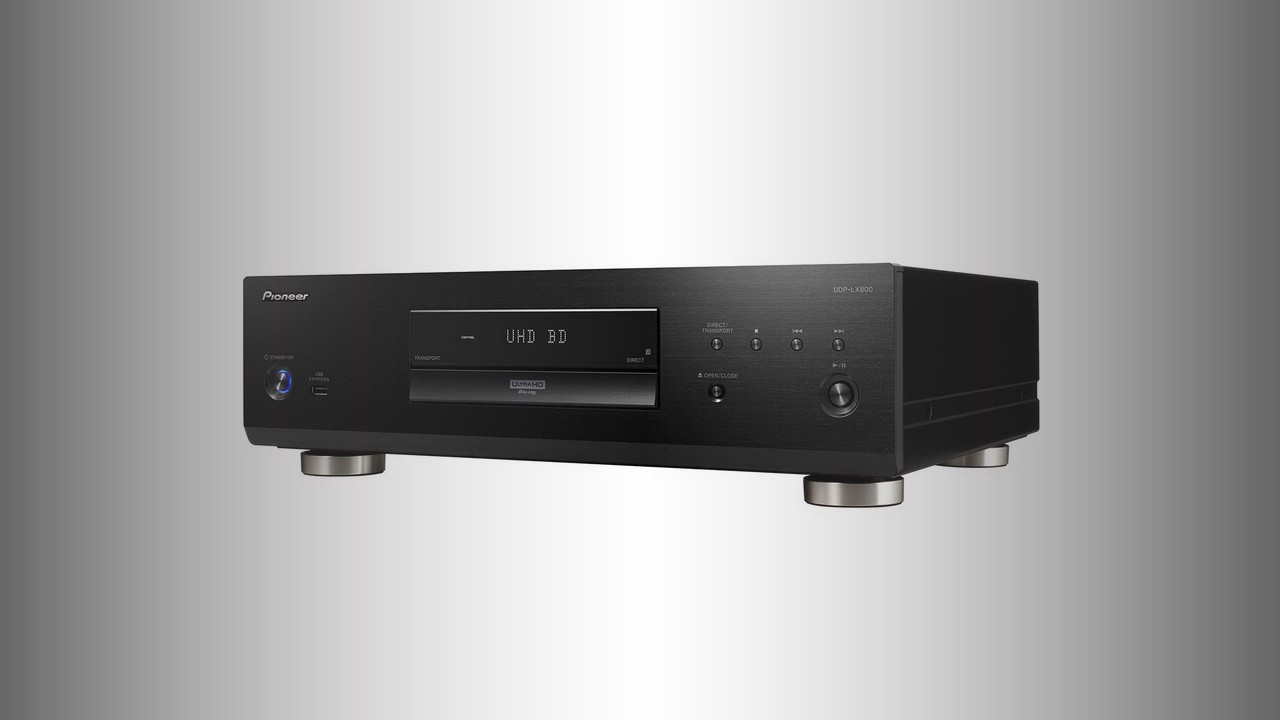
7. Pioneer UDP-LX800: Top-class universal player
Pioneer UDP-LX800 is a universal disc player designed as a high-grade source for demanding AV systems.
The Pioneer UDP-LX800 is not an AV receiver; it is a universal disc player.
Its relevance is as a premium source component for an AV receiver-based system, especially for buyers who still value physical media.
The source states that it plays CD, DVD, DVD-Audio, DVD-Video, SACD, and Ultra HD Blu-ray, while supporting Dolby Vision and HDR10. Its construction is described in unusually robust terms for a video source: a floating drive, an anti-vibration housing, a rigid internal frame divided into isolated power-supply, digital, and analog sections, and an optical drive chassis made from a thick steel plate. It also offers two HDMI outputs so video and audio streams can be transmitted separately, and PQLS is available for minimizing jitter with compatible Pioneer AV receivers.
Best for: Physical-media systems built around a capable AV receiver
- Plays CD, DVD, DVD-Audio, DVD-Video, SACD, and Ultra HD Blu-ray
- Dolby Vision and HDR10 support
- Separate HDMI outputs for video and audio
- PQLS jitter-reduction with compatible Pioneer AV receivers
Verdict: Not a receiver, but a serious source component for systems where disc playback quality and AV receiver integration matter.

8. Arcam AVR31: Powerful 7.1-channel AV receiver
Arcam AVR31 combines multichannel processing, Dirac calibration, and G-class amplification in a serious AV receiver platform.
The Arcam AVR31 is a high-end-leaning AV receiver in this selection, with the source identifying it as the most powerful model in Arcam’s updated AV receiver series.
It is a 7.1-channel receiver that supports Dolby Atmos in a 5.1.2 configuration, while 7.1.4 operation is possible with additional external power amplification.
DTS:X and IMAX Enhanced support are also stated. For serious listening, the AVR31’s strongest supplied points are its full 16-channel Dirac calibration, Direct mode for reliable stereo sound, a large toroidal transformer in the power supply, and G-class amplifier stages. Power is stated as 7 x 100 W into 8 ohms. The article also mentions streaming from a mobile device through Apple AirPlay 2 or Google Chromecast.
Best for: Ambitious theater systems with audiophile calibration priorities
- Dolby Atmos, DTS:X, and IMAX Enhanced support
- Full 16-channel Dirac calibration
- G-class amplifier stages
- Apple AirPlay 2 and Google Chromecast streaming
Verdict: A serious AV receiver for buyers who want strong room-correction capability, flexible expansion toward larger Atmos layouts, and a design with explicit stereo-listening attention.

9. Yamaha RX-A1080: High-performance AV receiver
Yamaha RX-A1080 is an Aventage AV receiver with seven-channel amplification and Yamaha’s vibration-control chassis approach.
The Yamaha RX-A1080 belongs to Yamaha’s Aventage line, which the source frames around full-bodied movie sound and accurate music reproduction.
It is a seven-channel receiver rated at 110 W per channel into 8 ohms with two channels loaded, and it can support a 5.1 system with a height channel or front-speaker bi-amping.
The supplied material places strong emphasis on mechanical and layout details. The aluminum front panel is described as helping prevent interference from entering the body, while the chassis includes Yamaha’s ART Wedge central support, intended to address vibration. The front panel also includes an HDMI input with MHL support and a USB port optimized for i-devices, reinforcing the model’s role as a full AV hub rather than only an amplifier.
Best for: Yamaha-focused systems balancing movies and music
- Seven-channel Aventage receiver design
- 110 W per channel into 8 ohms with two channels loaded
- Supports height-channel use or front-speaker bi-amping
- Aluminum front panel and ART Wedge chassis support
Verdict: A well-supported AV receiver choice for listeners drawn to Yamaha’s Aventage emphasis on movie impact, music accuracy, and vibration-conscious construction.

10. Onkyo TX-RZ30: Dolby Atmos AV receiver with 8K video support and Dirac Live
Onkyo TX-RZ30 is a 9.2-channel AV receiver with Dolby Atmos, 8K video support, and extensive streaming and control features.
The Onkyo TX-RZ30 is a midrange 9.2-channel AV receiver with a broad modern feature set.
The source states support for Dolby Atmos playback, 8K video, and Dirac Live Room Correction through a purchased license.
Power is listed at 100 W per channel with two channels driven. Connectivity and control are major strengths in the supplied article. The TX-RZ30 supports Google Assistant and Siri voice control, includes an IR remote, and can be controlled through RS232. Google Cast, AirPlay 2, and multiple streaming services are listed, while two-way Bluetooth allows both wireless headphone listening and playback from a phone or tablet. Sonos integration is also included.
Best for: Feature-rich modern theater with broad streaming and control options
- 9.2-channel AV receiver platform
- Dolby Atmos playback and 8K video support
- Dirac Live Room Correction available with license
- Google Cast, AirPlay 2, two-way Bluetooth, and Sonos integration
Verdict: A flexible AV receiver for buyers who want a high channel count, current video support, broad streaming access, and optional Dirac Live correction.
Quick comparison
The entries separate into three groups: true AV receivers, supporting source or speaker components, and brand-context articles.
The receiver models differ most clearly by channel count, calibration approach, expansion path, and streaming or control features.
The non-receiver entries should be treated as system-building context rather than direct substitutes for an AV receiver.
| Product | Best for | Verdict |
|---|---|---|
| Marantz | Brand-context research | Helpful for understanding Marantz’s hi-fi reputation, but not a model-level AV receiver recommendation. |
| NAD T758 V3i: AV Receiver worthy of consideration | Audiophile-leaning home theater | Stands out for modular architecture, AirPlay 2, honest power discussion, and Speaker iQ plus Dirac Live correction. |
| Denon SC-N10: A great alternative to a soundbar | Compact speaker matching | A small-room speaker option for traditional systems, not an AV receiver. |
| Yamaha MCR-N470: A versatile compact HiFi system featuring a wide range of functions | Compact two-channel music use | A versatile music system with CD, network, wireless, and speaker integration, but no supplied surround-receiver role. |
| Denon AVR-X1700H: Fully equipped seven-channel AV receiver | Mainstream 5.2.2 home theater | A practical seven-channel receiver with Dolby Atmos, DTS:X, and height virtualization for living-room systems. |
| Integra | Installation-brand research | Useful for understanding Integra’s custom-installation positioning, not enough for a specific product recommendation. |
| Pioneer UDP-LX800: Top-class universal player | Disc-based AV systems | A premium universal player and source component, particularly relevant with compatible Pioneer AV receivers. |
| Arcam AVR31: Powerful 7.1-channel AV receiver | Serious room-corrected theater | A powerful receiver platform with Dirac calibration, Atmos expansion potential, and G-class amplification. |
| Yamaha RX-A1080: High-performance AV receiver | Aventage movie-and-music systems | A seven-channel Yamaha receiver emphasizing accurate music reproduction, movie sound, and vibration-conscious construction. |
| Onkyo TX-RZ30: Dolby Atmos AV receiver with 8K video support and Dirac Live | Feature-heavy 9.2-channel systems | A modern receiver with high channel count, broad streaming, 8K video support, and optional Dirac Live correction. |
Frequently asked questions
Which entries here are actual AV receivers?
The NAD T 758 V3i, Denon AVR-X1700H, Arcam AVR31, Yamaha RX-A1080, and Onkyo TX-RZ30 are the dedicated AV receiver entries in the supplied material.
The Marantz and Integra pieces are brand context, while the Denon SC-N10, Yamaha MCR-N470, and Pioneer UDP-LX800 are related system components rather than AV receivers.
How should I choose between seven-channel and 9.2-channel receivers?
Start with the speaker layout you plan to run.
A seven-channel model such as the Denon AVR-X1700H can support a 5.2.2 layout, while the Onkyo TX-RZ30 is presented as a 9.2-channel receiver for larger or more flexible multichannel systems.
The Arcam AVR31 is a 7.1-channel receiver but can operate in a 7.1.4-channel mode with additional external amplification.
Is room correction important for serious listening?
It can be very important because the room strongly affects tonal balance, bass, and imaging.
The NAD T 758 V3i includes Speaker iQ and Dirac Live, the Arcam AVR31 includes full 16-channel Dirac calibration, and the Onkyo TX-RZ30 offers Dirac Live Room Correction with a purchased license.
These systems are especially relevant when speaker placement or room acoustics are not ideal.
Can an AV receiver also be a good music hub?
Yes, if its design and features support that role.
The NAD T 758 V3i is described as aimed at both home-theater lovers and audiophiles, the Yamaha RX-A1080 is framed around accurate music reproduction as well as movie sound, and the Arcam AVR31 includes Direct mode for stereo sound.
Streaming features such as AirPlay 2, Google Chromecast, Google Cast, Bluetooth, and MusicCast also matter depending on the model.
How to buy a serious-listening AV receiver from this shortlist
Begin by separating true receiver needs from supporting-system needs.
If the priority is an AV receiver, focus first on the NAD T 758 V3i, Denon AVR-X1700H, Arcam AVR31, Yamaha RX-A1080, and Onkyo TX-RZ30.
The other entries may still matter, but they answer different questions: the Pioneer UDP-LX800 is a disc source, the Denon SC-N10 is a compact speaker option, the Yamaha MCR-N470 is a compact music system, and the Marantz and Integra pieces provide brand context. For a music-conscious receiver, room correction should be high on the checklist. NAD’s combination of Speaker iQ and Dirac Live, Arcam’s full 16-channel Dirac calibration, and Onkyo’s optional Dirac Live support are all meaningful distinctions in the supplied material. If your room is difficult or your speakers cannot be placed ideally, those features may matter more than headline power claims. Next, match channel count to the system you will actually build. The Denon AVR-X1700H is a sensible fit for a 5.2.2 Dolby Atmos/DTS:X living-room system. The Yamaha RX-A1080 is a seven-channel Aventage option with support for a height-channel approach or front-speaker bi-amping. The Arcam AVR31 can move beyond its internal 7.1-channel amplification into 7.1.4 operation with external amplifiers. The Onkyo TX-RZ30’s 9.2-channel platform is the broader choice in this list for users who want more channels and a wide modern feature package. Finally, consider how you listen day to day. AirPlay 2 matters on the NAD, Arcam, and Onkyo entries. Google Chromecast or Google Cast is relevant on the Arcam and Onkyo models. The Onkyo adds extensive streaming-service support, two-way Bluetooth, voice control, RS232 control, and Sonos integration. Physical-media listeners should also think about a source such as the Pioneer UDP-LX800, especially where separate audio and video HDMI outputs or compatible Pioneer receiver integration are useful. The right receiver is the one whose channel layout, correction system, source handling, and expansion path match the room rather than simply the most feature-dense model on paper.



Sound Off
0Join the discussion if you have something to add.