

The Arcam A15 is Best Overall because it combines 80W per channel, broad analogue and digital connectivity, MM phono, Bluetooth and headphone use in one integrated amplifier.
It is the most straightforward choice for a conventional full system.
The SMSL DA-8S may be smarter for a compact, efficient and explicitly affordable setup, while the tube-focused Cayin and Ranieri reward more specialised priorities.
Best Overall: Arcam A15.
The Arcam A15 takes the top position because it is the most broadly equipped conventional integrated amplifier among these five products without becoming a specialist component that depends on other separates. Its 80W per channel into 8 ohms is documented as suitable for large floor-standing speakers as well as low-impedance bookshelf models, and it combines analogue, digital, phono, Bluetooth and headphone facilities in a single chassis. For many buyers, that breadth reduces the number of boxes and workarounds needed to build a capable system.
That verdict should not be mistaken for a blanket declaration that it is best for every listener. The five products have notably different jobs. The Cayin MT-35 Mk3 is a tube integrated amplifier with selectable operating modes. The Totaldac Amp-1-Sublime is a heavyweight power amplifier that can become a balanced monoblock. The SMSL DA-8S pursues small size and Class D efficiency. The Ranieri Varieta is a preamplifier designed for DHT tube experimentation. Each can be a more logical purchase than the Arcam when those specific requirements define the system.
Why this comparison matters
These five products do not represent five interchangeable ways of buying an amplifier. They span a full-featured integrated amplifier, a tube integrated amplifier, a compact Class D integrated amplifier, a high-output power amplifier and a tube preamplifier. That difference determines what else must be in the system before sound preference is even considered.
The practical decision is therefore not simply about output power. A buyer who needs a phono stage, digital inputs and Bluetooth has a very different brief from one assembling a separate pre/power system, seeking to use balanced monoblocks, or wanting to compare directly heated triode tubes. The A15 is the broadest conventional answer. The SMSL concentrates on small size and efficient operation. Cayin makes tube operation and selectable output modes central. Totaldac prioritises power-amplifier capability and unusually high output figures. Ranieri is a preamplifier for users whose interest is specifically in DHT tube substitution.
The rankings reflect completeness and likely applicability as an amplifier purchase based on the supplied coverage, rather than a claim that every product was auditioned together or that one circuit approach is inherently superior. A lower-ranked component can be the more suitable choice where its particular role matches the rest of the system.
Five products at a glance
The most useful way to read this ranking is from complete-system convenience toward increasingly specialised amplification. The A15 and Cayin are integrated amplifiers, so both can directly form the core of a speaker system. The SMSL is also an amplifier with volume control and speaker outputs, but it is much smaller and less extensively connected. Totaldac and Ranieri occupy separate stages of a larger system: one supplies speaker-driving power, while the other controls and conditions line-level signal.
Power figures reinforce the distinction but do not settle it alone. Totaldac’s specified output is by far the highest, particularly in monoblock mode, yet it has neither the A15’s documented phono and digital facilities nor the Cayin’s integrated tube presentation. Cayin’s 36W-per-channel ultra-linear rating, or 18W in triode mode, invites a more considered speaker pairing. SMSL specifies 80W into 4 ohms in a 1kg chassis, while Arcam specifies 80W into 8 ohms in a more fully featured 10kg integrated design. These are different packages for different priorities.
| Rank | Product | Best for | Verdict |
|---|---|---|---|
| 1 | Arcam A15 | A complete, flexible integrated system with MM vinyl, digital sources, Bluetooth and headphones. | Best Overall: the broadest documented blend of power, source connectivity and system flexibility. |
| 2 | SMSL DA-8S | Compact and explicitly affordable Class D amplification with RCA, XLR and Bluetooth. | Best Value: a small, efficient solution when minimal size and simple connectivity take priority. |
| 3 | Cayin MT-35 Mk3 | Tube-focused listeners wanting an integrated amplifier with adjustable bias and selectable modes. | The more involving tube choice, provided its stated output suits the loudspeakers. |
| 4 | Totaldac Amp-1-Sublime | High-power separate systems and users considering fully balanced monoblocks. | The output-capability leader, but it demands a separate preamplifier and a larger commitment. |
| 5 | Ranieri Audio Labs Varieta | Experienced users who want to evaluate a broad range of compatible DHT tubes. | The most specialised preamplifier and the feature winner for tube experimentation, not a standalone speaker amplifier. |
How we compared them
This comparison synthesises the supplied Stereoindex source coverage only. It is not a simultaneous head-to-head listening test, laboratory comparison or fresh hands-on evaluation. Rankings weigh the documented product role, connectivity, output capability, stated operating flexibility and suitability for a complete audio system.
Where the source provides numerical specifications, they are used to distinguish products, but numbers from unlike component categories are not treated as directly equivalent. In particular, the Ranieri Varieta is a preamplifier, not a speaker-driving integrated or power amplifier, and the Totaldac Amp-1-Sublime is a power amplifier rather than an all-in-one integrated model. Claims attributed in the source to a manufacturer are treated as manufacturer claims, not independent findings.
The Arcam A15 wins because it brings together the most broadly useful documented feature set in a genuine integrated amplifier: 80W per channel into 8 ohms, three analogue RCA inputs, MM phono, coaxial and optical digital inputs, USB, Ethernet, Bluetooth, headphone capability, trigger input and preamp output. It is therefore equipped to serve more source types and more conventional complete systems without immediately requiring additional components. Its rivals are stronger for narrower briefs. SMSL is far more compact and explicitly affordable, Cayin is the clear tube-integrated alternative, Totaldac offers vastly higher specified power in a separates system, and Ranieri is purpose-built for DHT tube exploration. None, however, matches the A15’s documented balance of speaker-driving capability, source accommodation and expansion potential in one amplifier.
The supplied source explicitly calls the SMSL DA-8S compact and affordable while documenting 2 x 80W into 4 ohms, efficiency above 92%, RCA and balanced XLR inputs, Bluetooth with aptX, and a 1kg aluminium chassis. No price is provided, so this is not a calculated price comparison; it is an award based on the source’s stated affordable positioning and its compact, functional specification.
The Varieta has the most distinctive documented feature set: compatibility with a broad list of four-pin directly heated triodes, a Rotare selector that reconfigures the circuit for the chosen tube, auto-biasing, transformer-coupled zero-feedback topology, tube-rectified linearly stabilised supply and remote control. These features are especially meaningful for its intended tube-experimentation role.
What separates these five products?
The Arcam A15 and SMSL DA-8S are the closest practical alternatives because both can directly run speakers and include Bluetooth. Arcam is the more complete hub: it adds MM phono, three RCA inputs, wired digital inputs, USB, Ethernet, a headphone output and preamp output. SMSL counters with dramatically smaller dimensions, a 1kg weight, stated efficiency above 92%, a balanced XLR input and tone adjustment. The choice is therefore completeness versus compactness, rather than a simple power contest, especially because their published power ratings are expressed into different loads.
Cayin competes with Arcam as a full integrated amplifier but changes the premise from facilities to valves. Its three RCA inputs, Bluetooth and headphone socket are sufficient for a simpler system, while its tube complement, output-tube bias adjustment and ultra-linear/triode switch give it an ownership experience that neither solid-state integrated duplicate. Its 2 x 36W ultra-linear and 2 x 18W triode ratings make speaker matching more central than with Arcam’s stated 80W into 8 ohms.
Totaldac is not a direct replacement for any of the three integrated amplifiers unless a preamplifier is already present. Its stereo and monoblock output figures are substantially greater, and its balanced monoblock option is distinctive, but it gives up integrated source management entirely. Ranieri makes the complementary point from the other direction: it is a sophisticated tube preamp, not a power stage. A system using Varieta and Totaldac could serve a highly specialised separates brief, whereas an A15, Cayin or SMSL can each make sound through speakers from connected sources in one main amplifier box.
The rankings consequently favour the product that solves the most common full-system problem with the fewest omissions. They do not deny the specialist strengths of the other four. SMSL is the sensible compact value choice, Cayin the tube integrated choice, Totaldac the high-power separates choice, and Ranieri the DHT experimentation choice.

1. Arcam A15
The Arcam A15 earns the overall win because the supplied coverage presents it as the most balanced answer to the widest range of normal amplifier requirements. It is a Class AB integrated amplifier rated at 80W per channel into 8 ohms, with Arcam positioning that extra power over the 50W A5 as useful for large floor-standing loudspeakers and low-impedance bookshelf designs. The source describes its sound as smooth and powerful, but the larger point is practical: it combines meaningful speaker-driving capability with an unusually comprehensive connection set in this five-product field.
Three analogue RCA inputs and an MM phono stage cover conventional line-level sources and a moving-magnet turntable. Two coaxial inputs and one optical input allow direct connection of a CD or Blu-ray player to the DAC, while USB and wired Ethernet are also listed. Bluetooth 5.2 supports adaptive aptX and AAC, with 24-bit high-definition streaming stated in the source, and it can connect to Bluetooth headphones. A wired headphone output, trigger input and preamp output extend its usefulness further. That means the A15 can work as a compact centrepiece today while leaving a documented route to use an external power amplifier later via its preamp output.
Against the SMSL DA-8S, the Arcam is larger, heavier and less minimalist, but it adds phono, wired digital inputs, Ethernet, a headphone output and more analogue input provision. Against the Cayin MT-35 Mk3, it provides a substantially broader documented source interface and higher stated power in its standard configuration, though it does not offer Cayin’s tube complement, tube rolling compatibility or triode mode. The Totaldac offers dramatically higher stated power, but it is a power amp and therefore requires a preamplifier. Ranieri’s Varieta is likewise complementary rather than directly substitutable: it is a DHT preamplifier and cannot drive speakers on its own.
The limitation is not a flaw so much as a boundary of its concept. Buyers pursuing tube experimentation, a pure power-amplifier stage, or the smallest possible chassis should look elsewhere. But for someone who needs one serious integrated amplifier to serve turntable, digital and wireless sources, the A15 has the most complete documented case.
Best for: Listeners building a full, flexible speaker system around one integrated amplifier, including MM vinyl, wired digital sources, Bluetooth and headphones.
- 80W per channel into 8 ohms, with source coverage identifying suitability for large floor-standing and low-impedance bookshelf speakers.
- Broad documented connectivity: three RCA inputs, MM phono, coaxial and optical digital inputs, USB, Ethernet and Bluetooth.
- Headphone output, Bluetooth headphone connection, trigger input and preamp output add system flexibility.
- Class AB design in a substantial 10kg aluminium chassis.
- Built-in phono stage is specified for MM cartridges; MC cartridges require additional amplification according to the source.
- It does not offer the tube swapping, bias adjustment or triode mode of the Cayin.
- It cannot match the Totaldac’s stated output capability in a separates system.
Our verdict: The strongest all-round choice here. Its documented mix of power, sources, phono support and expansion options makes it the least compromised starting point for a broad range of conventional hi-fi systems.

2. SMSL DA-8S
The SMSL DA-8S is the most focused alternative to the Arcam A15. It is explicitly described in the source as compact and affordable, yet it is specified at 2 x 80W into 4 ohms and 2 x 40W into 8 ohms. Its Infineon MA12070-based Class D design is claimed to exceed 92% efficiency, and the 185 x 125 x 40mm aluminium enclosure weighs only 1kg. Those facts make it a distinct proposition rather than a cut-down version of the Arcam: it is designed to deliver useful speaker power with little physical bulk and lower stated power consumption demands.
Connection provision is simple but purposeful. The DA-8S has one balanced XLR input, one single-ended RCA input and Bluetooth 5.0 with aptX support, plus speaker terminals. That XLR input is a meaningful advantage for a buyer whose source or preamplifier is balanced, whereas the supplied A15 coverage lists RCA analogue inputs rather than a balanced analogue input. Its NJW1194 volume-control chip and SDB low- and high-frequency adjustment, each spanning -10dB to +10dB, make the SMSL more adjustable in that specific tonal-control sense than the other products described here.
Its simplicity also defines its compromises. Unlike the A15, it has no documented phono input, coaxial or optical digital input, USB, Ethernet, headphone output or preamp output. The Cayin adds a headphone jack and three RCA inputs, as well as tube-specific operating choices, though it is much larger and heavier. The DA-8S is not a power-amplifier platform with the Totaldac’s capacity, nor a DHT preamplifier like the Ranieri. It is the choice for a buyer who already has suitable sources and wants amplification to occupy as little space as possible.
The source’s explicit affordable description supports its Best Value award, but no price is supplied for the DA-8S. Accordingly, this is not a price calculation against the other products; it recognises the source’s stated positioning alongside its compact design, XLR input, Bluetooth and specified power.
Best for: Space-conscious buyers seeking an explicitly affordable, efficient Class D amplifier with RCA, balanced XLR and Bluetooth inputs.
- Explicitly described as compact and affordable in the supplied source.
- Small 185 x 125 x 40mm, 1kg aluminium chassis.
- Specified at 2 x 80W into 4 ohms and efficiency above 92%.
- Offers both balanced XLR and single-ended RCA inputs, plus Bluetooth 5.0 with aptX support.
- Only one RCA and one XLR wired input are documented.
- No built-in phono stage, wired digital inputs, headphone output, Ethernet or preamp output are listed.
- Its 40W-into-8-ohm specification is below the A15’s 80W-into-8-ohm rating.
Our verdict: The compact specialist is also the evidence-based value pick. It is ideal when space, efficiency and straightforward balanced or unbalanced connectivity matter more than all-in-one source accommodation.

3. Cayin MT-35 Mk3
The Cayin MT-35 Mk3 ranks highly not because it tries to duplicate the Arcam’s all-purpose feature set, but because it offers a materially different ownership experience. This is a Class AB tube integrated amplifier using four EL34 output tubes, two per channel, alongside 12AX7/ECC83 and 12AU7/ECC82 preamp tubes. It delivers 2 x 36W in ultra-linear mode, or 2 x 18W in triode mode. The manufacturer claims triode operation gives an especially refined and pure presentation; that remains a manufacturer claim rather than an independent comparative conclusion, but the selectable modes are a real documented difference.
For the interested tube user, the details are unusually important. The illuminated front-panel VU meter doubles as a gauge for output-tube bias adjustment, each output tube can be individually adjusted, and replacement is described as straightforward. In addition to EL34 tubes, the amplifier supports 6CA7, 6L6 and 5881 types. Separate 4- and 8-ohm speaker terminals help match the amplifier to compatible loudspeakers. The tube cage is detachable, and the seven tubes remain visible when it is removed. This is plainly more involved than the solid-state Arcam or SMSL, and that involvement is a benefit only for the buyer who wants it.
It is not short on basic convenience. Three RCA line inputs, Bluetooth 5.1 and support for AAC, aptX HD and LDAC are documented, while the front-panel headphone jack accommodates 16- to 300-ohm headphones. Compared with the A15, however, Cayin lacks documented phono, coaxial, optical, USB, Ethernet, trigger and preamp-output facilities. Its stated output in ultra-linear mode is lower than the Arcam’s 80W into 8 ohms, so speaker choice deserves more attention; in triode mode, its stated output falls further to 18W per channel. In exchange, it offers tube compatibility and operational choice neither integrated rival provides.
The Totaldac is for a very different, high-power separate system, and the Ranieri goes farther into tube experimentation but is only a preamplifier. The Cayin occupies the useful middle ground: it is an all-in-one speaker amplifier with enough connectivity for a simple system, but one whose central appeal is valves rather than maximum facilities or maximum output.
Best for: Buyers who want a self-contained tube integrated amplifier, selectable ultra-linear or triode operation, and the ability to adjust and replace output tubes.
- Tube integrated architecture with four EL34 output tubes and traditional 12AX7/12AU7-family preamp tubes.
- Ultra-linear and triode modes provide documented operating choice.
- Individual output-tube bias adjustment, detachable cage and compatibility with several output-tube types.
- Three RCA inputs, Bluetooth 5.1 with AAC, aptX HD and LDAC, plus a front headphone jack.
- Specified output is 2 x 36W in ultra-linear mode and 2 x 18W in triode mode, demanding more careful speaker matching than the A15 or Totaldac.
- No phono input, wired digital inputs, Ethernet, USB or preamp output are documented.
- Tube adjustment and replacement are part of ownership, which will not suit every buyer.
Our verdict: A compelling specialist integrated amplifier for the listener who actively wants tube ownership and selectable operating modes. It is less universal than the A15, but potentially the better fit when those tube-specific qualities are the purpose of the purchase.
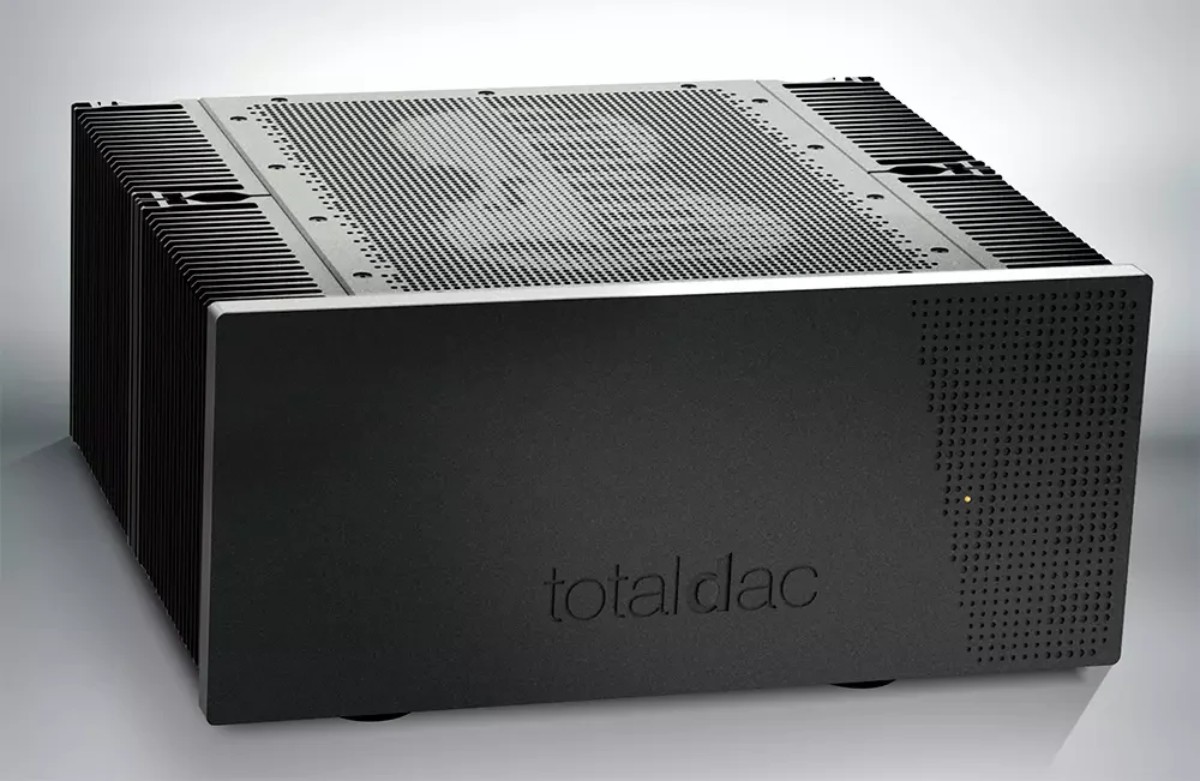
4. Totaldac Amp-1-Sublime
The Totaldac Amp-1-Sublime is the most physically and electrically imposing speaker-driving component in this comparison, but it must be assessed in its proper role. It is a transistor power amplifier, not an integrated amplifier. In stereo operation it is rated at 2 x 150W into 8 ohms, 2 x 300W into 4 ohms and 2 x 500W into 2 ohms. Used as a fully balanced monoblock, the stated ratings rise to 600W into 8 ohms and 1,000W into 4 ohms. Those figures place it in a different output category from the Arcam, Cayin and SMSL.
The source describes a 2,500VA power transformer and an ability to deliver high load current. It also lists a 33dB gain figure, 0.2mV noise, 0.06Hz-to-400kHz bandwidth at -3dB, and a circuit using Vishay Bulk Metal foil resistors with 0.01% resistance accuracy. Its design avoids common negative feedback, and it has a gain stage followed by a powerful transistor buffer. These are significant published design details, although they do not by themselves establish how it will sound in every system.
Its functional distinction is stereo or monoblock use. In stereo it accepts unbalanced RCA inputs; in fully balanced monoblock mode it uses an XLR input. This offers a clear route for a serious separates system and for users contemplating a pair of amplifiers. Yet it also creates the reason it ranks below the integrated products for general buying advice. It supplies no documented source switching, volume control, phono stage, Bluetooth, headphone socket or digital input. A separate preamplifier is required, which could be the Ranieri Varieta or another suitable unit.
For buyers who need substantial output and the flexibility to move toward balanced monoblocks, the Totaldac may be a better answer than the Arcam, SMSL or Cayin despite this overall ranking. The supplied source also gives a European price of 26,000 euros, but there is no comparable price information for most other products here, so no cross-product value conclusion is drawn from it. Its 54kg weight and 483 x 230 x 453mm dimensions also make it a component requiring deliberate installation planning.
Best for: Experienced separates-system builders who need a dedicated high-power transistor amplifier and may use fully balanced monoblocks.
- Highest stated output capability in this group: up to 2 x 500W into 2 ohms in stereo, or 1,000W into 4 ohms as a monoblock.
- Can operate as an RCA-input stereo amplifier or fully balanced XLR-input monoblock.
- Documented 2,500VA transformer, high-current capability, low stated noise and wide specified bandwidth.
- Uses published specialist circuit and component details, including no common negative feedback and Vishay foil resistors.
- A power amplifier only; it requires a separate preamplifier and source infrastructure.
- No documented volume control, phono stage, wireless facility, headphone output or source switching.
- Large and heavy at 54kg, with a published European price of 26,000 euros.
Our verdict: The right choice when the goal is not a convenient integrated amplifier but a high-output separates system. It is more capable on specified power than the integrated models, while being far less self-contained.

5. Ranieri Audio Labs Varieta
The Ranieri Audio Labs Varieta comes fifth only because it is the least directly comparable product here, not because it is a lesser expression of its own purpose. It is a directly heated triode vacuum-tube preamplifier, so it does not drive loudspeakers and must be paired with a power amplifier. For the right experienced user, its specialisation is unusually deep: it accepts a broad range of four-pin triodes including 300B, 2A3/6A3, 12A/201A, 26, 30, 31, 45, 50, 71A, 801A/10Y, 275A/252A, 245 and 842/VT52.
The central feature is the top-mounted Rotare selector. Rather than requiring manual recalibration or circuit modification when changing tube families, this mechanical dial selects the installed tube type and reconfigures the circuit accordingly. The source says electrical parameters are automatically adjusted to match the tube’s requirements. Auto-biasing removes manual bias adjustment, while the two-stage, zero-feedback topology has transformer-coupled outputs. The power supply is tube-rectified and linearly stabilised. Lundahl transformers, Caddock resistors, Alps potentiometers and WIMA capacitors are among the named components, and a remote provides basic operational control.
This feature set earns Best Features because it is the most distinctive and clearly documented operational toolkit in the group: the Varieta is built to make systematic comparison of many DHT types possible within one preamplifier. It is a more specialised type of flexibility than the A15’s broad connectivity, the Cayin’s output-tube compatibility, the SMSL’s compact Class D format or the Totaldac’s stereo/monoblock configuration.
Its limitation is fundamental. Unlike Arcam, Cayin and SMSL, it is not an integrated amplifier and cannot form a speaker system by itself. Unlike the Totaldac, it is not a power amplifier. It makes most sense paired with a suitable power amplifier, potentially including the Totaldac in a separates system, and in the hands of users who understand tube behaviour well enough to gain meaningful benefit from the extensive compatibility. For most buyers seeking a single amplifier to add to a system, the A15, SMSL or Cayin will be more direct solutions.
Best for: Experienced tube enthusiasts and builders assembling a separate system specifically to compare compatible directly heated triode tubes.
- Supports an extensive documented list of four-pin DHT tube types.
- Rotare mechanical selector reconfigures the circuit for the selected tube type.
- Auto-biasing eliminates manual bias adjustment when changing supported tubes.
- Zero-feedback, transformer-coupled two-stage topology, tube rectification and linearly stabilised power supply are documented.
- It is a preamplifier, not a speaker amplifier; a separate power amplifier is essential.
- The source explicitly positions it for experienced listeners and builders familiar with tube characteristics.
- Its specialist tube focus does not replace the everyday input, phono, digital or wireless convenience offered by the A15.
Our verdict: An outstandingly focused platform for DHT tube experimentation rather than a general integrated-amplifier recommendation. It becomes the most interesting option only after the buyer has committed to a suitable separate power amplifier and to tube exploration itself.
Which one should you choose?
Choose the Arcam A15 if you want one conventional integrated amplifier to anchor a varied system. Its 80W-per-channel rating into 8 ohms, three RCA inputs, MM phono stage, digital inputs, Bluetooth, headphone output, Ethernet and preamp output give it the widest documented spread of everyday facilities in this group.
Choose the SMSL DA-8S if compact dimensions, high stated efficiency and a simple combination of RCA, balanced XLR and Bluetooth inputs matter more than a built-in phono stage or digital wired inputs. It is also the only source explicitly described as affordable.
Choose the Cayin MT-35 Mk3 if a tube integrated amplifier, visible tube hardware, user-adjustable output-tube bias and a choice between ultra-linear and triode operation are central to the appeal. It needs sympathetic speaker matching because its stated power is lower than the Arcam’s and far below the Totaldac’s specified output.
Choose the Totaldac Amp-1-Sublime when you are building a separates system and specifically need a power amplifier with substantial specified power, high-current capability and the option to use it as a fully balanced monoblock. It is not a substitute for an integrated amplifier because a separate preamplifier and source connectivity are required.
Choose the Ranieri Audio Labs Varieta when the system already includes a power amplifier and the aim is to explore a wide range of four-pin directly heated triodes. Its Rotare selector and auto-biasing are aimed at making that specialist process more manageable, not at replacing an integrated amplifier.
Which one is best?
Arcam A15 is our Best Overall choice.
The Arcam A15 wins because it brings together the most broadly useful documented feature set in a genuine integrated amplifier: 80W per channel into 8 ohms, three analogue RCA inputs, MM phono, coaxial and optical digital inputs, USB, Ethernet, Bluetooth, headphone capability, trigger input and preamp output. It is therefore equipped to serve more source types and more conventional complete systems without immediately requiring additional components.
Its rivals are stronger for narrower briefs. SMSL is far more compact and explicitly affordable, Cayin is the clear tube-integrated alternative, Totaldac offers vastly higher specified power in a separates system, and Ranieri is purpose-built for DHT tube exploration. None, however, matches the A15’s documented balance of speaker-driving capability, source accommodation and expansion potential in one amplifier.
Frequently asked questions
Which product is the best all-in-one amplifier in this comparison?
The Arcam A15 is the best all-in-one choice on the supplied evidence.
It is the most comprehensively connected integrated amplifier here, combining 80W per channel into 8 ohms with MM phono, multiple analogue and digital inputs, Bluetooth, headphone facilities, Ethernet and a preamp output.
Cayin is also an integrated amplifier, but its documented focus is tube operation rather than the same breadth of source connectivity.
Can the Totaldac Amp-1-Sublime or Ranieri Varieta be used alone with speakers?
The Totaldac Amp-1-Sublime can drive speakers because it is a power amplifier, but it needs a separate preamplifier for volume control and source management.
The Ranieri Varieta is itself a preamplifier and cannot drive speakers on its own; it requires a separate power amplifier.
They can therefore belong in the same separates system, but neither offers the self-contained operation of the Arcam, Cayin or SMSL.
Which amplifier is most suitable for a turntable?
The Arcam A15 is the clearest choice if the turntable uses a moving-magnet cartridge, because it has a built-in MM phono stage.
The source explains that moving-coil cartridges usually have lower output and require additional amplification, so the A15’s stated MM stage should not be assumed to support MC cartridges directly.
No phono stage is documented for the Cayin, SMSL, Totaldac or Ranieri.
Which option is best for tube rolling and tube experimentation?
The Ranieri Varieta is the specialist choice for broad directly heated triode experimentation.
It supports numerous four-pin DHT types and uses its Rotare selector and auto-biasing to simplify tube changes.
The Cayin MT-35 Mk3 also supports replacement of its EL34 output tubes with compatible 6CA7, 6L6 or 5881 types, but it is a tube integrated amplifier with a narrower stated tube family and a different purpose.

Join the discussion
Share your thoughts, listening impressions or product experience.