

Choosing speakers is not simply a matter of finding the largest cabinet or the longest specification sheet.
Room size, placement, amplification and intended use all shape the right decision, while unconventional products can solve problems that a traditional pair of floorstanders cannot.
This selection spans slim passive speakers, ambitious flagship designs, modular monitors, an all-in-one wireless system, a soundbar and dedicated bass upgrades. It also includes two useful background articles: one explores PSB’s approach to natural sound, while the other examines the disputed subject of equipment warm-up. The entries are not directly comparable and should not be treated as a performance ranking. Instead, each highlights a distinct design idea or practical use case supported by the supplied source material.

1. AudioSolutions Figaro MK2 speakers will be at the High End Show in Munich
The AudioSolutions Figaro MK2 retains the original cabinet proportions while introducing a modernized exterior and a studded outrigger base.
The second-generation AudioSolutions Figaro keeps the proportions of the original while adopting a more modern appearance and a revised cabinet design.
Its practical and electrical updates include a studded outrigger base for greater stability and reduced contact with the supporting surface, substantially upgraded crossovers, larger-section conductors in the air-core inductors and a new PCB layout with shorter signal paths.
WBT Next-Gen screw terminals are retained.
Best for: Listeners considering an extensively revised passive floorstander
- More stable outrigger base
- Shorter crossover signal paths
- Upgraded air-core inductors
- WBT Next-Gen terminals
Verdict: The Figaro MK2 is a meaningful second-generation update focused on cabinet construction, stability and crossover refinement rather than a simple cosmetic refresh.

2. DALI OBERON 5: Slim Floorstanding Speakers with Big Hi-Fi Sound
The slim DALI OBERON 5 uses twin wood-fibre bass and midrange drivers, a soft-dome tweeter and a stabilizing aluminum base.
DALI’s OBERON 5 is a compact floorstander intended to provide full-range hi-fi presentation without dominating a living space.
It combines two 5.25-inch wood-fibre bass and midrange drivers with a lightweight soft-dome tweeter, while its slim cabinet and aluminum base make placement relatively straightforward.
Rubber feet and metal spikes are supplied for different flooring, and the choice of four finishes broadens its interior appeal. The source also presents it as suitable for both music systems and home cinema installations.
Best for: Smaller rooms and shared living spaces
- Slim floorstanding cabinet
- Twin 5.25-inch wood-fibre drivers
- Rubber feet and metal spikes included
- Four finish options
Verdict: The OBERON 5 is the most conventional all-rounder here, combining floorstanding scale with a modest footprint and practical placement options.

3. PSB Speakers celebrates 50th anniversary with documentary
PSB founder Paul Barton is the central figure in a documentary tracing the company’s history and natural-sound philosophy.
This is background viewing rather than a speaker recommendation, but it offers useful context for anyone interested in how loudspeaker philosophies develop.
The 20-minute documentary follows founder Paul Barton and PSB’s commitment to natural sound, including the origins of the company and the formation of the idea commonly described as Canadian sound.
It also touches on Barton’s involvement with Canada’s National Research Council and notable PSB models.
Best for: Readers interested in loudspeaker history and design philosophy
- Explains PSB’s natural-sound philosophy
- Includes founder Paul Barton’s perspective
- Covers the origins of Canadian sound
Verdict: PSB’s documentary is a concise introduction to the people, research culture and ideas behind the brand rather than a guide to one current speaker.

4. Audiovector unveils an updated audiophile QR Special Edition series
Audiovector’s QR Special Edition speakers combine AMT tweeters, aluminum sandwich cones and rounded, damped HDF cabinets.
Audiovector’s QR Special Edition range revises its predecessors through changes to the drivers, crossovers, cabinets and bass-reflex system.
The source identifies low-hysteresis coils, stronger magnets, turbulence-controlling baskets and aluminum sandwich cones among the technical elements.
Its AMT tweeters are specified to extend to 40,000 Hz, while the cabinets use rounded HDF panels and additional damping. Golden brass plates and fabric grilles provide the series with distinct visual detailing.
Best for: Audiophiles comparing an updated multi-model speaker range
- Revised drivers and crossovers
- AMT tweeter design
- Damped HDF cabinets
- Improved bass-reflex damping
Verdict: The QR Special Edition series combines broad engineering revisions with recognizable design details, although individual models still need to be assessed for room and system suitability.

5. Bang & Olufsen BeoPlay A9: A masterpiece in terms of design and sound
The circular Bang & Olufsen BeoPlay A9 can stand on removable wooden legs or be installed on a wall.
The BeoPlay A9 approaches the speaker as both an audio system and a prominent interior object.
Its circular enclosure can stand on removable wooden legs or be mounted on a wall, while interchangeable color panels allow its appearance to be altered.
The source specifies 320 watts of output, AirPlay wireless playback and wired AUX, Ethernet and USB connections. Its cable and connector area is concealed to preserve the clean presentation.
Best for: Design-led rooms needing a self-contained audio system
- Floor-standing or wall-mounted installation
- Interchangeable color panels
- AirPlay and wired connectivity
- Concealed connector area
Verdict: The BeoPlay A9 stands apart as a flexible all-in-one design for listeners who value visual integration as much as conventional speaker placement.

6. Warming up audio equipment: Advantages and disadvantages
The warm-up guide considers why speakers, amplifiers, cables and electronic components may not settle on the same timetable.
This explanatory article addresses the disagreement surrounding equipment warm-up and break-in without pretending that every component behaves identically.
It distinguishes the short period before listening from longer-term break-in and notes that cables, speakers, amplifiers, passive circuits and semiconductor components are unlikely to share one universal schedule.
Its most practical lesson is to avoid definitive conclusions based on the first few minutes with an unfamiliar system while remaining cautious about sweeping claims.
Best for: Listeners evaluating new or unfamiliar equipment
- Distinguishes warm-up from break-in
- Recognizes differences between components
- Encourages caution with first impressions
Verdict: This is a useful reminder that initial listening impressions deserve context, but it does not support a single warm-up rule for every audio product.
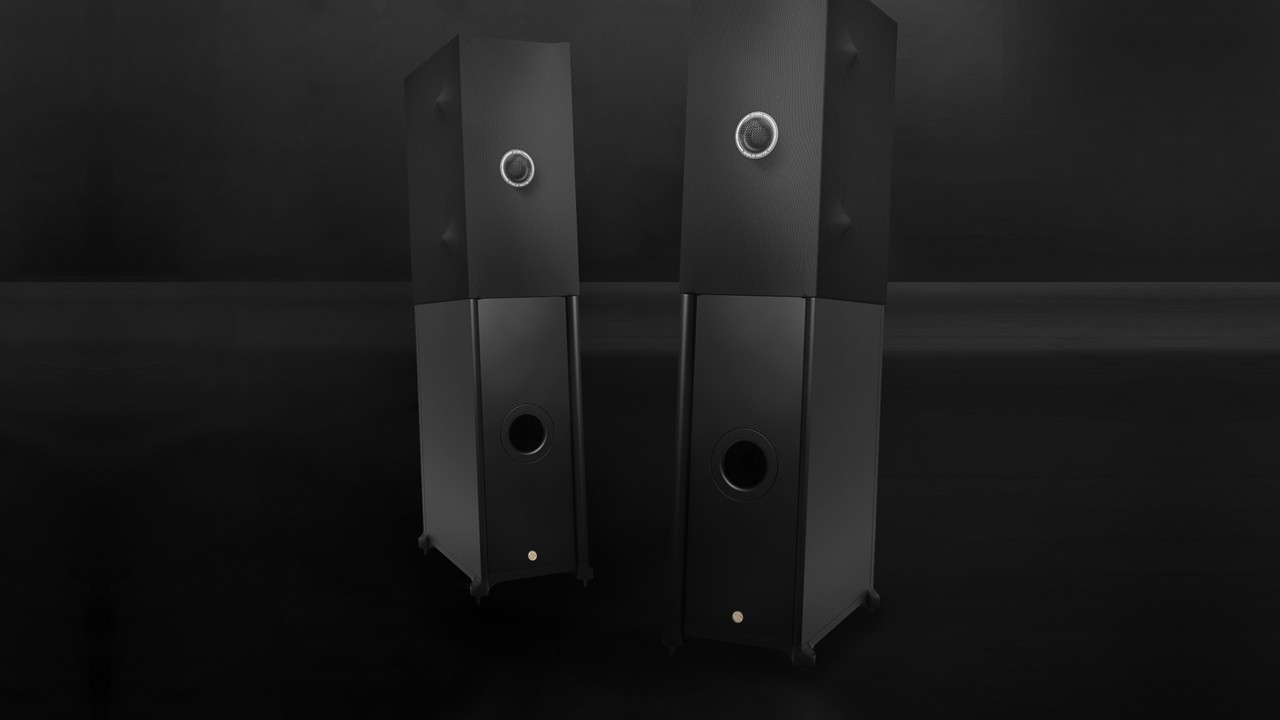
7. Gold Note Diana: Beautiful modular speaker system from Italy
Gold Note’s modular Diana system pairs a passive two-way monitor with the matching Diana III-F floorstanding bass section.
Gold Note’s Diana range is built around two passive two-way monitors and a matching passive floorstanding bass module.
Diana I uses one 6.5-inch glass-fibre midrange driver and is rated at 88 dB sensitivity, while Diana II adds a second midrange driver and raises the stated sensitivity to 91 dB; both use a 1.1-inch silk-dome tweeter.
Either monitor can be placed on the Diana III-F, whose 6.5-inch glass-fibre driver handles low frequencies. Recycled fabric derived from race-car seat material is laminated over internal foam damping to form a durable exterior.
Best for: Listeners who want a passive system that can grow modularly
- Modular monitor and bass-module format
- Two monitor configurations
- Silk-dome tweeters
- Durable recycled-fabric covering
Verdict: The Diana family offers an unusual route from standmount-style listening to a visually integrated full-height passive system.

8. MoFi SourcePoint V10 Master Edition: Flagship 3-Way Speaker by Andrew Jones
The MoFi SourcePoint V10 Master Edition uses five 10-inch elements, including a concentric driver, two woofers and two rear passive radiators.
Designed by Andrew Jones, the SourcePoint V10 Master Edition develops MoFi’s SourcePoint concept into a large three-way floorstander.
It combines a dedicated 10-inch concentric midrange and high-frequency driver with two 10-inch woofers and two rear-firing 10-inch passive radiators.
Separating the bass from the concentric driver is intended to reduce its workload and preserve midrange and treble clarity. A three-position adjustment allows high-frequency output to be tailored to room acoustics or listener preference, while MoFi states a frequency range of 27 Hz to 30 kHz.
Best for: Large-scale systems requiring substantial bass architecture
- Dedicated concentric midrange and treble driver
- Twin 10-inch woofers
- Twin rear passive radiators
- Three-position high-frequency adjustment
Verdict: The SourcePoint V10 Master Edition is the most ambitious conventional floorstander in the selection, with extensive bass hardware and useful high-frequency adjustment.

9. Harbeth Nelson: Speaker stands with active subwoofers
Harbeth Nelson units serve as both stands and active subwoofers for P3 and BBC LS3/5A-format monitors.
Harbeth’s Nelson combines the physical role of a speaker stand with an active bass system for the company’s P3 monitors and BBC LS3/5A designs.
Each unit contains an 11 cm Harbeth-made woofer and a 50-watt amplifier, with level control provided to help match the bass to the monitor.
The manufacturer states that the system extends the operating range to 35 Hz at minus 3 dB. Nelson units use external 24-volt power supplies, connect in parallel with the monitors and are supplied as a pair.
Best for: Compatible compact monitors needing integrated bass support
- Combines speaker stand and subwoofer
- Adjustable bass level
- Designed for P3 and LS3/5A monitors
- Supplied as a stereo pair
Verdict: Nelson is a specialized but elegant solution for adding active low-frequency support without placing separate subwoofer boxes elsewhere in the room.

10. Majority Teton Plus: Powerful bluetooth soundbar with wireless subwoofer
The Majority Teton Plus pairs a 2.1-channel soundbar with an external wireless 5.25-inch subwoofer.
The Majority Teton Plus is a 2.1-channel soundbar package aimed at television, film, music and game playback.
It combines a soundbar with an external wireless 5.25-inch subwoofer and has a stated total output of 180 watts.
Sound can be adjusted through EQ controls on the supplied remote. Bluetooth and HDMI ARC cover common wireless and television connections, with USB, optical and AUX inputs available for additional sources.
Best for: Television systems needing a simple bass-equipped audio upgrade
- Wireless 5.25-inch subwoofer
- HDMI ARC and Bluetooth
- USB, optical and AUX inputs
- Remote-controlled EQ
Verdict: The Teton Plus is the practical television-focused option, offering broad connectivity and a separate wireless subwoofer in a straightforward 2.1-channel package.
Frequently asked questions
Should I choose floorstanding speakers or compact monitors?
Floorstanders such as the DALI OBERON 5 place more cabinet volume and drivers in one enclosure, but slim dimensions do not eliminate the need for careful positioning.
Compact monitors can suit tighter spaces, while modular options such as the Gold Note Diana system or Harbeth Nelson stands provide a route to additional bass without replacing the main speakers.
Do passive speakers need a separate amplifier?
Yes.
Conventional passive models require compatible amplification, and every Gold Note Diana component is explicitly passive despite the III-F handling bass duties.
By contrast, the BeoPlay A9 is a self-contained system, the Majority Teton Plus includes powered electronics, and Harbeth Nelson places a 50-watt amplifier inside each bass stand.
How should room placement influence the choice?
Consider cabinet size, distance from walls, floor type and the space available around each speaker.
The OBERON 5 includes both rubber feet and spikes, the Figaro MK2 uses outriggers for stability, and the SourcePoint V10 offers a three-position high-frequency adjustment to help accommodate room acoustics and listening preference.
Must new speakers be broken in before they can be judged?
There is no single timetable supported here for every speaker or component.
Warm-up and longer-term break-in are different ideas, and mechanical, passive and electronic parts may behave differently.
Avoid treating the first few minutes as definitive, but also be cautious of universal break-in claims.
How to Choose From This Speaker Shortlist
Begin with the system format rather than a preferred brand.
For a traditional stereo setup, decide whether the room can accommodate a floorstander such as the DALI OBERON 5, AudioSolutions Figaro MK2 or MoFi SourcePoint V10 Master Edition.
The available space, distance from nearby walls, floor construction and amplifier compatibility matter more than cabinet appearance alone. Compact-speaker owners should think carefully about bass integration. Gold Note’s Diana concept offers a passive modular path, while Harbeth Nelson is a highly specific active solution designed to support compatible P3 and LS3/5A monitors. Confirm whether a bass component is active or passive before budgeting, because a passive module still depends on external amplification. If simplicity and visual integration come first, the BeoPlay A9 and Majority Teton Plus address very different needs. The A9 is a design-led all-in-one system with floor and wall installation options, whereas the Teton Plus is primarily a television-oriented soundbar package with a wireless subwoofer and HDMI ARC. Neither should be compared directly with a passive stereo pair without first deciding how the system will be used. Finally, treat manufacturer specifications and launch descriptions as a starting point. Check dimensions, connection requirements and placement constraints, then assess how the chosen design fits the room and existing equipment. Allow unfamiliar components time to stabilize before making firm judgments, but do not assume that every product requires the same warm-up or break-in routine.



Join the discussion
Share your thoughts, listening impressions or product experience.