Musical Fidelity B1xi: A Modern Integrated Amplifier with Classic Priorities
The Musical Fidelity B1xi combines a Class AB amplifier, MM phono stage, digital inputs, HDMI ARC, Bluetooth, headphone output, and flexible analog connectivity in a deliberately non-streaming integrated design.
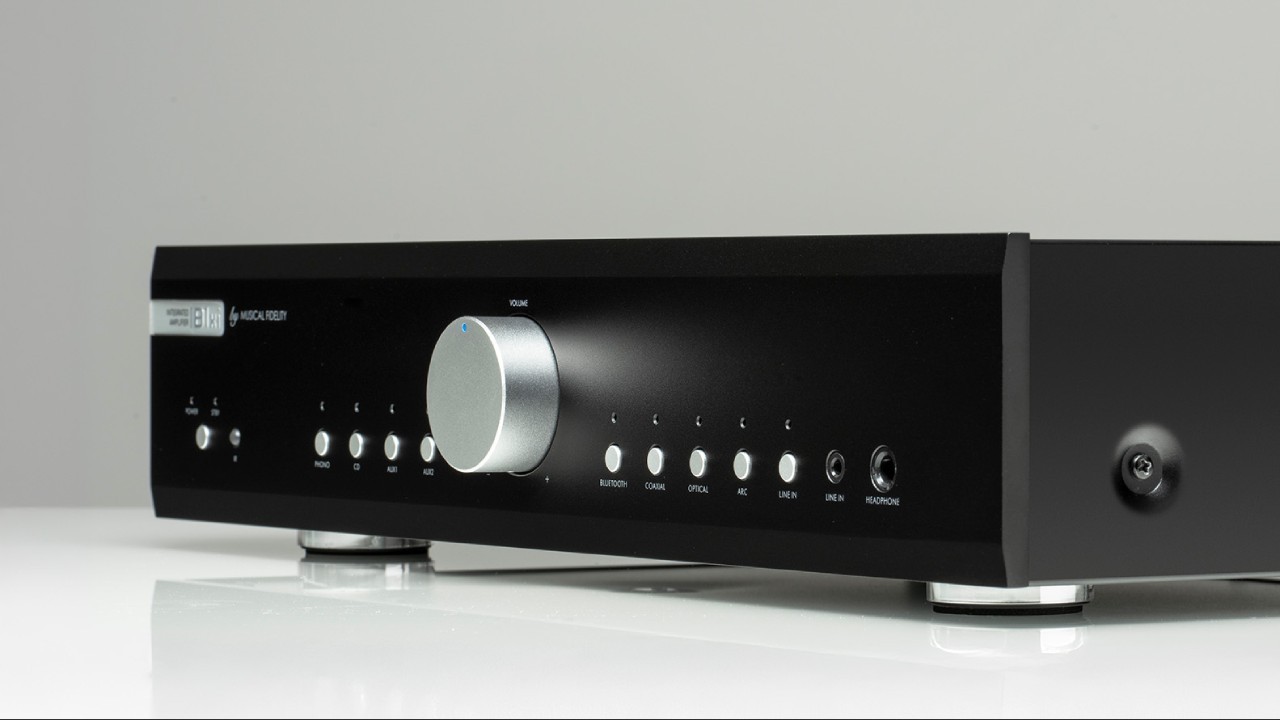
The Musical Fidelity B1xi is an integrated amplifier built around a familiar hi-fi idea: put the amplifier first, provide enough inputs for a modern system, and avoid features that may age faster than the core audio hardware. Presented as a successor in spirit to the company’s B1 amplifier from the 1990s, the B1xi brings Class AB amplification, analog and digital connectivity, and practical system expansion options into a full-width component aimed at listeners who want a conventional stereo amplifier with contemporary convenience. Its appeal lies not in being an all-in-one network hub, but in combining useful everyday inputs with a more traditional amplifier architecture and a stated emphasis on long service life.
A Class AB Integrated Amplifier with a Traditional Hi-Fi Core
At the center of the B1xi is a fully discrete, transistor-based Class AB amplifier design. Musical Fidelity positions the amplifier as part of its B-series approach: a more accessible route into the company’s design philosophy, while retaining the kind of architecture associated with dedicated stereo amplification. The rated output is 60 watts into eight ohms, increasing to 100 watts into four ohms and 140 watts into two ohms. Those figures matter because they suggest the amplifier has been specified to cope with speakers of varying electrical demands, rather than being limited to only the easiest loads.
For a prospective owner, this makes the B1xi a practical candidate for systems where speaker choice may change over time. A 60-watt integrated amplifier is not automatically defined by that single eight-ohm number; the way output changes into lower impedances can be equally important when considering real loudspeakers. The published figures indicate that Musical Fidelity has designed the B1xi with useful current delivery in mind, and the company also references peak headroom and dynamic range as part of the amplifier’s operating character. Without making listening claims, the documented specification points toward an amplifier intended to be more than a minimal desktop unit or convenience-only component.
The amplifier’s stated distortion and noise figures further underline its conventional hi-fi priorities. Musical Fidelity specifies THD+N of less than 0.02 percent across 20 Hz to 20 kHz, an A-weighted signal-to-noise ratio above 100 dB, and a frequency response of 10 Hz to 30 kHz at +0/-3 dB. These are the kinds of baseline engineering details that help define the product as a serious stereo amplifier rather than simply a lifestyle connectivity box. They do not predict system synergy by themselves, but they provide useful context for how the B1xi has been specified.

Separated Circuitry and Power Supplies
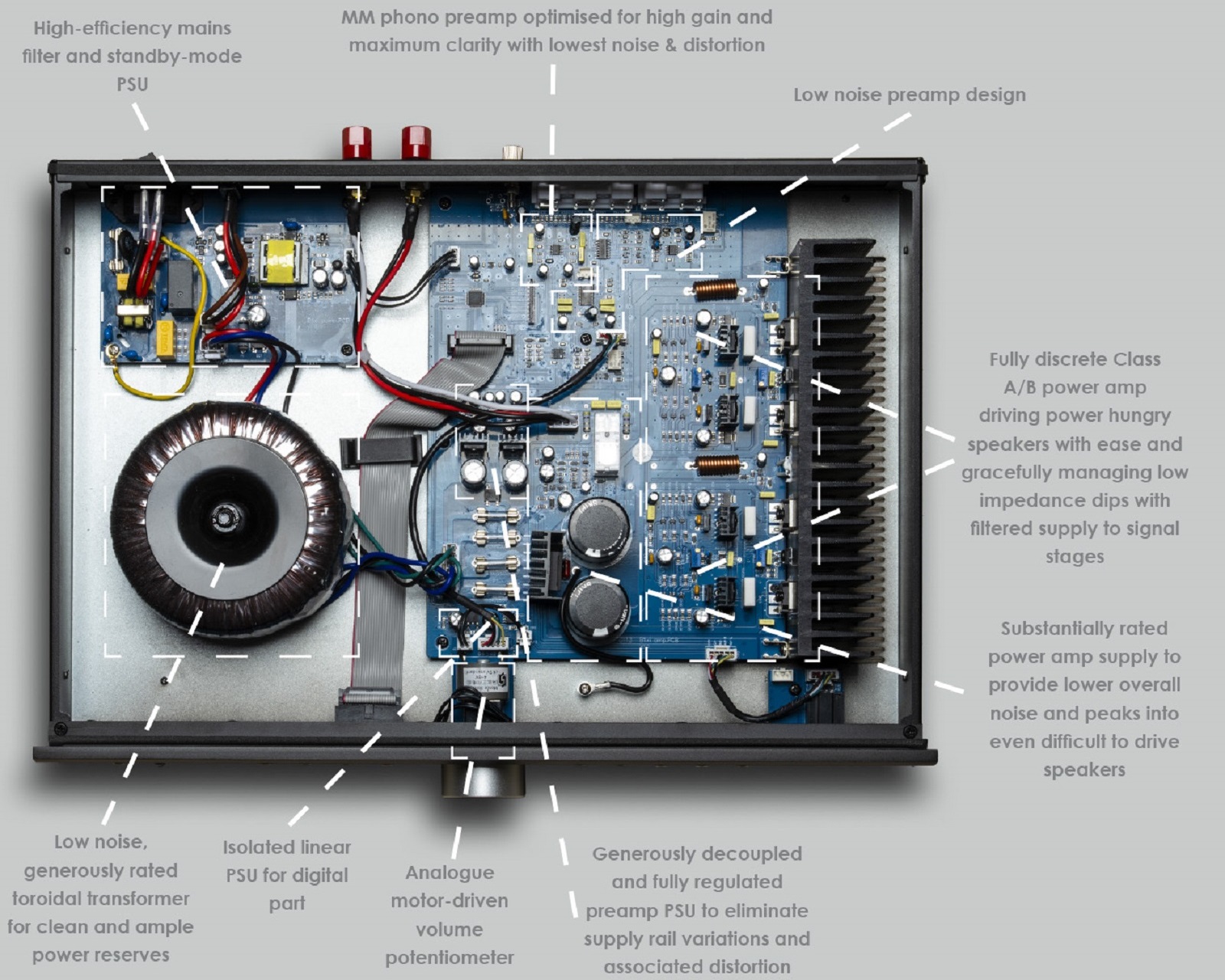
One of the more distinctive aspects of the B1xi is the way Musical Fidelity describes its internal organization. The design is essentially divided into an electrically isolated preamplifier section and power amplifier section. The preamplifier has its own linear power supply, an approach intended to support low noise and strong channel separation. In an integrated amplifier, where multiple stages share one chassis, this kind of separation can be significant because the preamp stage handles low-level signals that are more vulnerable to interference.
The volume control is handled by a motor-driven analog potentiometer. That choice preserves a traditional analog signal adjustment method while still allowing convenient remote operation if implemented in the system. For many listeners, the volume control is one of the most frequently used parts of an amplifier, so its execution is not a minor detail. A motorized analog potentiometer also fits the B1xi’s broader character: modern enough for day-to-day usability, but not dependent on a fully digital control architecture.
Musical Fidelity also notes that the digital circuit boards are physically separated and have their own linear power supplies. This is a useful design decision in a product that combines analog inputs, a phono stage, digital inputs, Bluetooth, and HDMI ARC. Digital sections can be sources of unwanted electrical noise if poorly integrated. Separating them onto their own boards and supplies is a documented attempt to keep the convenience of modern inputs from undermining the amplifier’s analog foundation.

Analog Inputs for Turntables and Line Sources
The B1xi includes a low-noise, high-gain moving-magnet phono preamplifier. This is an important inclusion because vinyl playback remains one of the areas where an integrated amplifier can either simplify or complicate system building. With an MM phono stage onboard, an owner using a compatible moving-magnet cartridge does not need to budget for an external phono preamp at the outset. That keeps the system cleaner and reduces the number of boxes, cables, and power supplies required.
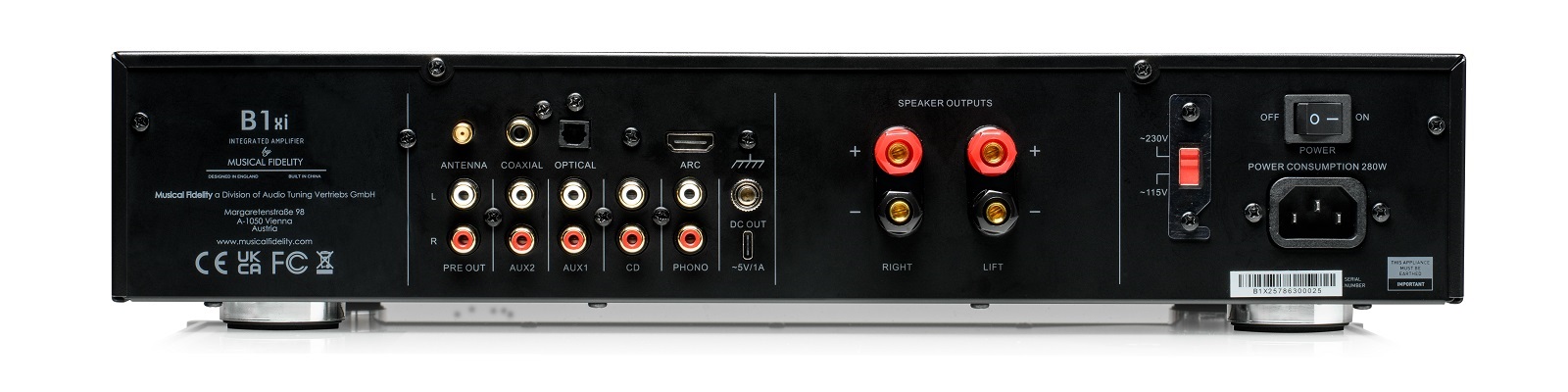
Alongside the phono input are three line-level RCA inputs. This gives the B1xi room for conventional sources such as a CD player, tuner, outboard DAC, cassette deck, or other analog component. In a market where some amplifiers have reduced analog input counts in favor of streaming functions, three RCA inputs plus phono makes the B1xi feel oriented toward users who still value multiple physical sources.
The amplifier also includes variable RCA outputs. These can be used for a subwoofer or for feeding a separate power amplifier. That flexibility is useful in two common scenarios. First, a listener may want to add low-frequency support through a subwoofer without replacing the amplifier. Second, the B1xi can potentially serve as a preamplifier if a future system upgrade includes an external power amplifier. The variable nature of the outputs is important because output level follows the amplifier’s volume control, making them suitable for such applications.
Digital Inputs, HDMI ARC, and Bluetooth Without Becoming a Streamer
The B1xi’s digital input set is broad for a stereo integrated amplifier in this price-conscious category. It includes optical and coaxial digital inputs, each supporting up to 24-bit/192 kHz signals. These connections cover many common digital sources, including televisions, disc transports, media players, and external streamers with digital outputs. By including both formats, the B1xi avoids forcing the owner into a single connection standard.
HDMI ARC is another practical feature. For many homes, the stereo system also serves television audio, and HDMI ARC allows compatible TVs to send audio back to the amplifier over HDMI. This can make the B1xi easier to integrate into a living-room system than a purely analog amplifier. It is especially relevant for listeners who prefer a proper two-channel speaker setup for television and music, but do not want a multichannel AV receiver.
Bluetooth is included for casual wireless playback. This does not turn the B1xi into a full streaming platform, but it does make it easy for visitors or household members to play music from a phone or tablet without connecting extra hardware. At the same time, Musical Fidelity has deliberately omitted built-in streaming features. The company’s stated reasoning is that all-in-one streaming amplifiers are more expensive and less future-proof. That decision may be attractive to owners who prefer to choose and replace an external streamer independently, rather than tie the amplifier’s useful life to an embedded network platform.

Convenience Details That Support Real Systems
The B1xi includes a 5V USB-C output designed to power an external streamer. This is a small but thoughtful feature because it acknowledges how many owners are likely to use the amplifier: with a compact streaming transport connected by optical, coaxial, or analog output. A powered USB-C connection can reduce reliance on an extra wall adapter and help keep the system area tidier, even though the amplifier itself does not perform streaming functions.
A 3.5 mm headphone output is also provided. While the source information does not specify a dedicated headphone amplifier circuit or headphone power figures, the presence of a front-panel-style headphone connection adds everyday usefulness. It gives the B1xi a private listening option without requiring an external headphone amp for basic use.
Speaker connection is handled by banana plug binding posts. The amplifier’s chassis measures 90 x 430 x 324 millimeters, which places it in a conventional full-width hi-fi format. That matters for users building a rack-based system with other standard components, such as CD players, DACs, streamers, or turntables. The B1xi is not trying to be a miniature lifestyle amplifier; its dimensions and connection set suggest it is meant to sit at the center of a traditional stereo system.
Who the Musical Fidelity B1xi Is Most Suitable For
The B1xi is likely to make the most sense for listeners who want a dedicated stereo integrated amplifier with enough connectivity to handle both legacy and modern sources. A vinyl listener with an MM cartridge, a CD or digital transport user, and someone who wants TV audio through stereo speakers could all use the B1xi without immediately needing several add-on boxes. Its combination of phono, line-level RCA, optical, coaxial, HDMI ARC, Bluetooth, variable outputs, and USB-C power creates a flexible foundation.
It is also well suited to buyers who are cautious about built-in streaming. If you already own a streamer, prefer a particular streaming ecosystem, or expect streaming standards to change over time, the B1xi’s non-streaming approach may be an advantage. You can update the streaming source later while keeping the amplifier in place.
It will be less suitable for someone who specifically wants a single-box network amplifier with app control, integrated streaming services, multiroom features, or built-in wireless platform support. It is also not aimed at users who need home-theater surround processing. The B1xi’s strengths are centered on two-channel amplification and source flexibility, not on replacing an AV receiver or network audio hub.
Market Position and Value Priorities
With a suggested retail price of just under $800, the Musical Fidelity B1xi occupies an area where buyers often have to choose between amplifier quality, analog versatility, and digital convenience. The B1xi’s documented feature set is notable because it does not sacrifice the basics: it includes a Class AB amplifier section, a dedicated MM phono input, several analog inputs, current digital inputs, and expansion outputs.
Its value proposition is not based on having every possible software feature. Instead, the product is organized around hardware that should remain useful even if streaming preferences change. For owners who want to build a stable stereo system and choose source components separately, that can be a more reassuring approach than relying on an integrated network platform that may become outdated before the amplifier section does.
Conclusion
The Musical Fidelity B1xi is attractive because it combines a traditional Class AB integrated amplifier architecture with a practical spread of modern connections. Its documented strengths include discrete amplification, separated internal sections, an MM phono stage, multiple analog inputs, optical and coaxial digital inputs, HDMI ARC, Bluetooth, variable outputs, USB-C power for an external streamer, and a standard hi-fi form factor. It is best suited to listeners who want a capable two-channel amplifier for turntables, digital sources, TV audio, and future system expansion, while keeping streaming hardware separate and replaceable.