

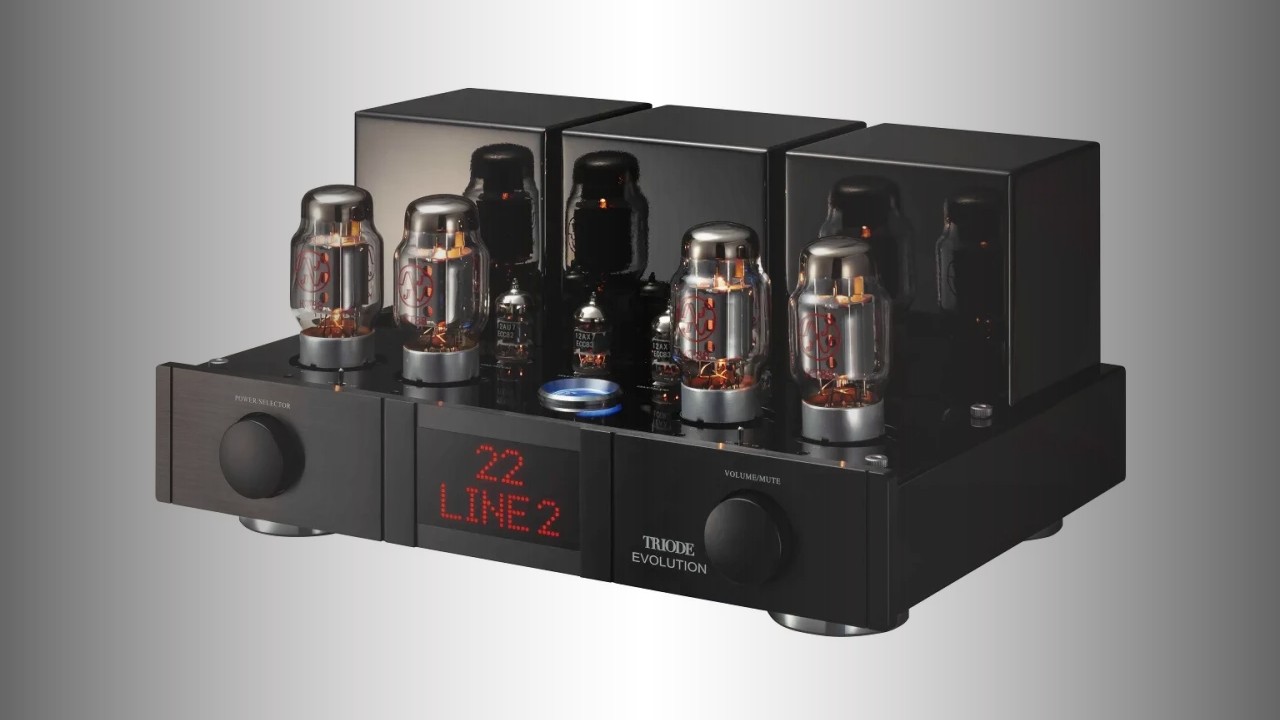
The Triode Evolution Musashi is a substantial integrated amplifier from the Japanese specialist, positioned for listeners who want the architecture and ownership character of a tube amplifier without giving up meaningful power or system flexibility. Priced at $5,000 and scheduled for summer market arrival, it develops the Musashi concept with KT150 output tubes, 12AU7 tubes in the preamplifier section, push-pull class AB operation, and a documented output of 2 × 80 watts into an 8-ohm nominal load. Those figures and design choices place it in a particular corner of the hi-fi world: not a minimalist low-power tube amp, and not a purely solid-state control hub, but an integrated amplifier intended to anchor a serious two-channel system while retaining hands-on tube ownership appeal.
A tube integrated built around KT150 output valves
At the center of the Evolution Musashi is Triode’s continued use of KT150 output tubes. That detail matters because the KT150 is associated with higher-power tube amplifier designs, and in this implementation it supports a specified 2 × 80 watt output into 8 ohms. For prospective owners, the practical implication is straightforward: this is an integrated tube amplifier designed with more available output than many traditional low-powered valve designs.
The amplifier’s push-pull class AB output stage is equally important to understanding its intended role. Push-pull tube circuits are commonly chosen when a designer wants to combine tube operation with useful power delivery, and class AB operation is a familiar approach in amplifiers that need to balance output capability with efficiency. Triode’s published specification does not invite assumptions about how the amplifier sounds, but it does show that the Evolution Musashi has been configured for systems where speaker drive and headroom are part of the brief.
This separates the product from the idea of a tube amplifier as a purely niche or delicate component. With 80 watts per channel specified into 8 ohms, the Evolution Musashi is aimed at owners who may want tube circuitry in a more broadly applicable integrated amplifier format. It remains a tube product with the associated maintenance and setup considerations, but its power rating gives it a more versatile profile than many lower-output alternatives.
12AU7 preamplifier stage and a complete integrated layout
The Evolution Musashi is not simply a power amplifier with a volume control attached. Triode specifies 12AU7 tubes for the preamplifier section, making the tube architecture part of the signal path before the output stage as well. For listeners assembling a system around a source component and loudspeakers, this integrated format can reduce box count while preserving a dedicated preamp-and-power-amp structure inside a single chassis.
An integrated amplifier remains one of the most sensible forms for many two-channel systems. It consolidates input switching, level control, and amplification, avoiding the extra cables, rack space, and matching decisions required by separate preamplifier and power amplifier components. In the Evolution Musashi, that convenience is paired with a tube-based design that will appeal to owners who value the involvement and engineering character of valve amplification.
The presence of both input selection and volume control also makes the amplifier suitable as the central control point in a traditional stereo setup. The source material does not specify the number or type of inputs, so it would be inappropriate to infer a complete connectivity list. What is documented, however, is that the unit functions as an integrated amplifier first, with user-accessible controls that allow it to serve as the main amplifier in a conventional hi-fi chain.
Manual bias adjustment adds involvement and control
One of the more distinctive documented features is the mechanism that allows users to manually adjust bias voltage. Bias adjustment is an important part of many tube amplifier designs because it helps set the operating conditions of the output tubes. For owners who are comfortable with tube equipment, manual bias can be an attractive feature: it provides a direct way to keep the amplifier correctly set up as tubes age or are replaced.
This is not merely a technical footnote. Tube ownership often involves a closer relationship with the component than is typical of sealed solid-state electronics. Tubes are consumable parts, and their behavior can change over time. A manual bias facility gives the owner a role in maintaining the amplifier’s operating condition rather than treating it as a completely closed system.
That said, the same feature also helps define the right audience. Manual bias adjustment may not be ideal for someone who wants an entirely maintenance-free amplifier experience. It is better suited to a user who is willing to understand the process, follow the manufacturer’s instructions, and treat setup as part of responsible ownership. In that sense, the Evolution Musashi speaks to enthusiasts who see hands-on adjustability as a benefit rather than an inconvenience.
Power-amplifier mode increases system flexibility
The Evolution Musashi includes a particularly useful system feature: the input selector and volume control can be deactivated, allowing the unit to operate as a standard power amplifier. This broadens the product’s role beyond that of a fixed integrated amplifier and may be one of its most practically significant design choices.
For example, an owner could use the Evolution Musashi as the primary integrated amplifier in a simpler system, then later incorporate an external preamplifier or another upstream control component if the system evolves. The ability to bypass the integrated control section helps protect long-term flexibility. It also makes the amplifier easier to integrate into setups where volume control is handled elsewhere, provided the rest of the system is compatible.
This feature is valuable because it acknowledges how hi-fi systems often change over time. A listener may start with one source and an integrated amplifier, then move toward separates, experiment with different preamplification, or reorganize a system around a different control architecture. The Evolution Musashi’s power-amplifier capability gives it a second role without requiring the owner to replace the amplifier stage.
Specifications that point to a serious full-size component
Triode specifies a frequency range of 6 Hz to 80,000 Hz and a signal-to-noise ratio of 93 dB. These figures should not be translated into listening claims, but they do indicate the company’s published performance targets for bandwidth and noise behavior. For prospective buyers comparing amplifier architectures, such data helps place the Evolution Musashi among full-scale hi-fi components rather than lifestyle audio products.
The amplifier’s physical presence reinforces that impression. At 440 × 337 × 220 mm and 32.8 kg, this is a large and heavy component that requires appropriate support, ventilation, and installation planning. Tube amplifiers also generate heat, and the Evolution Musashi’s specified power consumption of 520 W, falling to 190 W at idle, suggests that owners should consider placement carefully. A sturdy rack, open airflow, and sensible access for tube maintenance would be relevant practical considerations.
The weight also reflects the realities of high-power tube amplifier construction, where transformers and chassis structure are major contributors to mass. While the source information does not detail the internal transformer design or chassis materials, the published dimensions and weight make clear that this is not a compact desktop amplifier. It is intended as a substantial centerpiece for a dedicated stereo system.
Who the Evolution Musashi is most suitable for
The Evolution Musashi is likely to make the most sense for listeners who want a tube integrated amplifier with meaningful output power and a degree of operational flexibility. Its 2 × 80 watt rating into 8 ohms, KT150 output tubes, and push-pull class AB architecture make it more broadly system-oriented than many very low-powered valve amplifiers. Its ability to function as a power amplifier also gives it appeal for owners who expect their system to develop over time.
It is also well suited to enthusiasts who appreciate the maintenance and setup culture of tube amplification. The manual bias feature will be attractive to users who want direct control over tube operating conditions and are comfortable following correct procedures. For those users, the amplifier offers a combination of traditional valve involvement and modern integrated-amplifier practicality.
It may be less suitable for buyers who want the smallest possible amplifier, the lowest possible power consumption, or an entirely hands-off ownership experience. At 32.8 kg, with significant stated power consumption and manual bias adjustment, the Evolution Musashi asks for commitment in space, setup, and care. That is not a drawback for the right owner, but it is an important part of understanding the product honestly.

Market position and ownership appeal
At $5,000, the Evolution Musashi occupies a serious but focused position in the integrated amplifier market. The price places attention on the amplifier’s combination of tube circuitry, specified output power, manual adjustment, and dual integrated/power-amplifier functionality. Rather than being defined by a long list of digital features or network functions, its appeal is centered on amplification architecture and system integration.
That makes the product distinctive in a market where many integrated amplifiers are increasingly built around streaming, DAC sections, and app-driven control. The documented strengths of the Evolution Musashi lie elsewhere: KT150 output tubes, 12AU7 preamplification, a class AB push-pull power stage, manual bias control, and a bypass option for use as a power amplifier. For the buyer seeking those priorities, the amplifier’s focus can be an advantage.
Its identity is therefore clear. This is a full-size tube integrated amplifier for a dedicated stereo system, designed to offer substantial output and owner-adjustable operation while remaining adaptable if the system later moves toward separates. That clarity may be its most attractive quality.
Conclusion
The Triode Evolution Musashi stands out through a well-defined set of documented strengths: KT150 output tubes, 12AU7 tubes in the preamplifier section, push-pull class AB operation, 2 × 80 watts into 8 ohms, manual bias adjustment, and the option to bypass its input selector and volume control for use as a power amplifier. It is a substantial component in both design and physical presence, aimed at listeners who want a serious tube integrated amplifier rather than a compact, maintenance-free convenience product. Its ideal audience is the enthusiast who values tube architecture, appreciates hands-on setup, needs useful power, and wants an amplifier that can remain relevant as a two-channel system evolves.


Join the discussion
Share your thoughts, listening impressions or product experience.