

Some amplifier recommendations revolve around the same familiar names and formats: a stereo integrated here, a muscle amplifier there, perhaps a phono stage for vinyl users.
The products gathered here are more varied.
Widget not in any sidebars
They include compact Class D designs, heavyweight mono power amplifiers, a high-control tube integrated, a specialist phono amplifier, and a multichannel home-cinema power amp. The source material also includes two related articles that are not conventional standalone amplifier picks: one about unusual speaker materials, including active speakers with built-in amplification, and one about a turntable that deliberately omits an onboard phono preamplifier. Rather than forcing them into the same category, this guide treats them honestly as system-planning context. Use this as a discovery-led shortlist. The point is not to crown a single universal winner, but to clarify which kind of amplifier, or amplifier-adjacent component, makes sense for a particular system: vinyl replay, two-channel listening, difficult loudspeakers, compact installations, tube amplification, or serious home cinema.
1. Cabasse Abyss: Innovative high-end amplifier
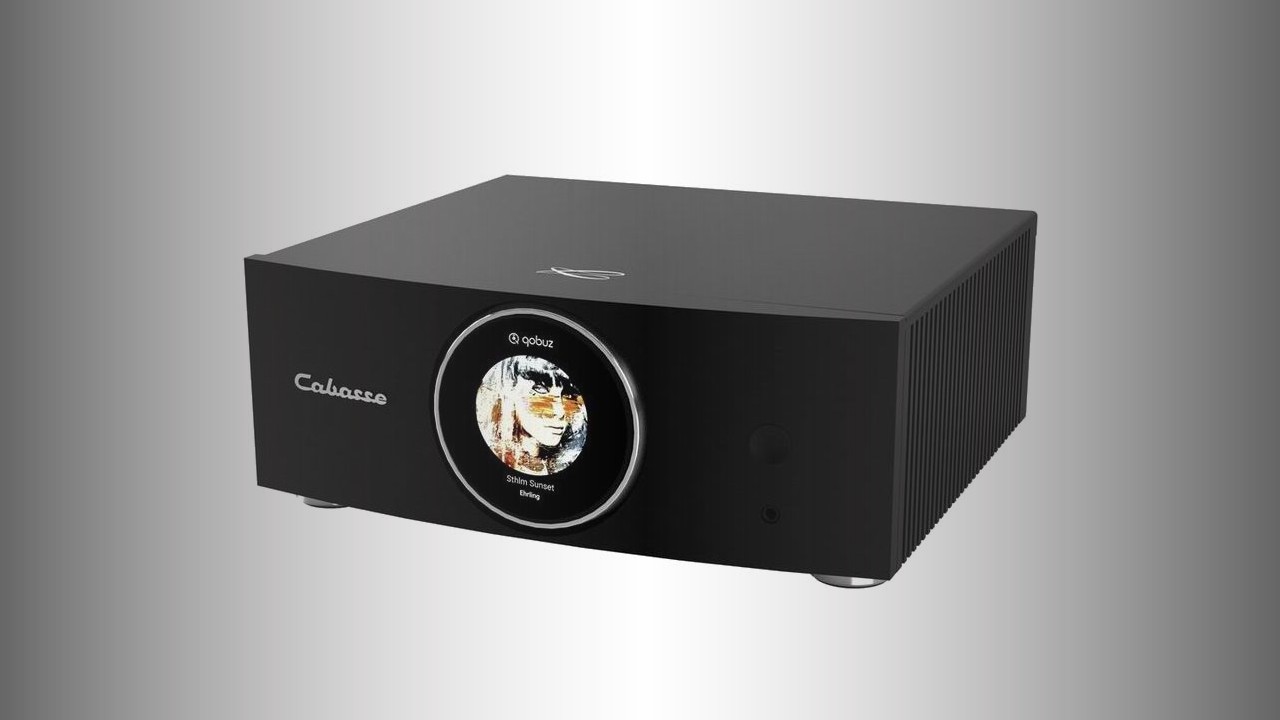
Cabasse Abyss, a compact high-end integrated amplifier with touch control, rotating volume adjustment, DSP calibration, and Class D power.
The Cabasse Abyss is presented as a modern high-end integrated amplifier with Class D power, DSP-based calibration, streaming-oriented connectivity, and a distinctive control interface.
Its amplifier section is rated at 2 x 120 watts into 8 ohms or 215 watts into 4 ohms, while Cabasse’s DFE technology is described as optimizing dynamics according to volume, frequency, and musical content.
The touch screen and rotating volume ring make operation part of the product’s identity, although the source notes a practical drawback: dust can collect around and under the ring over time.
Best for: Modern two-channel systems needing streaming and DSP features
- Rated at 2 x 120 W into 8 ohms
- DSP calibration and DFE processing
- Streaming and source-connection focus
- Smooth rotating volume control
Verdict: A sophisticated integrated amplifier with strong digital-era features, tempered by a small but real usability concern around the volume ring.
2. Cyrus Audio 40 PPA: High-End Phono Amplifier with Remote Control & Multi-Turntable Support

Cyrus Audio 40 PPA phono amplifier, designed with remote-adjustable cartridge settings and a front glass information display.
The Cyrus Audio 40 PPA is a specialist phono amplifier aimed at users who want cartridge adjustment without constant rear-panel fiddling.
The source highlights a redesigned internal circuit, a six-layer PCB layout intended to reduce interference, and a new power supply claimed to reduce noise compared with the Classic Phono.
Its most practical feature is control: gain can be adjusted in 5 dB steps, settings can be managed by remote, and selected values are shown on the front glass display.
Best for: Vinyl systems needing flexible cartridge setup
- Remote control for key adjustments
- Gain adjustable in 5 dB steps
- Six-layer PCB layout aimed at reducing interference
- Front display for selected values
Verdict: A highly configurable phono stage for listeners who want precise adjustment from the listening seat rather than behind the rack.
3. 7 awesome speakers made from unusual materials

Unusual speaker designs, including concrete cabinets and active models with internal amplification.
This is not a standalone amplifier recommendation, but it is relevant to amplifier buyers considering active or wireless alternatives to separates.
The article surveys unconventional speaker construction, including Le Pavé Parisien, a small reinforced-concrete wireless speaker with a built-in 20-watt Class D amplifier and eight hours of battery life.
It also highlights larger concrete speaker designs where cabinet and driver materials take center stage, reminding system builders that amplification is only one part of the playback chain.
Best for: Readers weighing active speakers against separate amplifiers
- Shows active speakers with built-in amplification
- Le Pavé Parisien includes a 20 W Class D amplifier
- Highlights the role of cabinet and driver materials
Verdict: Useful amplifier-adjacent context rather than a core amplifier pick, especially for anyone considering all-in-one active speaker solutions.
4. Boulder 1151: A compact powerhouse for audiophiles

Boulder 1151 mono amplifier, designed for high-output performance from a compact chassis.
The Boulder 1151 is a mono power amplifier aimed at demanding loudspeaker loads while retaining a compact footprint that matches Boulder’s 1110 preamplifier.
It is rated at 350 watts into 8 ohms, 600 watts into 4 ohms, and 750 watts into 2 ohms.
The source emphasizes practical engineering as much as output power, including an advanced protection circuit, redesigned automatic bias control, a robust output stage with 40 output transistors, and 12 power capacitors.
Best for: High-end systems with demanding loudspeakers and limited rack space
- Rated down to 2 ohms
- Compact footprint matching Boulder 1110
- Advanced protection circuit
- Automatic bias management
Verdict: A compact mono amplifier for serious systems where load handling, protection, and clean integration matter as much as rated power.
5. Teac TN-5BB: The new flagship turntable

Teac TN-5BB turntable, shown as a vinyl source that requires external phono amplification.
The Teac TN-5BB is a turntable rather than an amplifier, but it belongs in amplifier planning because it has no built-in phono preamplifier.
That means buyers need a suitable external phono stage or an amplifier with an appropriate phono input.
The source describes balanced outputs, a hybrid frame using artificial marble, MDF, and Washi paper, plus a servo-controlled drive system with optical speed monitoring and button selection for 33, 45, and 78 rpm.
Best for: Vinyl users planning a separate phono stage or phono-equipped amplifier
- No built-in phono preamplifier for external matching
- Balanced outputs
- Hybrid vibration-damping frame
- Optical speed monitoring system
Verdict: Not an amplifier, but an important reminder that turntable choice can determine whether a phono amplifier is required.
6. Accuphase M-6200: Extreme mono power amplifier

Accuphase M-6200 mono power amplifier, built around parallel circuits and heavy-duty power-supply engineering.
The Accuphase M-6200 is described as an extreme mono power amplifier built around parallel amplification circuits to reduce noise, improve attenuation, increase output current, and lower output impedance.
The source cites a damping factor greater than 1000 and signal-to-noise figures of 127 dB at maximum gain and 133 dB at the -12 dB gain setting.
It can also be switched into bridge mode, where the source states output rises to 2400 watts into a 2 ohm load.
Best for: Very ambitious systems requiring mono amplification and high load control
- Parallel amplification circuits
- Damping factor greater than 1000
- Bridge mode stated at 2400 W into 2 ohms
- Large shielded transformer and dual capacitors
Verdict: A statement mono amplifier for systems where current delivery, damping, and low-noise engineering are central priorities.
7. Musical Fidelity M8 500s: Power amplifier with premium-level components
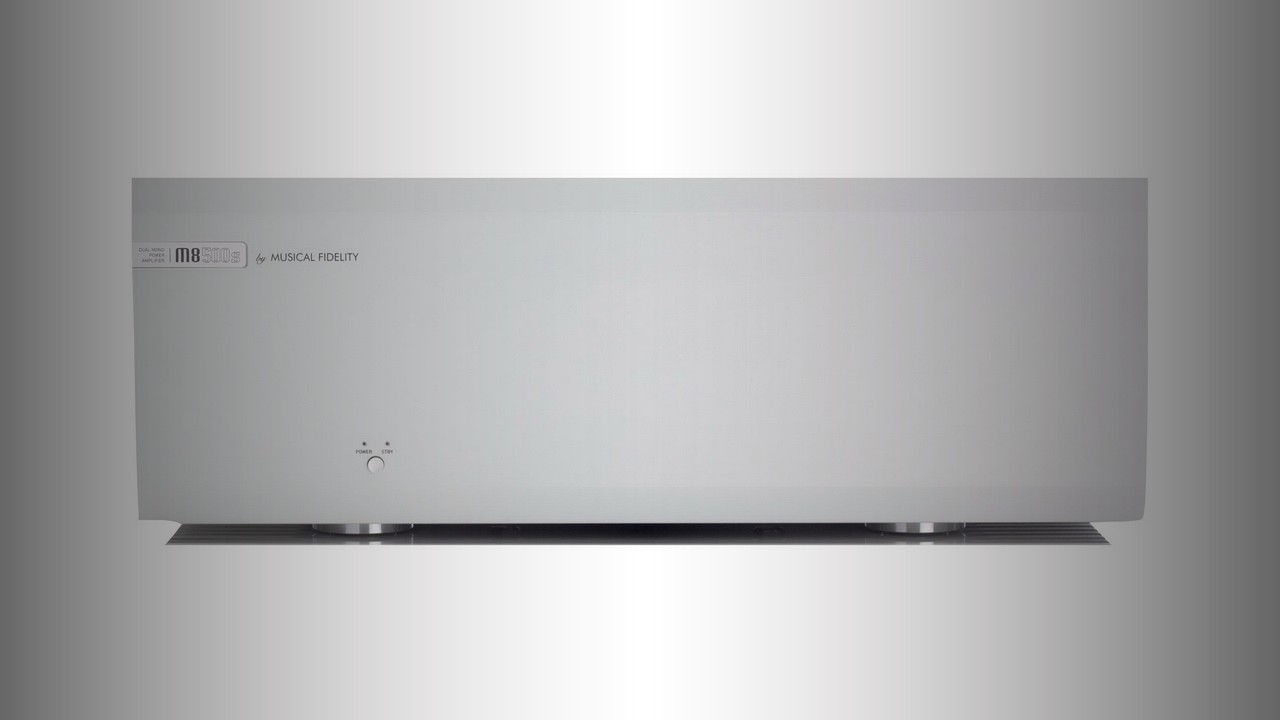
Musical Fidelity M8 500s stereo power amplifier, combining high rated output with a restrained industrial chassis.
The Musical Fidelity M8 500s is a two-channel power amplifier built around the company’s stated preference for spending on electronic components, circuit boards, and power transformers rather than decorative metalwork.
The source describes a deliberately restrained exterior, with a welded steel chassis, substantial heat sinks, and a thick front panel.
It is rated at 2 x 500 watts into 8 ohms and is presented as a more compact two-channel counterpart to Musical Fidelity’s 700m monoblocks.
Best for: Stereo systems needing very high power without ornamental design excess
- Rated at 2 x 500 W into 8 ohms
- Emphasis on electronic components and transformers
- Practical, minimalist chassis design
- Two-channel format derived from monoblock thinking
Verdict: A purposeful high-power stereo amplifier for listeners who value component investment over decorative casework.
8. Unison Research S6 Black Edition: Pure Class A Tube Power with Modern Control

Unison Research S6 Black Edition integrated tube amplifier with KT77 output tubes and pure Class A operation.
The Unison Research S6 Black Edition is an integrated tube amplifier presented as a deep technical reworking of the S6 concept rather than a cosmetic refresh.
Its output stage operates in pure Class A using an ultra-linear configuration with a 20 percent tap, and power is rated at 40 watts into 6 ohms.
Each channel uses three KT77 Gold Lion output tubes in parallel, while the source also highlights a reworked signal path and power supply aimed at greater transparency, speed, tonal authority, and loudspeaker control.
Best for: Listeners wanting tube amplification with more stated control and current capability
- Pure Class A operation
- Rated at 40 W into 6 ohms
- Three KT77 Gold Lion output tubes per channel
- Reworked signal path and power supply
Verdict: A serious tube integrated for systems where valve character and practical loudspeaker drive both matter.
9. Fosi Audio ZA3: Compact and powerful integrated amplifier

Fosi Audio ZA3 compact integrated amplifier with RCA, XLR, subwoofer output, and stereo or mono operation.
The Fosi Audio ZA3 is a compact integrated amplifier that can operate in stereo or mono mode, making it unusually flexible for small-system and multi-amp setups.
The source states that it uses TI TPA3255 amplifier chips and can deliver up to 2 x 150 watts or 1 x 240 watts into 4 ohms.
Connectivity includes stereo RCA, balanced stereo XLR, speaker terminals, a powered subwoofer output, and a 12 V trigger; the article also cites an SNR of at least 106 dB and THD of 0.006 percent.
Best for: Compact hi-fi systems needing flexible wiring and configuration
- Stereo or mono operation
- RCA and balanced XLR inputs
- Powered subwoofer output
- 12 V trigger input
Verdict: A small integrated amplifier with useful connectivity and configuration options for space-conscious systems.
10. Marantz AMP 30

Marantz AMP 30 six-channel power amplifier, designed for high-performance home-cinema systems.
The Marantz AMP 30 is a six-channel power amplifier aimed at serious home-cinema installations rather than simple two-channel systems.
The source describes a slim chassis using Marantz HDAM circuitry and Current Feedback Amplification, with each channel rated at 200 watts into 8 ohms and 400 watts into 4 ohms.
It is positioned below larger channel-count solutions for systems that need substantial multichannel power without moving to a 16-channel amplifier.
Best for: Home cinema systems needing serious multichannel amplification
- Six-channel power amplifier layout
- Rated at 200 W per channel into 8 ohms
- Rated at 400 W per channel into 4 ohms
- Uses Marantz HDAM and Current Feedback Amplification
Verdict: A focused multichannel power amplifier for cinema systems that need six strong channels rather than an oversized channel count.
Quick comparison
These products are not interchangeable.
Some are full integrated amplifiers, some are power amplifiers that require a preamplifier or processor, one is a phono stage, and two entries are included as system-planning context rather than direct amplifier recommendations.
The simplest way to compare them is by role: what problem each one solves in a hi-fi or home-cinema system.
| Product | Best for | Verdict |
|---|---|---|
| Cabasse Abyss | Streaming-oriented stereo systems with DSP support | A modern integrated amplifier with strong digital features and a noted dust-prone volume-ring detail. |
| Cyrus Audio 40 PPA | Vinyl users needing adjustable phono amplification | A remote-adjustable phono stage with fine gain control and a display-led interface. |
| 7 awesome speakers made from unusual materials | Readers considering active speakers or unusual system formats | Context for built-in amplification and speaker construction, not a standalone amplifier pick. |
| Boulder 1151 | Demanding loudspeakers in high-end mono-amplifier systems | A compact mono power amplifier with high rated output and protection-focused engineering. |
| Teac TN-5BB | Turntable systems that will use an external phono stage | A vinyl source that affects amplifier choice because it has no built-in phono preamplifier. |
| Accuphase M-6200 | No-compromise mono amplification and difficult speaker control | An extreme mono power amplifier built around parallel circuits, high damping, and major power-supply hardware. |
| Musical Fidelity M8 500s | High-power stereo systems | A powerful two-channel amplifier that prioritizes electronic substance over decorative design. |
| Unison Research S6 Black Edition | Tube-integrated systems needing Class A operation and stated control | A reworked tube integrated combining KT77 output tubes with a more control-oriented design approach. |
| Fosi Audio ZA3 | Compact, flexible stereo or mono installations | A small integrated amplifier with RCA, XLR, subwoofer output, trigger input, and stereo/mono flexibility. |
| Marantz AMP 30 | Home cinema systems requiring six powered channels | A six-channel Marantz power amplifier for serious multichannel systems without excessive channel count. |
Frequently asked questions
Should I choose an integrated amplifier, a power amplifier, or a phono amplifier?
Choose an integrated amplifier when you want source switching, volume control, and speaker drive in one unit.
Choose a power amplifier when you already have a preamplifier, processor, or control section.
Choose a phono amplifier when your turntable and cartridge need the extra gain and equalization required for vinyl playback, as illustrated by the Cyrus 40 PPA and the Teac TN-5BB’s lack of built-in phono amplification.
Do the highest wattage figures automatically mean the best amplifier?
No.
Power ratings matter, especially with demanding speakers, but the source material also points to load handling, damping factor, protection circuits, power-supply design, bias control, and connectivity.
A Boulder or Accuphase mono amplifier solves a different problem from a compact Fosi Audio ZA3 or a six-channel Marantz AMP 30.
When does a phono stage become important in an amplifier system?
A phono stage matters whenever the turntable does not include one and the amplifier lacks a suitable phono input.
The Teac TN-5BB is specifically described without a built-in phono preamplifier, while the Cyrus Audio 40 PPA is a dedicated phono amplifier with remote-adjustable cartridge settings and gain control.
Are compact Class D amplifiers a serious option?
They can be, depending on the system.
The Cabasse Abyss and Fosi Audio ZA3 both use Class D amplification in different ways: the Cabasse adds DSP and streaming-oriented features, while the Fosi emphasizes compact size, stereo or mono operation, and broad connectivity.
Match the format to the system rather than judging by amplifier class alone.
How to Choose from This List
Start with the role your system actually needs filled.
If you want one box for stereo listening with modern source handling, the Cabasse Abyss is the most directly integrated, feature-rich option in this group.
If your priority is compact flexibility, balanced input, subwoofer output, and the ability to run stereo or mono, the Fosi Audio ZA3 is the most space-conscious amplifier here. For vinyl, separate the turntable question from the amplification question. The Cyrus Audio 40 PPA is the dedicated phono stage in this selection, with remote adjustment and gain steps that make cartridge setup more manageable. The Teac TN-5BB is not an amplifier, but because it has no built-in phono preamplifier, it clearly pushes the owner toward an external phono stage or an amplifier with the correct phono input. If the speakers are difficult to drive or the system is built at a very high level, the power-amplifier choices diverge. The Boulder 1151 is a compact mono amplifier with strong rated output into low impedances and practical protection circuitry. The Accuphase M-6200 is the most extreme mono design described, with parallel circuits, very high damping, and bridge-mode capability stated in the source. The Musical Fidelity M8 500s takes a two-channel route, offering very high rated stereo output with a stated emphasis on core electronics rather than decorative construction. For listeners drawn to valves, the Unison Research S6 Black Edition is the tube integrated to consider from this set, with pure Class A operation, KT77 output tubes, and a reworked circuit and power supply. For cinema systems, the Marantz AMP 30 is the clear outlier and the obvious fit: six powered channels, Marantz HDAM circuitry, Current Feedback Amplification, and rated output intended for serious multichannel use. The two amplifier-adjacent entries are useful reminders. Active speakers can remove the need for a separate amplifier altogether, while a turntable without a phono stage can add an amplifier requirement you might otherwise overlook. The best choice is therefore not the most powerful or most complex product by default; it is the one that matches your sources, speakers, channel count, cartridge needs, space, and preferred system architecture.
Widget not in any sidebars
Widget not in any sidebars
Widget not in any sidebars


Join the discussion
Share your thoughts, listening impressions or product experience.