

Speakers now cover a remarkably broad range of applications, from imposing passive floorstanders and self-contained wireless systems to desktop soundbars, portable Bluetooth models and dedicated home-cinema add-ons.
The right choice therefore starts with how and where the speaker will be used, rather than with cabinet size or driver count alone.
This Stereoindex selection highlights distinctive designs across those categories. DALI, Børresen, AVID and SeaWave Acoustics address ambitious floorstanding systems, while Triangle and DALI offer active alternatives with amplification built in. Wharfedale and Cabasse focus on specific home-cinema roles, and the Razer and LG models provide more compact solutions for computers and portable listening. These products are not direct substitutes for one another. Each recommendation is based on the configuration, connectivity and intended application described in the source material, with manufacturer performance claims treated as such rather than as independent test results.

1. DALI EPIKORE 11
The DALI EPIKORE 11 is a natural-wood-veneer floorstander with four bass drivers and an EVO-K hybrid high-frequency module.
The DALI EPIKORE 11 is a substantial 4½-way floorstander that brings technology associated with the flagship DALI KORE into a natural-wood-veneer cabinet.
Four 8-inch bass drivers and a 6½-inch midrange driver use DALI’s second-generation SMC magnetic material, while the EVO-K hybrid module covers high frequencies.
Paper-and-wood-fibre cones are employed to combine low weight with rigidity. Its scale and driver complement make it a model to consider for a spacious, carefully planned passive system.
Best for: Large, ambitious passive stereo systems
- Four 8-inch bass drivers
- EVO-K hybrid high-frequency module
- Second-generation SMC technology
- Natural wood veneer finish
Verdict: The EPIKORE 11 combines a large 4½-way format with several technologies derived from DALI’s flagship loudspeaker work.
2. Razer Leviathan V2 Pro
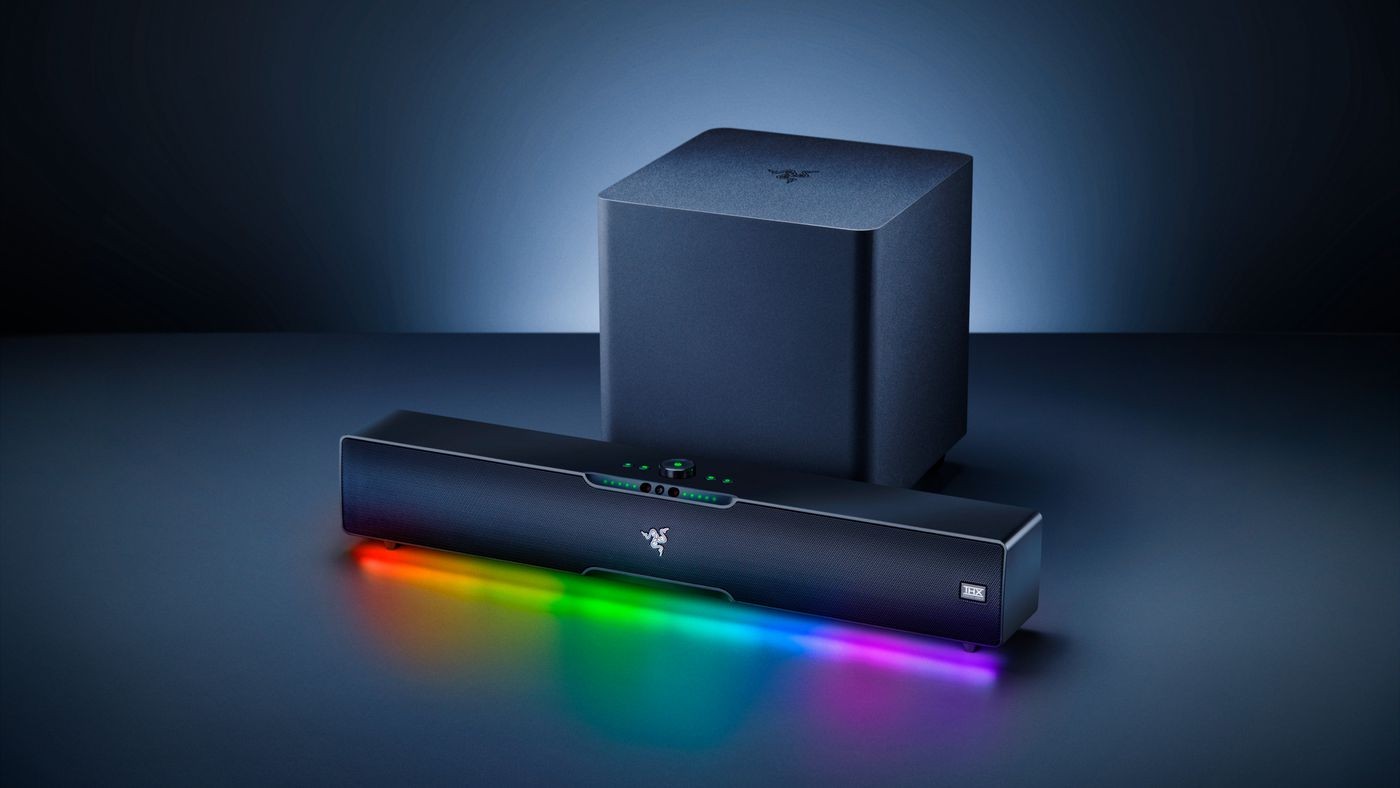
The Razer Leviathan V2 Pro packages five full-range drivers, a downward-firing bass driver and listener tracking into a compact desktop soundbar.
Designed as a replacement for conventional computer speakers, the Leviathan V2 Pro combines a 600 mm-wide desktop soundbar with a downward-firing bass driver.
Its infrared camera tracks the listener’s head so that the THX Spatial Audio processing can adapt its directional output and simulate a 7.1-channel presentation from stereo or multichannel content.
USB handles the computer connection, while Bluetooth 5.0 and a 3.5 mm analogue input broaden its source compatibility.
Best for: Desktop gaming and computer entertainment
- Compact 600 mm-wide enclosure
- Listener-position tracking
- THX Spatial Audio processing
- USB, Bluetooth and analogue inputs
Verdict: The Leviathan V2 Pro is a space-conscious computer-audio option for listeners who value virtual surround processing and head tracking.
3. Wharfedale Diamond 12 3D
The Wharfedale Diamond 12 3D Atmos module can be placed on compatible Diamond speakers or installed on a wall.
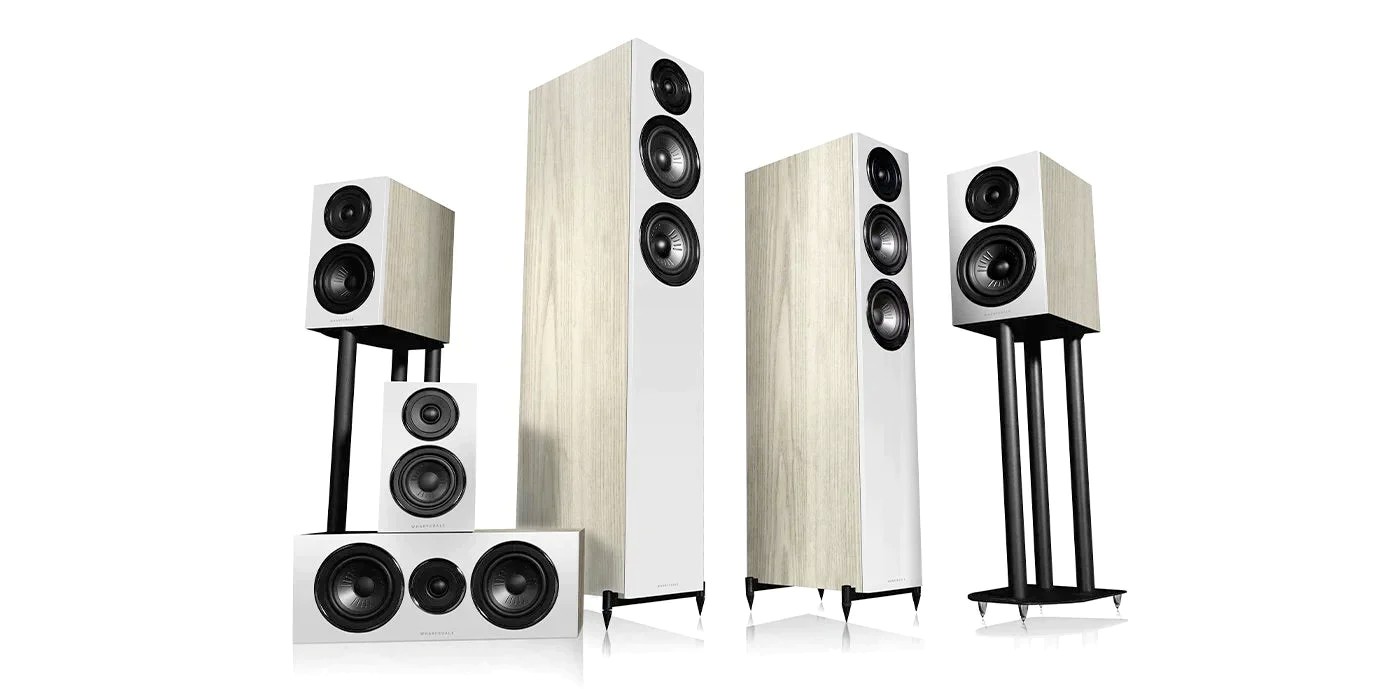
The Wharfedale Diamond 12 3D is a Dolby Atmos module created to complement the Diamond 12 range visually and acoustically.
It can sit on top of Diamond 12.1 or Diamond 12.3 speakers, while integrated wall-mounting provisions offer an alternative installation route.
Its 10 cm polypropylene-and-mica composite driver follows the same general design approach as the drivers in the matching Diamond models. Black, white, walnut and light oak finishes help it blend into an existing system.
Best for: Adding height channels to a Diamond 12 system
- Matches the Diamond 12 series
- Speaker-top or wall installation
- Four finish choices
- 10 cm composite-cone driver
Verdict: The Diamond 12 3D provides a visually coordinated and installation-friendly route to Dolby Atmos height channels for Diamond 12 owners.

4. SeaWave Acoustics AM45
The 125 kg SeaWave Acoustics AM45 combines twin horns, an open-baffle midrange and separate large bass drivers.
SeaWave Acoustics takes a large-scale four-way approach with the AM45.
Two horns serve the high- and ultra-high-frequency ranges, using a 2-inch titanium-dome driver and a 1-inch Korean Hanji paper-cone supertweeter.
A 6-inch Hanji paper-cone midrange operates in an open-baffle arrangement, while separate 8- and 11-inch drivers handle bass. Each 1.36 m-tall enclosure weighs 125 kg, so room planning, delivery access and floor support are essential considerations. SeaWave states a 20 Hz to 35 kHz response within ±2 dB and 94 dB sensitivity.
Best for: Very large rooms and dedicated installations
- Four-way horn-assisted design
- Open-baffle midrange section
- Separate 8- and 11-inch bass drivers
- Manufacturer-stated 94 dB sensitivity
Verdict: The AM45 is an unusually imposing horn-assisted floorstander that demands serious space and installation planning.

5. Børresen C2 and Børresen C3
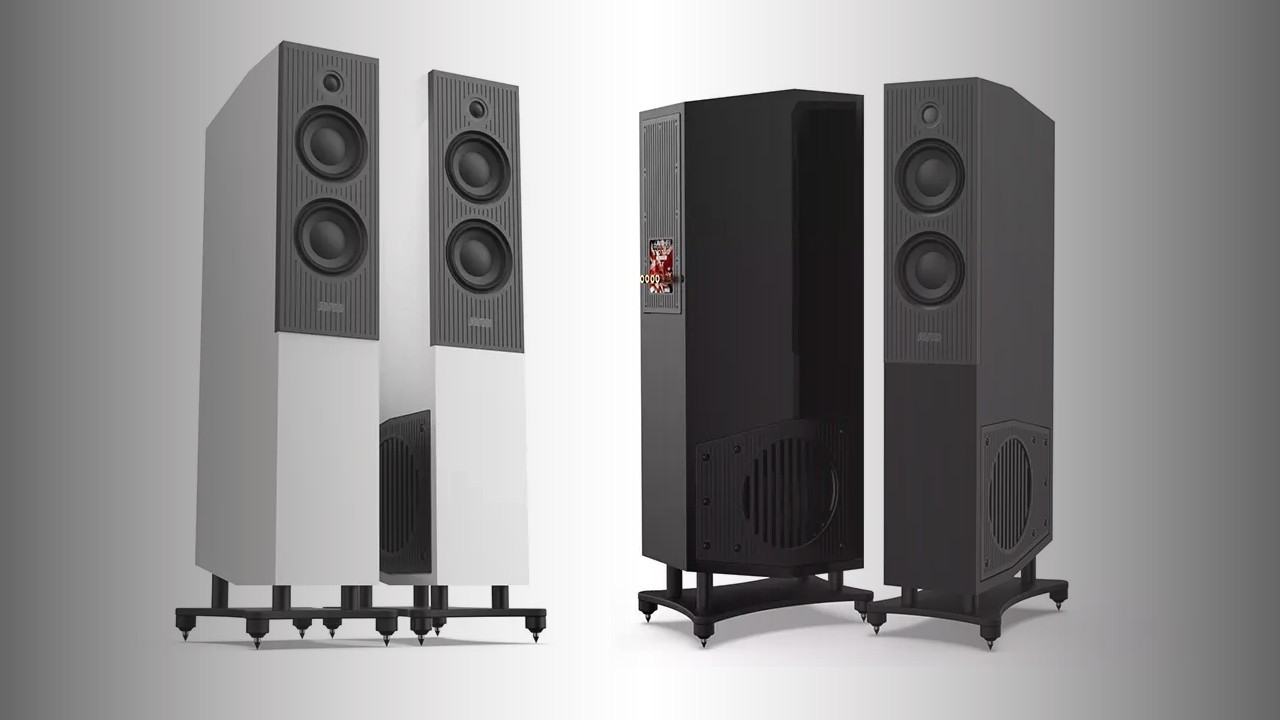
The Børresen C2 and C3 are related floorstanders using DCC5 Neo drivers and the company’s lightweight RP94 planar ribbon tweeter.
The Børresen C2 and C3 expand the Danish company’s C series with two floorstanding formats positioned between its O and X ranges.
Both employ the DCC5 Neo woofer/midrange driver, whose neodymium motor uses dual copper caps intended to reduce electromagnetic resonance and induction.
The three-layer cone combines an aramid honeycomb core with a carbon-fibre exterior, while the internally developed RP94 planar ribbon tweeter has a quoted sensitivity of 94 dB and a moving mass of 0.01 grams. Their upgraded crossovers support both bi-wiring and bi-amping.
Best for: Premium passive systems needing a choice of floorstander sizes
- DCC5 Neo woofer/midrange driver
- Three-layer aramid and carbon-fibre cone
- RP94 planar ribbon tweeter
- Bi-wiring and bi-amping support
Verdict: The C2 and C3 offer two routes into Børresen’s C-series technology, with advanced driver construction and flexible amplifier connections.
6. AVID Evo Two
The AVID Evo Two mounts its soft-dome tweeter, twin midrange drivers and 25 cm woofer on an anodised aluminium panel.
The AVID Evo Two is a UK-manufactured 3.5-way floorstander positioned above the Evo Three.
Its driver array consists of a 28 mm Acuflex soft-dome tweeter, two 16 cm midrange drivers with 75 mm titanium voice coils and a 25 cm woofer.
The drivers are secured to a substantial anodised aluminium panel, while the crossover uses ClarityCap capacitors to reduce resistance in the signal path. At 42 kg per speaker, the Evo Two also warrants forethought about placement and handling. AVID claims enhanced bass, wider dynamics and a more expansive soundstage relative to earlier models.
Best for: Substantial passive systems built around AVID electronics
- 3.5-way driver configuration
- Dedicated 25 cm woofer
- Anodised aluminium driver panel
- ClarityCap crossover capacitors
Verdict: The Evo Two is a heavyweight 3.5-way design intended to extend AVID’s system range with greater scale and dedicated bass capability.

7. LG XBOOM GO XG2T and XG8T
The LG XBOOM GO range pairs the compact, cord-equipped XG2T with the larger, illuminated XG8T portable speaker.
LG’s two XBOOM GO models address different kinds of portable listening.
The XG2T weighs less than 500 grams, includes an adjustable attachment cord, offers up to 10 hours of playback and carries an IP67 dust-and-water-protection rating.
The larger XG8T takes a party-oriented approach with app-controlled coloured lighting, an adjustable carrying strap and up to 15 hours of playback. LG also states that the range was tested against military standards for exposure to demanding conditions such as heat, rain and sand.
Best for: Portable music outdoors or at social gatherings
- Lightweight XG2T option
- IP67 protection on the XG2T
- Up to 15 hours of playback from the XG8T
- App-controlled lighting on the XG8T
Verdict: The compact XG2T suits highly mobile use, while the larger XG8T prioritises longer playback and party-oriented lighting.
8. DALI Rubicon 6 C
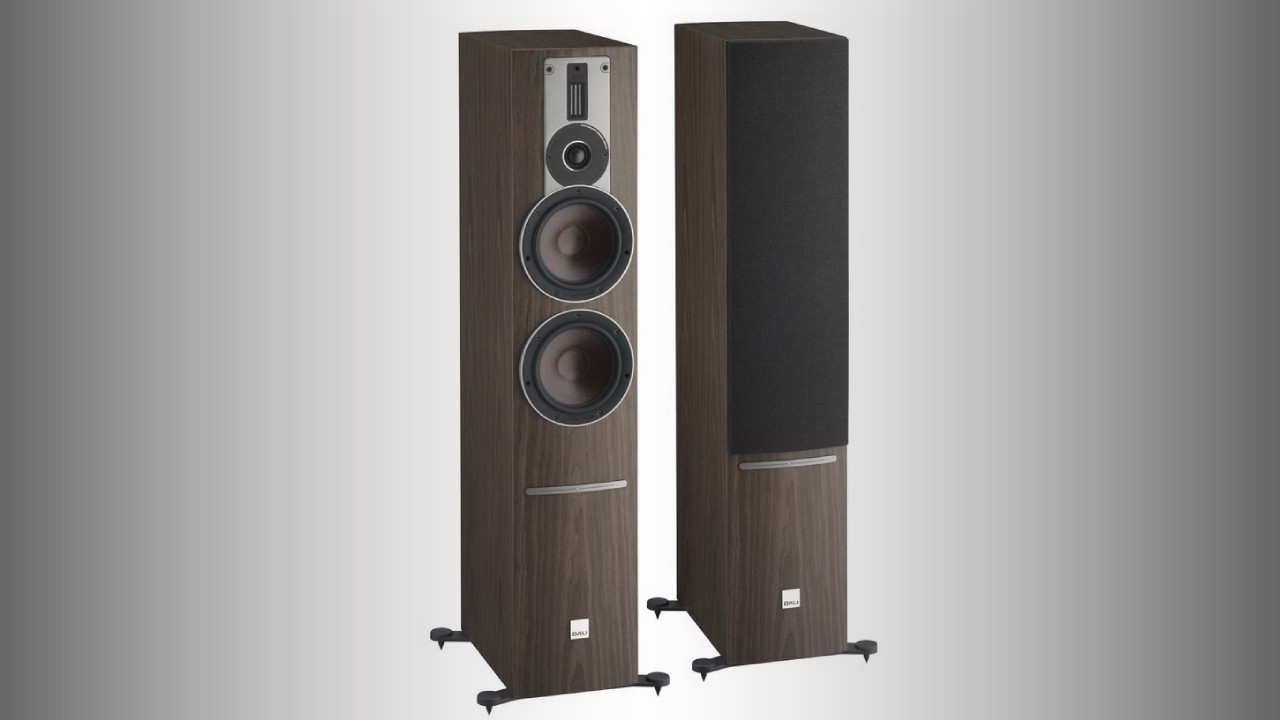
The active DALI Rubicon 6 C integrates dual Class D amplifiers, a hybrid crossover and wood-fibre-cone drivers in each cabinet.
The DALI Rubicon 6 C converts the company’s familiar floorstanding format into an active system.
Each speaker contains two 250-watt Class D amplifiers and uses a hybrid crossover arrangement, with digital processing applied in the low-frequency region and an analogue filter retained for the midrange and treble.
The bass and mid-bass drivers use cellulose cones reinforced with wood fibres, along with DALI’s SMC magnetic material. This configuration removes the need to choose a separate power amplifier while retaining key elements of the passive Rubicon design.
Best for: Listeners seeking an active floorstanding system
- Two Class D amplifiers in each speaker
- Hybrid digital and analogue crossover
- Wood-fibre-reinforced cellulose cones
- DALI SMC magnetic material
Verdict: The Rubicon 6 C combines built-in amplification and low-frequency digital processing with established Rubicon driver technology.

9. Cabasse Santorin 25
The Cabasse Santorin 25 uses a downward-firing 25 cm driver to distribute bass around the room.
The Cabasse Santorin 25 is a powered subwoofer designed to complement the company’s iO3 home-cinema system.
A downward-firing 25 cm driver creates 360-degree sound propagation and uses a cellulose-fibre composite cone.
Its TS190 D amplifier is rated at 200 watts, with 400-watt peak capability, while the adjustable 40–180 Hz crossover helps integrate the subwoofer with partnering speakers. Cabasse specifies a 30 Hz lower cutoff and says the model is suitable for rooms of up to 50 square metres. Connection is through an unbalanced RCA input.
Best for: Bass reinforcement in an iO3 home-cinema system
- Downward-firing 25 cm driver
- Adjustable 40–180 Hz crossover
- Integrated 200-watt amplifier
- Black or white matt finish
Verdict: The Santorin 25 is a focused home-cinema subwoofer with straightforward RCA connectivity and useful crossover adjustment.

10. Triangle Capella
The Triangle Capella system uses a compact Stereo Hub to connect streaming services, televisions and other digital or analogue sources.
Triangle’s Capella is an active two-way wireless system built around an included Stereo Hub.
The hub accepts streaming through Bluetooth and Wi-Fi services, along with HDMI ARC, USB-B, coaxial, optical and analogue sources, then sends audio wirelessly to the speakers through WiSA.
Each driver has its own 50-watt amplification circuit, giving the system a total output rating of two times 100 watts. Digital crossover processing and automatic room calibration complete a package designed to centralise source switching without running signal cables to both speakers.
Best for: Flexible wireless stereo and television systems
- Included WiSA Stereo Hub
- Broad wired and wireless connectivity
- Dedicated amplification for each driver
- Automatic room calibration
Verdict: The Triangle Capella combines active speakers, extensive hub-based connectivity and room calibration in a cohesive wireless system.
Frequently asked questions
Should I choose active or passive speakers?
Active speakers include amplification, which can simplify system building and reduce the need for separate electronics.
Models such as the DALI Rubicon 6 C and Triangle Capella follow this approach.
Passive floorstanders such as the DALI EPIKORE 11, Børresen C2 and C3, and AVID Evo Two require suitable external amplification but allow the amplifier to be selected or upgraded separately.
How much should room size influence speaker choice?
Room dimensions, listening distance and placement freedom should guide the decision.
Large, heavy floorstanders such as the SeaWave AM45 need substantial space and careful handling, whereas a desktop soundbar or compact wireless system suits tighter environments.
Manufacturer room-size guidance can provide a starting point, but placement and room acoustics still matter.
Can Dolby Atmos modules replace conventional stereo speakers?
No.
A module such as the Wharfedale Diamond 12 3D is intended to add height information to a compatible home-cinema system.
It works alongside the main speakers and can be placed on suitable Diamond 12 models or mounted on a wall; it is not a substitute for the front stereo pair.
Which connections should I check before buying speakers?
Confirm that the speaker system accepts every source you intend to use.
The Leviathan V2 Pro provides USB, Bluetooth and analogue input for desktop use, while the Triangle Capella’s hub adds HDMI ARC, USB, optical, coaxial and analogue connections.
A powered subwoofer such as the Cabasse Santorin 25 instead requires an appropriate RCA subwoofer or preamplifier output.
Choosing the Right Speaker for Your System
Begin with the application.
A passive stereo system requires compatible amplification and enough space for both the speakers and their preferred placement.
Active designs remove the separate power amplifier from the shopping list, but their input architecture, control method and wireless platform should be checked carefully before purchase. For television use, HDMI ARC can be especially convenient, while computer systems may be better served by USB and compact dimensions. Physical considerations are just as important as electronic compatibility. Check cabinet dimensions, individual speaker weight, delivery access and the distance available from walls. The SeaWave AM45 and AVID Evo Two are particularly heavy, while the DALI EPIKORE 11 has a driver complement suited to a much more ambitious installation than a typical desktop or bedroom system. Portable speakers introduce different priorities, including battery duration, attachment options and verified dust or water protection. Home-cinema additions should be chosen for a clearly defined role. The Wharfedale Diamond 12 3D supplies height channels rather than replacing the main speakers, and the Cabasse Santorin 25 handles low-frequency reinforcement rather than full-range reproduction. Matching finish and voicing within an established speaker family can make expansion more coherent. Finally, distinguish published specifications and manufacturer claims from independent listening evidence. Driver materials, amplifier ratings and connectivity reveal whether a product is practical for a given system, but they cannot determine personal preference on their own. Where possible, assess the complete system in a room and at a listening distance comparable to your own before settling on a design.



Join the discussion
Share your thoughts, listening impressions or product experience.