What makes a home cinema feel genuinely remarkable?
A practical guide to three serious home cinema components: the Lyngdorf MP-40 2.1 processor, Onkyo TX-RZ50 AV receiver, and Marantz SR8015 flagship receiver.

A convincing home cinema is not built from one impressive specification.
It depends on control, format support, speaker layout flexibility, room correction, and the ability to keep complex systems easy to live with.
The three components below approach that job from different angles: a dedicated surround processor, a feature-rich AV receiver, and a flagship receiver with serious amplification and calibration tools. For systems built around separate power amplification, Lyngdorf’s MP-40 2.1 focuses on digital signal integrity, HDMI 2.1 connectivity, immersive audio, and RoomPerfect room correction. For a receiver-led setup, Onkyo’s TX-RZ50 offers broad 3D audio support and flexible speaker configuration options. Marantz’s SR8015 takes the integrated receiver route further, combining 11.2-channel capability with substantial internal construction and Audyssey calibration. The right choice depends less on finding the most imposing box and more on matching the component to the system you are actually building. Processor-based systems suit owners planning separate amplification; AV receivers suit installations where decoding, switching, processing, and amplification need to live in one chassis.
1. Lyngdorf MP-40 2.1
Lyngdorf MP-40 2.1 surround processor, intended as the digital control center of a serious home cinema.
The Lyngdorf MP-40 2.1 is for serious home cinema systems where the processor is expected to manage the entire experience without adding its own character.
It is described as a fully digital 12-channel surround processor with HDMI 2.1, 8K support, immersive audio formats, and Lyngdorf’s RoomPerfect system for addressing the room’s influence on sound.
It sits below the MP-60 while retaining the same sound quality, digital purity, and RoomPerfect approach, with fewer expansion options for systems that do not need the flagship’s extra capacity.
Best for: Dedicated home cinemas using separate power amplification
- Fully digital 12-channel surround processor
- HDMI 2.1 with 8K support
- RoomPerfect room correction
- Positioned below the MP-60 with fewer expansion options
Verdict: A calm, system-focused surround processor for listeners who want digital control, room correction, and immersive-format support without paying for expansion they may not use.

2. Onkyo TX-RZ50
Onkyo TX-RZ50 AV receiver, built for immersive formats and expandable speaker configurations.
The Onkyo TX-RZ50 is an AV receiver designed to sit at the center of a modern home entertainment system.
It supports up to 7.2.2 channels of 3D surround sound from its built-in amplification, with Dolby Atmos, DTS:X, and IMAX Enhanced support.
Its 11.2-channel pre-outs and 11-channel processing also allow a 7.2.4 speaker system when an external 2-channel power amplifier is added. For older material, Dolby Surround and DTS Neural:X can derive height information for spatial playback, while Dolby Atmos Height Virtualizer is available for greater immersion when playing Dolby formats.
Best for: Feature-rich receiver-based systems with flexible speaker layouts
- Dolby Atmos, DTS:X, and IMAX Enhanced support
- Built-in support for 5.2.4 or 7.2.2 configurations
- 7.2.4 possible with an external 2-channel power amplifier
- Dolby Surround and DTS Neural:X for older soundtracks
Verdict: A versatile AV receiver for users who want immersive audio options, upgrade flexibility, and home-system integration in one chassis.

3. Marantz SR8015
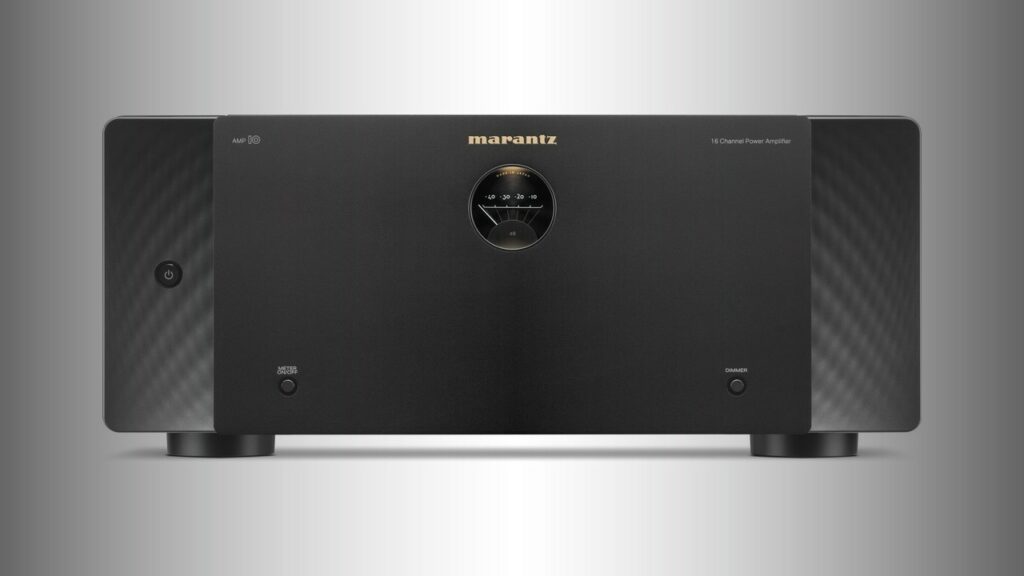
Marantz SR8015 AV receiver, combining 11.2-channel processing with substantial amplification and Audyssey calibration.
The Marantz SR8015 is an 11.2-channel flagship AV receiver built around substantial internal engineering and broad format support.
Its copper-plated chassis houses a massive shielded toroidal transformer, selected components, discrete HDAM amplifier modules with current feedback, and high-capacity capacitors.
It can decode Dolby Atmos in a 7.1.4-channel layout without an additional amplifier, along with DTS:X and Auro-3D, and it also supports DTS Virtual:X for creating a three-dimensional effect from simpler configurations. Audyssey MultEQ XT32 handles speaker calibration, supported by Dynamic Volume, Dynamic EQ, LFC, and Sub EQ HT for dual subwoofer correction.
Best for: High-capability receiver systems needing strong onboard amplification and calibration
- 11.2-channel flagship AV receiver
- Dolby Atmos 7.1.4 without an additional amplifier
- DTS:X, Auro-3D, and DTS Virtual:X support
- Audyssey MultEQ XT32 with dual-subwoofer correction tools
Verdict: A fully equipped flagship receiver for home cinemas that need extensive decoding, room calibration, and 11.2-channel capability in a single component.
Frequently asked questions
Should I choose an AV receiver or a surround processor?
Choose an AV receiver if you want decoding, HDMI switching, processing, and amplification in one chassis.
Choose a surround processor such as the Lyngdorf MP-40 2.1 if your system is built around separate power amplifiers and you want the processor dedicated to signal management, room correction, and format handling.
How many channels do I need for immersive home cinema?
That depends on the speaker layout you plan to install.
The Onkyo TX-RZ50 can run 5.2.4 or 7.2.2 with its built-in amplification and can process 7.2.4 with an added 2-channel amplifier.
The Marantz SR8015 can handle Dolby Atmos in a 7.1.4 layout without an additional amplifier. The Lyngdorf MP-40 2.1 is a 12-channel processor for systems using external amplification.
Why does room correction matter in home cinema?
Rooms strongly affect bass, clarity, and surround balance.
The Lyngdorf uses RoomPerfect to address the room’s influence, while the Marantz includes Audyssey MultEQ XT32 with related tools for volume, tonal balance, low-frequency management, and dual-subwoofer correction.
These systems are useful when speaker placement and room acoustics are less than ideal.
Can older stereo or surround material benefit from these systems?
Yes, within the limits of the processing provided.
The Onkyo TX-RZ50 includes Dolby Surround and DTS Neural:X, which can extract height information from older soundtracks for spatial playback.
The Marantz SR8015 supports DTS Virtual:X, which is intended to create a three-dimensional effect even from simpler configurations.
How to choose the right home cinema control center
Start with the architecture of the system.
If you already own, or plan to buy, separate power amplifiers, the Lyngdorf MP-40 2.1 is the most purpose-built option here: it is a fully digital 12-channel processor with RoomPerfect, HDMI 2.1, 8K support, and immersive-format handling.
It is especially relevant when the priority is clean signal management and room-aware processing rather than built-in amplification. If you want one component to handle most duties, the Onkyo TX-RZ50 and Marantz SR8015 are the more direct choices. The Onkyo is attractive for flexible immersive layouts, including built-in 5.2.4 or 7.2.2 operation and 7.2.4 processing with an added 2-channel power amplifier. It also covers Dolby Atmos, DTS:X, IMAX Enhanced, and upmixing options for older content. The Marantz SR8015 is the stronger fit when the receiver itself needs to be the system’s high-capability hub. Its 11.2-channel design, Dolby Atmos 7.1.4 capability without an extra amplifier, DTS:X, Auro-3D, DTS Virtual:X, substantial internal construction, and Audyssey MultEQ XT32 calibration package make it a comprehensive receiver for ambitious speaker layouts. Before choosing, map the speakers you intend to use, confirm whether external amplification is part of the plan, and decide how important room correction is in your space. A smaller, well-matched layout with appropriate calibration will usually serve a home cinema better than a more complex channel count that the room, amplification, or installation cannot support properly.