

The right turntable is not necessarily the most elaborate one.
It is the model that suits your amplifier, speakers, records and preferred level of involvement.
Built-in phono stages and Bluetooth can simplify a system, while adjustable tonearms, replaceable cartridges and balanced connection options leave more room for future changes. This selection covers several distinct approaches. The Goldring GR3 and TONE Turntable emphasize straightforward setup, the Audio-Technica AT-LPW50BT combines wired and wireless flexibility, and the Pro-Ject AUTOMAT A2 provides fully automatic operation. More specialized designs from EAT, MoFi Electronics, Musical Fidelity, Rekkord Audio and VPI focus on isolation, adjustment or upgrade potential. Before choosing, check whether your amplifier has a phono input, whether you need wireless playback, and which record speeds you use. It is also worth deciding whether you want a factory-prepared package or a turntable that encourages cartridge, tonearm and cable changes over time.
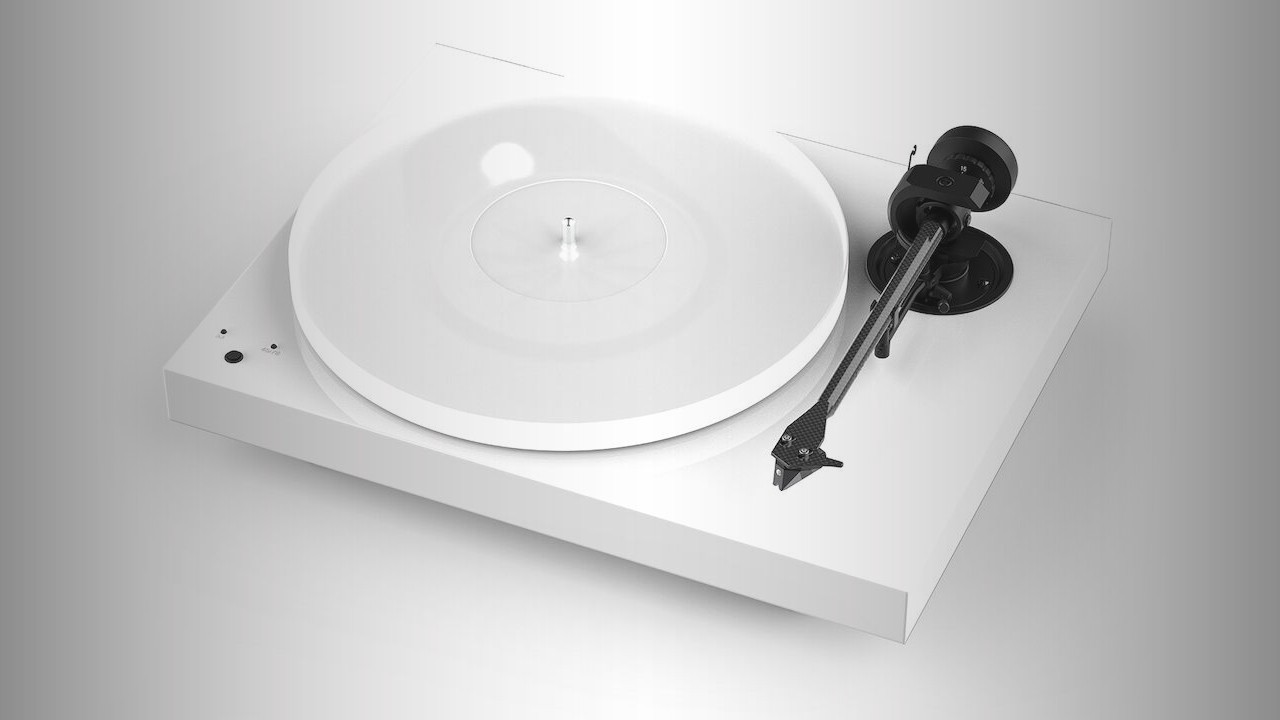
1. Pro-Ject X1 B
The Pro-Ject X1 B pairs a carefully finished plinth with electronic speed selection and a balanced-ready signal path.
The Pro-Ject X1 B combines convenient everyday operation with a clear upgrade route.
It arrives with an Ortofon Pick it S2 MM cartridge, but its True Balanced signal path is prepared for use with a suitable moving-coil cartridge and compatible balanced phono amplifier.
Moving to that configuration requires the appropriate connections and additional cable rather than replacing the turntable. Electronic switching between 33 and 45 rpm avoids manual belt changes, while the eight-layer lacquer and optional real-walnut veneer give the plinth a carefully finished appearance.
Best for: Listeners planning a balanced cartridge upgrade
- True Balanced signal path supports a future balanced MC setup
- Ortofon Pick it S2 MM cartridge included
- Electronic 33 and 45 rpm switching
- Lacquer or real-walnut finish options
Verdict: A refined, upgrade-minded turntable that remains practical with its supplied moving-magnet cartridge.

2. Goldring GR3 Turntable
The Goldring GR3 arrives with an E3 moving-magnet cartridge and an integrated phono preamplifier.
Goldring has designed the GR3 around simple system integration.
Its Goldring E3 moving-magnet cartridge is installed and adjusted at the factory, reducing the setup required before playing a record.
The built-in phono preamplifier means the turntable can connect to an amplifier without a dedicated phono input or directly to compatible active speakers. That makes it especially relevant for listeners who want a compact vinyl system without immediately adding a separate phono stage.
Best for: Straightforward plug-and-play systems
- Factory-installed Goldring E3 MM cartridge
- Built-in phono preamplifier
- Compatible with amplifiers and active speakers
- Minimal initial setup
Verdict: The GR3 is a sensible choice when easy setup and a built-in phono stage matter more than extensive configuration.
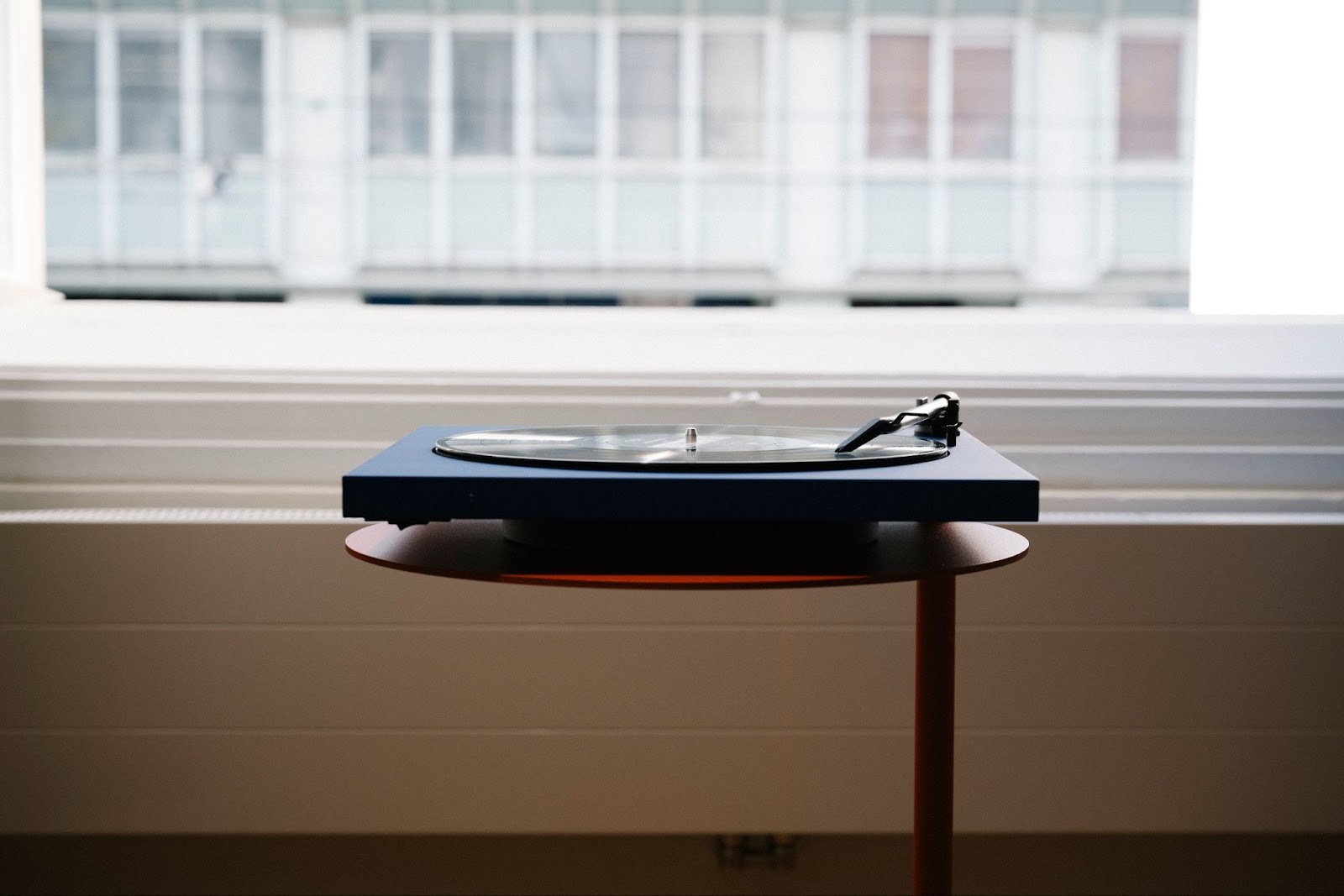
3. TONE Turntable
The TONE Turntable hides its motor, bearing, phono stage and Bluetooth hardware within a compact aluminum base.
The TONE Turntable takes an unusually minimalist approach, concealing its motor, bearing, phono stage and Bluetooth module inside a round aluminum base.
A slim MDF plinth and lightweight platter preserve the low-profile appearance, while the straight metal tonearm uses a fixed counterweight.
Tracking and anti-skating are adjusted at the factory, and an Ortofon OM5e cartridge is supplied. The result is a turntable intended to reduce setup demands while supporting both conventional and wireless system arrangements.
Best for: Minimalist rooms and uncomplicated setup
- Built-in phono stage
- Integrated Bluetooth module
- Factory-adjusted counterweight and anti-skating
- Ortofon OM5e cartridge included
Verdict: TONE combines distinctive low-profile design with factory preparation, an integrated phono stage and Bluetooth connectivity.

4. Audio-Technica AT-LPW50BT
The rosewood-finished Audio-Technica AT-LPW50BT features a carbon-fiber tonearm, switchable phono stage and Bluetooth connection.
The manual, belt-driven AT-LPW50BT offers several ways to build a vinyl system.
Its switchable phono preamplifier permits connection to equipment with or without a phono input, while Bluetooth provides a wireless alternative.
The straight carbon-fiber tonearm has adjustable tracking force and dynamic anti-skating, and the supplied AT-VM95E cartridge accepts other styli from the VM95 range. A 30 mm MDF plinth, cast-aluminum platter and rubber mat address resonance, while the motor encoder regulates rotation at 33⅓ and 45 rpm.
Best for: Flexible wired and wireless systems
- Wired and Bluetooth playback options
- Switchable built-in phono preamplifier
- Adjustable carbon-fiber tonearm
- VM95-series stylus compatibility
Verdict: The AT-LPW50BT balances accessible connectivity with meaningful tonearm and stylus adjustment options.
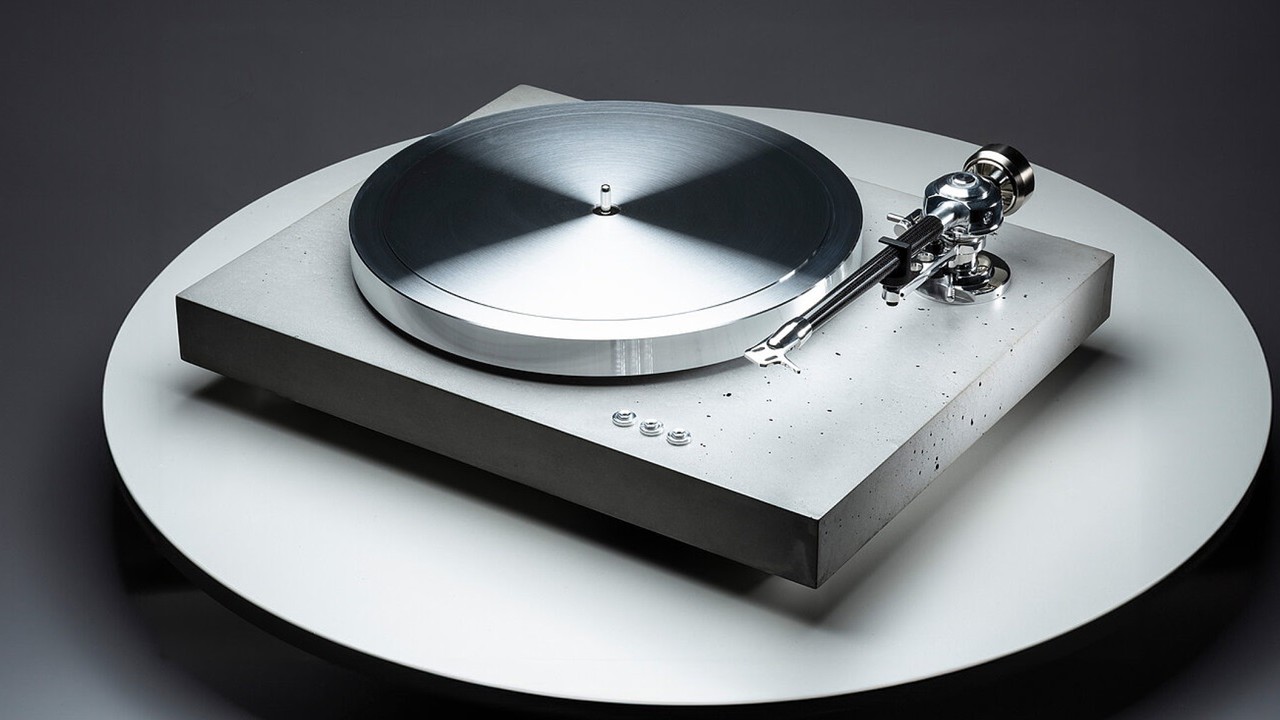
5. EAT C-Dur Concrete
The EAT C-Dur Concrete uses a substantial concrete chassis, an aluminum platter assembly and a 10-inch carbon-fiber tonearm.
The defining feature of the EAT C-Dur Concrete is its handmade solid-concrete chassis, which weighs nearly 32 kg and is intended to suppress vibration and resonance.
Its 10-inch carbon-fiber C-Note tonearm incorporates internal silicone damping, while the main platter and 900 g sub-platter are made from solid aluminum.
The motor sits in a separate steel housing for isolation, and electronic control provides convenient selection of 33 or 45 rpm. A semi-balanced DIN-to-RCA cable is supplied, with provision for moving to a fully balanced cable.
Best for: Systems prioritizing mechanical isolation
- Heavy solid-concrete chassis
- 10-inch carbon-fiber tonearm
- Separately housed motor
- Electronic 33 and 45 rpm control
Verdict: The C-Dur Concrete is a highly specialized design built around mass, damping and separation from vibration.

6. MoFi Electronics MasterDeck
The MoFi Electronics MasterDeck combines a thick aluminum-and-Delrin platter with a fully adjustable 10-inch tonearm.
The MasterDeck sits at the top of MoFi Electronics' turntable range and provides unusually broad setup control.
Its 10-inch dual-pivot tonearm has a removable headshell and permits adjustment of azimuth, vertical tracking angle, overhang and anti-skating.
Three speeds are supported: 33⅓, 45 and 78 rpm, supplemented by fine speed adjustment and a display. The DC motor operates in an isolated housing, while the thick aluminum-and-Delrin platter runs on an inverted bearing. An aluminum and solid-wood body rests on Harmonic Resolution Systems support feet for mechanical and acoustic isolation.
Best for: Experienced users seeking extensive adjustment
- Supports 33⅓, 45 and 78 rpm
- Extensively adjustable 10-inch tonearm
- Removable headshell
- Isolated motor and HRS support feet
Verdict: The MasterDeck is the most configuration-focused option here, particularly for listeners who need three speeds and detailed tonearm control.

7. Musical Fidelity Roundtable S
The Musical Fidelity Roundtable S has a rounded MDF plinth, polished-steel platter and nine-inch aluminum tonearm.
The Roundtable S is a belt-driven design with a polished-steel platter, a varnished MDF plinth and rounded corners.
Its statically balanced nine-inch aluminum tonearm allows tracking-force adjustment and accommodates cartridges weighing between 5 and 13 g.
An Ortofon 2M Red moving-magnet cartridge is included, and the turntable is adjusted at the factory apart from setting the recommended tracking force. Adjustable tonearm height also makes a later cartridge change more practical. Playback is available at 33 and 45 rpm.
Best for: Listeners who want an included cartridge with upgrade scope
- Ortofon 2M Red cartridge included
- Adjustable tonearm height and tracking force
- Supports cartridges from 5 to 13 g
- Factory-adjusted assembly
Verdict: The Roundtable S offers a prepared starting point without removing the adjustments needed for a future cartridge change.

8. Rekkord Audio M500
The Rekkord Audio M500 integrates its aluminum-clad sub-chassis, tonearm and platter bearing on four damping springs.
The Rekkord Audio M500 uses a suspended sub-chassis supported by four parabolic springs, with the tonearm and platter bearing mounted to the isolated structure.
Its straight aluminum tonearm runs on a cardan bearing and includes a carbon headshell, damped cueing lift, adjustable tracking force and an accessible anti-skating system.
Buyers can choose a version without a cartridge or one with a pre-installed Ortofon 2M Blue. A touch control with LED indication handles electronic speed selection, while the low-noise belt-drive motor is damped from the chassis.
Best for: Vinyl enthusiasts choosing their own cartridge path
- Spring-supported sub-chassis
- Choice of no cartridge or an Ortofon 2M Blue
- Adjustable tracking force and anti-skating
- Touch-operated electronic speed selection
Verdict: The M500 combines suspended construction with useful setup controls and a choice between supplied-cartridge and cartridge-free configurations.

9. VPI Cliffwood
The VPI Cliffwood uses a laminated MDF plinth, aluminum platter and nine-inch gimbal-mounted tonearm.
The VPI Cliffwood is a manual, belt-driven model intended as a more accessible entry into the manufacturer's range.
It combines a 30 mm laminated MDF plinth, aluminum platter and nine-inch damped aluminum gimbal tonearm.
A VPI/Grado Green cartridge is installed, but there is no built-in phono stage, so a suitable phono input or external preamplifier is required. The tonearm platform can also accept VPI's more advanced JMW 9 tonearm, creating a defined upgrade route. It supports 33 and 45 rpm and is offered in three finishes.
Best for: Manual vinyl systems with future tonearm upgrades
- VPI/Grado Green cartridge included
- Tonearm platform supports a JMW 9 upgrade
- Damped nine-inch aluminum tonearm
- Three finish choices
Verdict: The Cliffwood provides a focused manual setup with an included cartridge and a specific path to a more advanced VPI tonearm.

10. Pro-Ject AUTOMAT A2
The Pro-Ject AUTOMAT A2 combines automatic tonearm operation with a substantial MDF enclosure and an Ortofon 2M Red cartridge.
The Pro-Ject AUTOMAT A2 is the convenience-led choice in this group.
Its automatic mechanism controls the tonearm at the beginning and end of playback, with selectable drop points for seven-inch singles and 12-inch records.
The listener can still set tracking force, and a pre-adjusted Ortofon 2M Red cartridge is supplied. A substantial hand-painted MDF enclosure, separate floating support for the tonearm bearing, platter bearing and motor, and aluminum feet with silicone damping are intended to limit unwanted vibration. The straight 8.3-inch tonearm uses an upgraded four-point gimbal bearing.
Best for: Listeners who prefer automatic operation
- Fully automatic start and return operation
- Selectable drop points for seven-inch and 12-inch records
- Pre-adjusted Ortofon 2M Red cartridge
- Separate floating support for key components
Verdict: The AUTOMAT A2 adds full automation while retaining adjustable tracking force and a pre-aligned Ortofon cartridge.
Frequently asked questions
Do I need a turntable with a built-in phono preamplifier?
You need phono amplification somewhere in the signal chain.
If your amplifier or active speakers lack a phono input, a model with a built-in stage, such as the Goldring GR3, TONE Turntable or Audio-Technica AT-LPW50BT, can simplify connection.
Otherwise, choose a separate compatible phono preamplifier.
Is Bluetooth useful on a turntable?
Bluetooth is useful when wireless speaker or headphone compatibility matters more than maintaining an entirely wired signal path.
The TONE Turntable and Audio-Technica AT-LPW50BT provide wireless operation while retaining other connection options, making them more adaptable than a wireless-only source.
Should I choose a manual or automatic turntable?
A manual turntable requires you to place and lift the tonearm, while a fully automatic model handles the beginning and end of playback.
The Pro-Ject AUTOMAT A2 is the clearest fit for convenience; the other models suit listeners comfortable with more hands-on operation and, in several cases, more adjustment.
What should I check before changing a cartridge?
Confirm the mounting format, supported cartridge weight and available tracking-force, anti-skating and tonearm-height adjustments.
The Audio-Technica supports VM95-series replacement styli, the Roundtable S accommodates cartridges from 5 to 13 g, and the Rekkord M500 is available without a cartridge for buyers who want to select their own.
How to make the final choice
Begin with system compatibility rather than appearance.
Check for a phono input on your amplifier or active speakers, then decide whether an integrated phono stage would reduce cost and complexity.
Bluetooth can be valuable in a flexible living space, but it is unnecessary if the turntable will remain connected by cable. Owners of 78 rpm records should also note that three-speed support is not universal; among these models, the MasterDeck explicitly supports 78 rpm. Next, consider how much setup and maintenance you want. The Goldring GR3, TONE Turntable and AUTOMAT A2 reduce different kinds of effort through factory preparation, integrated electronics or automation. The X1 B, MasterDeck, Roundtable S, M500 and Cliffwood offer more obvious routes for changing cartridges, cables or tonearms. Heavy or suspended designs such as the C-Dur Concrete and M500 may be preferable where vibration control is a central concern. Finally, allow for the complete signal chain. A turntable without a built-in phono stage needs a compatible external stage or amplifier input, and a balanced-ready design still requires the appropriate cartridge, phono amplifier and cabling. Matching those practical details to your records and listening habits is more important than choosing the model with the longest specification list.


Join the discussion
Share your thoughts, listening impressions or product experience.