

An AV receiver is the control center of a component home theater, combining source management, surround processing and amplification.
The strongest receiver choices in this selection are the Onkyo TX-RZ740 and McIntosh MHT300: the Onkyo supports a larger 9.2-channel layout and IMAX Enhanced, while the McIntosh combines seven amplified channels with Dolby Atmos, DTS:X and modern high-bandwidth video support.
The supplied material also covers soundbars, passive speakers, a turntable and manufacturer profiles. These are not substitutes for an AV receiver in every system, so they are identified clearly rather than presented as equivalent products. The Yamaha and Denon soundbars suit simpler television installations, while the Tannoy and Denon speakers are possible building blocks for a receiver-based system. Before choosing, decide how many speakers the room can accommodate, which surround formats matter and whether every source can be connected. A receiver should be selected as part of a complete system: passive speakers need suitable amplification, while powered soundbars already incorporate their own electronics and generally offer a more self-contained route to television sound.

1. Yamaha YSP-1600: Slim and powerful soundbar
The low-profile Yamaha YSP-1600 soundbar combines HDMI and optical TV connections with Bluetooth, Wi-Fi and MusicCast.
The Yamaha YSP-1600 is a low-profile soundbar rather than an AV receiver, but it offers a compact alternative for rooms where a full component system would be impractical.
Its connections include an optical input and an HDMI input with HDCP 2.2 support.
Integrated Bluetooth and Wi-Fi are joined by AirPlay and DLNA, while MusicCast compatibility allows it to participate in Yamaha’s multi-room ecosystem. Cinema, Music, Sports and Game modes adapt its presentation to different material, and UniVolume is intended to reduce disruptive level changes when the source changes. Control is available from the supplied remote, a compatible TV remote through the learning function, or an iOS or Android application.
Best for: A compact, network-connected TV audio system
- Low-profile enclosure
- Bluetooth and Wi-Fi included
- AirPlay, DLNA and MusicCast support
- Multiple control options
Verdict: Choose the YSP-1600 when simplicity and wireless playback matter more than the expansion options of a conventional AV receiver.

2. Tannoy Mercury 7.2: High-quality speakers made for hi-fi fans
The Tannoy Mercury 7.2 is the larger bookshelf model in a range that also includes floorstanding, center-channel and subwoofer options.
The Tannoy Mercury 7.2 is the larger bookshelf speaker in the redesigned Mercury 7 range.
It is not an AV receiver and requires external amplification, but it can serve as part of a stereo or home-theater system.
Tannoy revised the Mercury design to pursue a more articulate and engaging presentation while reducing compromises associated with budget models. The wider range also includes floorstanding and smaller bookshelf speakers, a dedicated center channel and a matching powered subwoofer, giving buyers a coordinated path toward a multichannel setup. Black, light oak and dark walnut finishes are available.
Best for: Building a matching passive-speaker system
- Suitable for stereo or home-theater systems
- Part of a coordinated speaker range
- Three finish options
- Richer sound than the smaller models in its line
Verdict: The Mercury 7.2 is a flexible bookshelf option for listeners assembling a receiver-powered stereo or home theater from coordinated Tannoy models.

3. Denon SC-N10: A great alternative to a soundbar
The compact Denon SC-N10 uses a 12-centimeter woofer, a dome tweeter and a rear bass-reflex port in a damped MDF cabinet.
The Denon SC-N10 is a compact passive two-way speaker intended for small living spaces.
Its damped MDF enclosure contains a 12-centimeter woofer and a 30-millimeter dome tweeter, with a removable grille covering the front panel.
The rear bass-reflex outlet has a small diameter that permits placement relatively close to a wall. These speakers still require a suitable amplifier or receiver, and the source specifically highlights their smooth midrange and suitability for acoustic music. Adding a suitable subwoofer can turn the pair into a component-based alternative to a soundbar.
Best for: Small rooms and compact receiver-based systems
- Compact damped MDF enclosure
- Two-way driver configuration
- Can be placed relatively close to a wall
- Available in black or white
Verdict: The SC-N10 suits listeners who prefer separate passive speakers to a soundbar and have appropriate amplification available.

4. Onkyo TX-RZ740: 9.2 Channel IMAX Enhanced AV Receiver
The Onkyo TX-RZ740 is a 9.2-channel AV receiver with built-in amplification and IMAX Enhanced support.
The Onkyo TX-RZ740 is the first conventional AV receiver in this selection and supports a 9.2-channel system.
Its defining addition over the preceding model is IMAX Enhanced, a certification and playback ecosystem developed around specially prepared content and a version of DTS:X.
The receiver is designed to process digital and analog audio sources and use its built-in amplification to distribute sound beyond a single room. Buyers comparing it with the earlier TX-RZ730 should note the reduced legacy connectivity: the TX-RZ740 removes one component input, cuts the optical-input count from two to one and has fewer pairs of speaker terminals.
Best for: An expansive multichannel home theater
- 9.2-channel configuration
- IMAX Enhanced support
- Built-in amplification
- Handles digital and analog audio sources
Verdict: The TX-RZ740 is the most direct fit here for buyers wanting a 9.2-channel receiver with IMAX Enhanced, provided its reduced legacy connections meet the system’s needs.
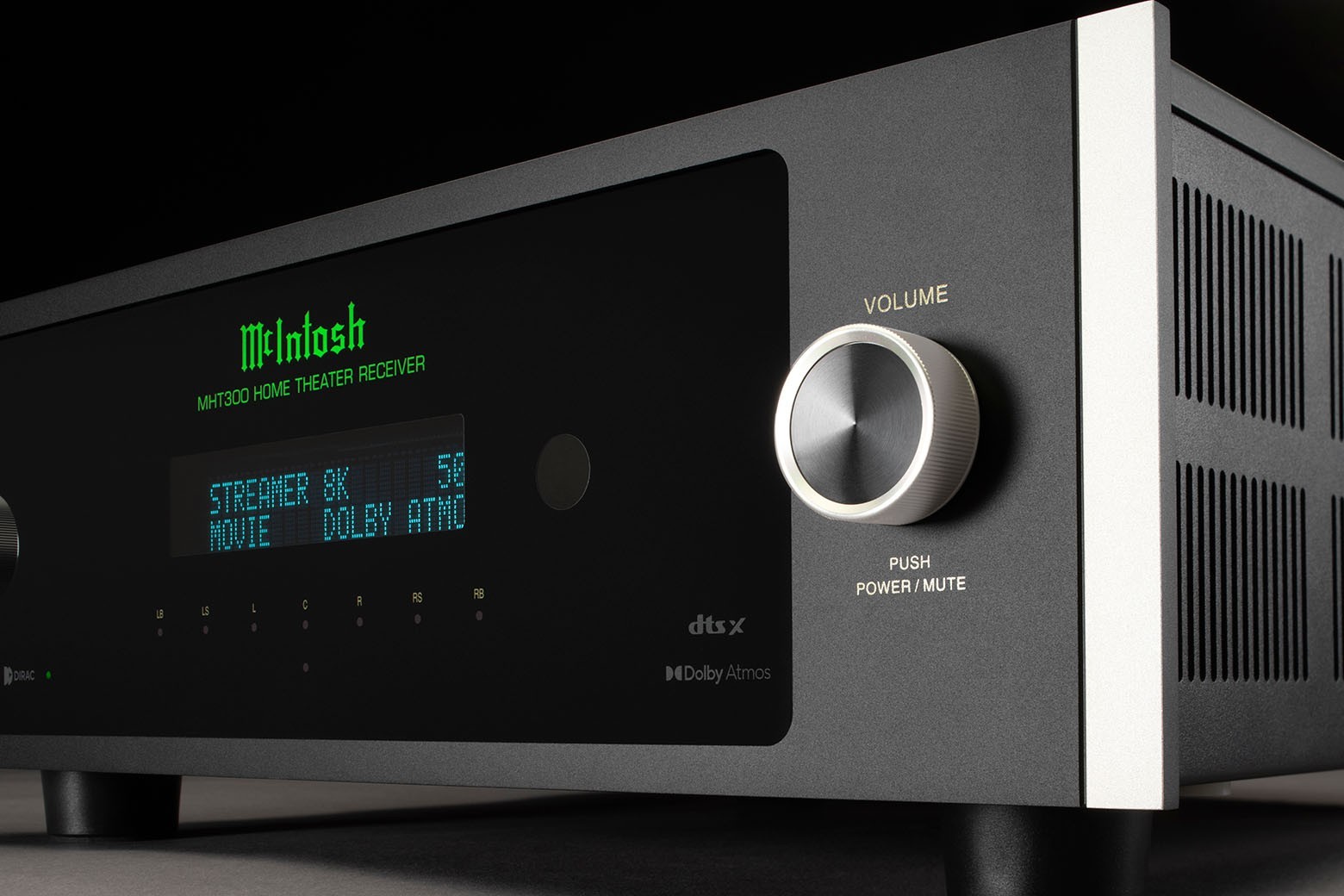
5. McIntosh MHT300: Absolute Hi-End class AV receiver
The McIntosh MHT300 provides seven amplified channels, Dolby Atmos and DTS:X decoding, plus preamp outputs for expansion.
The McIntosh MHT300 is a premium home-theater receiver with seven channels of amplification rated in the source at 120 watts per channel into 8 ohms.
It can operate as a 7.2-channel system or be configured for 5.2.2-channel Dolby Atmos and DTS:X playback.
Video support extends to UHD 4K at 120 frames per second and 8K at 60 frames per second, making it the more explicitly equipped option here for high-bandwidth sources. Preamp outputs also allow external power amplification to be added when a more extensive installation demands it. This is the receiver for buyers seeking a single McIntosh component rather than a separate processor and multichannel power amplifier combination.
Best for: A premium seven-channel home theater
- 7.2 or 5.2.2-channel operation
- Dolby Atmos and DTS:X support
- 4K 120fps and 8K 60fps video support
- Preamp outputs for system expansion
Verdict: The MHT300 combines McIntosh amplification, immersive-audio decoding and current high-bandwidth video support in one receiver chassis.

6. Denon DHT-S516H: Powerful 2.1 soundbar with a wireless subwoofer
The Denon DHT-S516H pairs a low-profile two-way soundbar with an automatically connected wireless subwoofer.
The Denon DHT-S516H is a self-contained 2.1 soundbar package, not an AV receiver.
Its wireless subwoofer connects automatically to the main speaker, while the bar uses two-way stereo sections with oval woofers and 20-millimeter soft-dome tweeters.
The low enclosure is designed to sit in front of many televisions without obstructing their infrared sensors; an infrared command repeater provides a fallback when blockage occurs. HDMI input and output with Audio Return Channel permit a single-cable TV connection, and optical, analog and USB connections accommodate additional sources. At roughly one meter wide, the bar is described as a suitable visual match for televisions with 50- to 55-inch screens.
Best for: Straightforward 2.1 television sound
- Wireless subwoofer included
- HDMI connection with Audio Return Channel
- Low-profile design with IR repeater
- Optical, analog and USB connections
Verdict: The DHT-S516H is a practical receiver-free package for buyers who want a soundbar, wireless subwoofer and broad connection choice.

7. Denon DP-400: Perfect turntable for any entry-level stereo system
The Denon DP-400 is a belt-drive turntable with three playback speeds, an aluminum platter and automated operation.
The Denon DP-400 is a turntable rather than an AV receiver, but it represents the type of analog source a receiver-based system may need to accommodate.
Its rigid plastic body has 4-millimeter walls, a stated weight of 5.8 kilograms, anti-vibration feet and a dust cover.
The source describes automated start and stop operation, including automatic placement of the stylus at the beginning of a record and return of the tonearm after playback. Manual cueing remains available for selecting an individual track. A belt-driven, die-cast aluminum platter supports 33⅓, 45 and 78 rpm records, with an integrated sensor monitoring playback speed.
Best for: Adding vinyl playback to a component system
- Automated start and tonearm return
- Manual track selection remains possible
- Supports three playback speeds
- Anti-vibration feet
Verdict: The DP-400 is relevant to an AV setup as an analog source, provided the chosen receiver offers a suitable connection path.

8. Primare
Primare is known for Scandinavian industrial design, clear ergonomics and audiophile-oriented component construction.
This source is a manufacturer profile rather than a review of a specific AV receiver.
Primare began in Denmark and established its identity through a combination of restrained industrial design, ergonomics and audiophile-oriented construction.
Its early component ranges helped define the company’s recognizable visual language, including features such as motorized volume control and distinctive remote operation. The profile provides useful background for readers considering Primare electronics, but it does not supply enough model-specific information to recommend a particular receiver or compare its channel count, connections or surround formats.
Best for: Understanding Primare’s design background
- Distinctive industrial design
- Emphasis on ergonomics
- Audiophile-oriented construction
Verdict: Primare is a relevant AV-electronics brand, but this company history cannot substitute for a model-level receiver assessment.

9. McIntosh
McIntosh built its reputation around high-power, low-distortion amplification and its combined-coupled circuit technology.
The McIntosh article is a company history, not a review of an individual AV receiver.
It traces the brand’s origins to the pursuit of high-power, low-distortion amplification and describes the development of the 50W-1 amplifier and its patented combined-coupled circuit.
That background helps explain the amplification heritage behind products such as the MHT300 elsewhere in this guide. However, the profile contains no receiver-specific channel layout, video connectivity or format support, so it should be treated as context rather than as a separate buying recommendation.
Best for: Researching the brand behind the MHT300
- Longstanding amplification focus
- High-power, low-distortion design objective
- Patented combined-coupled circuit heritage
Verdict: This McIntosh profile offers valuable brand context but no standalone AV receiver specification on which to base a purchase.

10. Anthem
Anthem develops Canadian-made AV receivers, processors and multichannel power amplifiers for home-theater systems.
Anthem is presented here as a Canadian home-theater electronics brand producing AV processors, AV receivers and multichannel power amplifiers.
The profile states that its equipment is designed and manufactured in Canada and that components within each power-amplifier family share standardized housings and amplifier modules.
It also describes Anthem’s use of modular upgrades for an earlier processor and its choice of a Sigma Designs VXP media-processing chip. These details indicate a serious home-theater focus, but no current receiver model, channel configuration or connection list is supplied, preventing a direct product recommendation.
Best for: Exploring a home-theater electronics manufacturer
- Produces receivers, processors and power amplifiers
- Designed and manufactured in Canada
- Uses shared architecture within amplifier families
- History of modular processor upgrades
Verdict: Anthem merits consideration as a specialist AV brand, although this profile lacks the model-specific evidence required for a receiver verdict.
Frequently asked questions
How many receiver channels should I choose?
Start with the speaker layout you can realistically install.
The McIntosh MHT300 supports 7.2 or 5.2.2 operation, while the Onkyo TX-RZ740 supports a larger 9.2-channel system; extra channels have little value if the room cannot accommodate the corresponding speakers.
Do passive speakers need an AV receiver?
Passive models such as the Tannoy Mercury 7.2 and Denon SC-N10 require suitable external amplification.
An AV receiver can provide that amplification while also handling source selection and multichannel processing.
When is a soundbar more appropriate than an AV receiver?
A soundbar is useful when space, wiring simplicity or ease of installation takes priority over system expansion.
The Yamaha YSP-1600 integrates wireless playback features, while the Denon DHT-S516H includes a wireless subwoofer and HDMI Audio Return Channel connectivity.
Which connections should I check before buying a receiver?
List every television, digital, analog and network source first, then confirm that the receiver has enough compatible inputs.
Legacy connections deserve particular attention: the Onkyo TX-RZ740 has one optical input and fewer legacy connections than its predecessor, while the McIntosh MHT300 explicitly supports 4K 120fps and 8K 60fps video.
How to choose the right AV setup
Begin with the room and speaker plan rather than the longest feature list.
A 5.2.2 arrangement places different demands on installation than a 7.2 or 9.2 system, and the intended layout determines how many amplified channels are genuinely useful.
The McIntosh MHT300 is the clearer match for a premium seven-channel or 5.2.2 installation, while the Onkyo TX-RZ740 is the more suitable option from this selection when nine-channel expansion and IMAX Enhanced are priorities. Connectivity should be audited source by source. Confirm the required HDMI video formats, count optical and analog devices, and check whether a turntable such as the Denon DP-400 has an appropriate route into the system. Preamp outputs, as provided on the MHT300, are relevant when external amplification may be added later. Legacy equipment owners should pay particular attention to the TX-RZ740’s reduced component, optical and speaker-terminal provision compared with its predecessor. Finally, decide whether a component system is appropriate at all. Passive Tannoy or Denon speakers provide flexibility but need amplification and cabling. The Yamaha YSP-1600 and Denon DHT-S516H reduce that complexity by integrating amplification into a soundbar format, with the Denon also including a wireless subwoofer. Brand histories for Primare, McIntosh and Anthem can inform further research, but a receiver decision should ultimately rest on model-specific channel support, connections, surround processing and compatibility with the chosen speakers.

Join the discussion
Share your thoughts, listening impressions or product experience.