Practical Speaker Picks for Different Rooms and Setups
A practical Stereoindex guide to choosing speakers by use case, covering active stereo models, desktop systems, portable Bluetooth, soundbars, studio monitors, built-in options, and traditional hi-fi speakers.
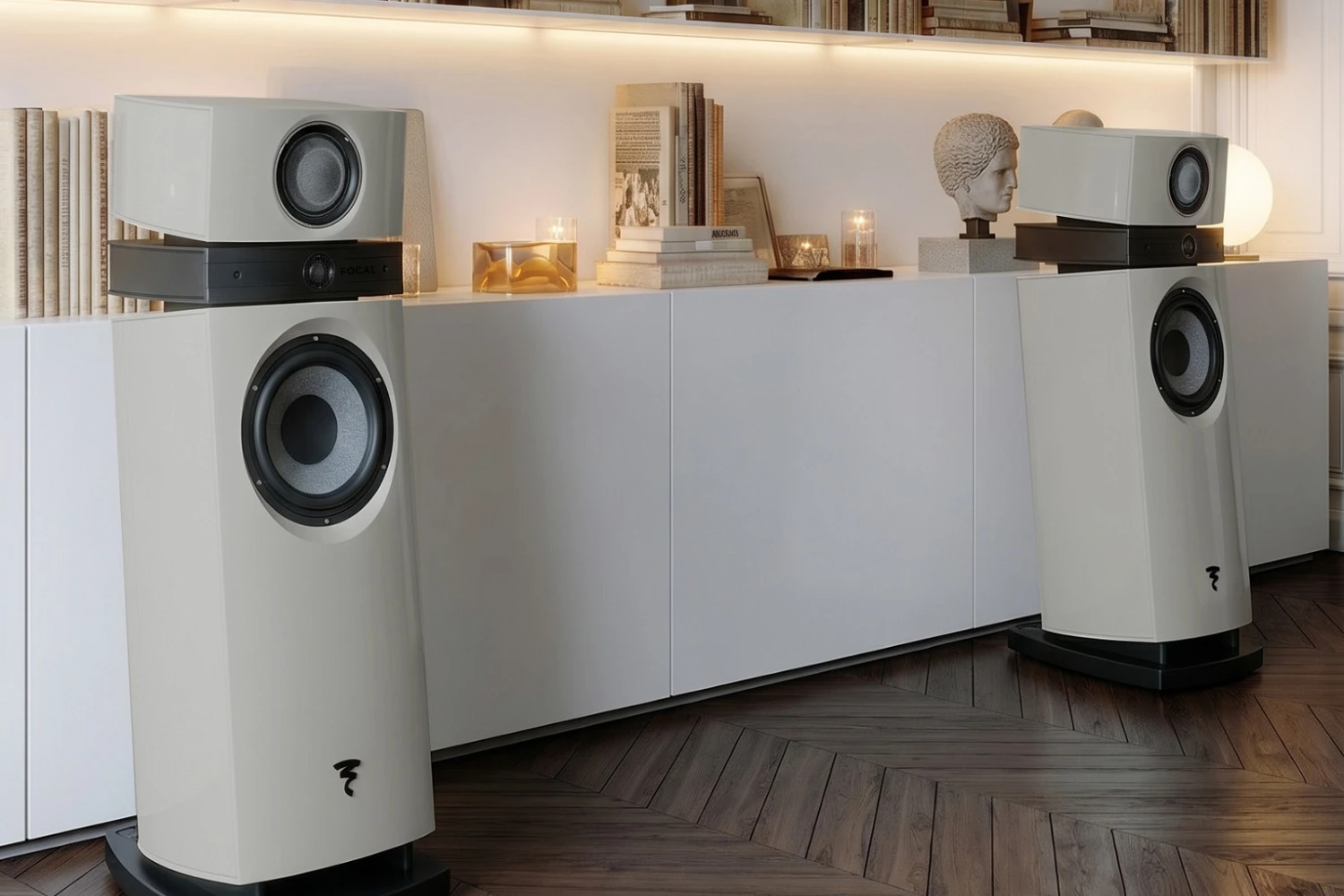
Shopping for speakers is less about chasing one universal answer and more about matching the product type to the way you actually listen.
A desktop system, a TV-friendly active pair, a portable Bluetooth speaker, a studio monitor, and a high-end floorstander all solve different problems, even though they sit under the same broad category.
This guide brings together a varied set of Stereoindex source articles covering active stereo speakers, compact desktop systems, portable speakers, soundbars, studio monitors, built-in cabinet speakers, standmount hi-fi designs, and a high-end floorstanding model. The emphasis is practical: connectivity, placement, cabinet format, intended use, and the distinctions that matter before you start comparing finer details. The recommendations below are grounded only in the supplied source material. Where the source gives detailed drivers, inputs, amplification, or placement features, those details are included; where it describes a broader category rather than a specific product, the entry is treated as buying context rather than a performance ranking.

1. Q Acoustics M20: Active Speakers with Location-Based Sound Correction
Q Acoustics M20 active stereo speakers with rounded cabinets, full front grilles, rear bass reflex ports, and a master-slave electronics layout.
The Q Acoustics M20 is a compact active stereo system built around the familiar master-slave arrangement, with amplification and DSP housed in one speaker.
Its strongest practical appeal is flexibility: Bluetooth 5.0 with aptX HD support, USB computer connection through the built-in DAC, optical and coaxial digital inputs, and an analog RCA input give it several ways to fit into a modern setup.
The DSP location setting is especially useful for real rooms, allowing adjustment depending on whether the speakers are placed in a corner, against a wall, or more freely in the room.
Best for: Listeners who want a flexible active stereo pair for desk, TV, or room use
- DSP adjustment for corner, wall, or free-space placement
- Bluetooth 5.0 with aptX HD support
- USB input with built-in DAC for computer use
- Optical, coaxial, and analog RCA inputs
Verdict: The Q Acoustics M20 is a practical active speaker choice when placement flexibility and broad input options matter as much as compact stereo sound.
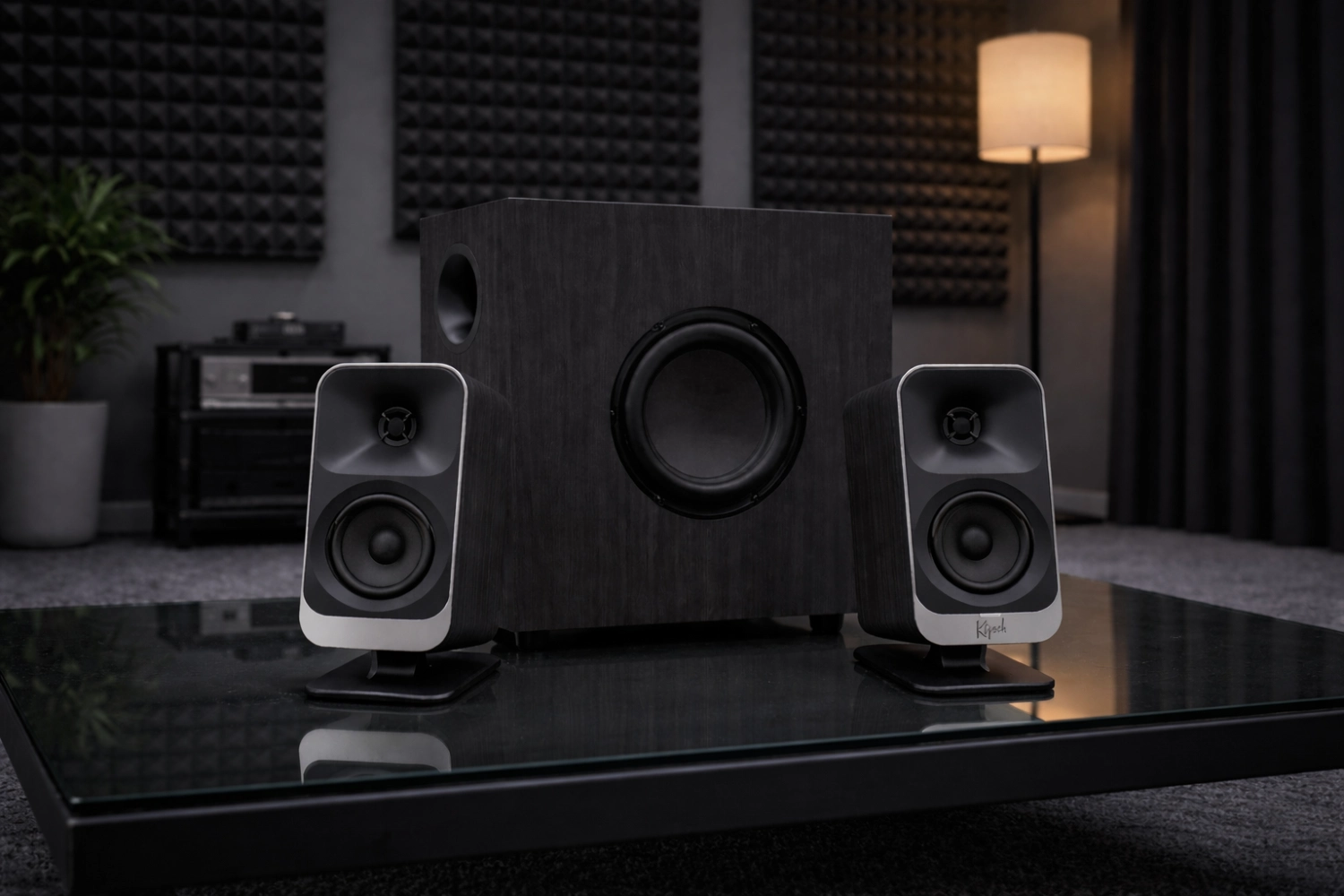
2. Klipsch ProMedia Lumina: The Iconic 2.1 System Reinvented
Klipsch ProMedia Lumina 2.1 desktop system pairing compact powered satellite speakers with a dedicated subwoofer.
The Klipsch ProMedia Lumina revisits the compact 2.1 desktop idea with powered satellite speakers and a dedicated subwoofer.
The source frames it as a modern reinterpretation for hybrid spaces where music, gaming, streaming, and work all happen at the same desk.
Compared with typical compact desktop speakers, the separate subwoofer is the key architectural difference, intended to add scale and low-frequency impact while the updated satellites keep the system visually cleaner and more compact.
Best for: Desktop users who want a compact 2.1 system rather than a simple speaker pair
- 2.1-channel layout with compact powered satellites and a dedicated subwoofer
- Designed for desktop music, gaming, streaming, and work setups
- More compact and visually cleaner satellite design
- Subwoofer tuned for tighter, more controlled low-frequency performance
Verdict: The ProMedia Lumina makes the most sense for a desk-based listener who wants the added weight of a subwoofer in a modernized compact system.
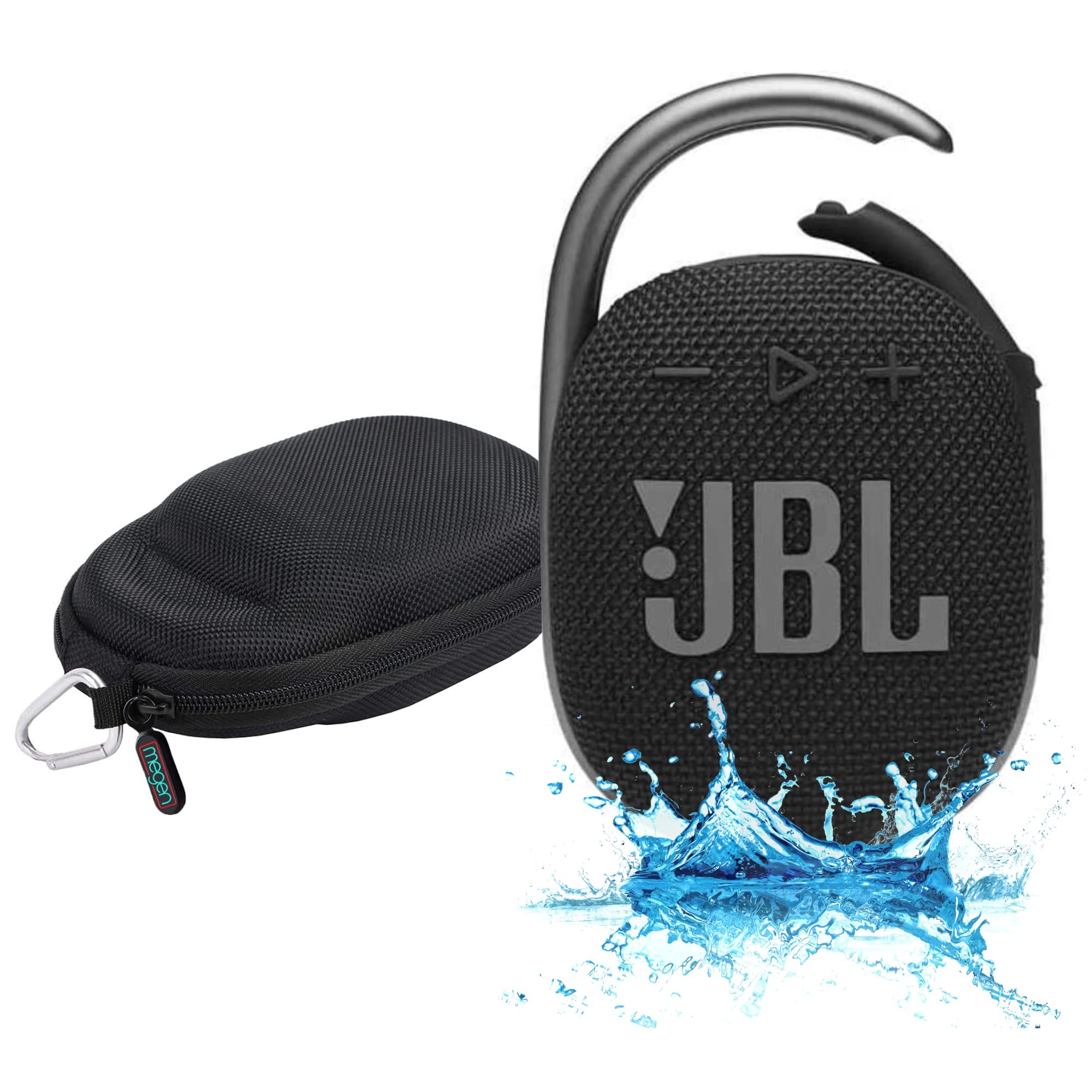
3. JBL Clip 4: Fifty percent more powerful than big brother
JBL Clip 4 portable Bluetooth speaker with integrated carabiner, front controls, rubberized rear elements, and IP67-rated protection.
The JBL Clip 4 is the portable outlier in this speaker selection: a small Bluetooth speaker with a built-in carabiner, rubberized rear elements for placing it on flat surfaces, and IP67-rated protection.
The source highlights a 40 mm, 5 W driver, Bluetooth 5.1, up to 10 hours of wireless playback, USB-C charging, and a weight of about 300 g.
Its role is not to replace a stereo system, but to provide easy music playback wherever a compact, clip-on design is useful.
Best for: Portable listening where compact size, durability, and easy attachment matter
- Compact body with integrated carabiner
- IP67-rated housing protection
- Bluetooth 5.1 with up to 10 hours of wireless playback
- USB-C charging
Verdict: The JBL Clip 4 is a straightforward portable speaker for listeners who prioritize carry-anywhere convenience over stereo scale.

4. Triangle Borea Connect: Compact speakers offering a seamless audio experience
Triangle Borea Connect active compact speakers designed with HDMI, USB-B, remote operation, and integrated phono functionality in mind.
Triangle’s Borea Connect models extend the Borea active speaker line with connectivity aimed at both TV and desktop use.
The addition of HDMI allows direct TV connection and control through either the supplied remote or the TV remote, while USB-B supports direct computer connection.
The source also notes an integrated vinyl preamp and a collaboration with Pro-Ject, making these speakers especially relevant for buyers who want a compact active system that can bridge television, computer, and turntable sources without building a larger component stack.
Best for: Compact active speaker setups serving a TV, computer, and turntable
- HDMI input for direct TV connection
- USB-B input for computer use
- Integrated vinyl preamp
- Remote control and TV remote operation supported
Verdict: Triangle Borea Connect is a strong fit when the priority is a neat, source-flexible active speaker system rather than a traditional passive hi-fi chain.

5. The Best Soundbars at CES
Soundbars can range from slim TV-friendly cabinets to larger multi-channel designs intended for more immersive home theater use.
This source article is a soundbar buying context piece rather than a single product recommendation.
Its useful takeaway is that soundbars have moved beyond the simple long, thin TV-speaker format: the category now includes everything from compact models intended to disappear into interiors to larger multi-channel designs with Dolby Atmos capability.
For buyers who want better TV sound with a smaller footprint than separate speakers and components, the soundbar category remains worth considering, especially where cabinet size, driver placement, and room integration are central concerns.
Best for: TV viewers who want a simpler speaker solution with minimal system clutter
- Designed as compact TV speaker solutions
- Available in small-footprint and larger multi-channel forms
- Some models include Dolby Atmos capability
- Broad category suited to home theater simplification
Verdict: A soundbar is the practical speaker choice when TV integration and space efficiency outweigh the flexibility of separate stereo or surround speakers.

6. The best studio monitors right now
Focal Alpha 65 Evo studio monitor with a two-way active design, front slotted port, and rear RCA, XLR, and TRS inputs.
This article makes the case for using professional active studio monitors in a home audio system, with the important caveat that setup requirements differ from consumer speakers.
The source points to advantages such as active bandpass amplification, high overload capacity, and low intermodulation distortion, while also noting the practical need for a pre-amplifier plus interconnect and power cables for each monitor.
The Focal Alpha 65 Evo is described as an example, with a two-way design, inverted aluminum dome tweeter, Slatefiber mid/bass driver, Class D amplification, front slotted port, and RCA, XLR, and TRS inputs.
Best for: Listeners comfortable with pro-style active monitors and the extra cabling they require
- Active bandpass amplification
- High overload capacity
- Low intermodulation distortion
- Balanced and unbalanced input options noted on the Focal Alpha 65 Evo
Verdict: Studio monitors can be a serious value route for home listening, provided the buyer accepts their utilitarian design and system setup needs.

7. Onkyo Creator GX-10DB and GX-30ARC: Powerful active desktop speakers
Onkyo Creator GX-10DB and GX-30ARC active desktop speakers with compact cabinets and angled stands for monitor-side placement.
Onkyo’s Creator GX-10DB and GX-30ARC are compact active desktop speakers designed for use beside a monitor, with the manufacturer also positioning them as TV companions.
Both use a master-slave architecture, Class D amplification, and DSP, and the source emphasizes their compact form, contemporary design, angled stands, and broad connectivity.
Bluetooth 5.3 is specifically listed for both models, while the GX-30ARC name and source positioning underline the range’s work-and-entertainment focus.
Best for: Desk setups that need compact powered speakers for work and entertainment
- Compact active desktop format
- Master-slave system architecture
- Class D amplification with DSP
- Bluetooth 5.3 on both models
Verdict: The Onkyo Creator models are aimed at buyers who want modern active desktop speakers with integrated amplification, DSP, and practical connectivity.

8. Lyngdorf CS-2: Built-in full-range shelf speaker
Lyngdorf CS-2 built-in cabinet speaker with matte black MDF enclosure, front bass reflex port, soft dome tweeter, and aluminum-cone mid/bass driver.
The Lyngdorf CS-2 is a built-in cabinet speaker intended primarily for furniture integration, though the source also notes niche-in-wall mounting.
Its 20 cm-deep MDF cabinet is shallower than the related CS-1, and the front-facing bass reflex port helps suit installation scenarios where rear clearance may be limited.
The driver complement includes a 1-inch soft fabric dome tweeter and a 6.5-inch aluminum-cone mid/bass driver, making this a specialist solution for discreet custom-style installations rather than a conventional freestanding speaker.
Best for: Discreet built-in or furniture-integrated speaker installations
- Designed for furniture integration
- Can also be mounted in a wall niche
- Shallow 20 cm MDF cabinet
- Front-facing bass reflex port
Verdict: The Lyngdorf CS-2 is a purpose-built option for buyers who need a cabinet speaker to disappear into furniture or a niche without relying on a standard bookshelf design.

9. Xavian Medea: Two-way speaker with a bass reflex housing
Xavian Medea two-way bass reflex speaker with hand-veneered MDF cabinet and optional sand-fillable stand.
The Xavian Medea is a two-way bass reflex loudspeaker using ScanSpeak Ellipticor drivers, with a cabinet made from MDF and finished by hand veneering.
The source emphasizes cabinet construction details, including complex internal bracing and bitumen-lined walls, along with an optional dedicated stand that can be filled with ten kilograms of sand.
This is a more traditional hi-fi speaker proposition than the active desktop and lifestyle models elsewhere in the guide, with attention placed on driver choice, cabinet work, and matching support.
Best for: Traditional hi-fi systems where cabinet construction and stand matching are priorities
- Two-way bass reflex design
- Uses ScanSpeak Ellipticor drivers
- Hand-veneered MDF cabinet
- Optional stand can be sand-filled
Verdict: The Xavian Medea suits listeners looking at a carefully built passive speaker with notable driver selection and a dedicated stand option.
10. Focal Scala Utopia Evo M: New Drivers, PRISM Tweeter & $40,000 High-End Speaker
Focal Scala Utopia Evo M floorstanding speaker with three-way bass reflex architecture, updated midrange driver, and PRISM M-profile tweeter.
The Focal Scala Utopia Evo M is the high-end floorstanding entry here, keeping the Scala’s three-way bass reflex architecture while revising key components including drivers, crossover filter, enclosure tuning, and mechanical structure.
The source highlights a new 5-inch reinforced W-cone midrange driver with an M-profile diaphragm, plus a 27 mm PRISM M-profile inverted dome tweeter.
Focal’s stated focus is cleaner, more linear midrange performance with less distortion and greater control at higher listening levels, making this a speaker aimed squarely at ambitious full-range hi-fi systems.
Best for: High-end full-range hi-fi systems built around a serious floorstanding speaker
- Three-way bass reflex architecture
- Revised drivers, crossover filter, enclosure tuning, and mechanical structure
- New 5-inch reinforced W-cone M-profile midrange driver
- 27 mm PRISM M-profile inverted dome tweeter
Verdict: The Scala Utopia Evo M is the most ambitious speaker in this selection, focused on revised driver technology and structural updates within Focal’s established Scala architecture.
Quick comparison
The table below separates the entries by the kind of problem they solve.
Rather than treating a portable Bluetooth speaker, a soundbar, a studio monitor, and a high-end floorstander as direct competitors, it highlights the most useful distinction for each item.
| Product | Best for | Verdict |
|---|---|---|
| Q Acoustics M20 | Flexible active stereo with multiple wired and wireless inputs | Choose it when you want a compact powered stereo pair with placement-based DSP adjustment. |
| Klipsch ProMedia Lumina | Desktop 2.1 listening with a dedicated subwoofer | Choose it when a desk system needs more low-frequency scale than typical compact speakers can provide. |
| JBL Clip 4 | Portable Bluetooth listening | Choose it for compact carry, attachment convenience, and IP67-rated protection. |
| Triangle Borea Connect | Active speakers for TV, computer, and vinyl sources | Choose it when HDMI, USB-B, and an integrated vinyl preamp can simplify the system. |
| Soundbars at CES | Simplified TV audio in a compact format | Choose the soundbar category when space efficiency and TV integration are the main goals. |
| Studio monitors | Pro-style active listening setups | Choose this route if you accept the need for a pre-amplifier and separate cables for each monitor. |
| Onkyo Creator GX-10DB and GX-30ARC | Compact active desktop speakers | Choose them for monitor-side use with integrated amplification, DSP, and Bluetooth 5.3. |
| Lyngdorf CS-2 | Furniture-integrated or niche-mounted installations | Choose it when the speaker must be built into cabinetry or a shallow installation space. |
| Xavian Medea | Passive hi-fi systems using standmount-style speakers | Choose it if driver selection, cabinet construction, and a dedicated stand option are priorities. |
| Focal Scala Utopia Evo M | Ambitious high-end floorstanding systems | Choose it for a full-scale passive loudspeaker centered on updated drivers and cabinet engineering. |
Frequently asked questions
Should I choose active or passive speakers?
Active speakers such as the Q Acoustics M20, Triangle Borea Connect, Onkyo Creator models, and studio monitors include amplification, which can reduce the need for separate components.
Passive speakers such as the Xavian Medea and Focal Scala Utopia Evo M require external amplification but fit more traditional hi-fi systems where the amplifier and speaker are chosen separately.
What matters most for desktop speakers?
For a desk, prioritize cabinet size, input options, and how the speakers direct sound toward the listener.
The Onkyo Creator models use angled stands for desk placement, the Klipsch ProMedia Lumina adds a dedicated subwoofer to a compact 2.1 layout, and the Q Acoustics M20 and Triangle Borea Connect add broader source flexibility.
Are soundbars a replacement for stereo speakers?
A soundbar is usually the simpler TV-focused option, especially when space and setup convenience matter.
A stereo pair can offer more flexible placement and a more traditional left-right speaker arrangement, while some soundbars focus on compact interiors and others move toward larger multi-channel home theater designs.
When does a built-in speaker make sense?
A built-in or furniture-integrated speaker makes sense when the room design does not allow conventional speaker placement.
The Lyngdorf CS-2 is specifically intended for furniture integration and can also be mounted in a wall niche, with a shallow cabinet and front-facing bass reflex port suited to discreet installations.
How to choose the right speaker type
Start with placement and source needs before comparing driver materials or cabinet details.
If the speakers will sit on a desk, compact active models are usually the cleanest route: Onkyo’s Creator speakers are aimed directly at monitor-side use, the Klipsch ProMedia Lumina adds a subwoofer for a 2.1 layout, and the Q Acoustics M20 offers broader stereo-system flexibility with DSP placement settings and multiple digital and analog inputs.
For TV use, decide whether you want simplicity or a more speaker-like stereo system. A soundbar keeps the footprint small and focuses on direct TV integration. Triangle Borea Connect takes a different path by combining active speaker convenience with HDMI, USB-B, remote operation, and an integrated vinyl preamp, which may suit a living-room system that also handles computer and turntable sources. For traditional hi-fi, the decision shifts toward passive speakers, amplification, stands, and room integration. Xavian Medea is presented as a carefully constructed two-way bass reflex speaker with ScanSpeak Ellipticor drivers and an optional sand-fillable stand. Focal Scala Utopia Evo M sits at the high end of the supplied material, with a revised three-way bass reflex design, updated drivers, crossover, enclosure tuning, and mechanical structure. Special cases deserve special products. The JBL Clip 4 is for portable Bluetooth use, not room-filling stereo ambitions. The Lyngdorf CS-2 is for discreet installation in furniture or a wall niche. Studio monitors can deliver a professional active approach in the home, but the source rightly notes the need for a pre-amplifier and separate interconnect and power cabling. The strongest buying decision is the one that fits the room, source devices, and setup constraints first; the speaker format should follow from that.