
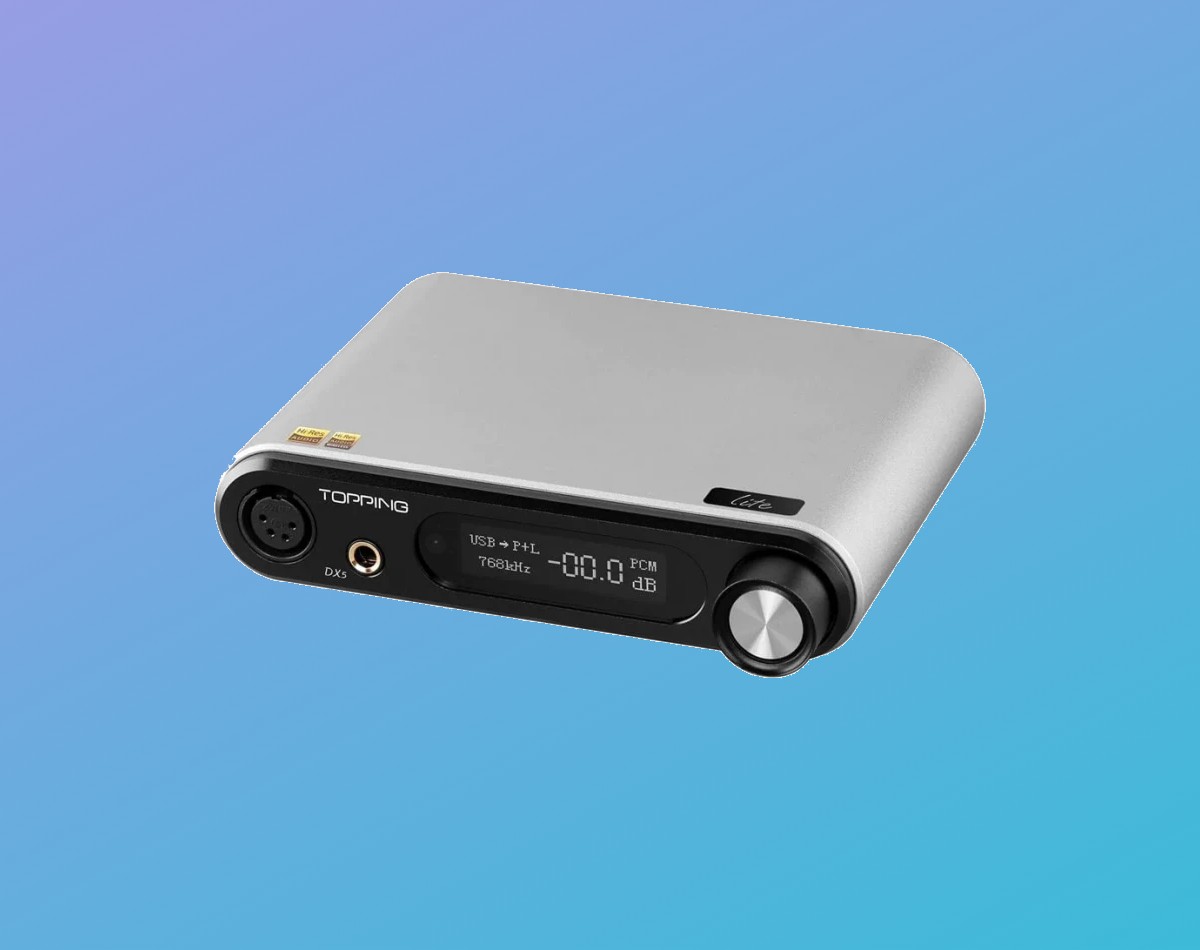
The Topping DX5 Lite is designed for listeners who want one digital component to handle several roles at once. It is a digital-to-analog converter, a headphone amplifier, and a variable-output preamplifier, giving it a useful place in systems built around computers, digital transports, wireless sources, powered speakers, or an external power amplifier. Rather than presenting itself as a single-purpose DAC, the DX5 Lite is positioned as a practical control point: it accepts digital audio over USB, optical, coaxial, and Bluetooth, then feeds either headphones or a downstream audio system through RCA or XLR outputs. At $349 and offered in black or silver, it sits in an accessible part of the market while retaining several features that matter to technically minded hi-fi users.
A multi-role component rather than a single-purpose DAC
The central appeal of the DX5 Lite is its ability to cover several common needs without requiring separate boxes for every function. In a computer-based listening space, it can operate as the USB DAC and headphone amplifier. In a speaker system, its variable output allows it to serve as a preamplifier feeding an external power amplifier or powered speakers. For users who alternate between headphones and speakers, that combination can simplify both cabling and day-to-day operation.
This kind of flexibility is particularly useful in modern digital systems, where the source may be a laptop, streamer, TV, disc transport, or phone. The DX5 Lite does not require the owner to commit to one usage pattern. It can begin as a desktop headphone amplifier and later be integrated into a speaker setup, or it can act as the central digital hub from the start. That adaptability is one of the product’s most practical strengths.
Dual ESS DAC architecture and XMOS USB processing
Inside the DX5 Lite, Topping uses a dual ES9068AS DAC arrangement from ESS Technology. The use of two DAC chips is a notable design choice in a product at this level because it shows that the conversion stage has been treated as a core part of the device rather than as an afterthought to the headphone amplifier. The ES9068AS is part of ESS Technology’s established range of audio conversion chips, and its presence will be familiar to buyers who pay attention to DAC architecture.
USB signal handling is assigned to an XMOS XU216 processor. That matters because USB audio performance depends not only on the DAC chip but also on the way incoming digital data is managed. With USB as the most important input for many desktop listeners, the inclusion of a dedicated XMOS processor gives the DX5 Lite a clear focus on computer audio and high-resolution playback. The unit supports high-resolution PCM streams over USB and native DSD512, making it suitable for owners with libraries that extend beyond standard CD-resolution files.

Digital input options for computers, transports and TVs
The DX5 Lite is not limited to USB. It also accepts digital audio through optical and coaxial inputs, with those connections supporting up to 24-bit/192 kHz. This is important for system matching because many non-computer sources still rely on S/PDIF outputs. A CD transport, network streamer, television, or digital audio interface may be easier to connect via optical or coaxial than by USB, and the DX5 Lite gives those sources a route into its DAC stage.
The distinction between USB and S/PDIF capability is worth noting. USB is the route for the highest documented digital format support, including native DSD512. Optical and coaxial inputs are limited to 24-bit/192 kHz, which is still sufficient for many digital sources and high-resolution PCM files. In practical terms, the DX5 Lite can be built around a computer as its primary high-resolution source while still accommodating other digital components in the same system.
Bluetooth with higher-quality codec support
The built-in Bluetooth adapter adds a convenient wireless path into the DX5 Lite. Codec support includes LDAC, aptX HD, and aptX LL, which gives the unit broader wireless compatibility than basic Bluetooth audio alone. For a listener who uses a phone, tablet, or portable player, Bluetooth can make casual listening quicker and more convenient without changing the wired system connections.
The presence of LDAC and aptX HD is useful for users whose source devices support those codecs, while aptX LL is notable for applications where lower latency is desirable. Bluetooth should not be viewed as replacing the DX5 Lite’s wired digital inputs for every use, but it broadens the product’s appeal. A system that is normally fed from USB or coaxial can still accept a wireless stream when convenience matters.

Headphone outputs for different cable types
For headphone listening, the DX5 Lite provides two front-end connection options: a 6.35 mm output and a four-pin XLR output. The 6.35 mm jack is the conventional choice for a wide range of full-size headphones, adapters, and studio-oriented cables. The four-pin XLR output gives users with compatible headphone cables another connection path, which can be valuable for owners who have already invested in that termination.
The headphone amplifier is built according to Topping’s proprietary NFCA scheme. The source information does not provide power ratings or load-specific figures, so it would be inappropriate to make claims about headphone matching beyond the documented connection options. Even so, the inclusion of a dedicated headphone stage with both 6.35 mm and four-pin XLR outputs clearly defines the DX5 Lite as more than a line-level DAC. It is intended to sit at the center of personal listening as well as a speaker-based system.
Variable outputs for powered speakers or a power amplifier
One of the most useful features of the DX5 Lite is its variable output capability. Through RCA or XLR connections, it can feed an external power amplifier or powered speakers. That turns the unit into a compact control component for a digital-first system: digital sources enter the DX5 Lite, volume is controlled before the output stage, and the analog signal is sent onward to the speakers or amplification stage.
This arrangement can be especially attractive for powered-speaker owners. Many powered monitors and active hi-fi speakers benefit from a separate DAC and volume control placed upstream. The DX5 Lite provides that role while also retaining headphone listening capability. For users with a power amplifier but no need for a traditional analog preamp, the same variable-output design can reduce system complexity when the source lineup is entirely digital.

Design choices that support everyday usability
The DX5 Lite’s documented design is not defined by one extravagant feature but by the way its feature set fits together. USB, optical, coaxial, and Bluetooth inputs cover the most common digital sources. RCA and XLR outputs support connection to downstream equipment. Two headphone outputs accommodate different headphone cable formats. The variable output expands the unit beyond headphone use. Each of these elements contributes to a component that can adapt to several listening scenarios.
The availability of black and silver finishes also helps with system integration. Finish choice is not a technical feature, but it matters when a device is intended to sit visibly on a desk, equipment shelf, or near powered speakers. A product that can visually match both dark and light systems is easier to place in a range of home and desktop environments.
Conclusion
The Topping DX5 Lite is best understood as a flexible digital audio hub rather than just a DAC with a headphone socket. Its strongest documented qualities are its dual ESS ES9068AS DAC architecture, XMOS-based USB input, high-resolution USB support including native DSD512, optical and coaxial inputs, Bluetooth with LDAC, aptX HD and aptX LL, NFCA headphone amplification, and variable RCA/XLR outputs for use with powered speakers or an external power amplifier. It is most suitable for listeners building a digital-first desktop or small hi-fi system, especially those who want one $349 component to handle headphones, wired digital sources, wireless playback, and preamp duties. It will be less relevant for systems centered mainly on analog sources, but for users whose listening revolves around USB, S/PDIF, Bluetooth, headphones, and powered or externally amplified speakers, the DX5 Lite offers a well-organized set of practical features in one unit.