

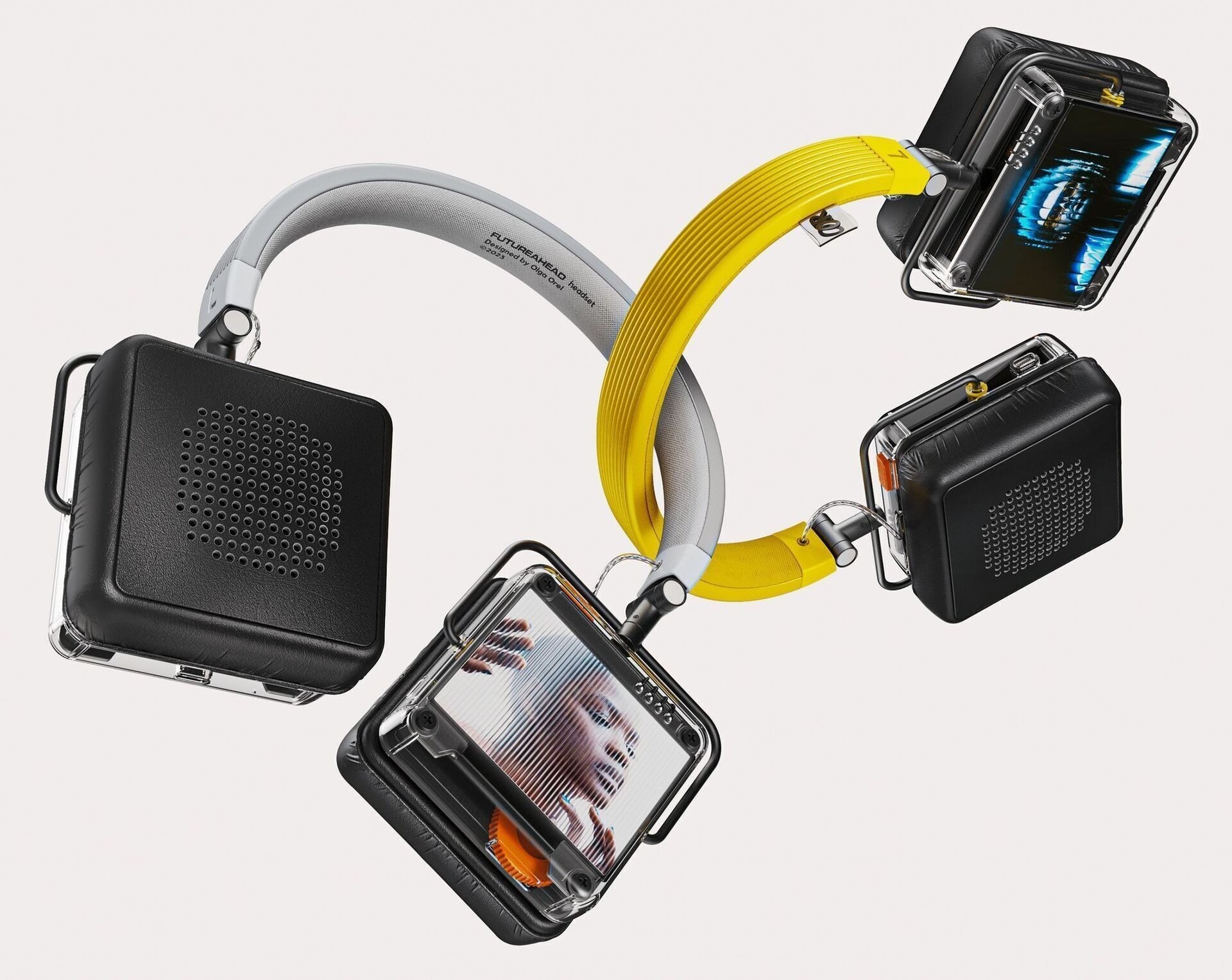
Most headphones are designed to disappear into a personal routine. Futureahead, designed by Olga Orel, takes the opposite approach. It treats the headset not only as a listening device, but also as a visible extension of what the listener is playing. The central idea is simple and unusual: both ear cups carry screens across their entire rectangular outer surfaces, turning the outside of the headphones into a display area for music information or dynamic graphics. That makes Futureahead a product aimed less at minimalism and more at expression, social presence, and the pleasure of making music taste visible.
A headset built around visible listening
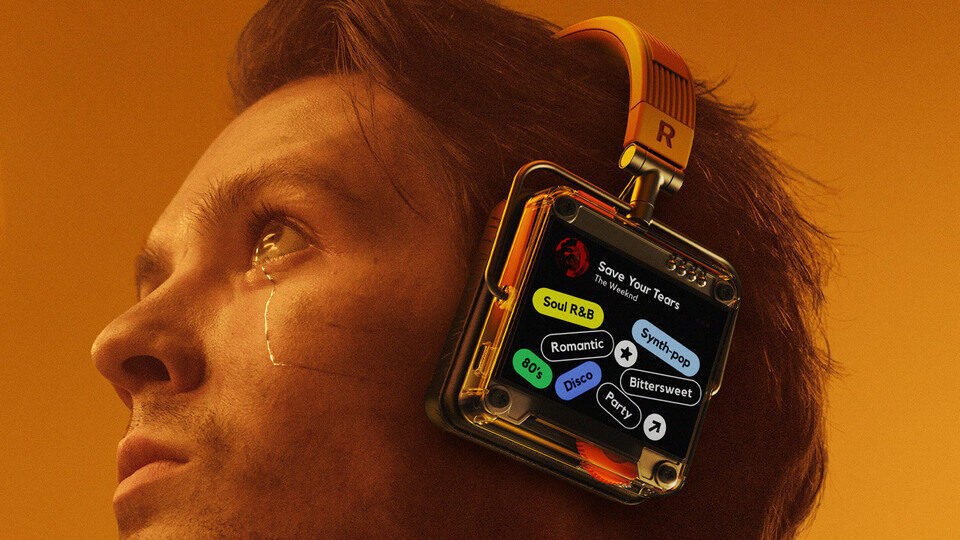
The defining feature of Futureahead is its pair of large exterior screens. Instead of limiting the design to logos, lights, or decorative trim, Olga Orel’s concept uses the full rectangular outside face of each cup as a display surface. According to the documented description, those screens can show playlists and up-to-date song information, giving people nearby a direct view of what the wearer is hearing.
That idea changes the social role of headphones. Conventional headsets usually create a private bubble: the user hears the music, while everyone else sees only the hardware. Futureahead makes that private activity more outward-facing. For listeners who enjoy sharing what they are into, the display concept could make headphones feel closer to a wearable music profile. It is not just about hearing a track; it is about letting the track’s identity become part of the wearer’s visual style.
The alternative display mode is equally important. Rather than always showing literal playback data, the cups can present abstract dynamic images that change with the rhythm and character of the sound. This gives the headset a less informational and more visual-performance role, especially in social spaces where track text may be less important than mood, movement, and atmosphere. For a product with such a bold exterior, having both practical and abstract display modes helps the concept avoid being tied to only one use case.
Retro-futurist styling with a clear point of view
Futureahead is described as being designed around the idea of “Nostalgia for the Future.” That phrase fits the product’s unusual mix of old and speculative design cues. The rectangular ear-cup form recalls the distinctive geometry of some music electronics from the 1980s, a period when portable audio products often looked more mechanical, more angular, and more obviously technological than many of today’s smoother devices.
The reference is not literal replication. The source material points to older rectangular products with FM radio as a memory point, while Futureahead replaces that earlier portable-audio character with built-in screens and app-based connectivity. The result is a headset that appears to draw on a past vision of the future rather than on current fashion alone. That gives the design a stronger identity than a simple novelty display would have on its own.
This matters because headphones are among the most visible audio products people own. They sit on the head, move through public places, and often become part of a person’s outfit. Futureahead’s black and white body color options support that visual role without overcomplicating the palette. The two colors also make sense for a design where the screens are the main visual event: the body can frame the display rather than compete with it.
Automatic activation keeps the concept simple
One useful detail is that the display behavior starts automatically when the headphones are placed on the head. That kind of automatic activation is well suited to a product whose main feature is meant to be experienced casually and visibly. If the wearer had to manually trigger the visual system every time, the idea could quickly feel cumbersome. Automatic startup makes the screens feel more integrated with the act of wearing the headset.
For prospective owners, this kind of usability detail may matter as much as the display itself. A visually expressive headset needs to be easy to live with, or the most distinctive feature becomes something the user eventually ignores. The documented automatic behavior suggests that Futureahead’s outward-facing element is not treated as a detachable gimmick, but as part of the normal wearing sequence.
The product description does not provide technical detail about how the sensing or activation works, so it would be inappropriate to speculate. Still, the stated behavior is relevant because it supports the product’s central promise: put the headphones on, and the public-facing music display becomes active without an extra ritual.
Connectivity and charging for everyday practicality
Beyond the display concept, Futureahead includes practical elements expected from modern wireless headphones. Bluetooth connectivity is provided, and the headset works with a mobile application. The presence of an app is particularly logical here because the product’s visual behavior likely needs some form of user-facing control or content handling, even though the source does not specify the exact app functions.
Bluetooth also fits the intended use. A wired headset with large public screens would feel less free as a wearable statement piece. Wireless connection allows the user to move naturally, while the phone remains the likely source for music and related information. For a device that is partly about showing playback identity, pairing with a mobile device is a sensible foundation.
USB charging is also documented. No battery capacity, charging speed, runtime, or USB connector type is provided, so those details should not be assumed. Even so, the use of USB charging places Futureahead within the normal expectations of portable audio hardware. It means the unusual visual design is not presented as a purely decorative object; it is framed as a practical headset that can be charged and used in the familiar way.
Round magnetic ear pads inside a rectangular exterior
One of the more thoughtful design choices is the contrast between the rectangular outer cup and the round ear pads. The source notes that, contrary to what one might expect from the blocky exterior form, the pads themselves are round. This is a useful reminder that visual identity and wearing interface do not have to be the same shape.
Round pads are a more familiar contact point for many over-ear or on-ear headphone designs, and they soften the relationship between the geometric outer shell and the listener’s head. The documented magnetic attachment is also notable. Magnetic ear pads can make removal and reattachment simpler than designs that rely on more awkward clips or adhesive structures, although the source does not state anything about replacement parts or long-term serviceability.
The comfortable headband mentioned in the product description is another practical counterweight to the bold exterior. With a headset as visually assertive as Futureahead, comfort still matters because the concept depends on the user wanting to wear it in public or social situations. The article source does not provide weight, clamp force, material information, or fit dimensions, so no detailed comfort claim can be made. But the inclusion of a comfortable headband in the documented feature set indicates that ergonomics were considered alongside the display-led styling.
Who Futureahead is most suitable for
Futureahead is most naturally suited to listeners who see headphones as part of personal presentation. Its strongest appeal is likely for extroverted music fans, social users, creators, performers, and people who enjoy making their listening habits visible. The screens are not hidden features; they are the main statement. If a person likes the idea of showing playlist information or letting music produce abstract visuals on the outside of the cups, Futureahead’s concept speaks directly to that preference.
It may also interest design-focused buyers who enjoy retro-futurist objects. The “Nostalgia for the Future” approach gives the headset a more considered aesthetic than a standard wireless model with decorative lighting. The 1980s-inspired rectangular form, combined with modern display surfaces, Bluetooth, app connection, USB charging, magnetic pads, and two color options, creates a distinctive object for someone who values visual identity as much as conventional headphone utility.
It will be less suitable for listeners who want understated equipment, who prefer headphones that attract as little attention as possible, or who do not want their music choices displayed. The product description does not include acoustic specifications, codec support, battery life, noise cancellation, microphone functions, pricing, or availability information, so buyers focused primarily on those criteria would need more detail before forming a complete view. Based on the documented features, Futureahead’s primary strength is not a spec-sheet argument; it is a design and interaction idea built around public-facing listening.
Conclusion
Futureahead by Olga Orel stands out because it gives headphones a different social function. Its full-surface outer-cup screens can show playlists, song information, or abstract visuals that respond to the music, while automatic activation, Bluetooth connectivity, mobile-app support, USB charging, magnetic round ear pads, a comfortable headband, and black or white finishes ground the concept in everyday usability. It is best understood as a visually expressive headset for people who want their music experience to be seen as well as heard, especially those drawn to bold wearable design and retro-futurist audio objects.
