


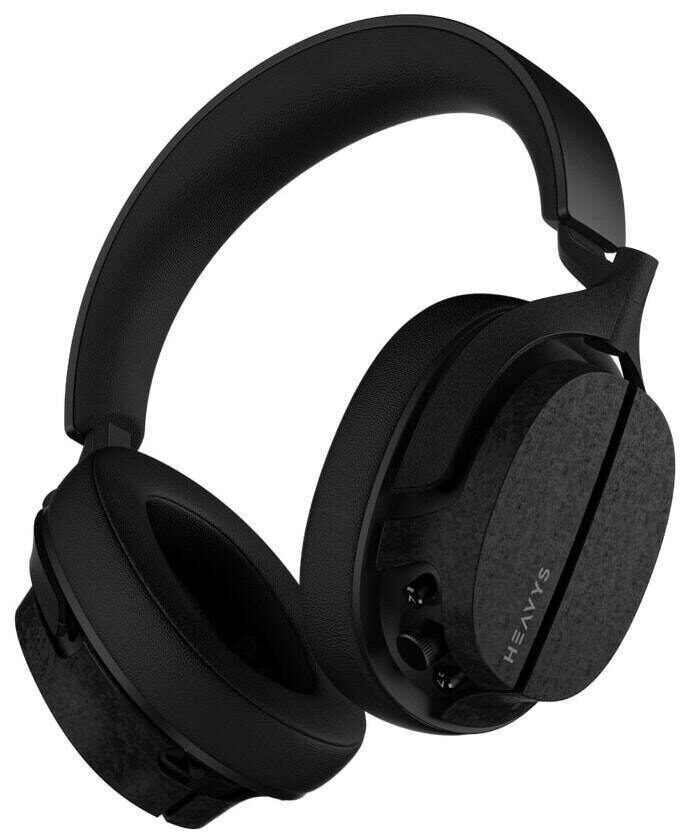
Most headphones are designed to be generalists. Heavys Headphones take a different route. This over-ear wireless model was conceived specifically for listeners who spend much of their time with heavy music, where dense guitars, aggressive drums, fast transients, and sustained high listening levels can all place particular demands on a headphone design. Rather than presenting heavy metal as simply another playlist category, Heavys builds the product concept around it, combining a multi-driver architecture, active noise cancellation, wired and wireless connectivity, and a dedicated hearing-protection system. The result is not just a styling exercise for rock and metal fans, but a deliberately engineered headphone platform with several distinctive design decisions.
A headphone concept shaped by heavy music
The most important thing to understand about Heavys is its narrow focus. These headphones were not described as a universal lifestyle accessory first and a music product second. They were developed as a listening tool for fans of heavy music, with attention given to frequency range, dynamic behavior, and listening safety at higher volumes.
That focus matters because heavy music can expose weaknesses in conventional headphones. Layered electric guitars can become congested, cymbals can turn harsh, kick drums can lose weight, and vocals can be buried if the driver system and tuning are not well controlled. Heavys addresses the challenge not by relying on a single full-range driver in each earcup, but by using a more complex driver arrangement intended to divide the workload across frequency bands.
The project also has notable engineering pedigree. Heavys was developed with Axel Grell, an engineer associated with decades of work on Sennheiser HD-series headphones. That background does not by itself define how the Heavys model will perform, but it does help explain why the product leans heavily on acoustic architecture rather than only on software features or visual branding. For prospective owners, the appeal is that the heavy-music angle is supported by a clear technical idea.
Eight drivers and a divided frequency approach
Heavys uses eight drivers in total, with four drivers in each earcup. The signal is distributed by crossovers: low frequencies are directed to dedicated woofers, the midrange is handled by midrange drivers, and treble is assigned to four tweeters across the headphone. This is an uncommon arrangement in wireless over-ear headphones, which more typically use one dynamic driver per side.
The practical value of a multi-driver system is not that more drivers automatically guarantee better sound. What makes the Heavys approach interesting is the intention behind it. By separating bass, midrange, and treble duties, the design aims to let each driver operate in a more specific frequency region. In principle, this can help a headphone manage the competing demands of heavy music: bass weight, midrange density, vocal presence, and treble energy all need to coexist without one element dominating the rest.
For a listener who spends hours with metal, hardcore, punk, hard rock, industrial, or similarly dense genres, that division of labor is a meaningful design choice. Heavy recordings often contain continuous high-energy information across much of the audible spectrum. A driver system designed from the start around that load may be attractive to those who feel standard wireless headphones are tuned too softly, too bass-heavy, or too broadly for their music.
A distinctive tweeter placement
One of the most unusual aspects of Heavys is the placement of its tweeters. Rather than positioning every driver in the same conventional location at the side of the ear, the tweeters are placed in a separate module positioned opposite, in front of the auricle. The manufacturer says this arrangement is intended to create more realistic imaging.
That claim should be understood as a design goal rather than a listening conclusion. Still, the placement is notable because spatial presentation in headphones is strongly influenced by how sound reaches the ear. Moving treble drivers to a different physical position changes the relationship between the driver, the outer ear, and the listener’s perception of direction and space.
For heavy music, imaging may not always be discussed as often as bass impact or loudness, but it can be important. Double-tracked guitars, ride cymbals, tom fills, layered vocals, and complex production effects all benefit from separation and placement. The separate tweeter module gives Heavys a distinctive acoustic identity and suggests that the product is trying to do more than simply deliver high output.
Wireless convenience with useful codec support
Heavys is a wireless over-ear headphone using Bluetooth 5.1 BLE. Codec support includes SBC, AAC, aptX Adaptive, and LHDC. That is a broad set of options and gives the headphones flexibility across common mobile and digital sources. SBC and AAC cover baseline compatibility with many phones and tablets, while aptX Adaptive and LHDC are aimed at users whose devices support higher-capability Bluetooth transmission.
The inclusion of multiple codecs is useful because headphone owners rarely use only one source. A listener might connect to an iPhone, an Android phone, a laptop, a tablet, or a portable player at different times. Broader codec support can reduce the chance that the headphone is limited to the most basic connection mode in every scenario.
Battery life is another practical strength on paper. In wireless mode, Heavys is specified to run for up to 50 hours on a single charge. For commuting, travel, office use, gaming between albums, or long listening sessions, that figure suggests the product was designed for extended use rather than short, occasional listening. Heavy music fans who use headphones daily may find that especially relevant, since fewer charging interruptions make the headphone easier to live with.
Wired options for flexibility
Heavys does not rely exclusively on Bluetooth. It also includes USB and 3.5 mm cable connections. That is an important design choice for a headphone aimed at committed music listeners, because wireless convenience is not always the preferred or available option.
A 3.5 mm input keeps the headphones compatible with traditional headphone outputs, portable audio players, laptops, mixers, and other devices that may not offer Bluetooth or may be used in situations where latency and connection stability matter. USB connectivity adds another path for direct connection to digital sources, depending on the user’s setup.
This flexibility makes Heavys easier to place into different listening routines. A user can move from wireless phone listening to a wired desktop connection without needing an entirely separate headphone. For a product with a genre-specific identity, that wider connectivity helps prevent it from becoming too narrowly tied to one listening scenario.
Active noise cancellation and transparent mode
Heavys includes active noise cancellation, along with a transparent mode. These features are now common in modern wireless headphones, but they are still highly relevant here. Heavy music is often enjoyed at energetic levels, and external noise can encourage users to raise the volume further. Active noise cancellation can help reduce environmental noise so the listener does not need to compete as aggressively with the outside world.
Transparent mode serves the opposite purpose. It allows the listener to remain more aware of surroundings when needed, which can be useful while commuting, working in a shared space, or moving through public areas. For an over-ear headphone with a strong musical focus, having both isolation-oriented and awareness-oriented modes improves day-to-day usability.
The presence of ANC also positions Heavys as more than a specialist home-listening product. It is intended to function in real-world environments, where buses, trains, offices, streets, and household noise all affect how people listen. That makes the headphone concept more practical for listeners who want their heavy-music headphone to travel with them.

Hearing protection as a central feature
The startup behind Heavys places particular emphasis on patented hearing-protection technology. According to the company, the headphones are intended to deliver a powerful and loud presentation while helping protect the ears. That is a significant part of the product’s identity, because it acknowledges a real issue for fans of high-energy music: listening volume.
It is important not to treat any headphone feature as a guarantee against hearing damage. Safe listening still depends on volume, duration, fit, environment, and user behavior. However, the fact that hearing protection is presented as a core design element is meaningful. Many headphones focus on output, bass, or excitement without addressing the long-term consequences of high-level listening.
For prospective owners, this feature may be one of the most attractive parts of the Heavys concept. A headphone made for heavy music but also built around ear protection recognizes that loudness and listening health are connected. Listeners who frequently turn up the volume to achieve impact may appreciate a design that at least attempts to balance intensity with caution.
Conclusion
Heavys Headphones stand out because they are deliberately specific. Their eight-driver architecture, separate tweeter placement, Bluetooth 5.1 BLE with multiple codec options, USB and 3.5 mm wired connections, up to 50 hours of wireless battery life, active noise cancellation, transparent mode, and patented hearing-protection technology all support a clear purpose: serving listeners who spend serious time with heavy music. They are most suitable for metal, hard rock, punk, hardcore, and other heavy-genre fans who want a wireless over-ear headphone with unusual acoustic engineering and practical everyday features. They are less obviously aimed at buyers seeking a minimalist, general-purpose headphone or those who prefer simple single-driver designs. As a product concept, Heavys is strongest when viewed as a focused listening tool: technically distinctive, genre-aware, and designed for people who want intensity, flexibility, and greater attention to listening safety in one package.

