

A capable home cinema can take several forms: a straightforward receiver-based system, an expandable processor-and-power-amplifier installation, a discreet active-speaker package or a disc-focused setup.
The right choice depends less on headline specifications than on your speaker layout, room, sources and plans for future expansion.
This shortlist covers products with clearly different roles. Some are accessible AV receivers with automatic calibration and convenient streaming, while others address ambitious multichannel rooms, concealed installations or high-quality optical-disc playback. They should not be treated as direct equivalents. Before deciding, count the channels you intend to use, confirm the required video and audio connections, and consider whether room correction, radio, multiroom playback or physical media matters to you. For processor-only models, remember to budget for suitable external power amplification.

1. Yamaha HTR-3072
The Yamaha HTR-3072 front panel, with its central display, large volume control and accessible USB, AUX, headphone and calibration connections.
The Yamaha HTR-3072 is a practical AV receiver with the visual character of Yamaha’s budget RX-V range.
Its front panel keeps frequently used connections accessible, including USB for audio storage, a 3.5 mm analogue AUX input and a 6.3 mm headphone output.
A dedicated microphone connection supports Yamaha’s YPAO automatic calibration system, making this a sensible candidate for buyers who want help adapting their speakers to the room.
Best for: Straightforward receiver-based systems
- YPAO automatic calibration
- Front USB audio connection
- Headphone and analogue AUX inputs
- Clearly accessible front-panel controls
Verdict: A functional Yamaha receiver that prioritizes accessible connections and automatic speaker calibration.

2. Pioneer VSA-LX805
The Pioneer VSA-LX805, an 11-channel flagship AV receiver designed to control expansive immersive-audio systems.
Pioneer’s flagship VSA-LX805 is built for substantial home theaters, providing 11 amplification channels and supporting a 7.2.4 speaker configuration.
Its audio architecture includes two ESS ES9026PRO DACs, Class AB output stages and cast-aluminum cooling.
Dirac Live Room Calibration is included, while optional Dirac Live Bass Control modules extend correction to one or two subwoofers at additional cost.
Best for: Large immersive-audio systems
- Eleven amplified channels
- Supports a 7.2.4 speaker layout
- Dirac Live Room Calibration
- Optional multi-subwoofer bass control
Verdict: A high-channel-count receiver for buyers building a 7.2.4 theater and seeking sophisticated room calibration.

3. Marantz Cinema 60 DAB
The Marantz Cinema 60 DAB, distinguished by its circular display, gold branding and clean front-panel design.
The Marantz Cinema 60 DAB combines seven-channel home-cinema duties with a broad selection of music features.
DAB+/FM radio, HEOS streaming, Spotify Connect, AirPlay 2 and two-way Bluetooth make it suitable for a system shared between films and everyday listening.
Its restrained front panel uses Marantz’s characteristic circular display and provides a more living-room-friendly appearance than many conventional AV components.
Best for: Seven-channel cinema and music systems
- Seven-channel surround capability
- DAB+ and FM radio
- HEOS, Spotify Connect and AirPlay 2
- Two-way Bluetooth
Verdict: A versatile control center for users who want surround sound, radio and wireless music playback in one receiver.

4. Onkyo TX-RZ30
The Onkyo TX-RZ30, a 9.2-channel AV receiver offering Dolby Atmos, 8K video handling and network playback.
The Onkyo TX-RZ30 is a 9.2-channel receiver positioned below the TX-RZ50, with Dolby Atmos playback and support for 8K video.
Its extensive network features include Google Cast, AirPlay 2, major music services and Sonos integration, while two-way Bluetooth can receive audio from a mobile device or transmit it to wireless headphones.
Full-frequency Dirac Live Room Correction is available through a separately purchased license.
Best for: Connected 9.2-channel theaters
- 9.2-channel architecture
- Dolby Atmos and 8K video support
- Google Cast, AirPlay 2 and Sonos integration
- Optional full-frequency Dirac Live correction
Verdict: A well-connected midrange receiver for systems that need modern video support, broad streaming access and an optional calibration upgrade.

5. Marantz AV8805
The Marantz AV8805 AV processor, with its circular front display and additional controls concealed behind the front-panel cover.
The Marantz AV8805 is an AV processor rather than an amplified receiver, so it is intended to partner with external power amplifiers.
Its 15.2-channel RCA and XLR outputs provide considerable system flexibility, with balanced XLR connections particularly useful where long cable runs could invite interference.
Support for Dolby Atmos, DTS:X and Auro-3D, alongside 24-bit/192 kHz DACs across all channels, suits elaborate cinema installations that also place importance on music reproduction.
Best for: High-end systems with separate power amplifiers
- 15.2-channel RCA and XLR outputs
- Dolby Atmos, DTS:X and Auro-3D support
- Balanced connections for long cable runs
- Mobile-app control
Verdict: A flexible multichannel processor for complex theaters where external amplification and balanced connectivity are central requirements.

6. Grimani CinemaFive Ensemble
The Grimani CinemaFive Ensemble combines five slim active satellite speakers with four active subwoofers for a discreet 5.4 installation.
The Grimani CinemaFive Ensemble is an active 5.4 speaker package created for compact, discreet home theaters.
It combines five two-way Rixos S satellite speakers with four Epsilon subwoofers, delivering a stated total system output of 2,160 watts.
Slim enclosures support installation in walls or niches, and the manufacturer recommends the system for rooms measuring 14 to 28 square meters. Integrated DSP, equalization, calibration, diagnostics and IP monitoring distinguish it from conventional passive speaker packages.
Best for: Compact custom-installed theaters
- Complete active 5.4 configuration
- Slim enclosures for discreet installation
- Integrated DSP and room equalization
- Remote diagnostics and IP monitoring
Verdict: A specialized active system for smaller rooms where concealed installation, multiple subwoofers and integrated processing are priorities.

7. Denon AVR-S760H
The Denon AVR-S760H, a 7.2-channel receiver equipped for 5.1.2 immersive audio, 8K video and HEOS streaming.
The Denon AVR-S760H is a 7.2-channel receiver supporting 8K video and a 5.1.2 Dolby Atmos or DTS:X speaker arrangement.
For rooms without dedicated height speakers, Dolby Atmos Height Virtualization and DTS Virtual:X offer alternative presentation options.
Network and USB playback cover high-resolution FLAC, WAV and ALAC files up to 24-bit/192 kHz, as well as DSD, while HEOS, AirPlay 2, Wi-Fi and Bluetooth support wireless listening and multiroom use.
Best for: Accessible 5.1.2 Atmos systems
- 5.1.2 Dolby Atmos and DTS:X playback
- 8K video support
- High-resolution network and USB audio
- HEOS and AirPlay 2 multiroom features
Verdict: A versatile 7.2-channel receiver that balances immersive audio, modern video handling and useful network-music features.

8. Arcam Radia AV Series
The Arcam Radia AV Series brings receivers, a 16-channel processor and matching power amplifiers together under one design and control platform.
The Arcam Radia AV Series is a coordinated home-cinema range rather than a single component.
It comprises the AVA15, AVA25 and AVA35 receivers, the 16-channel AVP45 processor, and PA4 and PA9 power amplifiers.
Shared styling, software and control logic allow a system to begin with a receiver and develop into a processor-and-amplifier configuration without abandoning the same product platform.
Best for: Scalable home-cinema installations
- Three receiver options
- Dedicated 16-channel processor
- Matching multichannel power amplifiers
- Shared software and control platform
Verdict: A coherent component family for buyers who want a receiver-based starting point with a path toward separate processing and amplification.
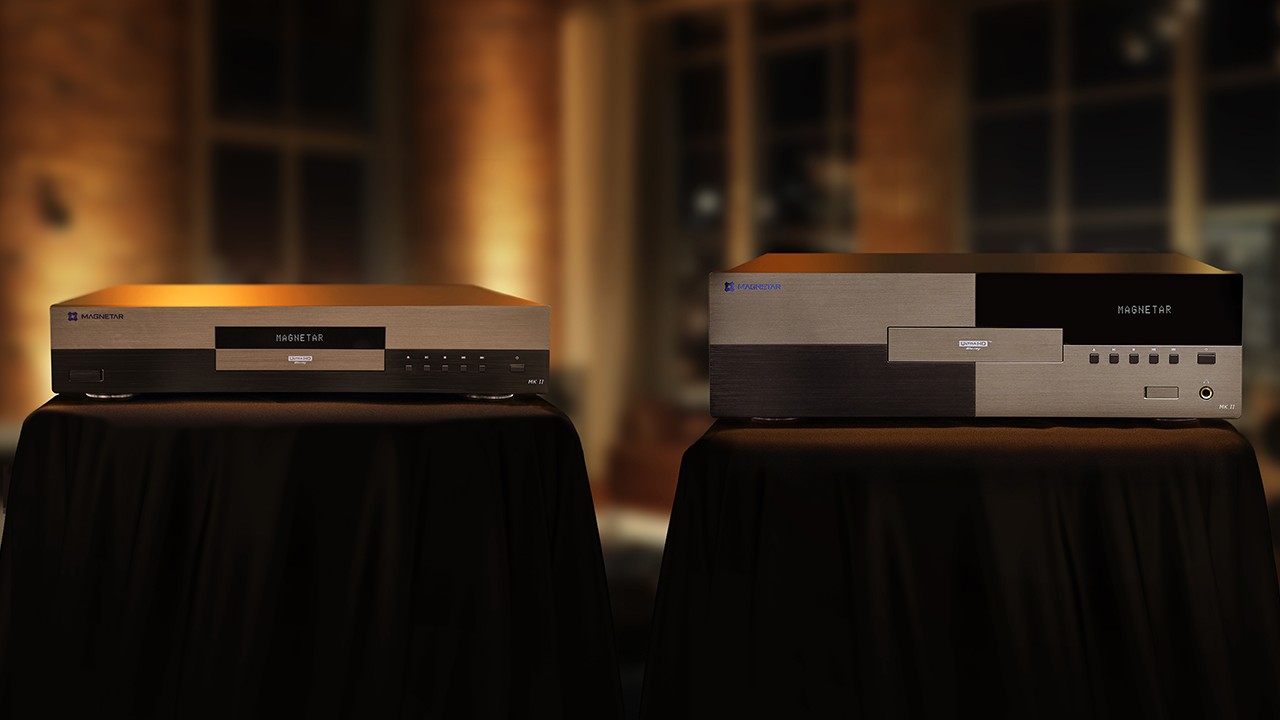
9. Magnetar UDP900MkII and UDP800MkII
The Magnetar UDP900MkII and UDP800MkII are premium 4K UHD Blu-ray players designed to accommodate multigeneration optical-disc libraries.
The Magnetar UDP900MkII and UDP800MkII are premium optical-disc players aimed at viewers who continue to value physical media.
Both are described as capable of playing previous optical-disc formats as well as 4K UHD Blu-ray, making them relevant to collections assembled across multiple disc generations.
These are source components, not receivers, so they need to be partnered with an appropriate display and audio system.
Best for: Committed 4K disc collectors
- 4K UHD Blu-ray playback
- Compatibility with earlier optical-disc formats
- Designed for established physical-media collections
Verdict: A pair of premium universal-disc sources for home cinemas built around physical media rather than streaming alone.

10. Harman Kardon BDS 580
The Harman Kardon BDS 580 integrates a slot-loading Blu-ray drive, display and illuminated volume control in a compact receiver chassis.
The Harman Kardon BDS 580 integrates a Blu-ray disc drive and surround receiver in a single chassis.
Its drive supports Blu-ray 3D and BD-Live, while the front panel provides USB, a headphone connection and an input for the EzSet/EQ calibration microphone.
EzSet/EQ III automatically adjusts speaker levels, tuning and equalization for the connected system and room, and control is also available through mobile applications for iOS and Android devices.
Best for: Disc-based systems needing fewer separate components
- Integrated Blu-ray 3D disc drive
- EzSet/EQ III automatic calibration
- Front USB and headphone connections
- Mobile-app control
Verdict: A space-conscious Blu-ray receiver that combines physical-media playback, surround control and automatic setup in one unit.
Frequently asked questions
How many receiver channels do I need for Dolby Atmos?
A 5.1.2 layout requires seven amplified speaker channels: five at ear level, one subwoofer channel and two height speakers.
Larger arrangements such as 7.2.4 require more amplification, so choose the intended speaker layout before comparing receivers.
Is an AV processor the same as an AV receiver?
No.
An AV receiver combines processing and power amplification, while a processor such as the Marantz AV8805 normally requires separate power amplifiers.
A processor-based system can offer greater connection and expansion flexibility but involves more components and cabling.
When is room correction worth prioritizing?
Room correction is useful when speaker positioning, bass behavior or room acoustics make manual setup difficult.
Systems here offer options including YPAO, EzSet/EQ and Dirac Live, but check whether the desired correction package is included or requires a separate license.
Should I choose streaming or a 4K UHD Blu-ray player?
Streaming is convenient and is integrated into several listed receivers, while a dedicated player suits an existing disc collection and avoids relying entirely on online services.
If physical media matters, confirm support for every disc format in your library and allow an additional input on the receiver or display.
How to Choose the Right Home Cinema Foundation
Start with the room and speaker plan rather than the longest feature list.
A 5.1.2 system can be served by a seven-channel receiver such as the Denon AVR-S760H, while a 7.2.4 layout calls for the additional amplification offered by a model such as the Pioneer VSA-LX805.
If nine-channel operation, extensive streaming and optional Dirac Live are priorities, the Onkyo TX-RZ30 occupies a useful middle ground. Think carefully about system architecture. A receiver keeps processing and amplification in one chassis, whereas the Marantz AV8805 and Arcam’s processor-and-power-amplifier options support more modular installations. The Grimani CinemaFive Ensemble takes a different approach by integrating amplification and processing into a complete active 5.4 speaker package intended for discreet installation in smaller cinema rooms. Source choice matters as well. Network services, AirPlay 2, HEOS, Bluetooth and radio can make a receiver the center of everyday music listening, but collectors may still want a dedicated universal-disc player such as one of the Magnetar models. The Harman Kardon BDS 580 instead combines disc playback and receiver functions to reduce the number of separate boxes. Finally, verify every practical detail before settling on a component: available inputs, speaker impedance requirements, channel allocation, room-correction licensing, installation depth and the need for external amplification. Choosing around those constraints will produce a more coherent system than paying for channels or features that the room will never use.



Join the discussion
Share your thoughts, listening impressions or product experience.