

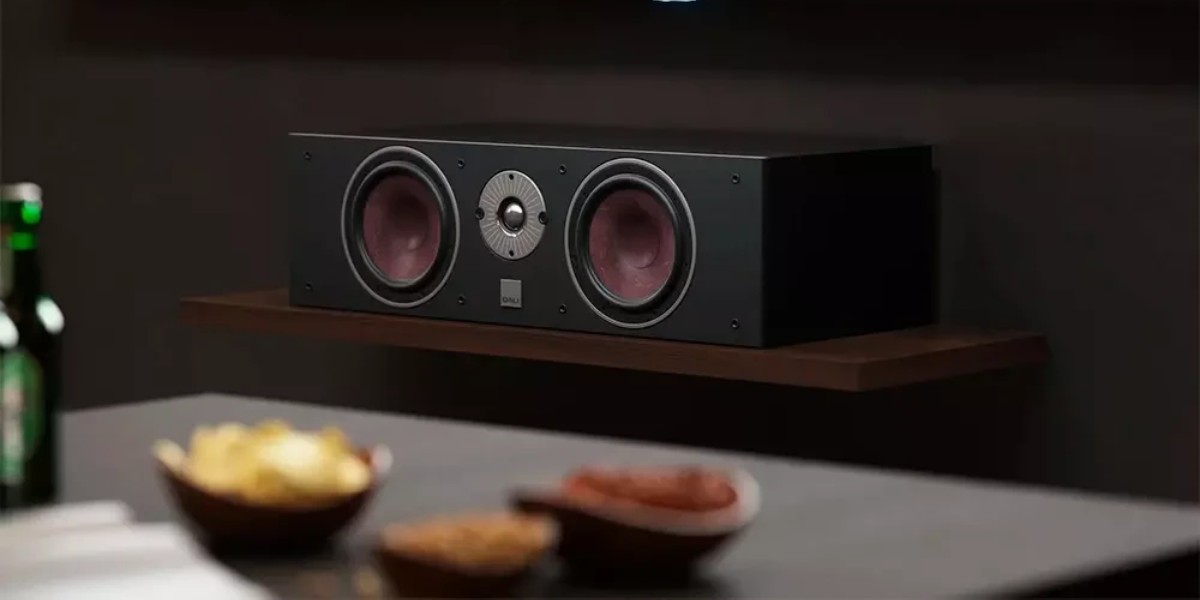
The center channel is often the hardest-working loudspeaker in a home theater system. It carries dialogue, anchors on-screen action, and frequently handles a large share of music and effects in multichannel mixes. DALI’s Oberon Grand Vokal addresses that role with a deliberately substantial design: a two-way center channel measuring 201 x 700 x 310 mm and built around two 7-inch SMC woofers partnered with a 29 mm ultra-light soft-dome tweeter. Rather than treating the center as a compact accessory, DALI has given the Oberon Grand Vokal the physical size and driver complement to suit systems where the front-center speaker needs to keep pace with larger left and right channels.
A center channel with real physical presence
At 700 mm wide and 310 mm deep, the Oberon Grand Vokal is not a small lifestyle center speaker. That is one of its defining characteristics. A center channel with this footprint is aimed at installations where performance capability and visual integration with a serious front soundstage matter more than ultra-compact dimensions. Prospective owners will need to plan shelf depth, cabinet ventilation, screen height, and furniture support, but the payoff is a design that gives DALI space to use larger bass/midrange drivers than are commonly found in slimmer center speakers.
The 201 mm cabinet height is also significant. It allows the Oberon Grand Vokal to house a pair of 7-inch woofers, rather than relying on smaller drivers to cover the lower midrange and upper bass. For a center channel, this can matter because voices are not limited to a narrow band of frequencies. Male dialogue, orchestral weight, ambient effects, and music routed through the center channel all benefit from a speaker designed with enough cabinet volume and driver area to operate confidently across a broad frequency range.
DALI specifies the Oberon Grand Vokal’s frequency range as 45 Hz to 26,000 Hz, ±3 dB. That figure underlines the product’s intent: this is not merely a dialogue bar for the vocal band, but a center loudspeaker intended to reproduce a wide portion of the soundtrack. In many home theater systems a subwoofer will still handle the deepest bass, but a center channel that reaches lower into the mid-bass can help preserve body and continuity in front-channel content.
Dual 7-inch SMC woofers and a soft-dome tweeter
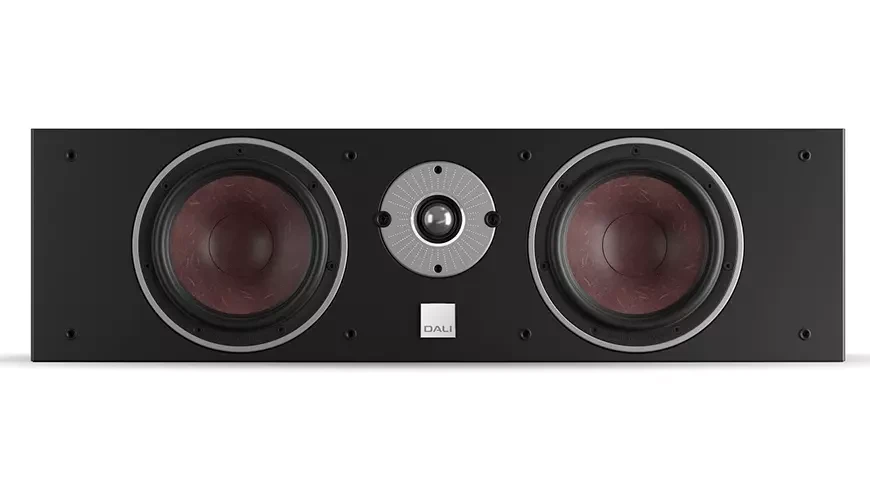
The driver arrangement is central to the Oberon Grand Vokal’s appeal. DALI uses two 7-inch SMC woofers, flanking a 29 mm ultra-light soft-dome tweeter. The twin-woofer layout gives the speaker more radiating area than a single-driver center design, while the tweeter is specified to take over from 2.5 kHz. That crossover point places the soft dome in charge of the upper midrange and treble region where intelligibility, detail, and spatial cues are especially important.
SMC, or Soft Magnetic Compound, is a technology associated with DALI’s approach to reducing unwanted effects in the motor system of its drivers. The source information identifies the woofers as SMC units, which is notable because the center channel must often deal with complex, rapidly changing material: speech, Foley effects, soundtrack transitions, and dense action sequences. While no listening conclusion should be drawn without direct evaluation, the choice of DALI’s SMC woofer technology shows that the Grand Vokal is not a simplified center model built only around size. Its driver specification is part of the product’s technical identity.
The 29 mm ultra-light soft-dome tweeter is another practical design choice. Soft-dome tweeters are widely used in hi-fi loudspeakers because they can be engineered for broad dispersion and smooth high-frequency behavior. In a center-channel context, dispersion is an important consideration because listeners are often seated across a sofa rather than in a single central chair. The published information does not provide off-axis measurements, so it would be wrong to make specific claims about seating coverage. Still, the use of a dedicated dome tweeter rather than a full-range or coaxial compromise indicates that DALI has treated treble reproduction as a dedicated part of the design.

Why a capable center channel matters
In a two-channel system, the stereo image is created between left and right speakers. In a multichannel system, the center channel has a more explicit job: it locks speech and on-screen information to the display. When the center speaker is undersized relative to the rest of the system, dialogue can feel disconnected in scale, and effects that pan across the front stage may lose consistency. The Oberon Grand Vokal is attractive because it is built for listeners who understand that the center speaker is not secondary equipment.
DALI describes the speaker as intended for crystal-clear dialogue, sound effects, and music at any volume. That positioning is important because modern film and streaming soundtracks can place demanding content into the center channel. Dialogue is the obvious example, but music mixes, crowd ambience, and directional effects may also appear there. A center speaker with two 7-inch woofers and a broad specified frequency range is therefore useful not only for speech clarity but also for maintaining substance in the overall presentation.
The Grand Vokal’s size also suggests a role in systems where the left and right speakers are more than compact satellites. If the front left and right channels have meaningful bass and dynamic capability, a small center speaker can become the limiting element. DALI’s larger center-channel format gives system designers and home users a way to keep the center speaker more proportionate to the rest of the front array.
Finish choices and installation considerations
The Oberon Grand Vokal is available in Dark Walnut and Black Ash finishes. Those are conventional but useful options for home theater furniture and living-room integration. Black Ash is likely to suit darker media units and screen-focused rooms, while Dark Walnut offers a warmer furniture-like appearance. The important point is that DALI has not positioned this as a hidden architectural product; it is a visible loudspeaker that needs to coexist with the equipment and décor around it.
Because the cabinet is 700 mm wide and 310 mm deep, placement should be considered before purchase. It may sit below a television, in a dedicated AV cabinet, or on a sturdy shelf, depending on the room. The dimensions make it more suitable for planned installations than improvised placement on a narrow console. Owners should also consider how the speaker aligns with ear height and screen position, since the center channel’s location strongly influences the perceived connection between dialogue and picture.
The available information does not specify sensitivity, impedance, recommended amplifier power, porting, or terminal layout, so system matching should be approached with the usual care. The Grand Vokal is a passive loudspeaker, so it will require suitable amplification from an AV receiver or power amplifier. Prospective owners should confirm the electrical specifications and installation guidance from DALI or an authorized retailer when integrating it into an existing theater system.
How it fits beside DALI’s broader home theater announcements
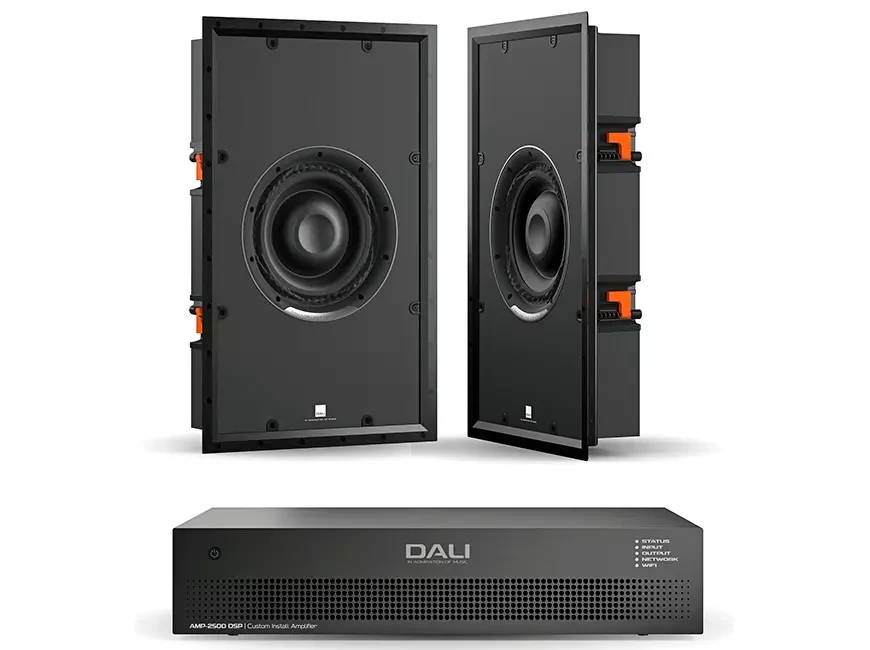
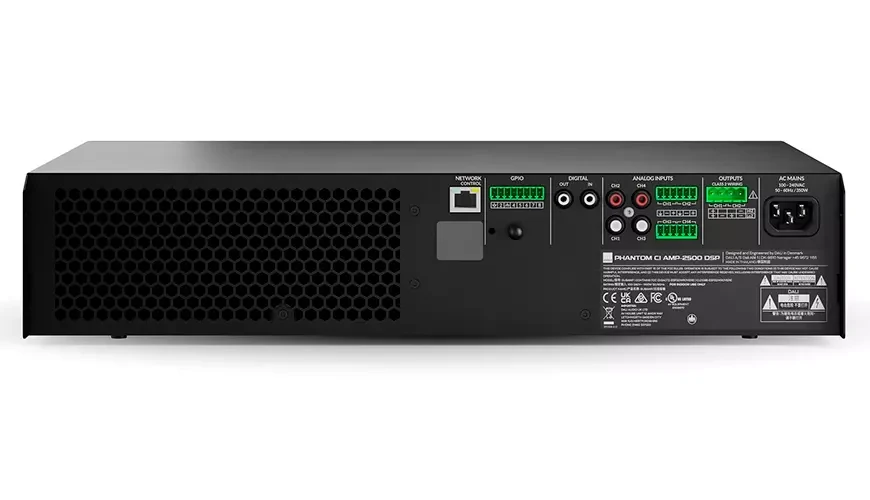
The Oberon Grand Vokal was introduced alongside other DALI products aimed at custom and theater-oriented systems, including the Phantom CI AMP-2500 DSP installation amplifier and the Phantom SUB S-100 passive in-wall subwoofer. Those products serve different purposes, but their presence in the same announcement helps frame the Grand Vokal as part of a broader interest in serious multichannel installations rather than casual TV sound enhancement.
The Phantom SUB S-100 is a low-profile in-wall subwoofer using a 10-inch driver, while the CI AMP-2500 DSP is a rack-mounted Class D amplifier rated at 2 x 500 W, with bridge mode specified at 1 kW. It also includes DSP and a web-based configurator with presets for DALI CI series built-in speakers. These details do not directly define the Oberon Grand Vokal, and DALI does not present them as required partners for it. Still, they show the environment in which the Grand Vokal makes sense: systems where speakers, amplification, bass management, and room integration are considered as a whole.
For someone building a conventional room-based theater rather than a fully in-wall system, the Grand Vokal remains the relevant product here. It is the visible center-channel solution, while the Phantom products address installation amplification and hidden bass. That distinction is useful: the Grand Vokal is for users who want a substantial cabinet speaker at the front of the room, not a recessed architectural speaker.
Who the Oberon Grand Vokal is most suitable for
The DALI Oberon Grand Vokal is best suited to home theater owners who place a high priority on the center channel and have the space to accommodate a large cabinet. It will appeal to listeners building a front soundstage around capable passive speakers, particularly where a compact center would look or feel out of scale. It is also relevant for users who watch films, series, concerts, and multichannel music often enough that center-channel performance is a central part of the system rather than an afterthought.
It is less appropriate for rooms where furniture depth is limited, where the center speaker must fit inside a very low shelf, or where a minimalist visual footprint is the main objective. Buyers looking for an active soundbar, wireless TV speaker, or in-wall center channel are looking at a different category. The Grand Vokal asks for physical space and external amplification, and those requirements should be viewed as part of its identity rather than minor details.
The balanced case for the product is therefore clear. Its strengths are scale, driver area, a wide stated frequency range, and a design focused on the demands of a real center channel. Its practical limitations are equally straightforward: it is a sizeable passive loudspeaker that needs appropriate placement and system planning.
Conclusion
The DALI Oberon Grand Vokal stands out as a serious center channel for home theater systems that need more than a compact dialogue speaker. Its documented strengths include a large cabinet, dual 7-inch SMC woofers, a 29 mm ultra-light soft-dome tweeter, a 2.5 kHz crossover point, and a specified 45 Hz to 26,000 Hz frequency range. Available in Dark Walnut and Black Ash, it is designed for visible integration into a room-based AV system rather than hidden installation. For prospective owners with the space, amplification, and front-stage ambitions to justify a substantial passive center speaker, the Oberon Grand Vokal is an attractive and purposeful addition to DALI’s lineup.
