

Choosing a DAC is less about chasing a single universal winner and more about matching the converter to your system, your sources, and your listening habits.
The models gathered here range from pocketable Bluetooth DAC/headphone amps to heavy, transformer-coupled desktop components and tube-based high-end designs.
Some are straightforward digital hubs, while others add preamp functions, headphone amplification, wireless playback, or network streaming. The source material behind this guide includes reviews, product introductions, and technical announcements, so the level of listening detail varies from item to item. Where a product is described mainly through its published architecture or manufacturer claims, this guide treats those points carefully rather than turning them into unsupported performance judgments. A useful DAC shortlist should start with practical questions: do you need USB only, or also optical, coaxial, AES/EBU, Bluetooth, I2S, or network playback? Will the DAC feed an integrated amplifier, a power amp, active speakers, or headphones? Do you want a compact all-in-one, a purist converter, or a component with a distinctive analog stage? The recommendations below are arranged in the supplied order and focus on what each model is clearly built to do.
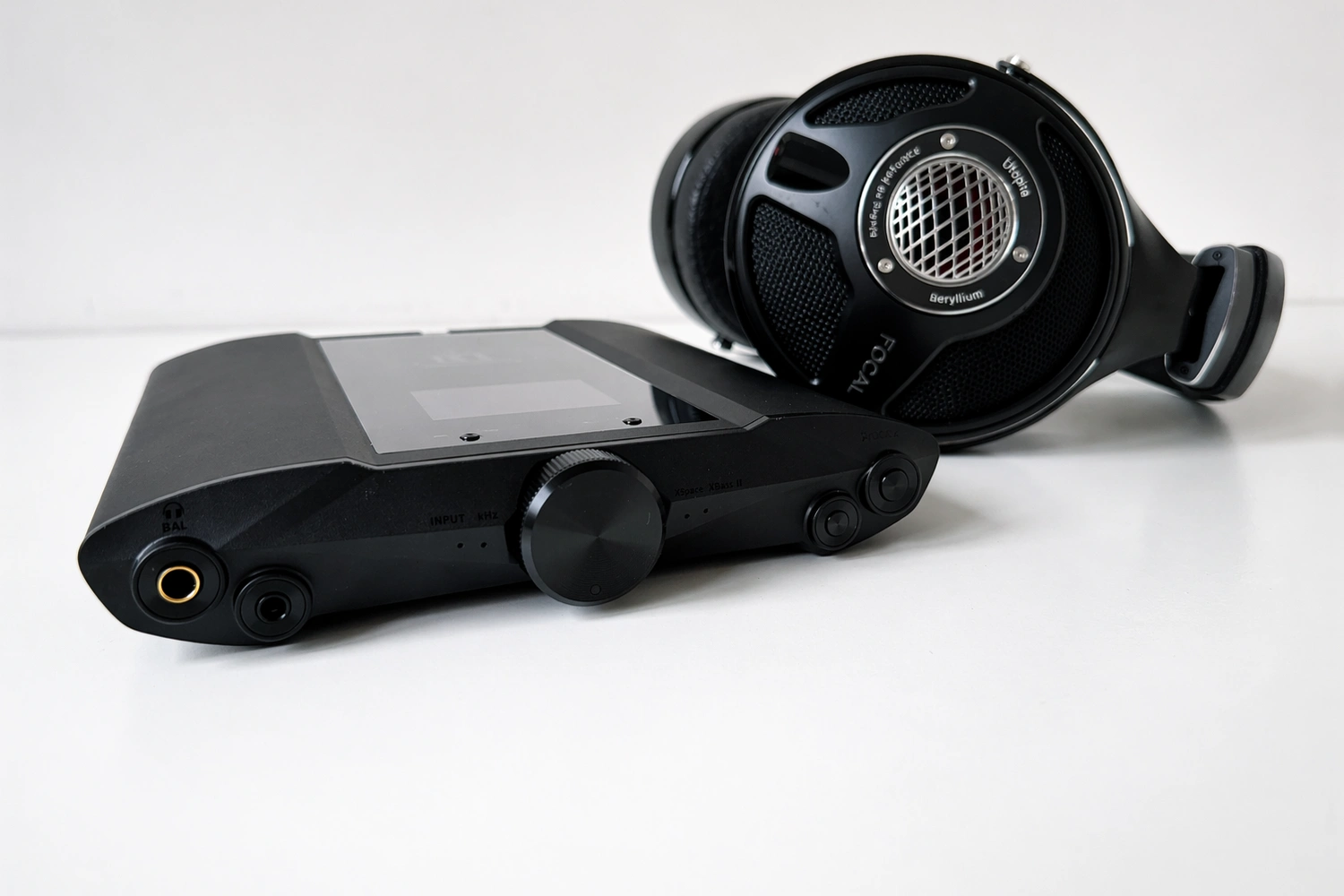
1. iFi iDSD Valkyrie
iFi iDSD Valkyrie shown as a substantial transportable DAC/headphone amp with premium casing and accessories.
The iFi iDSD Valkyrie is presented as a flagship portable DAC/headphone amp that leans closer to transportable hi-fi than pocket convenience.
The source describes it as battery powered and travel-capable, but also substantial in size, weight, packaging, and ambition.
Its appeal is strongest for listeners who want a serious DAC/amp for demanding headphones without being tied permanently to a desk. Build quality is a major part of the story. The review highlights a dense aluminum-and-glass body, a premium wooden presentation case, useful supplied accessories, optical connectivity, USB-C cabling and adapters, a carrying case, and iFi’s SilentPower iPower X supply. The tactile controls, especially the volume wheel, are singled out as precise and confidence-inspiring.
Best for: Demanding headphone users who want a serious transportable DAC/amp
- Flagship portable DAC/headphone amp positioning
- Battery-powered design that can still travel
- Premium aluminum-and-glass construction
- Generous accessory bundle including power supply and carrying case
Verdict: The iFi iDSD Valkyrie is the choice for listeners who value flagship DAC/amp ambition in a form that can move between listening spaces, provided portability does not have to mean pocket-sized.
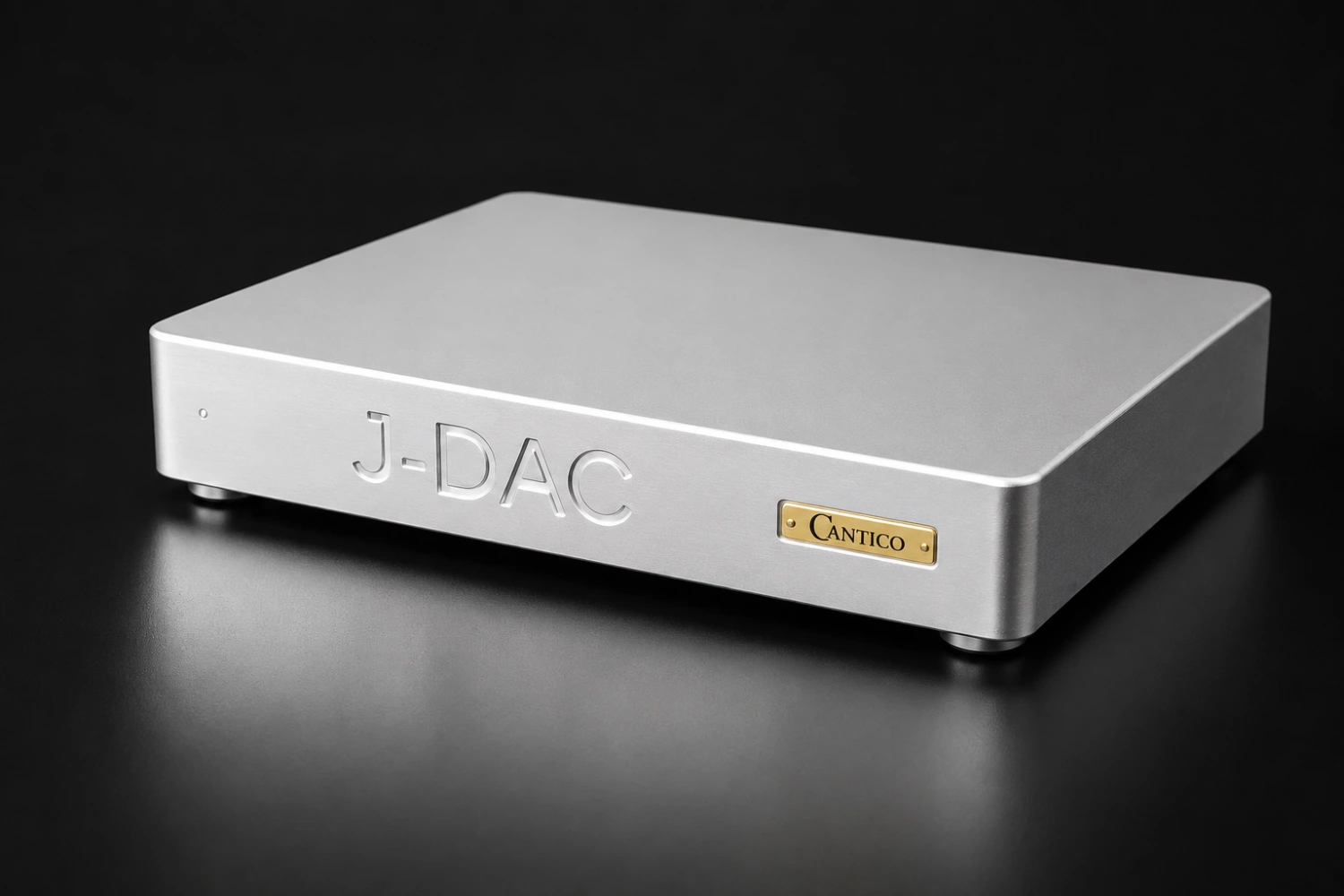
2. Cantico J-DAC
Cantico J-DAC with single-piece aluminum chassis and rear-panel selection for XLR or RCA output.
The Cantico J-DAC is a handcrafted Italian digital-to-analog converter built around a simplified signal path and a transformer-coupled output stage.
Cantico emphasizes galvanic isolation, separate power supplies for key modules, and a physically robust chassis machined from a single piece of aluminum.
At up to 13 kg with a 5 mm aluminum base plate, it is clearly conceived as a serious stationary component rather than a compact desktop add-on. Its analog output design is especially distinctive. Each channel uses a single JFET transistor between the conversion resistors and custom-made output transformers, and the company says this maintains quality across both balanced XLR and single-ended RCA outputs. Only one analog output type can be active at a time, selected by a rear-panel switch, reflecting the brand’s preference for avoiding extra switching circuitry.
Best for: Listeners seeking a purist, heavily built desktop DAC with transformer-coupled outputs
- Hand-assembled Italian construction
- Transformer-based output stage
- Balanced XLR and single-ended RCA outputs
- Separate toroidal transformers for power-supply sections
Verdict: The Cantico J-DAC stands out for its handcrafted construction, galvanic-isolation focus, and deliberately simple output architecture.

3. FiiO K5 Pro ESS
FiiO K5 Pro ESS packaged as a compact desktop DAC with external power supply and USB cable.
The FiiO K5 Pro ESS is positioned in the source as a budget-friendly DAC from a brand with a broad audio lineup spanning headphones, players, and converters.
It is a compact stationary device supplied with the DAC itself, a power cable with European plug, an external 15 V power supply, and a USB cable.
The package description reinforces its role as an accessible desktop component rather than a luxury statement piece. The source focuses heavily on unboxing and supplied accessories, so this entry is best viewed as a practical, value-oriented DAC option rather than one documented here through extensive performance specifics. For buyers who want a compact desktop DAC from a widely established audio brand, it earns consideration on simplicity and affordability cues in the source material.
Best for: Cost-conscious desktop listeners who want a simple DAC setup
- Budget-friendly positioning
- Compact desktop form factor
- External power supply included
- USB cable included
Verdict: The FiiO K5 Pro ESS is a sensible budget-leaning desktop DAC choice when compact size and straightforward supplied accessories matter most.
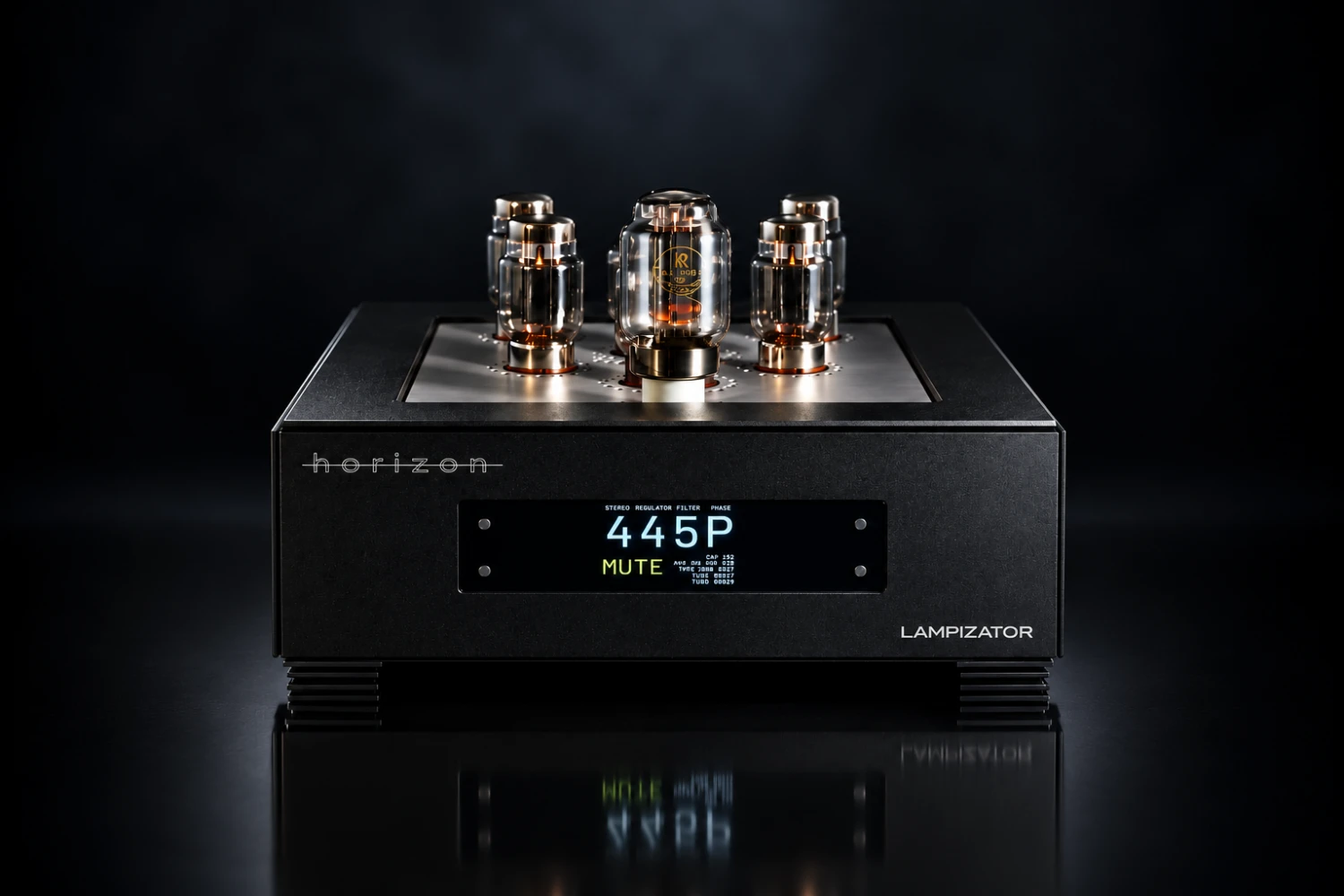
4. Lampizator Horizon 2
Lampizator Horizon 2 tube-based DAC with retained Horizon chassis format and updated internal platform.
The Lampizator Horizon 2 is a tube-based DAC that succeeds the Horizon 360 while retaining the established Horizon chassis dimensions, tube complement, and output capacitors.
Lampizator says the analog stage has been redesigned, with 6SN7 conversion tubes, KT88 output tubes, and a tube-rectified power supply.
This places the Horizon 2 firmly among high-end DACs for systems where the analog stage is as central as digital-format handling. A key practical feature is the updated SuperVolume system, which includes a bypass function. That allows the DAC to be used either with its internal level control or in a configuration better suited to an external preamplifier. The Horizon 2 also uses Lampizator’s firmware-controlled conversion process, with published support for PCM up to 768 kHz and DSD512, and its USB implementation adds DSD512 support along with reclocking and optical isolation. Compatible earlier models can be updated through a factory conversion program.
Best for: High-end systems where tube DAC architecture and preamp integration flexibility are priorities
- Tube-based conversion and output circuitry
- SuperVolume system with bypass function
- PCM up to 768 kHz and DSD512 support listed
- Factory conversion path for compatible earlier Horizon models
Verdict: The Lampizator Horizon 2 is a specialist high-end DAC for listeners who want tube-based digital conversion with modern format support and flexible volume-control integration.

5. Millennia Imersiv D-1 HDR-A DA converter
Millennia Imersiv D-1 HDR-A DA converter positioned around pro-audio heritage and a new conversion architecture.
The Millennia Imersiv D-1 HDR-A DA converter is presented through the company’s claims for its HDR-A technology and its pro-audio background.
Millennia Music and Media Systems has roots in recording equipment, including microphone preamplifiers used in film-score, classical, jazz, and foley production contexts according to the source.
That heritage frames the Imersiv D-1 as a converter aimed at accuracy, neutrality, and dynamic stability rather than lifestyle convenience. The strongest technical claims in the source are explicitly attributed to the designers: they say the S/N ratio and distortion are up to 100 times better than the best DA converters on the market. Because those figures are presented as company claims rather than independent measurements here, the safest way to read the Imersiv D-1 is as an ambitious pro-audio-derived DAC concept centered on Millennia’s HDR-A architecture.
Best for: Studio-minded listeners interested in pro-audio design priorities
- HDR-A conversion architecture
- Pro-audio manufacturer background
- Design philosophy centered on accuracy and neutrality
- Company claims major S/N and distortion improvements
Verdict: The Millennia Imersiv D-1 is an intriguing DAC for buyers drawn to pro-audio engineering and ambitious manufacturer claims, though the source does not provide independent verification of those claims.

6. SMSL RAW Pro-DAC1
SMSL RAW Pro-DAC1 desktop DAC with multiple digital inputs and balanced XLR plus RCA outputs.
The SMSL RAW Pro-DAC1 is a feature-rich DAC built around the ESS ES9039MSPRO chip.
The source lists MQA decoding and MQA-CD playback through USB, optical, and coaxial inputs, plus a third-generation XMOS XU-316 USB solution supporting 32-bit audio, DoP, and native DSD.
Published playback support reaches PCM up to 768 kHz and DSD up to DSD512. Connectivity is broad for a desktop DAC. Inputs include USB, optical, coaxial, Bluetooth, and AES/EBU, while outputs include balanced XLR and unbalanced RCA. The unit also includes Bluetooth 5.1 with LDAC, aptX HD, aptX, SBC, and AAC support, as well as gold-plated terminals and a low-noise analog power source according to the source. This is a strong fit for users who need many digital input options in one component.
Best for: Desktop systems needing broad digital connectivity and balanced outputs
- ESS ES9039MSPRO DAC chip
- USB, optical, coaxial, Bluetooth, and AES/EBU inputs
- Balanced XLR and RCA outputs
- PCM up to 768 kHz and DSD512 support listed
Verdict: The SMSL RAW Pro-DAC1 is a connectivity-heavy desktop DAC for users who want modern format support, Bluetooth, and both balanced and single-ended analog outputs.

7. FiiO BTR17
FiiO BTR17 compact Bluetooth DAC/headphone amplifier with OLED display, balanced output, and aluminum housing.
The FiiO BTR17 is a compact portable Bluetooth DAC and headphone amplifier with dual ESS DAC chips, THX amplification, and both 4.4 mm balanced and 3.5 mm outputs.
Its aluminum housing, leather back panel, OLED display, and physical controls make it a more fully featured portable interface than a basic dongle-style DAC.
Wireless support is central to the design. The BTR17 includes Bluetooth 5.4 and codec support listed for LDAC, aptX Lossless, aptX HD, and AAC. In USB DAC mode, it supports playback up to 32-bit/384 kHz or DSD256, which also gives it a role in home or desk use. The source also notes blue and black color options.
Best for: Portable listeners who want Bluetooth convenience plus wired headphone outputs
- Compact Bluetooth DAC/headphone amp design
- Balanced 4.4 mm and 3.5 mm outputs
- Bluetooth 5.4 with advanced codec support
- USB DAC mode up to 32-bit/384 kHz or DSD256
Verdict: The FiiO BTR17 is the practical pick for listeners who want a small DAC/headphone amp that can move between wireless portable use and USB DAC duties.
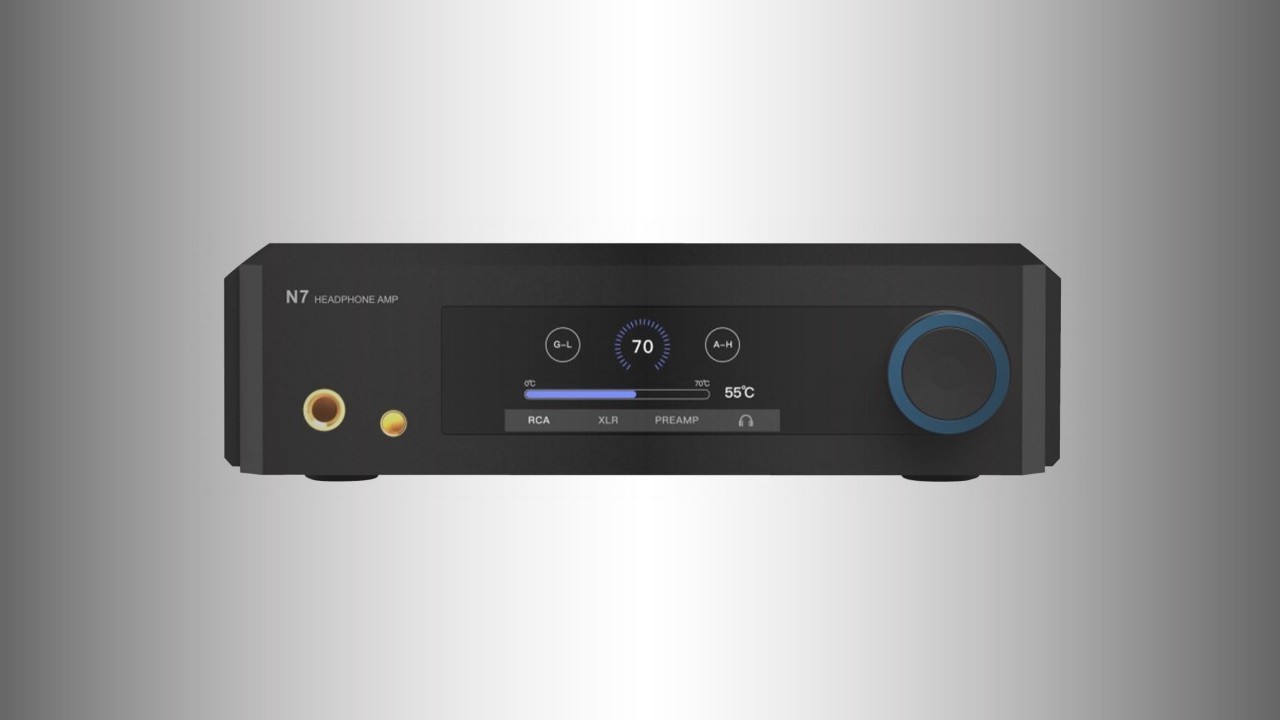
8. Aune N7 DAC Edition
Aune N7 DAC Edition combining DAC, balanced Class A headphone amplifier, and preamplifier functions.
The Aune N7 DAC Edition combines three roles in one chassis: DAC, balanced Class A headphone amplifier, and preamplifier.
Its digital section uses dual Cirrus Logic CS43198 DAC chips and supports PCM up to 32-bit/384 kHz and DSD256 over USB-C.
For listeners who want one compact component to handle conversion, headphone drive, and preamp duties, the functional brief is clear. The analog section is built with discrete JFET transistors, described in the source as giving a warm, natural character associated with tube designs. Volume control uses a four-channel R2R circuit based on JRC chips with dedicated operational amplifiers. The N7 is also specified for headphone impedances from 16 to 600 ohms, with listed output power up to mW at 32 ohms from the 6.35 mm output and up to 6570 mW at 32 ohms from the balanced 4.4 mm output.
Best for: Headphone-focused desktop systems needing DAC, amp, and preamp functions
- DAC, headphone amplifier, and preamplifier in one unit
- Dual Cirrus Logic CS43198 DAC setup
- Balanced Class A headphone amplification
- Supports headphones from 16 to 600 ohms
Verdict: The Aune N7 DAC Edition is a versatile desktop hub for users who want conversion, powerful headphone amplification, and preamp capability in a single component.

9. SimAudio Moon Neo 280D
SimAudio Moon Neo 280D DAC with traditional digital inputs, USB playback, optional network streaming, and Bluetooth.
The SimAudio Moon Neo 280D is a DAC built around traditional wired digital connectivity, with coaxial, optical, balanced inputs, and USB.
Through USB, the source lists PCM playback up to 32-bit/384 kHz and DSD64 to DSD256.
An optional network card adds wired and wireless streaming from UPnP servers, though the source notes that DSD is not accepted over the network. Its broader convenience features include vTuner internet radio, Tidal subscription capability, and Bluetooth with aptX support. The source also comments positively on the XMOS-based USB receiver and describes Bluetooth playback from a tablet as full-bodied and captivating, while noting that Apple users might have preferred AirPlay. This makes the 280D a flexible choice for systems where conventional inputs and everyday streaming conveniences both matter.
Best for: Hi-fi systems needing both traditional digital inputs and optional streaming features
- Coaxial, optical, balanced, and USB inputs
- USB playback up to 32-bit/384 kHz and DSD256 listed
- Optional network streaming card
- Bluetooth with aptX support
Verdict: The SimAudio Moon Neo 280D is a versatile system DAC for listeners who want solid wired input coverage with optional network and Bluetooth convenience.
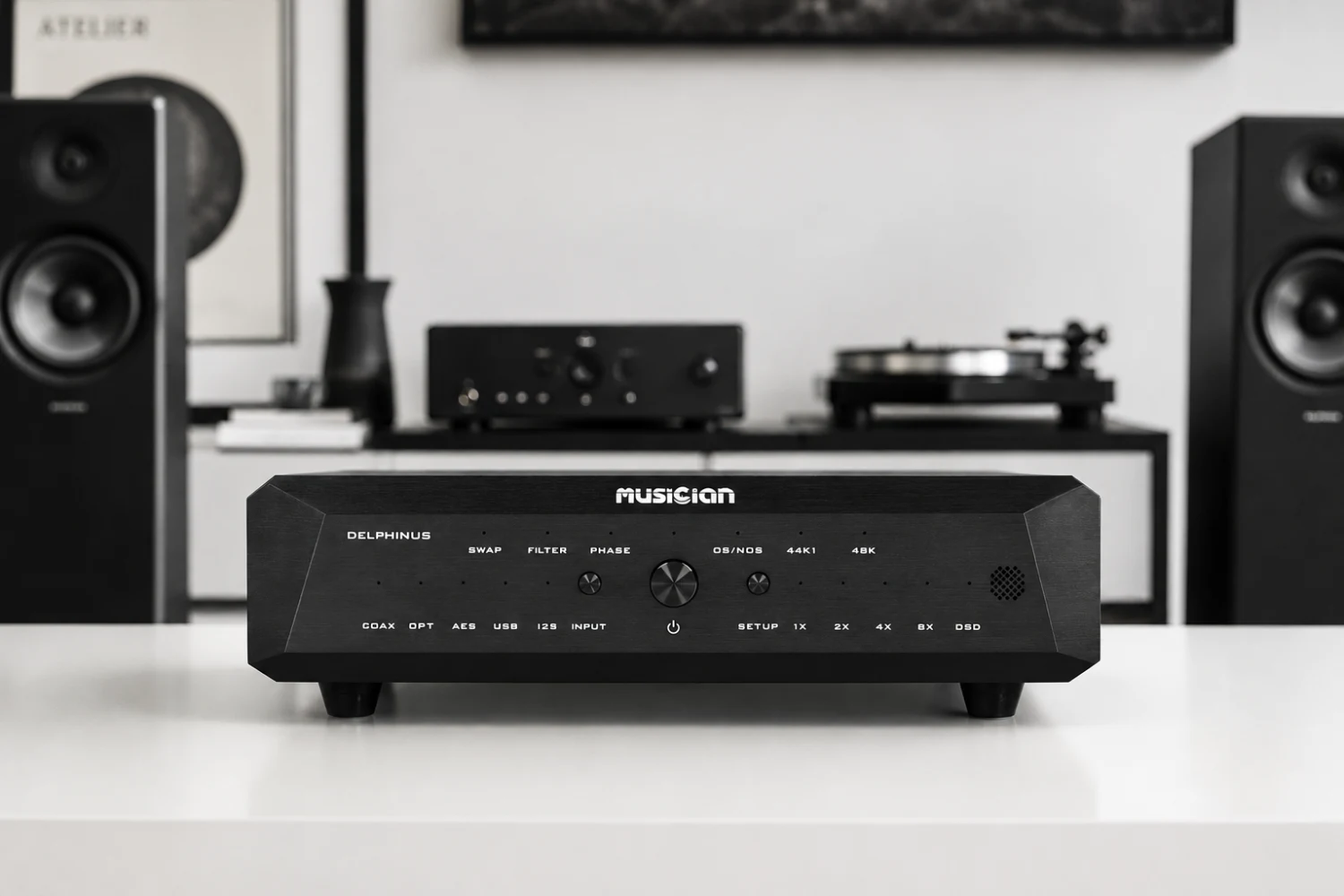
10. Musician Delphinus
Musician Delphinus desktop DAC with discrete R-2R conversion, front-panel status display, and multiple digital inputs.
The Musician Delphinus is a desktop DAC built around discrete R-2R conversion with a separate section for DSD signals.
Its resistor ladder is assembled with resistors specified to 0.005% precision.
The design gives users a choice between oversampling and non-oversampling operation, with Fast and Slow digital filter settings and phase inversion also available. Digital connectivity includes USB, I2S, coaxial, optical, and AES/EBU. USB and I2S support PCM up to 32-bit/1536 kHz and DSD1024, while coaxial, optical, and AES/EBU support PCM up to 24-bit/192 kHz and DSD64 via DoP. The front panel shows the active input, sampling frequency, oversampling ratio, DSD format, and phase setting, and Musician provides eight selectable I2S compatibility modes for matching different transports.
Best for: Desktop listeners who want R-2R conversion and extensive I2S configuration
- Discrete R-2R resistor-ladder architecture
- Separate DSD section
- OS and NOS modes with filter options
- USB and I2S support up to PCM 32-bit/1536 kHz and DSD1024
Verdict: The Musician Delphinus is a strong fit for users who value discrete R-2R architecture, high-resolution USB and I2S support, and adjustable digital operating modes.
Quick comparison
These DACs differ less by a single quality hierarchy than by role.
Some are designed primarily for headphone listening, some for stationary hi-fi systems, some for wireless convenience, and others for purist or high-end conversion architectures.
The table below summarizes the most useful distinctions supported by the source material.
| Product | Best for | Verdict |
|---|---|---|
| iFi iDSD Valkyrie | Demanding headphone users who want a serious transportable DAC/amp | Battery-powered and travel-capable, but built and positioned more like a flagship transportable component than a pocket DAC. |
| Cantico J-DAC | Purist desktop systems with balanced or single-ended analog output needs | A handcrafted Italian DAC focused on galvanic isolation, transformer-coupled outputs, and a simplified signal path. |
| FiiO K5 Pro ESS | Budget-conscious desktop setups | A compact, budget-friendly DAC package with the essentials supplied for straightforward desktop use. |
| Lampizator Horizon 2 | High-end systems built around tube DAC architecture | A tube-based DAC with redesigned analog stage, SuperVolume bypass flexibility, and modern PCM and DSD support. |
| Millennia Imersiv D-1 HDR-A DA converter | Studio-minded buyers interested in pro-audio design priorities | A pro-audio-derived DAC concept centered on Millennia’s HDR-A technology and company-stated performance ambitions. |
| SMSL RAW Pro-DAC1 | Desktop systems needing many input options | A modern ESS-based DAC with USB, optical, coaxial, Bluetooth, AES/EBU, XLR, RCA, MQA, PCM, and DSD support listed. |
| FiiO BTR17 | Portable wireless and USB headphone listening | A compact Bluetooth DAC/headphone amp with balanced output, advanced codec support, and USB DAC functionality. |
| Aune N7 DAC Edition | Headphone-centric desktop systems | A three-in-one DAC, balanced Class A headphone amplifier, and preamplifier with strong published headphone-drive specifications. |
| SimAudio Moon Neo 280D | Systems needing traditional digital inputs plus streaming convenience | A versatile DAC with USB, conventional digital inputs, optional network streaming, internet radio, Tidal capability, and aptX Bluetooth. |
| Musician Delphinus | R-2R enthusiasts and users with I2S-equipped transports | A discrete R-2R desktop DAC with separate DSD handling, OS/NOS operation, high-resolution USB and I2S support, and configurable I2S modes. |
Frequently asked questions
Should I choose a portable DAC/headphone amp or a desktop DAC?
Choose a portable DAC/headphone amp if headphones and mobility are central, as with the iFi iDSD Valkyrie or FiiO BTR17.
Choose a desktop DAC if the component will live in a hi-fi rack or feed an amplifier, preamplifier, active speakers, or a fixed headphone station, as with the Cantico J-DAC, SMSL RAW Pro-DAC1, SimAudio Moon Neo 280D, or Musician Delphinus.
Which inputs matter most on a DAC?
USB is usually the key input for computer audio and the highest published format support on several models here.
Optical and coaxial are useful for TVs, streamers, and disc transports.
AES/EBU and I2S matter more in specialized hi-fi systems, while Bluetooth is useful for quick playback from phones or tablets.
Do I need balanced XLR outputs?
Balanced outputs are useful if the rest of your system supports them or if you want to integrate the DAC into a balanced setup.
Models such as the Cantico J-DAC and SMSL RAW Pro-DAC1 include XLR outputs, while the Cantico requires choosing either XLR or RCA via a rear-panel switch because only one output type can be active at a time.
Are very high PCM and DSD numbers the most important buying factor?
Not by themselves.
Format support matters if you own or stream files in those formats, but system fit, output options, headphone-drive requirements, volume-control needs, and input compatibility are often more important.
For example, the Musician Delphinus emphasizes very high USB and I2S support, while the Aune N7 DAC Edition may be more relevant if you also need a headphone amplifier and preamplifier.
How to narrow the DAC shortlist
Start with the role the DAC must play.
For portable headphone use, the FiiO BTR17 is the most compact and wireless-focused option here, while the iFi iDSD Valkyrie is the more ambitious transportable DAC/amp for demanding headphones.
For a desktop headphone hub, the Aune N7 DAC Edition is the clearest all-in-one because it combines DAC, balanced Class A headphone amplification, and preamp functions. For a traditional hi-fi system, think first about outputs and system integration. The Cantico J-DAC suits buyers attracted to hand-built construction, transformer-coupled outputs, and a simplified signal path. The SMSL RAW Pro-DAC1 is more about broad connectivity, with USB, optical, coaxial, Bluetooth, AES/EBU, XLR, and RCA covered. The SimAudio Moon Neo 280D is useful when conventional digital inputs, optional network streaming, internet radio, Tidal capability, and aptX Bluetooth all matter in one component. If conversion architecture is the deciding factor, the Lampizator Horizon 2 and Musician Delphinus are the most distinctive in different ways. The Lampizator is a tube-based high-end DAC with volume-control flexibility and an upgrade path for compatible earlier models. The Musician Delphinus focuses on discrete R-2R conversion, separate DSD handling, OS/NOS selection, extensive I2S configuration, and very high published USB and I2S format support. The Millennia Imersiv D-1 is best approached as a pro-audio-influenced DAC with ambitious HDR-A claims, especially for readers interested in Millennia’s recording-equipment heritage. The safest buying path is to list your sources, required outputs, headphone needs, and control preferences before comparing architectures or headline format numbers. A DAC that fits the system cleanly will usually be more satisfying than one chosen only for the largest specification or the most exotic design language.